


Sleep. We all need it, humans and animals alike. Humans need between 6-8 hours per night. But have you ever thought about dogs? How much sleep DOES a dog need? Do they have the same type of sleep as a human or is it different?
Believe it or not, sleep remains a neurological mystery. No one knows exactly why mammals sleep. What we do know is that sleep is consistent across the mammalian and avian species. Though there are approximately 5,400 mammal species on earth, the patterns of sleep, including rapid eye movement (REM) and slow-phase, are markedly similar amongst them. So too are the patterns noted on an EEG (electroencephalogram)—a machine that records brainwaves.
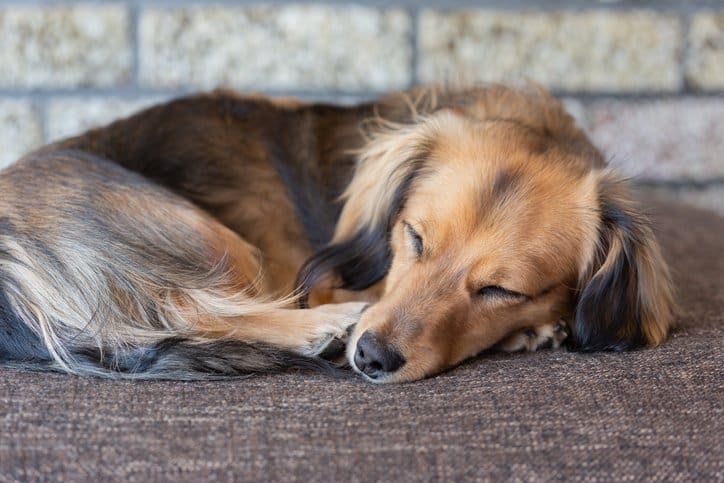
Sleep needs change throughout life. This is true for our canine friends, as well. Puppies sleep more than adult dogs. Elderly dogs will also tend to sleep more. Why do these changes occur?
Puppies are growing rapidly. Growth requires intense bursts of energy, after which the body needs to recover. It is normal for puppies to sleep up to 20 hours a day. On the converse, elderly dogs sleep more because of a slowing metabolic rate. This is a normal part of age. However, it is important to note that “slowing down” with old age can also be a sign of underlying conditions like arthritis or cancer. This is why it’s a good idea to have annual examinations (or even every 6 months) with your veterinarian to ensure that your dog doesn’t have any physical problems. Early management of arthritis and other conditions can dramatically improve quality of life for senior dogs.
Activity can also affect sleep time for dogs. Working dogs sleep less than inactive dogs. Inactive dogs also may have unusual sleep/wake cycles. This might be because many dogs are home alone during the daytime, and thus, they sleep. When owners come home, the dog becomes active. This daytime inactivity can lead to wakefulness at night, when the rest of the house is asleep. It’s a good idea to leave interesting toys for your dogs when you are gone for the day. Daily exercise for at least 15-30 minutes also promotes healthy sleep patterns…in everyone!
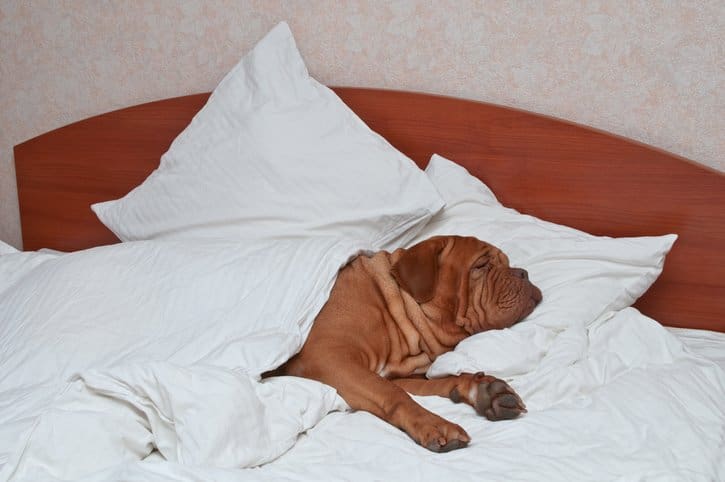
Breed and size can affect sleep too, but the reasons are less clear. Large and giant breed dogs in general seem to sleep more than their smaller counterparts (think Chihuahua versus Mastiff). This might be due to higher energy demands for bigger muscles and internal organs.
Much about sleep remains shrouded in mystery, but one thing is clear: we all need it!
Does my dog need a bedtime?
We all know that as humans, if we don’t get enough sleep, our cognition suffers. Here’s the beauty about being a dog—you can sleep anywhere, anytime! Like all animals, dogs do require a certain amount of sleep, but since they aren’t reading, writing, driving, or otherwise operating heavy machinery, you don’t need to worry about setting a bedtime for your canine companion. He will do that for himself. Maybe us humans should take a page from our dog’s playbook and rest when our body demands it!
My dog sleeps all day. Is this normal?
The truth is, sleep varies dramatically between individual canines, just as in humans. There may be correlations between breed and size, but in the end, each dog is unique. Dr William Thomas, a veterinary neurologist at the University of Tennessee, estimates that dogs sleep anywhere from 48-58% of the time. If your dog is active and alert when awake, has a good appetite, and seems otherwise normal, then perhaps your dog just needs the extra Zzzzzzs. On the other hand, if your pup is exhibiting lethargy, decreased appetite, or any other unusual signs, it is time for a check-up.
Here are some recent survey results on over 10,000 dogs’ sleeping habits.




Did not learn anything new…everyone knows that pups and senior dogs sleep
more…
Agreed, same as people.
What a bunch of farts you all are!!!
Its not rocket science to understand that each individual has different needs – you don’t need to dig up extra bs comments about vets and medication and checkups. To each his own! Don’t mix subjects.
My chocolate lab mix was brought to NYS from Alabama by a local shelter. She was treated for heartworm (which she had) when she got here & gets heart worm treatment every month – yes, I know its ivermectin, one of the wormers I used to give my horse! She is now 13, was diagnosed with lyme disease last year & treated for it. Her vision has been affected a bit – usually nighttime -& her strength has been affected, also. I, too agree with vet visits every 6 months especially for an older dog & more so, a dog like mine that has already been affected by a tick disease. As tick-caused diseases increase, we all need to be more observant – who is to say that heartworm is definitely NOT a danger here?
We got an 85 lb. Rottie from a farm We spoiled him Rotten. On his first vet visit we found that he already had heart worms. That is treated with arsenic, and the side effects are very bad. He finally died from H. W. Md. and Va. do see H.W. in dogs. From our own experience the treatment seems as bad as the disease. Cried buckets of tears the day our sweet Rottie girl died. Each owner has to decide if the treatment is worth the side effects.
Great to put some attention on the canine need for deep healthy sleep! I’ve noticed that client dogs with generalized anxiety, storm or noise phobias, separation anxiety etc often do much better when they are crate trained, and not just because it helps condition calm and quiet, but they are getting a more undisturbed sleep through the night. When they sleep in the hall they maybe feel obliged to remain on alert, but in the crate they know they are safe and they learn to let go and really go to sleep. My 15 year old dog, Tigerlily, has pretty severe spiral arthritis, and she was having some problems sleeping. She actually woke up one night with a terrible nightmare, screaming! The inspired me to see the veterinarian, who prescribed Trazadone. So, I give her a trazadone after supper and she sleeps very deeply til morning. Since I’ve been doing that, her daytime hours have been much cheerier! While at one point it seemed she was getting dementia, now she seems much more “with it!” It seems that she just needed help to get that deep nighttime sleep!
I am a firm believer in Titer tests – as does my vet. If your pet has enough of the antibodies, then they don’t need the vaccine injection. Blindly vaccinating can cause issues, especially with older pets. Unfortunately, Michigan doesn’t accept a Titer test for Rabies – perhaps someday they will!
Regarding the comment about heartworm..I never heard of HW in California. I and 4 dogs lived there for about 50 years. When I moved to TN,the vet explained that different areas have HW. Some do and some don’t.
I would like to see something about canine dreams, with all the twitches and leg jerking that goes on. My boy is 11 years old Australian Shepherd and as a baby or young lad, he didn’t do much twitching. But now as a gracefully graying male, he does it a lot. I get a lot of back thumps during the night 🙂
ALL THE ABOVE COMMENTS DO NOT TAKE INTO CONSIDERATION THAT MAMMELS– NOT JUST THE ABOVE OWNERS RECIOUS CANINES– ARE TOTALLY DIFFERENT THATN ONE ANOTHER.
NO STANDARDS CAN BE SET WITH PUNCTUALITY AS PEOPLE THINK.
ARE ANY OF THE ABOVE HUMANS EXACTLY ALIKE?
GIVE IT UP FOLKS, STOP BEING SO ANAL ABOUT LIFE & YOUR DESIRES.
MOST COMMENTS ARE HERE JUST BECAUSE MANY PEOPLE LIKE TO DISAGREE WITH ANYONE.
CORRECT THE EXPERTS ! GET A LIFE. THEY ALL ARE VERY LIMITED.
Who can afford today’s vets
Your dog can be healthy, you take it for check to the vet and they start to sale you whatever can get. Just add and add more. .Discussing.
I have 3 dogs and they are 16 ,16 and half and one 17. I still didn’t find one vet to really want to help my dogs in need, just look at them like $$$$$…
I learned myself how to feet them the best, no vaccines!
Vets just stress my dogs with over tests 🐾❤️🐾