


As an African American, I’ve found these past few months difficult. I’ve been examining different aspects of my personal and professional life and reflecting on the various journeys that brought me to where I am today.
I’m a dog trainer – a professional in an industry with few Black colleagues. This isn’t the first time I’ve wondered why there are so few people of color in my profession, but it’s potentially the most impactful time to discuss it, in hopes of increasing the diversity of what has long been an extremely white occupation in the U.S.
HOW I GOT HERE
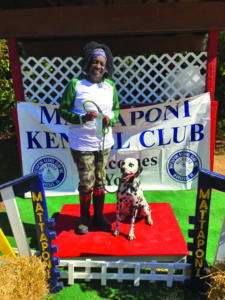
In 1985, I walked into my first dog obedience class with Casey, my new Irish Setter puppy. The class was run by the local kennel club and held at a community center in Jacksonville, North Carolina, where my U.S. Marine husband was stationed.
As the only African American in the class, I stood out, but this did not concern me. As a child, I attended predominantly white schools and lived in many white-majority neighborhoods; I was used to being one of the few Black people in many situations! Besides, I enjoyed what I learned in class so much that, after only a few sessions, I decided that I wanted to earn obedience titles with Casey and become an obedience instructor myself.
Recognizing my enthusiasm and knack for training, the seasoned and much older ladies of the kennel club took me under their wings, mentored me, and welcomed me into their inner circle. I’ve been thoroughly immersed in the world of dog training and behavior ever since.
IN THE MINORITY
I was incredibly lucky to have so much support from my fellow dog trainers, especially since I have often been the only African American wherever I went in the dog world, whether I was competing at local conformation dog shows or obedience or agility trials. I see more people of color in the dog world today, but at most local events, out of the dozens in attendance, you’d be able to count Black people on one or maybe two hands.
I’m confident when competing with my dogs against anyone in a dog show. But in all these years, I have felt most uncomfortable among my dog-trainer peers at professional dog-training conferences, workshops, and seminars. Why is this? I’ve thought about it a lot.
For one thing, I stand out even more at these educational meetings than at dog shows. The dog-training profession is strikingly white and largely comprised of white, middle- and upper middle-class women. This is especially true of the subset of trainers who use positive reinforcement and science-based training.
But it’s more than just being a minority. Through the years I have attended many dog-training conferences and events. While I can’t say I experienced any overt racism or bigotry, I often felt discounted and downright invisible. Worse, on occasion I was mistaken as “the help” at the conference hotels where the events were being held.
I don’t know how to explain this, except to say that dog trainers are not always perceived as the most inclusive people, welcoming and open to different points of view and perspectives. There is a joke about dog trainers that goes, “If you put two dog trainers in a room, what’s the only thing they would agree on? That the third dog trainer is wrong!” The profession is rife with contrasting schools of thought and methodologies, complete with exclusive cliques and very strong lines drawn in the sand.
Most people who know me know that I walk to the beat of my own drummer and I’m generally unbothered by the opinions of others. But I must admit that stepping out of the comfort zone of my own little training community into the big one at large was sometimes daunting even for me, a middle-class, suburban Black woman raised and educated among white people. Think of how difficult it might be for newcomers to break into the dog-training profession, especially when they don’t see anyone else who looks like them at the table.

It wasn’t until I became a minor celebrity from appearing on the reality television show “Greatest American Dog” in 2008 that other trainers started noticing and acknowledging me and speaking to me at events. At that point, dog training hadn’t ever been the center of a prime-time broadcast television show, and most trainers had seen at least one episode; it seemed like the show was a safe topic as an entry point to conversation. I met and made friends with many more fellow trainers after the show ended.
FRAUGHT RELATIONS BETWEEN DOGS AND AFRICAN AMERICANS
Historically, the relationship between Black Americans and dogs is quite different than that of white Americans. Our relationship with dogs has been complicated and tainted and affected by violence, fear, and intimidation.
As a very young child in the 1960s, I regularly saw images on the nightly news of Black people being knocked down with fire hoses and police wielding batons, accompanied by teeth-bared and lunging German Shepherd Dogs – dogs who were sometimes even let loose to terrorize and attack civil rights protestors. Those images haunt me to this day.
However, we can go even further back than that. Dogs were an integral tool in the implementation and management of the institution of slavery in this country, from their presence and usage on slave ships during the middle passage, to the shores and plantations where dogs were used as tools of intimidation and bred and trained to track, attack, and even kill runaway slaves.
These experiences have undoubtedly led to a multigenerational fear and avoidance of dogs in many Black families. Even within my own family, I have relatives with such a real and present fear of dogs that they refuse to visit my home (I have never had fewer than two dogs, and today I have five: two Dalmatians, a Pharaoh Hound, a long-haired Chihuahua and a Yorkie).
In poor neighborhoods in many cities, dogs often play a role as a household’s protection against crime. In neighborhoods where dogs like this are common, children are uniformly warned against approaching dogs – any dogs.
Given all this, it makes sense that it has been a bit of a longer and tougher road for dogs to be welcomed and thought of as viable and close members of African American families.
Statistics vary according to their source, but every survey or study we were able to find confirmed one thing: Black Americans are far less likely to be dog owners than Americans of other races.
In 2006, the Pew Research Center published a study that asked people of various races whether they owned pets, and if so, what kind? Of the white households that owned pets, 45% reported owning a dog. Of the Black households that owned pets, only 20% reported owning a dog.
It’s much easier to find statistics regarding “pet” ownership than “dog” ownership. A 2018 poll conducted by Branded Research, Inc., asked 14,755 participants about “pet” ownership. The majority – 66% – reported owning a pet of some kind. About 70% of Caucasian participants said they owned at least one pet; only 44% of Black participants said they were pet owners.
The 2017-2018 American Veterinary Medical Association’s “Pet Ownership & Demographics Sourcebook” shows similar numbers: “Pet ownership differs among racial and ethnic groups. The highest rate of pet ownership overall in 2016 was seen among white households (64.7%), with Latino/Hispanic (61.4%) households next. The lowest rate was found among Black/African-American households (36.9%).”
INCREASING THE VISIBILITY OF BLACK TRAINERS
I often ask other trainers how they got into dog training. For many, it wasn’t until they attended a dog-training class with their own dog (as in my own experience) or had the opportunity to hire a professional dog trainer to help them with their dog, that they considered entering the profession.

This is why I’d like to suggest that the more trainers there are who are people of color, the more people of color could see that dog training might be a good career choice for them! Also, I suspect that many more Black and brown people would engage the services of a professional dog trainer if there were more Black and brown dog trainers!
As a dog trainer, what can I do to help make my profession more inclusive and diverse? I have a few ideas:
1. Extra effort must be made to usher in newcomers from diverse populations. That means seeking and recruiting clients, staff, interns, and working students from different races, cultures, and nationalities.
2. We need to create and foster an environment that is nurturing and welcoming to everyone. Learning about cultural differences so we can better gain an understanding of and communicate with racial and cultural minorities is a good start.
3. I encourage all trainers to examine their own training programs, looking for possible barriers to diversity within our marketing and outreach, staff, communication style, and educational materials. This includes acknowledging possible biases and/or lack of sensitivities within ourselves and others around us and taking steps, no matter how small, to do better. To change, you must want to change.
4. Trainers should apply the same principles and be just as outspoken about our commitment to the humane, fair, and compassionate treatment of our fellow human beings as we are for dogs.
5. Let it be known that you fervently stand up against racism, discrimination, and bigotry, both within our industry and society at large. Our community mirrors society at large and is not exempt.
BE WELCOMING
My hat will always be off to those “ladies of the club,” who helped draw me into dog training some 35 years ago. Honestly, they were a gruff old bunch of heavy-handed women (with dogs and people), rough around the edges, and definitely entrenched in old-fashioned dog-training methods.
In regard to inclusivity, however, those women were way ahead of their time. They welcomed me with open arms when they didn’t have to. If it weren’t for them, I might have missed out on one of my greatest passions in life. Let’s work together to make sure other dog enthusiasts who look like me don’t miss out on theirs.
Canine education specialist, dog behavior counselor, and trainer Laurie C. Williams is the owner of Pup ‘N Iron Canine Fitness & Learning Center in Fredericksburg, Virginia.




Thank you for such a great article. I am also a long-time lover of dogs and a person of color. Found this article great and encouraging. ANd to the WDJ — this is great! It opens the doors to articles on trainers and owners who also may face other obstacles and challenges in the community, such as those with physical challenges. I want more stories like this and others. And I am going to go restart my subscription BECAUSE of this article.
Enjoyed this article, your thoughts and the words of your personal experiences. Amazed at the anger some people are expressing, but maybe they need to let it out. Hope they find their peace before they hurt anyone, including themselves. You are right in that the more types of people around the world who feel comfortable expanding their education of dog training only benefits more dogs (and probably other animals as well, bc it makes us practice observation and empathy for non-verbal beings). I for one can’t wait for the entirety of the human race to feel at home working positively with dogs. Good on you for never minding being the only black woman in your dog training circles to be doing so!
Laurie, thank you so much for sharing your experience and your wisdom (and your wonderful story!) – even knowing there would be responses like some of the above. Your courage and your message are so appreciated. Detractors: congratulations – you have just made the author’s point for her.
Thank you, Laurie and Whole Dog Journal, for writing and publishing this insightful article addressing an important issue. Our dog world is not a bubble that can ignore issues of fairness and justice in the larger world. Brava!
Thank you Laurie fro this very timely and insightful article. Lots of gross closet racists on here, proving your point nicely. They quite determined to remain racist and ignorant because their narrow world really does depend on pretending that racism does not exist. The person who made that silly comment about The NYT, that’s a publication for people who are educated and intelligent. Not for you hun.
The only Black people that I’ve met in the dog training world were training working dogs, when I was in that arena. It seems a lot of black families didn’t own dogs and if they did there was a tendency to keep them outside. Seems like they many were used in the inner cities as protection, mostly pit bulls and were also used in dogfighting. That, I believe is changing in a more positive direction. We definitely need more blacks in leadership roles. Good for you Laurie!
Enjoyed your thoughtful and informative article. Thank you.
thank you, Laurie! This is very helpful. Please let me know if this is okay to reprint in Capital Dog Training Club’s newsletter, Obichaff.
I was really happy to read this informative and beautiful article! I learned things I didn’t know about and more importantly, your honesty about minorities in terms of dog ownership, their unfortunate use in being trained to attack /kill, and how much more the world of dog training, achievements and family joy we have yet to achieve! As others have said, I am tired of the conversation being about race because I am so very fortunate to not have been exposed to this systemic racism too young to become that way also! People are people , and the best people are dog loving people! Thank you, Laurie, for all the ways you continue to make a difference in the world!😘🐶🐶🙏🏻
Every single one of us walks their own path. You might not want to “hear” someone’s journey was influenced by racial concerns and experiences however since you didn’t walk THEIR path does not mean it isn’t worth sharing. If this article offends you, you should search deep inside you as to why others can’t share their experiences unless it fits your narrative. Closed minds find something to hate in many places.
Very well put, Ellie. I was trying to think of a way to say we all need to examine our discomfort and be a part of the solution, but you did it superbly!