

Megaesophagus is a common disorder in dogs that describes slow motility with resultant dilation of the esophagus. The esophagus is a muscular, distensible organ that carries food from the mouth to the stomach. As a result of hypomotility, food will “pool” in the esophagus and stretch it. The stretching leads to damage to the nerves. This worsens hypomotility — a vicious cycle.
Megaesophagus can be either primary or secondary. In the primary case, an underlying cause is never discovered. It predominantly occurs in puppies, and rarely in an adult-onset form. Secondary occurs when some other predisposing condition such as myasthenia gravis, an autoimmune disease that causes muscle weakness, develops, leading to the megaesophagus.
Primary Causes of Megaesophagus in Dogs
Congenital Megaesophagus in Dogs
Unfortunately, some puppies are just born with a flaccid, slow-moving esophagus. Breeds that are genetically predisposed include the wire-haired fox terrier and miniature Schnauzer, but any breed can be affected. Initial symptoms may not be seen until a puppy is transitioned from maternal milk to dog food. Then symptoms of regurgitation—throwing up undigested food—and secondary pneumonia are noted. Regurgitation is different from vomiting. It occurs almost directly after a meal. Often the food comes back up with no effort, almost like a burp, and no digestion has occurred.
A frequent secondary consequence of regurgitation is aspiration pneumonia. As a puppy regurgitates while inhaling, food and stomach acid can be pulled into the lungs. In these cases, puppies must be treated for aspiration. This can include oxygen therapy, nebulization and coupage, and sometimes antibiotics. Hospitalization may be needed if the pneumonia is severe.
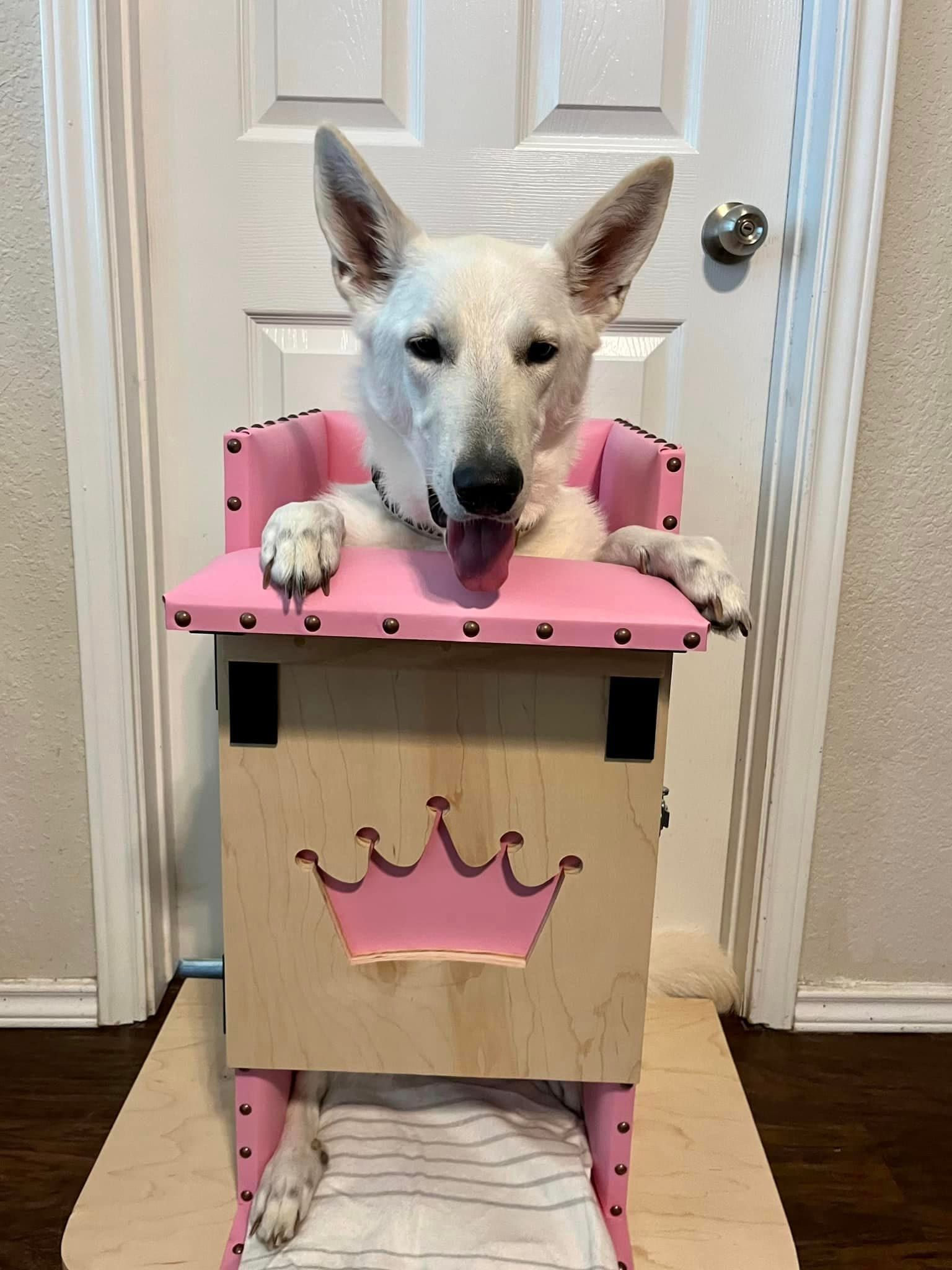
There is no surgical treatment for this type of megaesophagus; it can be managed with a variety of lifestyle changes. These include feeding and watering in an upright position using a Bailey chair (click here for a link to a company that manufactures custom Bailey chairs) with small, frequent, calorically dense meals. Some dogs do better with gruel while others prefer meatballs. It will depend on each dog’s ability to swallow.
A 2017 study showed some improvement in dogs with idiopathic/congenital megaesophagus when treated with sildenafil (Viagra). More studies need to be conducted to determine if this is a viable treatment option.
Megaesophagus is a lifetime condition, and any dog born with it must be closely watched for signs of aspiration pneumonia throughout their life.
Megaesophagus Can Be Caused by Vascular Ring Anomalies in Dogs
An important type of megaesophagus to mention that is both congenital and secondary is due to a vascular ring anomaly. In some breeds of dogs, particularly German Shepherds, an abnormal blood vessel can persist instead of regressing during development. The most common type is a persistent right aortic arch (PRAA). When a dog is born, that extra blood vessel causes constriction as the esophagus passes through the chest. In front of the vessel, the esophagus is dilated. As a puppy starts to eat dog food, it becomes trapped in the area, dilating the esophagus.
This is a fixable condition with surgery. However, after surgical repair, hypomotility may persist due to esophageal damage. Rapid diagnosis and treatment are essential to a good outcome. Any puppy that develops regurgitation at weaning should be immediately evaluated. Radiographs (x-rays) with and without contrast can be done to diagnose this condition. If a persistent vascular ring anomaly is diagnosed, surgery can be done to snip the extra vessel. This is generally conducted by a board-certified surgeon, but there are general practitioners who have performed this surgery as well.
Secondary Megaesophagus in Dogs
The list of underlying causes for acquired megaesophagus is extremely long and includes muscle diseases like polymyositis, infectious disease such as tetanus, Addison’s disease, cancer, myasthenia gravis, toxins including lead and thallium, and trauma.
As with primary, there is no surgical correction for this. The underlying disease must be identified and treated. In some cases, this will significantly improve the megaesophagus, but due to the stretching, it does not always return to normal size and motility. As a result, megaesophagus may persist, leading to episodes of aspiration pneumonia.
One of the most common causes in older dogs is myasthenia gravis. This is a systemic, autoimmune illness in which the body’s immune system destroys important receptors in nerve endings. It results in generalized weakness, particularly worse after exercise. There is a medication to treat MG, and it can improve the motility of the esophagus.
Ruling out other causes can take an exhaustive list of diagnostics, so be patient while your veterinarian examines possible underlying causes. By keeping close tabs on your dog’s health and providing your veterinarian with a thorough history, the etiology of megaesophagus in dogs can often be discovered.


My 8 year old beagle boxer mix has been perfectly healthy until recently. She now has ME and waiting on MG test results. Is it difficult to train the dog to eat in a Bailey chair ? How do get the right size. We walk every day and worry about giving her water during the walk.
I am so grateful I’ve found this site , my 5 year old minuture Dachshund has been diagnosed with Megaesophagus today , we are now waiting on a blood test for Myasthenia Gravis . My husband and I have cried / sobbed since we received this news earlier today . We should have the blood results back in 2- 3 days . We havnt seen him for a week , we are heartbroken thinking of him in a cage , all on his own , but I also realise that he is in the best place at the moment . I’m praying for Hunter , I dont know what else to do at the moment x
Been feeding 10yr old lab in bailey chair. Ground beef, rice, and water – high calorie 1 part ground beef, 1 part brown rice, 2 parts water in ice trays frozen. Seems to be working – we will see.
Hi I have a now 6month old Jack Russell, he was diagnosed with ME mid March at around 3months old. He has started to become protective of his food and food aggressive has anyone had any experience of this and can help me stop the behaviours? We hand feed him from the palm of our hand 3 times per day and it is gradually getting more difficult to do that safely.
Thank you Andrea
My Lilly is 14 and now is having trouble with the cough if she sleeps on her side. She was born with Mega does anyone have any advice how to help her.
Hello Nancy ~ Use a pillow or a folded blanket to rise her head at bed time : ) it will definitively make a huge difference!!
Our a Portugese miniature water mutt is now fourteen years old. Dumped on our local golf course at about six months old. We could not understand why he vomited so much. Finally after a dose of pneumonia a clever young vet diagnosed his problems looked like a no hoper. Did lots of research tried food feeding. Husband built him a Bailey chair, did not work at all.
We then started soaking kibble with some added meat, put it in a food processor, served it in a divided dish so he has to reach for it!
No probs apart from an occasional cough up of bile.he has survived a stroke and a few other issues, but can out run and more puppy like than most puppies. Only down side…bad breath. Our vet is amazed!
I have a mutt that I adopted at 5 months old with congenital idiopathic ME. 3 vets told me to euthanize her. She’ll turn 11 years old next month. Lots of trial and error with food, we havd success by putting kibble in a food processor until it’s a flour-like consistency. She eats from a slow-feed bowl standing at the kitchen table.
How do I get my 2 year old chocolate lab (51 lbs) the water she craves? Her diet consists of 4health 13.2 oz grain free canned turkey stew rated at 82% moisture with 333 kcal. I wash off the gravy to eliminate gagging. I feed her 4 times a day with 3 1/2 hours frequency. I have tried high speed blending all contents, but she was frequently regurgitating fluid 30 minutes following feeding in a Bailey Chair. I feared aspiration, so I reverted back to canned chunk feeding.
I was a bit surprised to read the comment about one of the major causes of secondary megaesophagus and older dogs being myasthenia gravis. I have a seven-year-old rescue. DNA test said some mix of corgi Weimaraner and Jack Russell. but he looks more like a combo of a Jack Russell and dachshund.
Anyhow, around the time he turned 2 he was diagnosed with myasthenia gravis. The way I found out was actually because I had gone to the vet over concern about his regurgitation and the vet suggested I have this ridiculously expensive blood test done just to be safe. I kinda had a gut feeling as soon as he suggested it. Buster had a pretty severe case of it too. We went through a couple serious bouts of aspiration pneumonia. As well as some devastating play times and walks where he would just collapse. He lost half of his bodyweight in just 2-3 months.
I did a lot of reading on the illness at that time. Everything I remember said it was common for dogs to get it around age 2 and that sometimes dogs were going into remission from the illness. Several people said they thought I should put him down as it was extremely time-consuming and difficult to care for him with this illness. However, I never thought twice about it. I was glad he had me to care for him.
After years of stressful living monitoring his every move and intake of food or water, He began to show signs of remission. Full disclosure I never got the super expensive blood test again. I just took his lack of collapsing as proof enough for me.
His megaesophagus Has been causing problems recently and I’ve had to return to keeping him upright for 20 to 30 minutes after eating. the reason I found this page is because I was wondering why he was fine for some time and now seems to be having issues again. Also if it might go back to being okay again (fingers crossed). however I haven’t been able to find any thing specifically on that issue. Does any one else have some insight?
i think mine is the youngest age in here, my baby pomeranian found to have ME when she is two month old.
her appetite is super ok, but just will vomit after food. she on antiobiotic right now. everytime after food n medication i need to carry her up right to make sure the food gies down to stomach itself prevent vomit.
any other supplement /medication can help my baby ? i m from malaysia.