

Megaesophagus is a common disorder in dogs that describes slow motility with resultant dilation of the esophagus. The esophagus is a muscular, distensible organ that carries food from the mouth to the stomach. As a result of hypomotility, food will “pool” in the esophagus and stretch it. The stretching leads to damage to the nerves. This worsens hypomotility — a vicious cycle.
Megaesophagus can be either primary or secondary. In the primary case, an underlying cause is never discovered. It predominantly occurs in puppies, and rarely in an adult-onset form. Secondary occurs when some other predisposing condition such as myasthenia gravis, an autoimmune disease that causes muscle weakness, develops, leading to the megaesophagus.
Primary Causes of Megaesophagus in Dogs
Congenital Megaesophagus in Dogs
Unfortunately, some puppies are just born with a flaccid, slow-moving esophagus. Breeds that are genetically predisposed include the wire-haired fox terrier and miniature Schnauzer, but any breed can be affected. Initial symptoms may not be seen until a puppy is transitioned from maternal milk to dog food. Then symptoms of regurgitation—throwing up undigested food—and secondary pneumonia are noted. Regurgitation is different from vomiting. It occurs almost directly after a meal. Often the food comes back up with no effort, almost like a burp, and no digestion has occurred.
A frequent secondary consequence of regurgitation is aspiration pneumonia. As a puppy regurgitates while inhaling, food and stomach acid can be pulled into the lungs. In these cases, puppies must be treated for aspiration. This can include oxygen therapy, nebulization and coupage, and sometimes antibiotics. Hospitalization may be needed if the pneumonia is severe.
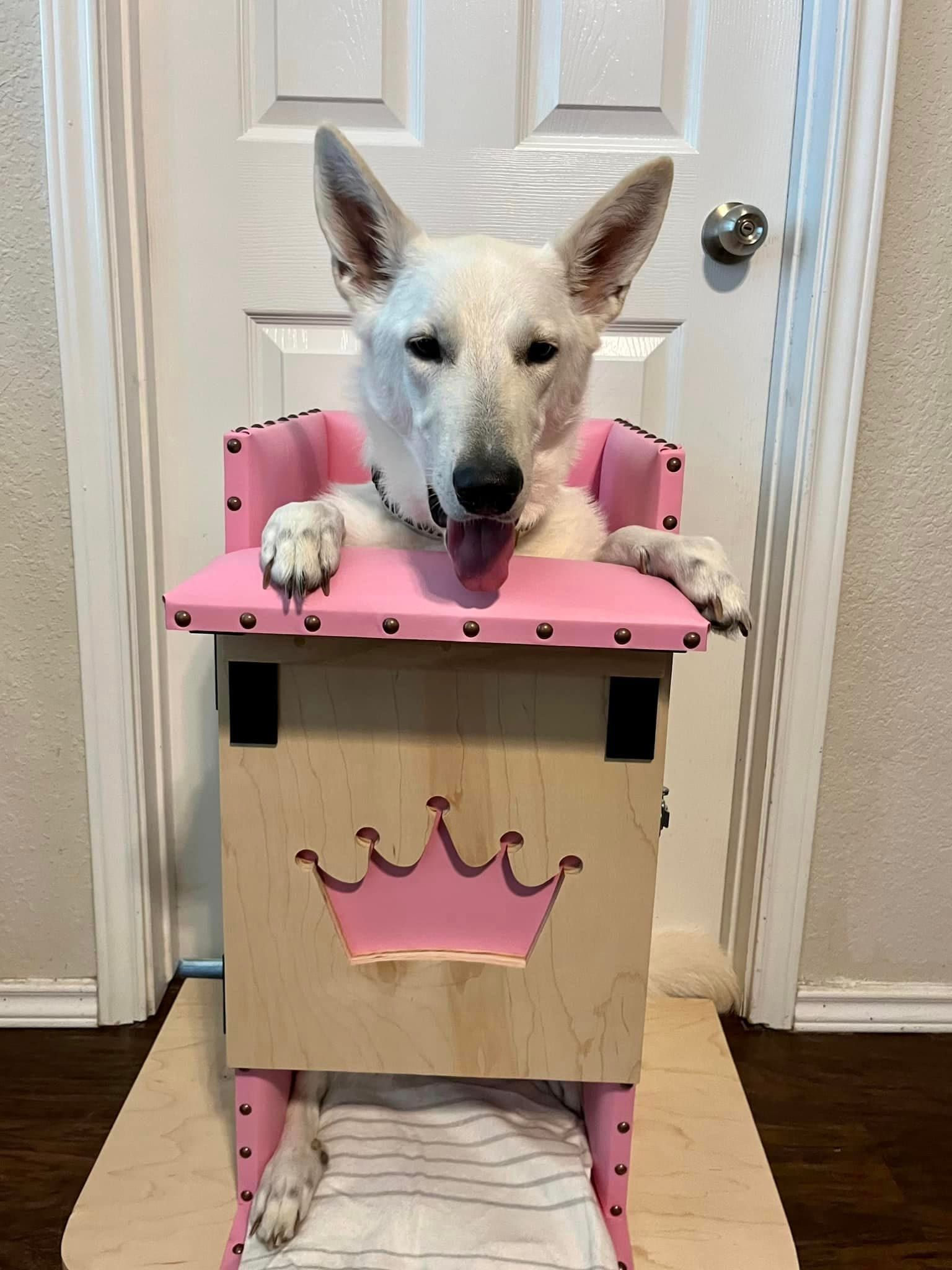
There is no surgical treatment for this type of megaesophagus; it can be managed with a variety of lifestyle changes. These include feeding and watering in an upright position using a Bailey chair (click here for a link to a company that manufactures custom Bailey chairs) with small, frequent, calorically dense meals. Some dogs do better with gruel while others prefer meatballs. It will depend on each dog’s ability to swallow.
A 2017 study showed some improvement in dogs with idiopathic/congenital megaesophagus when treated with sildenafil (Viagra). More studies need to be conducted to determine if this is a viable treatment option.
Megaesophagus is a lifetime condition, and any dog born with it must be closely watched for signs of aspiration pneumonia throughout their life.
Megaesophagus Can Be Caused by Vascular Ring Anomalies in Dogs
An important type of megaesophagus to mention that is both congenital and secondary is due to a vascular ring anomaly. In some breeds of dogs, particularly German Shepherds, an abnormal blood vessel can persist instead of regressing during development. The most common type is a persistent right aortic arch (PRAA). When a dog is born, that extra blood vessel causes constriction as the esophagus passes through the chest. In front of the vessel, the esophagus is dilated. As a puppy starts to eat dog food, it becomes trapped in the area, dilating the esophagus.
This is a fixable condition with surgery. However, after surgical repair, hypomotility may persist due to esophageal damage. Rapid diagnosis and treatment are essential to a good outcome. Any puppy that develops regurgitation at weaning should be immediately evaluated. Radiographs (x-rays) with and without contrast can be done to diagnose this condition. If a persistent vascular ring anomaly is diagnosed, surgery can be done to snip the extra vessel. This is generally conducted by a board-certified surgeon, but there are general practitioners who have performed this surgery as well.
Secondary Megaesophagus in Dogs
The list of underlying causes for acquired megaesophagus is extremely long and includes muscle diseases like polymyositis, infectious disease such as tetanus, Addison’s disease, cancer, myasthenia gravis, toxins including lead and thallium, and trauma.
As with primary, there is no surgical correction for this. The underlying disease must be identified and treated. In some cases, this will significantly improve the megaesophagus, but due to the stretching, it does not always return to normal size and motility. As a result, megaesophagus may persist, leading to episodes of aspiration pneumonia.
One of the most common causes in older dogs is myasthenia gravis. This is a systemic, autoimmune illness in which the body’s immune system destroys important receptors in nerve endings. It results in generalized weakness, particularly worse after exercise. There is a medication to treat MG, and it can improve the motility of the esophagus.
Ruling out other causes can take an exhaustive list of diagnostics, so be patient while your veterinarian examines possible underlying causes. By keeping close tabs on your dog’s health and providing your veterinarian with a thorough history, the etiology of megaesophagus in dogs can often be discovered.

Our six year old Dalmatian was diagnosed with polymyositis. He was having painful issues with his mouth and was scared to open it to eat. After several emergency veterinarian visits I was referred to a neurologist. Dr. Williams did the blood test for muscle Myositis and it came back negative. Ten days later he did a CT scan and a muscle biopsy to definitely rule this out. The CT scan didn’t show anything and the biopsy came back three weeks later with some suggestions that it’s Polymyositis. Now Rusty is acting very normal , eating, taking treats prior to the diagnosis and medications. Now he is on pred and cyclophosphamide for at least two to five months. Has anyone had any experience with this inflammatory disorder?
I have a 4 yr old GSD whose had ME since birth. I have experimented with making food ( sweet potatoes or carrots, peas or green beans, rice brown or jasmine, boiled eggs including the shell. Cooked and then run everything through the food processor, then add raw hamburger. I have used cooked salmon or turkey too.) I have used various kibble, which I soak in water for at least 8 hrs then run through food processor. All of these experiments have a consistency moist and sticky that works the best. Water is his enemy though and seems to be getting worse for him. He gets aspiration pneumonia 1-2 times a year. I had him in a homemade Bailey chair for 2-1/2 years until he got hit by a car and shattered his hip. We then used a box at chest level for a little over a year, now I am using the chair again to see if any better. He just got over pneumonia and are now trying viagra which has recently been found to help with food moving more quickly into the stomach. It is a lot of work but I love my dog, he’s extremely active and we even compete in Nosework trials. I probably will have to stop letting him drink even small amounts of water though and might try some thickened water(he hates gelatin). Anyway, sorry so long but it can be done if you have the patience but I know it’s not for everyone and each dog is different.
I know someone who gives their dog frozen watermelon cubes in place of water.
Can someone tell me what are the Spinal/Nerve drops which are supposed to help a dog with ME, and I’m in Canada.
I have never heard of these, and am new to ME. We are fostering a little one now who has it. There is a Facebook group called The Upright Canine Brigade that has been incredibly helpful. Maybe someone there knows what it is.
I adopted a Black Belgian Malinois, with yellow gold eyes, 10 yrs ago from a pound & Thora, me & my German Shepherd, Freyja, have been a pack since then.
Thora was beautiful from the inside out. Super sweet disposition, never aggressive & I often told her, she was my comedian. Thora was always up for a game of ball.
After months of ME induced pneumonia, Thora’s body just gave out. She passed, at home, in my arms yesterday morning.
My heart is half gone with her passing. Her sister, my GSD is also grieving. We miss our Little Girl.
ME is insidious. No one should ever have to suffer with this condition.
I cherish every day I had with Thora. God made one thing Perfectly, the Dog.
At least I know she is whole again & not in pain. God bless you Thora & thank you for being part of my life.
So sorry. My Wally was a black face Malinois with yellow eyes. Best boy. Such good dogs ❤️
Our yellow Lab BUSTER had (ME) at 10 yo. He lasted one day after his 12th birthday. About a month ago. Boy I miss him. We mixed a little kibble with hard boiled eggs. Peanut butter. Fresh pet refrigerated dog food. Blended all together and made meatballs. We used (BIG JOE) chair from Walmart. (30 bucks) For 2 year’s he did ok. He had issues with flem from time to time. But he two was on thyroid meds since age 3. I wish I never put him on that. I wish I would have found this site as well.
Our 3yr old dog was born with ME. We feed her 4 times a day using her Bailey chair. We keep her in her chair for one hour each feeding. We blend wet dog food with ground up dry food, Dynes weight gainer, slippery elm and Pepcid Ac in every feeding. She was still regurgitating 7-10 times a day. I just knew there was another problem. I took her to a internal medicine specialist and he put her on 20mg of sildenafil (viagra) twice a day. It had been a miracle pill! She maybe regurgitates once a day if that! The sildenafil helps relax the sphincter between her esophagus and her stomachs so it can open and help her food pass. I have learned that a lot of dogs that have ME also have (“LES achalasia-like syndrome”). she has already gained 2lbs in just 3 weeks! There is hope!
What breed of dog do u have? I’ve got a collie with megaesophagus she is 3 years old and we have done wanders with her she was 13kg then she started regurgitation 6 weeks ago out the blue after nearly every meal she gone down to 9 kg vet put her on 25 g slidefil a day but she still bringing up and losing weight.
I had a Greyhound with ME. After a lot of trial and error, I found that making my own dog food was the best answer. I used: ground chicken or turkey, one of my other dogs was allergic to beef and lamb so I didn’t want to take the chance he might eat it; sweet potatoes; and rice. Everything was cooked put into a food processor until it was a smooth consistency. I would make apx. 2 weeks worth and freeze it in Zip lock bags until I needed more. I added a handful of small kibble to the mix. This was over 10 years ago, before there were feeding chairs, etc. so his food bowl was put on a low stool. Cosmo wasn’t with us for long. At 6.5 y/o his stomach twisted and the vet said that he wouldn’t make it through the surgery because of his ME. He was the sweetest boy. When he didn’t feel good, he came and sat on my lap and wanted to be held.
I’m so sorry. Our boy is almost 2 and was diagnosed with me yesterday…
Dogs with hypothyroidism (even when treated by proper medication) have a higher likelihood of developing secondary megaesophagus. I have had TWO unrelated male Weimaraners to develop the condition after being hypothyroid for a period of years and on thyroid medication. My holistic vet informed me of this fact and I have found information online, to support this. We have never gotten to the point of having to use a special feeding chair. My holistic vet gave me special “Spinal/Nerve Drops” made by Animal Nutrition Technologies which helped tremendously when given before each meal. I also decided to place the food bowl on a RAISED surface so the dog’s mouth and neckline was even with the bowl. The oldest affected dog lived to be 16. The current dog is 10 going on 11. He also is diagnosed as having spinal arthritis (2 years ago and is on Gabapentin) and that may be what does him in – NOT the ME.
I rescued a dog from the shelter and he was diagnosed with ME. His problem is with water and not so much with food. He also seems to be in a lot of pain after drinking water. I would love to know where I can purchase the Spinal/Nerve Drops. We have tried numerous medications without much success.
Can someone tell me what are the Spinal/Nerve drops which are supposed to help a dog with ME, and I’m in Canada.
In early March I emailed the editors a suggestion to write an article about ME in the WDJ. I never got a response and never saw a print version so thought it was never received.
Today I stumbled on this piece. Now I wonder if it is coincidence or a direct result of my request.
I learned everything I could in 2014 when my 14 year old Golden Retriever was diagnosed with ME. Contrary to one vet’s opinion, it was not a death sentence. A yahoo support group, a Bailey’s chair (which we donated to an ME group after she passed unrelated to ME) and a custom pillow designed to elevate her head while she slept were the main changes to her life. Partner with your vet and learn all you can.
Hi Carole!
I adopted a small breed terrier mix from North Shore Animal League a few weeks ago. The dog had diarrhea and “ a mild cold” which was really kennel cough and was sent home on a variety of antibiotics. After the kc didn’t clear up by the end of the treatment, my dog was prescribed clavamox. He developed diarrhea and started vomiting more often and the cough changed. After several visits back to the clinic at North Shore Animal League, my dog was getting worse and was given Pepcid and a probiotic. He continue
D to vomit more and his cough was back harder. I took him to a local vet who say a mildly dilated esophagus and sent out bloodwork to test for myosynthia Gravis. Today she MG blood test came back 98% positive for it. Where did you get the special pillow for your dog and what other tips could you give me? My dog is being put on a med for MG along with Kara fate for dogs and an anti nausea. Any help would be appreciated!
Some research also going on at the University of Missouri around LES and ME – https://cvm.missouri.edu/collaboration-between-college-of-veterinary-medicine-and-the-school-of-medicine-develops-revolutionary-treatment-for-canine-megaesophagus/ for the more readable version and https://onlinelibrary.wiley.com/doi/full/10.1111/jvim.15476 for the jargony research article 🙂
Is Megaesophagus regurgitating food or water? My Blue Staff/Pit x regurgitates if he drinks too much water, but can scoff down a whole bowl of food with no issues. If he drinks too much water, his regurgitation may contain a little food but is 90% water.
Not sure if this is Megaesophagus or not and cannot afford the quoted £400 to run tests (just for tests – if confirmed, looking at over £2K for operation!!!!!! – Figure my vet maybe a hustler?). Because he’s had since birth (he’s now 2), insurance doesn’t cover. Dog seems in great shape (even Vet says he looks in fine fettle).
Dogs who have ME can regurgitate liquid or food. Anything that passes through their esophagus.
Michael, Carole is correct it can be either. But there are a few simple things you can do. By the way I still have my Golden who had MG & ME. I spent almost a year treating him with meds 3 times a day. But you need to change his feeding method. Find the highest or build him one, a high feeding feed-bowl & water bowl. I purchased an 18inch high feeding from Orvis(Orvis is not cheap, however what you buy will last you for a long time.)
Here is the way you need to imagine your dogs throat and esophagus, think of PVC pipe and you’re dropping a rock down the tube. Once I pictured the rock going down the tube. I hand fed my golden for 10 months and then switched over to an 18 inch high feeding bowl and water bowl. This allows the food or water to go down simulating the rock down the PVC.
It is abnormal for a dog to eat his food with his head below his chest if you vision that the food must go up over his windpipe and then down again. Another reason for going to a much higher feeding bowl. Hope that helps!
Scott