

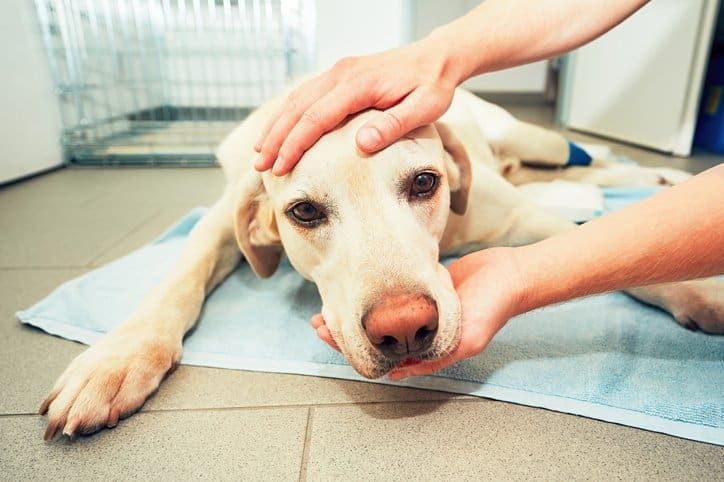
Mast cell tumors (MCTs) are one of the most frequent skin cancers seen in dogs. Mast cell tumors are the reason why careful monitoring of any skin growths is essential for maintaining a healthy canine. Any new masses on the skin should be evaluated by your veterinarian. In regards to MCTs, there are several predisposed breeds including Boxers, American Staffordshire terriers, and pit bulls.
What are Mast Cells?
Mast cells are important in the immune system, particularly in allergic reactions. They are found predominantly in the skin, but they are also found in lower numbers throughout the internal organs. Rarely are they found in the bloodstream. These cells are filled with substances such as histamine and heparin. During an allergic reaction, they degranulate – meaning they empty their contents onto or in the area of the offending allergen. The effect of mast cells can be seen when a patient develops hives and welts, as well as itching and redness.
As with any cell in the body, mast cells can develop cancer. The word cancer merely means the uncontrolled proliferation of cells. It can be divided into 2 broad categories – malignant and benign. Malignant cancers can be locally invasive and damaging, spread to other organ systems like the lungs, or both. Benign tumors do not spread to other organs and are cured by removal.
Symptoms of a Mast Cell Tumor in Dogs
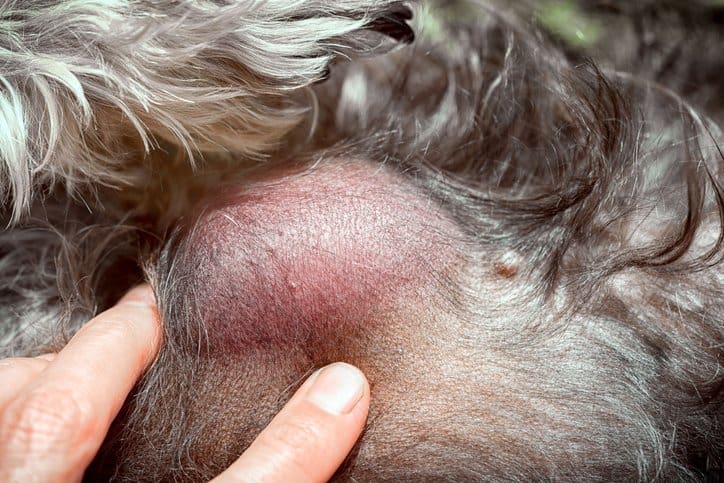
The symptoms of a MCT on dogs begin with a skin mass, most of the time (in rare circumstances, they can start in the internal organs, but this is more common in cats). They can be as small as a pea or as large as a softball. One important aspect is that they tend to wax and wane. They can start as small and suddenly become large, red, and irritated or weepy. This is a sign of degranulation, meaning the tumor has become irritated and released the nasty substances within it. The hallmark of a mast cell tumor is a tumor that grows and shrinks periodically.
If you note a skin mass on your dog, it should be checked by your veterinarian. As with any veterinary visit, your dog should have a nose-to-tail examination including weight and vitals, followed by a detailed history. Your veterinarian will ask how the mass has behaved, how long it has been present, and if it has changed significantly. They may also measure it with calipers.
Diagnosis and Treatment of a Mast Cell Tumor on a Dog
After a history and physical exam, your veterinarian will focus on the mass with gentle palpation. It is likely they will recommend a fine needle aspirate. This involves taking a very small needle and obtaining a sample of cells from the tumor. Another option is just having the entire mass removed and submitted for testing (excisional biopsy).
If your veterinarian is suspicious of a mast cell tumor and wants to sample it, they may recommend pre-medicating with Benadryl, an antihistamine. As we discussed above, one of the substances found in mast cells is histamine. Giving Benadryl may help prevent the tumor from degranulating during sampling. Sudden degranulation can cause a systemic reaction (anaphylaxis) and can be very serious or even life-threatening. Your veterinarian will handle any suspected MCTs gently, as a result.
Diagnosis is generally by a veterinary pathologist. MCTs are graded on two different scales – the older Patnaik scale (giving a number I through III with I being the least malignant), and the newer Kiupel system that simply evaluates high grade versus low grade.
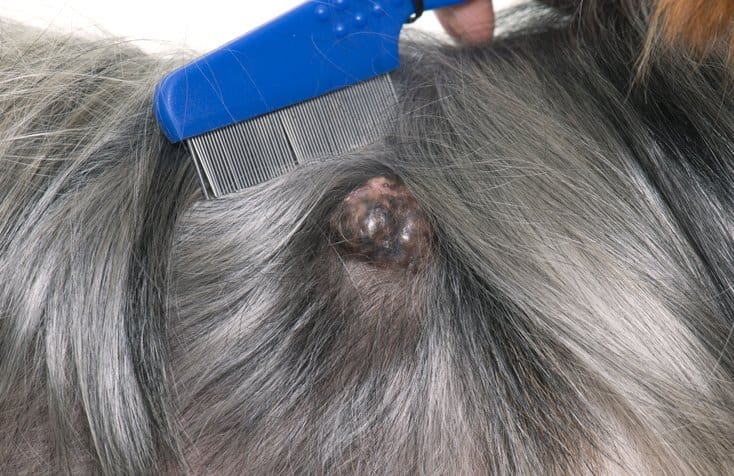
If your dog is diagnosed with a mast cell tumor, your veterinarian will recommend staging as the next step. This means determining if the cancer has spread by conducting bloodwork, urinalysis, chest xrays, and abdominal ultrasound. Once staging is completed, a clearer picture of prognosis can be seen.
Treatment of mast cell tumors in dogs involves initial surgical removal followed by evaluating whether the whole tumor was removed. If it wasn’t (called “dirty margins”), a second surgery may be needed. Radiation is also an option when the entire tumor wasn’t removed. It may seem “simple” to remove a whole tumor, but sometimes the cancer cells have infiltrated the surrounding tissue on a microscopic level. For low grade (Kiupel system) or grade I-II (Patnaik system), usually removal is sufficient if the margins are clear. Even with removal, a dog will be at higher risk for developing MCTs again.
With high grade/grade III tumors, following surgery, oncologists recommend chemotherapy. This is usually administered by a veterinary oncologist. If chemotherapy is not pursued, a dog with high grade MCT will likely stay on Benadryl and steroids to suppress the MCT until symptoms become too severe. As the disease progresses, the mast cell tumor will spread to distant sites like the liver, spleen, and lungs. Symptoms will correlate with the system that is affected.
A mast cell tumor is not the end of the world, but they can be very serious. It is important to notify your veterinarian when you find any skin masses so that they can be promptly evaluated. Early detection and treatment are critical to a successful outcome.
For more information on mast cell tumors in dogs, read our other articles on the topic:
About Mast Cell Tumors in Dogs
What Are The Treatment Options for Dogs With Mast Cell Tumors?


Hello everyone, to stop bleeding, we can try a Chinese herbal powder called Yunan Baiyao. Ive been told ny two vets to stop my mast-cell tumor dog from bleeding. I applied the powder on the tumor now. Observing if magic will work out.
Our almost 15 year old Golden has had an MCT on his right shoulder for six months. We’ve had days that it bleeds but I can usually stop it. It’s tripled in size and I cannot stop the bleeding. We do three Benadryl with breakfast and three with dinner. Any suggestions greatly appreciated. Especially to stop the bleeding.
Yunnan Baiyao Is apparently excellent at stopping bleeding.
Hi my little Yorkshire terrier has got a lump next to his anus , he is 16 yrs old I’m going to take him to the vet but I don’t think they will do ant treatment as his age and the lump is a little more then 10cm so I’m preparing myself for the inevitable I know it’s the right thing to do but I cannot see him suffer I’ve had since 7 weeks old he is part of my family it doesn’t get any easier also I don’t think it’s not fair to put him through anything x
Our 11 yr old white pittie was diagnosed with mast cell tumors 7 months ago. Vet took a slide sample from the worst tumor on her belly and said surgery would have to occur in order to determine the margins of it. I couldn’t afford the quoted price of surgery ($1000) so I opted for the conservative treatment of 3 Benadryl and 2 Pepcid every 12 hours. I am retired & home full-time, and noticed those 5 pills (given in a pill pocket) would make her sleep a lot, but then seemed to wear off after 6 hours. She would be back to licking & biting the tumor on her belly (which vet said would get grosser looking and ooze). At first I put cloth cone on her to prevent the licking & biting, but then figured what quality of life was that for her so took it off. I experimented & gave her 1 Benadryl tab every 4 hours and just 1 Pepcid daily (as otherwise the Pepcid seemed to cause her to desire to vomit). Eventually she chewed off the MST on her belly, leaving behind a small scar. None of the grossness the vet had predicted. About 5 months after her diagnosis, she developed another MST on inside of one of her back legs. She chewed on that MST, too, but it bled profusely. I immediately took her to another vet who gave an antibiotic for 10 days. That vet said she hoped I realized pittie wouldn’t survive this. I knew that from what I had been reading, but vet couldn’t tell me approximately how long pittie would live. I was told to try to keep her from bumping the bleeding MST on leg by putting a sock on that leg. Of course pittie tore it off & continued to chew on tumor like she had the one on her belly until her self-surgery removed that one, too. (I kept frequently laundering her bedding throughout that process.) During the past month of Covid-19 stay-at-home-even-more-than-before, I observed she has some days where she is so tired & weak-acting she can barely jump up one step onto our deck, and only eliminates 2x/day. Other days she runs around the backyard chasing squirrels with her long-time companion dog & leaps up that back deck step with energy. Very unpredictable. The first vet had told me I would know when to put her down by when her bad days were greater than her good days. I have recently switched her food from dry dog food to wet canned fish & mackerel dog food. Since she wasn’t licking or biting at any tumors, I cut back the Benadryl to 2 daily & the Pepcid only a few times weekly. (She really has only vomited a handful of times in the past 7 months…One day this week when she acted like she was going to, her companion dog began licking her face & she relaxed & didn’t.) I was told by one of the 2 vets that eventually she won’t be able to keep any food down & will look like she feels pretty cruddy. I notice that although lately she doesn’t feel like eating as much, she keeps regularly drinking water. Also recently her breathing was becoming very labored, so I experimented with reducing or eliminating the Benadryl; the past week her breathing rhythm during sleep now sounds more natural. I keep wondering if she will pass away on her own or if she will eventually be in great pain & need to be vet-assisted. On her bad days she mainly looks fatigued.
Hi Jennifer,
Have notice on Caí, or are aware of any side effects from the herbal medicine?
My dog had a mass cell tumor on his leg about a year ago his name is Cai I had it removed they got all the margins and I thought he was fine about a week later while he was still recovering another one appeared on his chest and a small one on his head about two months later, fortunately right after his surgery I went to a holistic Doctor Who gave me an immune herb called IMMUNE COMPLEX by the company (standard process) YOU CAN Get on Amazon or at whole foods, he also gave me a Chinese herb spelled Xue Fu Zhu Yu Tang, I also give him two Benadryl in the morning and two in the Eavening he’s been doing very well so far they have shrunk tremendously they were never big to begin with but they are staying small and the same size I also changed his food to a company that I have delivered I know longer give him kibble which I will never do for another one of my dogs the company that I get the dog food from is called the Farmers Dog… which also has fish oil real meat and vegetables if I had time to cook the food myself I would but I’m very busy this does cost a lot But I thank God and my lucky stars I’m able to do it the food has even helped him lose weight the kibble had him overweight by 15 pounds and he’s already lost it and looks 10 years younger I’m not saying this is a cure but I am saying so far I’m satisfied with it I don’t wanna put him through another surgery I’m scared that it will come back even worse just some information that may help anyone out there my name is Jennifer.
Hi there are you in NY?
My lovely dog Little Moo had a tumour removed last december then 5 more appeared in its place. She has had one that was ulcerated removed and another partially removed however this is growing back with a vengeance. I have put her on Piriton but his has not helped so changed to a different one, my vet has now put her on Loxicam. I am at a loss as putting her through constant surgery seems cruel. She spent all summer having operations. I had her neutered and the tumour became really aggressive at this point then she was attacked by another dog had 2 operations on a wound to her neck and it seems the tumours grow more when her body is trying to fight other things. I have changed her diet to mainly home cooked food and i apply cannabis oil hoping to cure her.
I have a 12 year old Female mixed breed dog that has a large Mammory gland Tumor that’s ulcerated and she also has a large tumor around her anus that leaks bloody fluid I’ve taken her to the vet and they basically told me they wouldn’t do the surgery and it’s pointless to do …do you have any info on what I should do and should I get another opinion? I don’t want To loose her she’s like family.i don’t understand what’s causing this and it’s not getting any better .
My mixed breed (shepherd,chow,spitz) has at least 6 of these Mast Cell Tumors now and also those scaley bumps that contain puss . My vets (2 different ones) have told me not to drain the scaleys and the Mast Cells are harmless. Meanwhile there isn’t a place on my dog that doesn’t have a lump. I have had one removed and it never came back but it cost so much I can’t keep doing that. I am a senior on limited income and love my dog dearly but I don’t know what to do. I give her cooked chicken and rice and very few treats. Anyone have any ideas to help me?
Nadine, do.some Google searches.on help for senior limited income pet owners. I can’t remember details but know that I have come across such info in the past especially as it relates to.serious let illnesses..
Best of luck.to.you and your sweet friend.! I make boneless chicken. In the slow cooker and freeze enough for several weeks. A cheap healthy treat is apple pieces. Just don’t let her have the he seeds (poisonous.)
Pet illnesses: typo!
Thank you so much for replying, I appreciate it more than you know. I am going to try the apples as treats as the ones I buy her are expensive and I will not give her anything that isn’t made in the USA. We are going to our vet this week and I will talk to one of them again.
Sorry I was wrong the site is Barverias boxers Vera Koller