

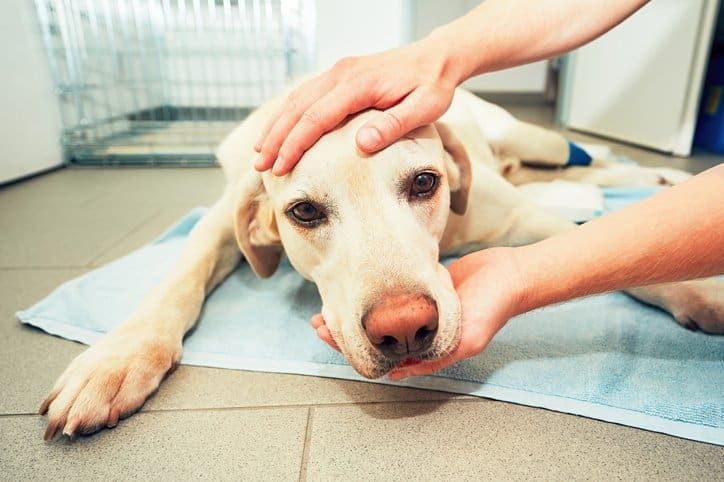
Mast cell tumors (MCTs) are one of the most frequent skin cancers seen in dogs. Mast cell tumors are the reason why careful monitoring of any skin growths is essential for maintaining a healthy canine. Any new masses on the skin should be evaluated by your veterinarian. In regards to MCTs, there are several predisposed breeds including Boxers, American Staffordshire terriers, and pit bulls.
What are Mast Cells?
Mast cells are important in the immune system, particularly in allergic reactions. They are found predominantly in the skin, but they are also found in lower numbers throughout the internal organs. Rarely are they found in the bloodstream. These cells are filled with substances such as histamine and heparin. During an allergic reaction, they degranulate – meaning they empty their contents onto or in the area of the offending allergen. The effect of mast cells can be seen when a patient develops hives and welts, as well as itching and redness.
As with any cell in the body, mast cells can develop cancer. The word cancer merely means the uncontrolled proliferation of cells. It can be divided into 2 broad categories – malignant and benign. Malignant cancers can be locally invasive and damaging, spread to other organ systems like the lungs, or both. Benign tumors do not spread to other organs and are cured by removal.
Symptoms of a Mast Cell Tumor in Dogs
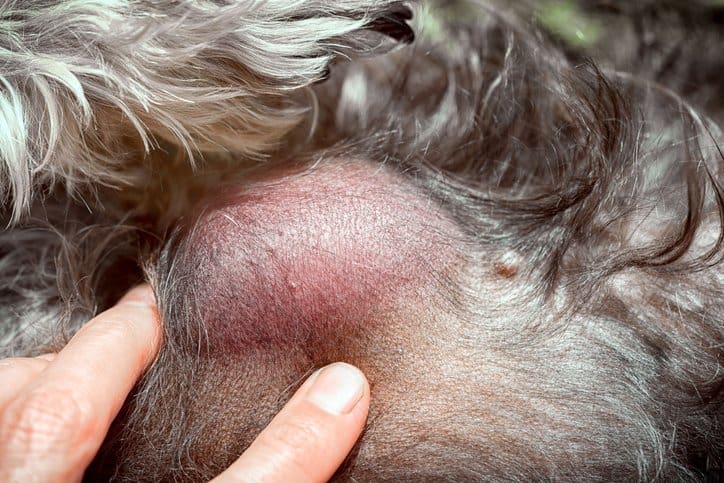
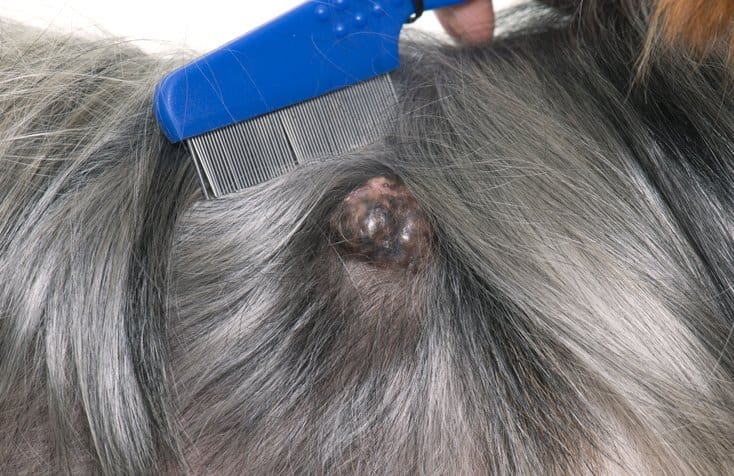
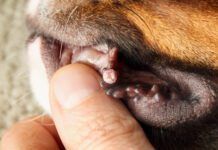
The symptoms of a MCT on dogs begin with a skin mass, most of the time (in rare circumstances, they can start in the internal organs, but this is more common in cats). They can be as small as a pea or as large as a softball. One important aspect is that they tend to wax and wane. They can start as small and suddenly become large, red, and irritated or weepy. This is a sign of degranulation, meaning the tumor has become irritated and released the nasty substances within it. The hallmark of a mast cell tumor is a tumor that grows and shrinks periodically.
If you note a skin mass on your dog, it should be checked by your veterinarian. As with any veterinary visit, your dog should have a nose-to-tail examination including weight and vitals, followed by a detailed history. Your veterinarian will ask how the mass has behaved, how long it has been present, and if it has changed significantly. They may also measure it with calipers.
Diagnosis and Treatment of a Mast Cell Tumor on a Dog
After a history and physical exam, your veterinarian will focus on the mass with gentle palpation. It is likely they will recommend a fine needle aspirate. This involves taking a very small needle and obtaining a sample of cells from the tumor. Another option is just having the entire mass removed and submitted for testing (excisional biopsy).
If your veterinarian is suspicious of a mast cell tumor and wants to sample it, they may recommend pre-medicating with Benadryl, an antihistamine. As we discussed above, one of the substances found in mast cells is histamine. Giving Benadryl may help prevent the tumor from degranulating during sampling. Sudden degranulation can cause a systemic reaction (anaphylaxis) and can be very serious or even life-threatening. Your veterinarian will handle any suspected MCTs gently, as a result.
Diagnosis is generally by a veterinary pathologist. MCTs are graded on two different scales – the older Patnaik scale (giving a number I through III with I being the least malignant), and the newer Kiupel system that simply evaluates high grade versus low grade.
If your dog is diagnosed with a mast cell tumor, your veterinarian will recommend staging as the next step. This means determining if the cancer has spread by conducting bloodwork, urinalysis, chest xrays, and abdominal ultrasound. Once staging is completed, a clearer picture of prognosis can be seen.
Treatment of mast cell tumors in dogs involves initial surgical removal followed by evaluating whether the whole tumor was removed. If it wasn’t (called “dirty margins”), a second surgery may be needed. Radiation is also an option when the entire tumor wasn’t removed. It may seem “simple” to remove a whole tumor, but sometimes the cancer cells have infiltrated the surrounding tissue on a microscopic level. For low grade (Kiupel system) or grade I-II (Patnaik system), usually removal is sufficient if the margins are clear. Even with removal, a dog will be at higher risk for developing MCTs again.
With high grade/grade III tumors, following surgery, oncologists recommend chemotherapy. This is usually administered by a veterinary oncologist. If chemotherapy is not pursued, a dog with high grade MCT will likely stay on Benadryl and steroids to suppress the MCT until symptoms become too severe. As the disease progresses, the mast cell tumor will spread to distant sites like the liver, spleen, and lungs. Symptoms will correlate with the system that is affected.
A mast cell tumor is not the end of the world, but they can be very serious. It is important to notify your veterinarian when you find any skin masses so that they can be promptly evaluated. Early detection and treatment are critical to a successful outcome.
For more information on mast cell tumors in dogs, read our other articles on the topic:
About Mast Cell Tumors in Dogs
What Are The Treatment Options for Dogs With Mast Cell Tumors?


My girl had a Mast Cell tumor about 2.5 yrs ago. I have a vet who is very experienced in dealing with mast cell tumors. She went on Benadryl and had it aspirated (they timed it so surgery would be within a couple of days. It turned out she had a low grade tumor, and surgery went fine with plenty of margin. I also had every test done known to man regarding mast cell tumors, including one that tells you if she has a certain mutation that makes it more likely she will have another mast cell. So far, knock on wood, she hasn’t had another one.
What I can tell you is that, having had breast cancer (15 yrs ago) I had a mastectomy and reconstruction. It was low grade enough (and not BRCA) that I could have just had a lumpectyomy. My philosophy is cancers like this just don’t go away with holistic concoctions. REMOVE the cancer and then go the holistic route. What I did was research foods and even probiotics high in histamine and low in histamine. Histamine is the big risk triggering mast cell tumors. Look up veggies and fruits that are low, high or histamine liberators and stick with the low. Certain probiotics are high (or low) in histamine, which I found out. Remember, dairy products such as yogurt are HIGH in histamine. Meats can be problematic, but you will find this in your research. There is a vet online (can’t remember his name) who is an expert in mast cell tumors and diet. You can google and find him. I would research and find a vet in your area that is very experienced and competent in dealing with mast cell tumors and knows to connect with a university to run various tests and be prepared with a helpful diet for after recovery from the surgery. Most traditional vets don’t deal with this so it’s up to you to do the research.
My little chihuahua has a small mast cell tumor removed Oct 2020. She is 13. Biopsy showed not in lymph nodes but just found out it was grade 2. Vet told me then he thought he got it all. Now she has a hard golf ball size lump on her belly. Vet said maybe a hernia. Opened her back up and can’t remove it. Not a hernia. Said it looks like lymph node. Waiting on biopsy. I love my dog so much. This is breaking my heart. I don’t know what to do. I don’t want her to suffer. She is eating food I cook her. Drinking water. I think the original surgery made things worse.
Look up 5 mushroom blend and start feeding it to your dog. Feed turmeric as well. Both have been well known to shrink tumours. CBD oil is very good as well
So 5 yr Mini Schnauzer had the jab this morning. She was also sedated and had a sample taken from lymph node as first staging. A few other spots shaved, they were obviously checking other lumps which are the typical comedones you get in Schnauzers. She is currently very quiet and quite zonked out, feeling sorry for herself, not wanting fussing. Reckon that will change as the sedative leaves her system!-)
She will be visiting the vets every few days over the next few weeks.
What is expected to happen? The tumour will turn black, harden as it dies and then it and the skin covering will fall away leaving an open wound we aren’t supposed to cover. That should take about a week and then we should see the wound heal over the following two weeks. After 4 weeks if the tumour was completely destroyed and the lymph nodes were clear then we have been very lucky. If there is any initial tumour left there is the option of one more jab and or surgery.
The cost of the jab if anyone is thinking of following it up was £500 GB, for 2mg in 2ml vial for a tumour 2cm across and quite raised. Dosage depends on tumour size. Expensive, but if it works, less money, pain and aggro than surgery. The brand name is Stelfonta. I will post progress here in the weeks ahead.
God luck to my little Tasha, and good luck to anyone reading this who’s pooch is also suffering.
Two days after the injection and the vet took the dressing off yesterday, the area of and around the tumour is going from blue to black and spreading further across the leg it is red and inflamed. Her hind quarters and lower abdomen are painful and we have to be careful handling her. For that reason she is on tramodol, along with steroids, anti-hustamines and anti-nausea drugs.
We have been told to expect the wound to start opening up as the skin starts to Slough off over this weekend. We have to leave the wound open and have been told how to deal with it. Will provide progress next week.
The wound opened up, in an unexpected way. Rather than becoming a hole in the middle that spread outwards, the skin separated in a ring around an island of flesh that cover whatever was left of the tumour. That final patch of skin has come off tonight – and disappeared, she may have are it. Yuk. She now has an open wound with a circle of flesh about 4 cm diameter missing, and muscle exposed. I can’t see any sign of anything remaining that looks like a tumour or looks out of place, but I am no expert.
From hereon in, over the next few weeks the wound should start skin over and heal.
Within herself, as each day has passed she has got more back to herself. She is protective of her leg and not yet playful, which means our older dog, her mum, gets to play with all the toys unmolested, but I don’t expect that it will be long until she feels confident enough to get stuck in again.
Still waiting on staging results from labbbut fingers crossed they will be clear.
Will update, probably next week.
The open wound is healing and is half the size it was, and the staging has determined that her closest lymph node was clear.
And she is back to her normal playful, loving, demanding self.
This drug (imho) is something of a wonder drug.
Probably the last update. The wound now is tiny and covered in a scan. Aspirations and examinations of her lymph node suggest no spread so we got lucky. The vet and I are both over the moon with her textbook reaction to the drug and her recovery. She describes the drug as working on the filaments that spread out from the tumour in the same way a weed killer works on roots, and clears the margins in a way that surgery couldn’t.
If your dog does get a MCT and you can afford such treatment or have insurance. Enquire about it. If your vet doesn’t know about it, ask them to look it up and consider it. it has worked wonders for my dog.
Thank you for sharing your experience. It is very helpful.
A large lump suddenly appeared on the rear thigh of my 5 yr Mini Schnauzer three weeks ago. Vet aspirated some cells and lab work came back, aggressive, malignant MCT.
Was booked for surgery yesterday but when I got there the vet ( a different one, one of the regulars ) said that she didn’t want to operate. In order to get good margins she would have to remove half the muscle on the thigh, and she feared the reconstructive surgery would never heal.
She suggested first trying a new to market drug, refined from plants from the rainforest, that she claimed has been getting incredible results. I felt sceptical, but they have been so good and have always made good calls on treatments for my dogs, and I could see what she meant about the amount of muscle mass that would need to be removed. As yet we don’t know if it has metastasised, and if it has and we are into the last month’s of her life I don’t want her to suffer that way.
Anyways, she said that it may eradicate the tumour completely or shrink it to an operable size so I agreed and she is booked in for a jab tomorrow.
The drug is Tigilanol tiglate / EBC-46 and having Googled it I am now feeling far more hopeful for my little girl. It is just becoming available here in the UK but I have no idea of availability elsewhere.
I also don’t know the cost of the drugs and treatments but I am fortunate enough to have good insurance and will recover almost all of the costs.
I’ll update in the weeks and months ahead.
My golden, 11 years old, has a mast cell on her upper lip….she weights 73 pounds…I noticed reading at the posts many have tried Benadryl …….will it be safe for my golden.
My dog athena bless her, is my therapy pet l. When i got her the vet said she had a cyst…at the age of 2 the “cyst” made her real sick we did a biopsy and found out stage 2 MCT. They were aggressive and removed a LOT of tissue. At the age of 3 in the fall i was giving her a wash in the back yard i was always checking for lumps and bumps (i found nothing) next day i brushed her and found a tumor the size of a base ball on her back leg. In a 24 hr window she got super sick we got it removed. When she was 4 i noticed her original suture line was swelling….i asked the vet to remove that tissue, they were going to until they shaved her down and saw 16 small rising nodules. They sent me to the cancer specialist who suggested we do radiation and removal.
I passed on the treatment because it would have only “extended her life expectancy 3-6months and she would have been feeling low the entire time.
I started changing her food,
Shes on bone broth (home made)
Baked chicken breast
Quinoa
Yam
Its helped her keep weight on
We recently celebrated her 6th birthday july 14th 2020 and now shes getting sick again, gassy, diarrhea tired ( these and lack of desire towards food are her signs)
Shes on benadryl 2: 50mg x2 daily as well.
I love her so much and this past year shes had a blast! Running and gunning like a pup should.
I hate MCT
Chlorine dioxide. Jim humble
We adopted an elder Beagle in 2017. Six months later she was diagnosed with a mast cell tomor on her spleen. We opted not to do surgery as we wanted to preserve as much quiality of her life as possible. Our vet felt best case scenario she could have 6 months to live give or take. We did a lot of research and discovered the benefits of Benadryl therapy. After discussing with our vet we started giving her Benadryl twice a day. She did wonderful on this therapy and the tumor did not grow rapidly, our vet was amazed year after year she returned for her check-up. Unfortunately, the end of July this year she succumb to the tumor and we had to lay our precious girl to rest. From first date of diagnosis she lived 28 months full of quality and love. I’m so glad we did our research and gave her the best possible chance to fight the tumor.
Hi all, I had a boxer/Pitt mix that had mct to back leg in thigh at age 13 yrs old. It was high grade but vet still performed removal which required a large amount of the muscle. I was scared of the surgery at his age but without it he would have very little chance. They were able to remove all the cancer without amputation (which my vet did not recommend due to his age). He lived four more yrs after(17), it did come with some negatives as he lost such a large amount of muscle in that leg that he never regained much of its strength and it eventually was too weak to hold him up so he would loose his balance alot and was not able to lift himself back up the last yr of his life. We would have to lift his hind end up for him and carry him up/down stairs but he never lost his zest for life and still demanded his daily walk that once was over a mile to not even a block until the day he passed away. I never regretted my decision for the surgery as he was happy and gave us 4 more years with him and gave him a chance to help train his little brother- a boxer that now has what I fear to be a mct on his back paw..this one I fear as he is relatively young (5yrs) and area does not have much tissue to work with for removal…
Hi April, What did you end up doing? My dog also does not have enough room for removal.