

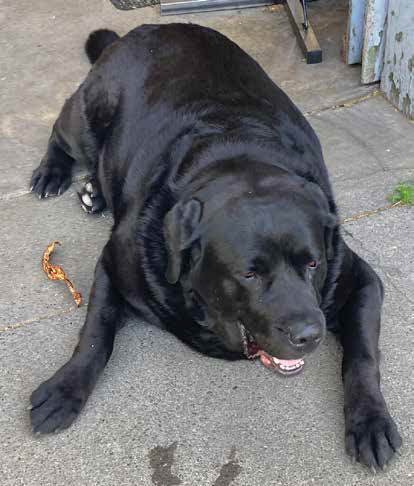
Our dogs’ food intake and access to exercise—and thus, their body weight and condition—are completely up to us. We control what they eat and when they get exercise. When our dogs are overweight, or fat, it’s our fault. Sadly, obesity has become a primary concern in veterinary medicine, just as it has in human medicine.
Why Does it Matter if My Dog is Obese?
Here’s why: Dogs who are maintained at a healthy weight have a lower risk than fat dogs for many life-threatening health problems, including diabetes, kidney disease, metabolic and endocrine disorders, hypertension, and some cancers. Older dogs with arthritis can remain ambulatory and active much longer if they are slender. Dogs with lean body mass have fewer injuries to bones, muscles, and tendons than dogs who carry excess weight. Studies have shown that fit dogs live, on average, about two years longer than overweight dogs.

Why Does it Matter if My Dog is Obese?
Here’s why: Dogs who are maintained at a healthy weight have a lower risk than fat dogs for many life-threatening health problems, including diabetes, kidney disease, metabolic and endocrine disorders, hypertension, and some cancers. Older dogs with arthritis can remain ambulatory and active much longer if they are slender. Dogs with lean body mass have fewer injuries to bones, muscles, and tendons than dogs who carry excess weight. Studies have shown that fit dogs live, on average, about two years longer than overweight dogs.
Find Out What Your Dog Should Weigh
Start by getting an accurate, honest assessment of your dog’s condition. Make an appointment for your dog’s annual health examination. At that visit, let your veterinarian know that you are concerned about your dog’s weight and want her professional opinion: How much should my dog weigh, ideally?
Many veterinarians are gun-shy when it comes to bringing up this topic with their clients; it makes many people defensive! But if you ask your vet for her opinion, and remain open and receptive to her answer, you just might learn that she’s been keeping her true opinion about your dog’s condition to herself. If she hesitates or waffles at all, ask a different question: “Do you think he should lose a little weight?”
Determine What Your Dog Weighs Now
Using the scales at your vet’s office, get an accurate weight for your dog. Write it down, along with the date. If you have a dog small enough to hold, you can also do it at home by stepping on the scale with and without the dog and doing a little subtraction.
Calories Count in Dog Diets
Don’t figure on a major weight loss all at once. That’s not healthy. Aim for a weight loss of 3% to 5% of your dog’s body weight per month, or 1% per week. A 50-pound dog should lose about half a pound per week, or 2 pounds per month.
How Much to Feed a Dog to by Weight
The number of calories your dog should be fed to maintain her ideal is referred to as her “resting energy requirement (RER).” To determine your dog’s RER, convert her ideal weight in pounds to kilograms by dividing by 2.2. Then multiply that number by 30 and add 70.
Say I have a dog who weighs 100 pounds, but who should weigh about 90 pounds. Ninety pounds divided by 2.2 is 40.9 kg. Now I multiply by 30 and add 70:
40.9 x 30 = 1,227 + 70 = 1,297
1,297. That’s how many calories per day I should feed the 100-pound dog whose ideal weight is around 90 pounds. Now go check the number of calories in the food you give your dog. The food my dog is eating right now contains 380 calories per cup. So, I’ll divide the number of calories my hypothetical fat dog should be getting by the number of calories in each cup of food:
1,297 ÷ 380 = 3.41 cups of food
“But wait!,” you say. “On the label of the food I feed my dog, it says I should be feeding a dog who weighs between 75 and 100 pounds between 4 3/4 and 5 1/2 cups of food per day!”
What can I say? That’s probably how your dog ended up overweight! The sad fact is that most dog food labels overestimate dogs’ RER. They generally cover for this by adding the note, “Adjust feeding for optimal body weight.”
The moral of my example: Look at your dog’s food label to get the caloric content of the food and calculate how much you should be feeding him based on his RER.
This amount may need to be adjusted in some cases. Dogs who are substantially overweight may do best with an interim target weight (rather than their ultimate ideal weight) to start with. Very active dogs may require up to 1.4 times their RER to keep their weight loss at a safe rate of no more than 5% per month. Puppies who are 4 months and older may need as much as two times their RER.
Of course, this addresses only the dog’s basic diet. If you feed a lot of treats, check the caloric content of the treats and reduce your dog’s food by about the amount of calories you are feeding him in treats. Because dog foods are complete and balanced and treats are not, however, you shouldn’t replace too many of his food calories with treats.
Hint: Most dogs care more about the number of treats they get than the size of each treat. It’s more rewarding for a dog to receive several small treats than one big one. Using tiny treats will help you reward your dog without adding too many extra calories.
Weigh Your Dog Frequently
It is critical you weigh your dog regularly. Especially when first starting a weight-loss program; start by weighing your dog once a week. If your dog is too heavy to pick up, you’ll need to go to your veterinarian’s office to get an accurate weight.
Once your dog begins losing weight steadily, you can go longer between weigh-ins but recheck at least twice a month to make sure you’re still on track. It’s easy to slip back into giving too much food and undo much of the good you’ve done if you rely solely on how your dog looks and feels. By the time you notice a difference, your dog could have gained a lot of weight back.
Increase Your Dog’s Exercise
Regular exercise is essential to a successful weight-loss program. Proper exercise not only burns calories, but also helps burn fat and build muscle, improving body condition. As your dog loses weight and gains muscle, he will feel better and become more active, which will speed up the weight-loss process.
If your dog is not used to exercise, don’t do too much too soon. Start with short sessions tailored to your dog’s capabilities, such as on-leash walks that gradually lengthen as your dog’s exercise tolerance increases. Don’t exercise your dog to the point where he is sore afterward. Non-weight-bearing exercise, such as swimming, is ideal for dogs with joint problems and for other dogs as well. Again, start slowly, using a dog life jacket if that helps him to feel more comfortable in the water.
If your dog is older or has health problems, consult with your veterinarian before beginning an exercise program. If your dog is reluctant to exercise, it could be a sign that something’s wrong. A trial of pain medication can help you figure out whether your dog’s lack of activity is related to discomfort.
Help Your Dog Reach a Healthy Weight
Your dog may not be happy about his new diet at first. He may start begging, counter-surfing, and even going through the kitchen trash, looking for a few extra calories. Give him a carrot to munch on. Soon enough, as you begin to spend more time with him walking, and as his body begins to feel lighter and less burdened with all that extra weight, he’ll start to enjoy those walks more and worry less about how many kibbles are in his bowl.



As a small animal vet, I would estimate that 2 out of 3 dogs I see are overweight or obese. The high-carb dry food that most people feed doesn’t help. Nor does using a “cup” that is a 42 oz. Big Gulp. (No lie, one of my clients ‘only’ fed his OBESE Lab 2 “cups” twice a day.) The client was horrified when I gave him a real actual 8 oz. cup. So sad.
Thanks for a great article.
Thank you for the calculation. My vets were not helpful when discussing my overweight dog. One commented, “His head probably weighs at least 10 pounds” the other “we only get 1 semester in nutrition”. He was also on steroids for allergies and expected him to lose weight after stopping but he GAINED weight! We also give various vegetables to supplement to help him feel full and use a slow feeder. He runs in our woods, will walk 2 miles with me but doesn’t seem to lose.
Great article. Years ago we had a vet who told us “your dog weighs too much”. She advised us to use a measuring cup and how much to feed the dog at each meal and to cut down on the treats. Also raw crunchy veggies are healthier than dog biscuits and avoid feeding “people food” as treats.
Ack! Fat dogs (and actually any animal) are a pet peeve of mine. It is just not fair. They didn’t make the choice to have all the issues that obesity causes. Or to even get that way. I have a family member who has a two year old dog that is too heavy. I said something nicely and it fell on deaf ears. She honestly does not think he is fat. So I shut up. But it will be really hard to keep my mouth shut if he has issues later due to being too heavy. Both of our dogs had a few too many lbs when we adopted them. I worked hard to help them slowly lose weight and we are diligent about keeping it off. And they are well fed, get plenty of treats, healthy ones, and a good long walk, or swim daily. I try to explain to people that dogs can’t judge the size of a treat, so few tiny pieces of something are just as good as big chunks of something. And that a little bite of baked chicken breast is just as good to them as a hunk of cheese. But, ugh, waste of breath. So frustrating.
I watch every morsel I put in my mouth to keep at a healthy weight. But my pets can’t. So I do it for them.
I once adopted an overweight dog and it took almost a year for her to lose the weight, keeping it at the recommended loss percentage you mentioned. I’m also currently fostering a dog who is very obese (though improving!). And who could forget Obese Beagle on Instagram! I’ve become much less judgy of the people I see with fat dogs, because they may not be the person who made the dog that way. Even though I’m not the one who made this dog fat, I am more likely to react negatively to someone who makes assumptions about me.
Always have your dog’s blood work checked regularly. Our wonderful lab was getting bigger and bigger. We cut back food and exercised with little improvement. Vet did blood work and found he had cushings disease then told us to increase his food as we were actually starving this big boy who was probably not going to lose weight. He went back on his normal food and took natural meds and did exercise and lived another happy 6 years. He passed weighing 100 lbs. Always get a really good checkup before putting your pet on a diet.
Thank you for this suggestion. Totally makes sense…
To help clients and other dog owners with weight management for their dogs, I created a calorie estimator for both dogs and cats using all the vet formulas for RER and life stage calculations.
It is a free download. It works with excel or google sheets.
If your dog needs to lose weight, just enter the amount and it will calculate the number of calories to reduce each day and it will estimate the number of days to lose the weight based on the calorie reduction.
I made a video on using the calorie estimator.
https://youtu.be/5NQI8yquAAg
https://www.homeskooling4dogs.com/daily-calorie-esitmator
https://www.homeskooling4dogs.com/daily-calorie-estimator-feline
Forgot to mention that after this conversation if ever this lady saw me and my dogs on the heath she would walk in the opposite direction!
I can identify with the author’s comment about people not liking you talking about the “elephant in the room! so to speak! I used to see a lady regularly with an obese chocolate Labrador. I managed not to make a comment until we were talking one day and she mentioned the dog was only 18 months old and had just had an operation for one if its elbow joints. I tried to be tactful and said “you’d be doing it a huge favour in getting rid of some of that excess weight then” but she glared at me and replied “My dog is not overweight he is stocky”. My reply was “Is that what your vet says?” and she answered “yes”. I found this hard to believe as dog resembled a Walrus more than a Labrador sadly. Other dog owners I met said her previous dog died too young due to obesity. Killing with kindness is still cruelty.
Obviously over feeding is a major cause of weight problems in dogs but shouldn’t the article note (maybe it did and I missed it) that certain underlying conditions such as hypothyroidism can also contribute to excess body weight in dogs? This occurred with my GSD.