


Apoquel and Cytopoint, both manufactured by Zoetis, have been around for some time now – eight years and five years, respectively. They represent the newest and most effective drugs in the veterinary arsenal to stop itching in dogs with allergies – but their use is not without risk of side effects or contraindications. That said, these drugs have vastly improved the lives of many severely allergic dogs without any ill effects whatsoever.
Before I explain why these drugs are so ground-breaking, allow me to briefly explain why allergies are so hard to treat in some dogs, and how the veterinary medication predecessors to these drugs differ.
Dog Allergy Treatments
The hallmark of allergies in dogs is normal, healthy-looking skin that seems to itch. The offending allergen is either inhaled (atopy) or ingested (food allergy). Inhaled allergens frequently cause seasonal itching (only in the spring or only in the fall). Food allergy typically causes itching year-round.
The goal of allergy therapy is to eliminate the itch. If you don’t stop the underlying itch, your dog will scratch, chew, bite, and rub his way to secondary skin infections, which add a second layer of itch and discomfort.
There is a complex, biochemical cascade, with lots of different mediators, that occurs between the allergen first being recognized by the body and the result, which is skin inflammation and itch. In broad terms, treatments for managing the allergic itch block or interrupt this cascade at various points. The more complete the block or interruption, the better the allergy itch control.
It would be ideal if it was possible to completely prevent the dog from coming into contact with any of the substances that he’s allergic to, but in the case of atopy, this is pretty much impossible. It is possible in the case of food allergies – if you can identify the food or foods that your dog is allergic to by undertaking a diet trial. To properly rule out food allergy, you must feed either an extremely limited-ingredient diet containing only ingredients that are novel for the dog (he’s never eaten them before) or a hydrolyzed protein diet and nothing else for eight to 12 weeks, and see if the itch subsides. (If it doesn’t, atopy, not food, is likely the issue.)
Most of the medications used to relieve allergy-caused itching don’t manage food allergy itch very well, so if you skip this step, you may end up disappointed and frustrated.
In lieu of complete protection from contact between the dog and the substances he’s allergic to, the gold standard for managing allergies is still allergy testing and immunotherapy (allergy shots), just like those that humans get.
The goal of this therapy is to stimulate the dog’s body to create antibodies against his allergens, thereby blocking the inflammatory cascade right at the starting gate. Unfortunately, this is not the most popular approach to allergy management for pet owners, as it is expensive, labor intensive, not without risk, and comes with no guarantee.
So we move on to medications. Antihistamines are inexpensive, available over the counter, and safe. The problem is, they don’t work very well in dogs. They definitely won’t help in the face of a full-blown allergy inflammatory breakout. Blocking histamine at that stage is just too late.
Probably the most useful place for antihistamines would be leading up to your dog’s allergy season. If you know he has trouble in the fall, starting an antihistamine ahead of time might help dampen his initial reaction to his allergens. Or, if a prescription medication is helping but not giving 100% relief, sometimes adding an antihistamine will help. Discuss this with your veterinarian.
Steroids work well to stop allergic itching and their effect is immediate, but they come with a plethora of negative effects on the body, including immune suppression. I’ll still prescribe them for severe, acute cases, but only in the beginning, to get the inflammation under control. After that, we look for a safer, long-term solution.
Atopica (cyclosporine) was approved by the Food & Drug Administration in 2003. It’s a reasonable alternative to steroids for longer-term allergy management. But like steroids, it can cause immune suppression. It also takes too long to kick in. It can be as long as four to eight weeks before you see maximal response – way too long for the allergic dog and his owner to wait.
Newer Dog Allergy Medicine
The newest allergy treatment options are Apoquel and Cytopoint. These medications interrupt the inflammatory cascade at different points. They are both rapid-acting and have minimal side effects. There are pros and cons to each which we will discuss.
Apoquel
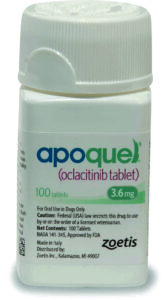
Apoquel (oclacitinib maleate) blocks the effects of cytokines, which are pro-inflammatory proteins heavily involved in the allergy cascade. It is an oral tablet administered twice daily for 14 days, then once daily. It takes effect quickly, within 24 hours, and works really well for many dogs. Side effects are not common, but vomiting, diarrhea, loss of appetite, and lethargy have been reported.
The results of safety testing done on Apoquel suggest the possibility of some immune suppression when using this drug. This is one of the potential downsides of Apoquel. Some dogs developed significant infections (pneumonia) and demodectic mange, which typically occurs in the face of immune suppression. This was especially true in puppies, which is why the drug is labeled for use only in dogs 12 months or older. It’s also not for use in breeding dogs or pregnant or nursing mothers.
Neither I nor my colleagues have had issues in our clinic with Apoquel causing immune suppression, and I do not hesitate to use it in appropriate patients. But the possibility makes careful monitoring of these patients prudent.
There is also a label warning – “Use with caution” – regarding the use of Apoquel in dogs with tumors. Cytopoint may be a better choice for these dogs, since it has no warnings or concerns regarding tumors.
Sometimes Apoquel works great when dosed twice a day, but not as well when the dose is reduced to the once-daily, long-term dose. I see this a lot in the clinic, and it’s so disappointing for the pet owner. A number of owners have asked me if they can just continue with twice-daily dosing. Unfortunately, long-term safety studies at this dose have not been done. Apoquel can be used this way off-label, but there is no way to know if it’s truly safe for your dog.
My preference for these dogs is to continue the Apoquel once a day (as labeled) and add Cytopoint. These two medications are perfectly safe to use together, and in my experience, this combination is often the magic bullet for those difficult-to-manage allergy dogs.
Cytopoint
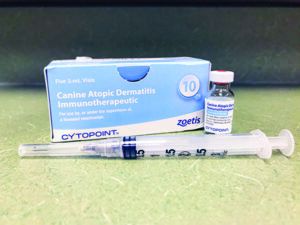
Cytopoint (lokivetmab) is a monoclonal antibody against the cytokine interleukin 31 (IL-31), a big player in the allergy inflammatory cascade. It is an injectable medication, administered under the skin. It takes effect quickly, relieving itch within 24 hours, and typically lasts anywhere from four to eight weeks.
Side effects are rare, but once again, vomiting, diarrhea, loss of appetite, and lethargy have been reported. Pain or discomfort at the injection site occasionally happens, but typically is mild and short-lived if it occurs. Cytopoint is not immune-suppressive, and there are no warnings or concerns about tumors.
However, the one potential downfall of Cytopoint is that the dog can form antibodies against it. If this happens, then the medication will lose its effectiveness – forever. I haven’t seen this yet, but if your dog is responding well to Cytopoint at first, and then less and less so, this is likely what’s happening. I hope I never see it.
As a practicing veterinarian, I really like Cytopoint. If I had an allergic dog, I would choose Cytopoint first.
If you have an allergic dog, hopefully this information helps you as you navigate your journey. As always, the best advice for you and your dog comes from your veterinarian.




I am very careful about what I give my dogs. For instance, no oral flea meds, only topical.
She developed atopic dermatitis and the vet thinks it’s environmental. I agree as I’ve been watching the pollen levels on my weather app. It’s either tree or grass pollen. I have been managing it with Benedryl twice a day and weekly baths with Douxo S3 PYO and she is doing marvelous. I will also use the Douxo wipes or spray in between baths if necessary. I rub her face every day to make sure she isn’t developing any little blisters. No licking or scratching either. Both of these are much safer for her so we will remain on this regimen as long as possible and I will be hyper vigilant. I don’t want her on steroids or any of these more powerful prescription drugs.
I thank the other commenters for their info on these two powerful drugs. Should my vet recommend either I will decline.
My French Bull dog Dante is literally the love of my life. I love him like a human. From the moment we got him, we realized he was smarter than any dog we had ever owned. My nickname is Mrs. Noah, so I can say that we have owned several types of dogs and well as every animal and reptile large and small. I am speaking from lots of experience. I am a total believer in going all natural for food as well as for health treatments. However, science has a place as well for us in the treatment for them. There is no reason to allow your pet to suffer or be uncomfortable due to allergies and skin disorders. I wouldn’t let my human children suffer so I treat my furry children the same. My other frenchie Saylor also tends to have allergies and both have been on Apoquel for years with zero side affects. So for the people that are entitled to their opinion, against Apoquel, it has been the answer to prayer for me. We were one of the first patients to get on it after many failed attempts to make my frenchie comfortable. I have not looked back and don’t mind the cost. It is a penny well spent. Owning animals is costly. As a responsible pet owner, you should want the absolute best for your dog . If your dog suffered from allergies, please put them on Apoquel. It will change their life and give them the quality of life they deserve.
I so wish I could find something that would work for my golden. We have been doing Apoquel for just over a year and tried a few cytopoint injections at the same time. Like the article said, she did really well when it was the initial 2 doses a day. She’s still itchy EVERY day. I’ve tried stopping the apoquel, but she gets even worse. She’s also on the Purina HA prescription diet. As soon as we introduce anything different food wise, her itchiness increases immediately.
We had a veterinary dermatologist, but they closed their practice and now there aren’t any dermatologists within a 3 hour drive for us.
I understood when we started the apoquel that while long term side effects are not yet known, there are also potential negative impacts to their health if the dogs continue to be so itchy/inflamed their whole lives. Heartbreaking.
Anything with chicken, including treats? Eliminate that first.
My Ramses had a food allergy and my vet at the time said it was likely protein and chicken is the usual culprit in the U.S. He ate every chuck roast in my freezer, including a few pork roasts for two weeks and the itching stopped. I put him on a clean lamb food and he was fine. Then I tried fish and he was also fine. Unfortunately the beef kibble had chicken added to it. I read the labels just like for me and anything with any poultry product was eliminated. Original Milk Bones are fine. So take him off chicken.
Then try weekly baths with Douxo S3 PYO. You can get it from amazon. I also give Diana pawPrints Benedryl twice a day. One pill for every 25 pounds. She gets 4 in the morning and 4 at night at 105 lbs. For your Golden, maybe 3 pills twice daily. I will say the anticipated hot dogs really have improved her recall. If it’s chicken for your Golden, make sure you use pure beef Kosher hot dogs and read the label to make sure no chicken in them. If you cut the hot dogs into six pieces you can get quite a few doses out of one hot dog as the pills are small and you get fit 2-3 in one slice.
There’s a really good article by a vet which explains how both Cytopoint and Apoquel actually work to stop pets from itching. The article explains the science behind how these two drugs actually work, and it’s very easy to understand. The vet’s name is Ron Hines. DVM. PhD.
You can find the article by Googling for “Vetspace.” Then when you’re on Vetspace click on articles about dogs’ conditions. Click again on the particular article about these two drugs to stop itching.
The article is entitled: “Cytopoint versus Apoquel.” Subtitled: For my itchy dog – which is safer? Which is more effective? Can I use both?
It’s well worth locating and reading this article by Dr. Ron Hines. DVM. PhD.
Very Sad to see this article in WDJ, it’s wrong on so many levels. It barely touches on all side affects these serious drugs cause. It was a “happy go lucky” infomercial for these drug companies, drugs that should be used as a LAST CHOICE, made to sound very safe. Again, Very Very disappointed in Whole Dog Journal.
You all have me scared. My Goldendoodle has been on Apoquel for several years now. I am wondering if I have been “killing” her. She just had a nodule removed from her lip that was a type of Melanoma but turned out to be benign, thank God. I have several Apoquel tablets left in her prescription bottle but think I will stop and see what happens. She also had a couple warts removed and researching warts, the indication was that dogs with a low immune system does develop warts. Aside from being contaminated by another dog.
I don’t think WDJ is necessarily indorsing the use of these medications but has provided and article as information for dog owners to understand their use in case their vet prescribes them for their dogs. WDJ also has provided this sight for owners to express their concerns and experiences.
I appreciate the feedback here because now I can approach my vet with more knowledge about my GDD’s Apoquel.
Sound approach. I added my 2 cents as I have had good results and sometimes I just feel the need to temper the handful of, sometimes vitriolic, responses on all social media feeds. Some saying they will unsubscribe because of an article that doesn’t follow their beliefs makes me chuckle. Only science should speak to all of us. And like any good pet owner, careful observations and consulting with your vet, and even a 2nd opinion is responsible pet ownership. Often there are so many underlying conditions or other influences that coincide with whatever is going on. Too easy for some to point at one thing and say with unscientific or no lab proof of whatever happened to their animal.
My dog is getting to be a senior. Tumours and fatty lumps will definitely happen at her age. I will monitor but keep her on her anti-itch regime.
Thank you
My puppy developed rashes at about 6 months on her belly, underarms & less obviously on her paws. We had her examined by 3 vets including a dermatologist that we had to wait 2 months to see and we did the intradermal skin testing and it’s confirmed she has atopic dermatitis. We waited until she was 1 year and started on 1/2 dose of Apoquel daily in addition to immunotherapy which could take up to 9 months to take effect. She went into heat just before the skin testing so her skin due to the hormones is still irritated but the Apoquel did appear to help alleviate the redness. Hopefully when we spay her it may help as well. She had a Cytopoint injection when it all began before we could see the derm specialist. Holistic treatments are not guaranteed and could take forever to work, if they do, and if you don’t get the intradermal skin testing done you are just conjecturing. While I agree big pharma should not be promoted, you need to consult your vet(s) and make the best decision you can with the evidence and research available. I don’t want my young dog to be on any medication long term but I can’t leave her suffering acutely in the meantime.
Thanks for your opinion, I agree, one-off statements of doom and gloom against medications that help relieve allergy issues are likened to the anti-vax scare that is sweeping the nation. We have an 8-year-old Boxer rescue we adopted at age 12 weeks, she came with the most outrageous itch, the cause of which could not be found. After a year of multiple food changes and topical shampoos, our Vet recommended we try Cytopoint, it worked immediately. she receives a shot every other 3 to 4 months and has never had a negative response. Thank you WDJ, for all of your timely information.
If I were you, I would research because what you are describing is what many pet owners have had happen to their dogs. Those same warts and many other immune / compromising issues! Please don’t allow your pet to become ill from these drugs! They suppress their immune systems and they can’t fight off anything! I just came home from the vet and refused cytopoint! I refuse to put my dog on allergy pills or shots without even knowing what he’s allergic to in the first place! This is ridiculous how they expect us to just trust them with these meds without even knowing what the allergy is in the first place! Whatever happened to allergy testing? I don’t understand why these doctors are doing this to people!
My dog was suffering itchiness without ever finding the cause – whether food or environmental.
I had her on Apoquel for a good 2 years and it did work wonders. I moved to Cytopoint as I had read in Whole Dog Journal and other credible sources about potentially compromising the immune system.
She has been on it for a good 2 years. So far so good. One injection tends to last a good 3-4 months and we usually do not have to give it to her during summer and early fall.
Been very happy t how comfortable my dog is on it. She is a 10-11 year old GSD/Airedale mix.
My beautiful golden was given Apoquil when it first came out. Her dermatologist indicated it was safe. She died from cancer which I am convinced was caused by Apoquil. My current little girl has allergies and was injuring herself so I put her in a cone. When I took her to the vet I was offered Apoquil and Cytopoint. I gave a resounding NO to both of those options. While I was still concerned I did allow a steroid injection with the hope it would “reset” her itchiness. So far so good. This is not something I would do routinely but I had no option. She is raw fed, no chemicals on or in her so I was at a loss. I tried all of the natural remedies I could find. I continue to research but Apoquil is a killer as far as I am concerned.