

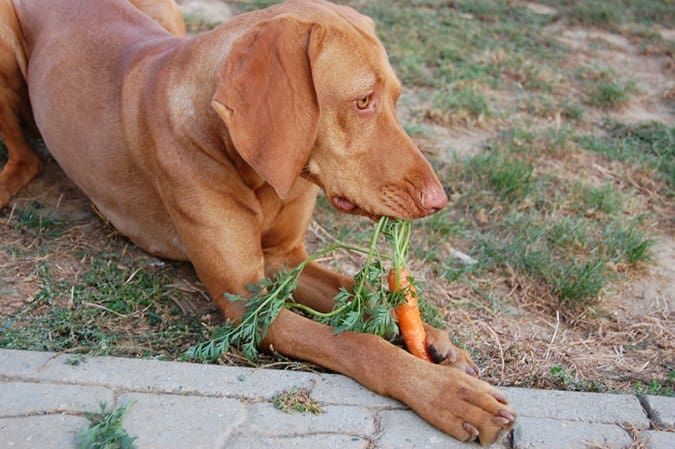
As omnivores, dogs can eat vegetables without ill effect—at least they can eat most vegetables. Many nutritionists believe a mixture of both meat and vegetables is important for a healthy dog. My darling baby boy is a 12-year-old German Shorthair Pointer mix. When he was around 6 years old, he started to put on some weight. Based on a suggestion from a friend, I did some research on what vegetables dogs can eat, cut back on his commercial dog food, and added a handful of frozen green beans to his dinner. The vegetable slowed down the gobbling up of his food, added volume without many calories to help him feel full, and easily fit into my budget. The trick worked! My pup slimmed down.
What Vegetables Can Dogs Eat?
Dogs Can Eat Cabbage, Lettuce, and Many Other Leafy Greens
A good rule for finding leafy greens that your dog can eat is to stick to those that you would consume. Lettuce, spinach, chard, cabbage and kale are all okay for dogs. Besides being rich in vitamins A, C, and K, calcium, iron and potassium, leafy greens are also a good source of fiber. Much like humans, dogs get the most nutrients when the veggies are uncooked. Of course, if you want you can steam your dog’s vegetables for something a little different, or bake them for a crunchier treat. The high fiber in leafy greens can cause some dogs to have an upset stomach after initially added to their diet. Introduce any new food slowly to keep your dog’s tummy safe.
Can Dogs Eat Carrots, Beets, and Other Root Vegetables?
In general root vegetables like carrots, beets, sweet potatoes and parsnips are safe to feed your dog. These vegetables are starchy and high in sugar, which means you do want to limit the amount you give to your dog (especially if his commercial or raw dog food already contains root vegetables – many do).
Get the recipe for homemade sweet potato dog chews.
Can Dogs Eat Stalk Vegetables?
This includes vegetables like celery and asparagus. It may be a little harder to get your dog to enjoy these types of vegetables, but they are safe for dogs to eat. Some don’t like the taste, and some find them hard to grind up in their teeth. To help, cut stalky vegetables into small pieces and/or steam them.
Can Dogs Eat Broccoli, Brussels Sprouts, Cauliflower, Corn, and Cucumber?
All of these veggies are safe for your dog to munch on but, like other vegetables, keep it to small quantities – especially if your dog isn’t used to eating these types of foods. Remember to take the corn off the cob before handing it over to your dog. Although the cob itself isn’t bad for a dog to consume, it is easy to swallow in chunks or whole, which can cause choking or intestinal obstruction. Whenever changing your dog’s diet make sure to check with your vet, go slow, and pay attention to your dog. If you follow these guidelines, adding vegetables to your pup’s food can help him receive a more varied, nutritionally complete profile in his diet.
Dogs Can Eat Squash
Squash of all varieties are safe for dogs to eat. Pumpkin and butternut squash can help dogs with bouts of diarrhea, and most dogs don’t mind the taste of squash. Use up all your excess summer squash from the garden by steaming it up for your dog, or cut up and bake this year’s jack-o-lantern after Halloween for your dog to eat. It’s best to limit your pup’s consumption to the meat of the squash, keeping the seeds and skin away.
Can Dogs Eat Peas and Other Legumes?
This vegetable group includes bean and alfalfa sprouts, mature beans such as kidney, pinto, and lentil, and peas. The topic of legumes in dog food has been in the news lately. The reason is due to a recent FDA update which states there are reports of canine dilated cardiopulmonary (DCM) in dogs eating pet foods containing legumes or potatoes high up on the ingredients list. If the protein of your dog’s diet relies heavily on legumes or potatoes, you should not only avoid giving more of this plant group to your dog, but also consider reducing the levels of legumes in his main dog food, i.e. changing dog foods. A note on green beans: Green beans may be the most widely-fed vegetable to dogs because of their taste and easy digestion. Please be aware that, despite their name, green beans are not actually classified as beans, and therefore don’t warrant the limitations recommended for true legumes.
Vegetables Dogs Can’t Eat
Dogs Can’t Eat Onions, Garlic, and Other Alliums
Alliums are bulb vegetables like onions, garlic, leeks, chives, and shallots. Do not give your dog access to these plants, as they are toxic to dogs. Negative side effects of eating onions or garlic for dogs range from a stomach ache to developing anemia which, at it’s worse, can cause organs to shut down.
- Frozen bags of vegetables are often on sale. Stock up. Have a blend ready to grab in a Tupperware bowl in the freezer.
- If your pup is sensitive to the cold of a frozen vegetable, put a small bowl in the refrigerator for easy treat access.
- For a summer treat, add vegetables to a 1:1 mixture of chicken broth and water in an ice tray. Once frozen, pop out one or two for a delicious hot day treat.
- When cooking, set aside the unused vegetable trimmings that are safe for your dog to consume. A great no-waste alternative to throwing it in the garbage.
- If your dog doesn’t want anything to do with vegetables and you want to supplement what he is getting in his regular diet, you can chop or puree them and mix them into his meals. For treats, adding some dog-safe peanut butter (no sugar, just peanuts) can get your dog started. Eventually you should be able to back off on the addition and feed the vegetable plain.
- Vegetables are a great reward in treat puzzle games. As always make sure you watch your dog when those are in use and that all edible treats are cleaned from the puzzle before storing away.



Lost me line one “As Omnivores”. Correction, Dogs are Carnivores and that is their scientific category as canids. Yes, carnivores ingest the GI contents of rabbits, etc and do selectively eat some plants here and there. Plants, however, are not a major part of the wolf diet. Overall, disappointed with WDJ articles on food and food ratings that basically applaud some of the worst commercial foods dry and canned. GI microflora in a carnivore is dependent on a species appropriate diet and plays a much bigger role in nutrition for a dog than the absolute concentrations of B vitamins, etc. in each meal. Legumes, for example, have no evolutionary role in a dog diet. They may be okay in small amounts as long as they are not fed at high enough concentration to throw off the carnivore microflora but I seriously doubt it. A list of safe and unsafe veggies to add into the meat diet at a low percentage is fine but please edit this article lest anyone think that they should feed their dog an omnivore diet.
Yikes! That got a bit spikey! My girls, both rescues, are mostly on a plant based diet with a small serving of air dried chicken at the evening meal. I have to say that this article has totally confused me as to whether a dog can be (mostly) vegan or not. However, I appreciate the advice on the vegetables. My girls get lots of them and seem to be doing fine. They also get some fruit which they enjoy. My problem is finding a suitable chew for them that won’t get lodged in their guts or doesn’t contain heavy metals, pesticides, or you name it. They really want to chew and carrots aren’t doing it for them. BTW, thanks for the bit about GA. My one girl needs a teeth cleaning and of course they want to use GA. I did find an inconveniently located vet that will do a non-sedated cleaning. I think that is the way to go. Thanks all, it’s a cloudy, gray miserable day here and this has been an amusing read.
I worked with a canine nutritionist who worked at Petsmart over 10 years ago when my older dog had a heatstroke which triggered a ministroke. What started out as adding frozen vegetables to my then dog’s food, graduated to me making most of their wet food to this day.
WITH MY VET’S SUPERVISON, my dogs eat romaine lettuce, kale, chopped broccoli, zucchini, butternut squash, sweet potatoes, tomatoes, spinach, oats, rice, corn, green beans, carrots, peas, cucumbers, apples, black berries, strawberries all run through the food processor along with various meats and lowfat cheese. I cook this mixture with a little canned pumpkin and an egg, mixed with dry kibble for texture. My dogs love it, they thrive on it, and the only time they go to the vet is for their shots…and my oldest dog is 13.
As for the ‘carni/omnivore’ argument people are waging… two of my dogs were strays, and they’re both girls. They eat plants on our walk. The people we rent our house from raised aussies for obedience and agility courses, and she had these plants all around the fence that her dogs loved to munch on, and all four of ours do too. I’m pretty sure that while they prefer meat, there are veggies that they like…I know when I chop up the squash, zucchini, and cucumbers, my pitty/hound and my GSD are hovering, waiting for a bite. Heck my GSD DROOLS!
As long as your vet is happy with your dog, your dog is healthy and being fed…. that’s all that matters.
Article is great. Thanks for sharing
Lots of conflicting views here. All I can add is that if my last 2 dogs, age 16 & 17, could investigate a bag of groceries fast enough, they would devour a head of celery (stalks only, attached leaves were left for me) and a bunch of asparagus (tips only thanks, I could have the stalks). They also loved to raid my peas in garden, eating pods and peas, because they obviously preferred really fresh picked. They were fed a commercial food recommended by WDJ, but would line up by fridge afterwards for their usual 2 mini carrots each. The dogs were an ECS and a 25% Dax mix rescue. Except for the carrot routine, they were never deliberately fed veggies, raiding & eating them was their choice.
I find all above info very informative. I have a Chihuahua /Jack Russell mix. Likes his chicken, legs, egg etc and seems to be doing well. He was rescued when he was 6. My last dog lived to age if 17.
A dog is a carnivore as it’s jaw only can move up and down, and therefore cannot chew. Which requires also molars which dogs do not have. They have only been domesticated for a few thousand years but have evolved over millions of years, which is not long enough for their digestive system to have changed. Also we are the only creature on the planet which cooks it’s food. That I think is food for thought.
Just remember that vegetables should not be the core of your dog`s diet. I would recommend them as treats rather than the main energy source.
Will my dog get sick from frozen food? Can I give her vegetables directly from the refrigerator or do they still need to be thawed?
Much healthier to eat raw organic wholefoods. Dogs can be allergic to brassicas. Wouldnt feed dogs spuds as they come from the deadly nightshade family. I make my twin gear juice and my rescued greyhound gets th leftover mulch with some wheatgrass and tumeric or coriander for eliminating heavy and toxic metals plus garlic for his anti infection and carrot to keep his tummy health. This is mixed with duck as he can’t stomach other meats. Yes expensive and time consuming cutting it off th bone. He has a few drops of cod liver oil and a few shakes of Himalayan rock salt. We use charcoal for poisoning, infection, inflammation and anaesthetic. It is a great shame th Australian vet association supports th unnecessary use of General Anaesthesia for teeth extraction when gas and local do th job just as well. Sad as GA can kill.dogs. mine cane back paralysed, deaf and his pancreatic probs returned after 6years of hard Yakka curing this naturally.