

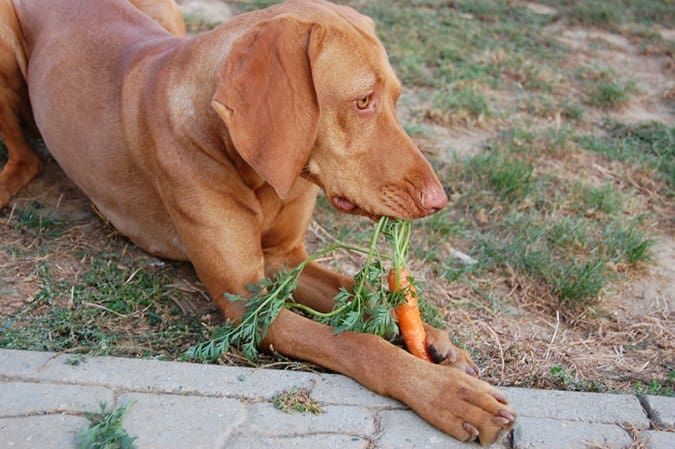
As omnivores, dogs can eat vegetables without ill effect—at least they can eat most vegetables. Many nutritionists believe a mixture of both meat and vegetables is important for a healthy dog. My darling baby boy is a 12-year-old German Shorthair Pointer mix. When he was around 6 years old, he started to put on some weight. Based on a suggestion from a friend, I did some research on what vegetables dogs can eat, cut back on his commercial dog food, and added a handful of frozen green beans to his dinner. The vegetable slowed down the gobbling up of his food, added volume without many calories to help him feel full, and easily fit into my budget. The trick worked! My pup slimmed down.
What Vegetables Can Dogs Eat?
Dogs Can Eat Cabbage, Lettuce, and Many Other Leafy Greens
A good rule for finding leafy greens that your dog can eat is to stick to those that you would consume. Lettuce, spinach, chard, cabbage and kale are all okay for dogs. Besides being rich in vitamins A, C, and K, calcium, iron and potassium, leafy greens are also a good source of fiber. Much like humans, dogs get the most nutrients when the veggies are uncooked. Of course, if you want you can steam your dog’s vegetables for something a little different, or bake them for a crunchier treat. The high fiber in leafy greens can cause some dogs to have an upset stomach after initially added to their diet. Introduce any new food slowly to keep your dog’s tummy safe.
Can Dogs Eat Carrots, Beets, and Other Root Vegetables?
In general root vegetables like carrots, beets, sweet potatoes and parsnips are safe to feed your dog. These vegetables are starchy and high in sugar, which means you do want to limit the amount you give to your dog (especially if his commercial or raw dog food already contains root vegetables – many do).
Get the recipe for homemade sweet potato dog chews.
Can Dogs Eat Stalk Vegetables?
This includes vegetables like celery and asparagus. It may be a little harder to get your dog to enjoy these types of vegetables, but they are safe for dogs to eat. Some don’t like the taste, and some find them hard to grind up in their teeth. To help, cut stalky vegetables into small pieces and/or steam them.
Can Dogs Eat Broccoli, Brussels Sprouts, Cauliflower, Corn, and Cucumber?
All of these veggies are safe for your dog to munch on but, like other vegetables, keep it to small quantities – especially if your dog isn’t used to eating these types of foods. Remember to take the corn off the cob before handing it over to your dog. Although the cob itself isn’t bad for a dog to consume, it is easy to swallow in chunks or whole, which can cause choking or intestinal obstruction. Whenever changing your dog’s diet make sure to check with your vet, go slow, and pay attention to your dog. If you follow these guidelines, adding vegetables to your pup’s food can help him receive a more varied, nutritionally complete profile in his diet.
Dogs Can Eat Squash
Squash of all varieties are safe for dogs to eat. Pumpkin and butternut squash can help dogs with bouts of diarrhea, and most dogs don’t mind the taste of squash. Use up all your excess summer squash from the garden by steaming it up for your dog, or cut up and bake this year’s jack-o-lantern after Halloween for your dog to eat. It’s best to limit your pup’s consumption to the meat of the squash, keeping the seeds and skin away.
Can Dogs Eat Peas and Other Legumes?
This vegetable group includes bean and alfalfa sprouts, mature beans such as kidney, pinto, and lentil, and peas. The topic of legumes in dog food has been in the news lately. The reason is due to a recent FDA update which states there are reports of canine dilated cardiopulmonary (DCM) in dogs eating pet foods containing legumes or potatoes high up on the ingredients list. If the protein of your dog’s diet relies heavily on legumes or potatoes, you should not only avoid giving more of this plant group to your dog, but also consider reducing the levels of legumes in his main dog food, i.e. changing dog foods. A note on green beans: Green beans may be the most widely-fed vegetable to dogs because of their taste and easy digestion. Please be aware that, despite their name, green beans are not actually classified as beans, and therefore don’t warrant the limitations recommended for true legumes.
Vegetables Dogs Can’t Eat
Dogs Can’t Eat Onions, Garlic, and Other Alliums
Alliums are bulb vegetables like onions, garlic, leeks, chives, and shallots. Do not give your dog access to these plants, as they are toxic to dogs. Negative side effects of eating onions or garlic for dogs range from a stomach ache to developing anemia which, at it’s worse, can cause organs to shut down.
- Frozen bags of vegetables are often on sale. Stock up. Have a blend ready to grab in a Tupperware bowl in the freezer.
- If your pup is sensitive to the cold of a frozen vegetable, put a small bowl in the refrigerator for easy treat access.
- For a summer treat, add vegetables to a 1:1 mixture of chicken broth and water in an ice tray. Once frozen, pop out one or two for a delicious hot day treat.
- When cooking, set aside the unused vegetable trimmings that are safe for your dog to consume. A great no-waste alternative to throwing it in the garbage.
- If your dog doesn’t want anything to do with vegetables and you want to supplement what he is getting in his regular diet, you can chop or puree them and mix them into his meals. For treats, adding some dog-safe peanut butter (no sugar, just peanuts) can get your dog started. Eventually you should be able to back off on the addition and feed the vegetable plain.
- Vegetables are a great reward in treat puzzle games. As always make sure you watch your dog when those are in use and that all edible treats are cleaned from the puzzle before storing away.


Coconut oil is fine. I just started my dog on whole roast chicken (everything but the bones goes in) and sweet potato/squash with a little courgette and cauliflower and she loves it and is walking better after limping due to what the vet was arthritis. No grains at all for arthritic dogs. It isnt that much more expensive and at 10 she is like a puppy.
Is a teaspoon of coconut oil daily harmful?
We make a special mix we call “Papa’s mix” that we use to give pills easily to our 15 yr old bichon and 10 yr old chihuahua. We buy 9 or 10 containers of chicken livers, cook them up, along with broccoli, green beans and carrots with some ground flax seed. We mix everything together so it is a nice texture that wraps around a pill. Our dogs love it and it removes the hassle of giving pills. I also buy something called “Just turkey” from a local Wegmans deli. It has no salt in it (or taste, as my husband says. ) My dogs, cats and I love it and it is also a great training treat. My dogs have eaten broccoli, green beans, sweet peppers, hard boiled eggs, peas, and carrots from puppyhood. Also we add the following to their canned food: Seameal, ground flax seed, nutritional yeast, and probiotic powder. Check out Dr. Pitcairn’s book. He is a pioneer in dog nutrition. Just learned our bichon has hip dysplasia and has lameness in the back legs. He is eating well and very alert. Does anybody have suggestions on how we can deal with this? I work and my husband is disabled and in a wheelchair. We plan on getting some wheels along with a pet stroller for our dog but are at a loss to figure out how we can deal with Perky’s condition when I return to work. Any suggestions?
We feed Orijen dog food, a mix of cooked veggies (peas and green beans-no salt!-mostly), Brutus Bone Broth (no alliums! Well tested), canned pumpkin, raw baby carrots (he likes the crunch), frozen green beans (these really keep his teeth clean!), and organic plain yogurt. He’s a senior, but he looks years younger thanks to his healthier diet.
is mustard Green okay for a dog?
My Westie was diagnosed with cancer at age 13. I started making his food. Since he is allergic to beef and chicken he gets semi cooked ground turkey, freeze dried lamb and pork. I use scrambled eggs and I use a food processor to finely chop spinach, carrots, brussel sprouts, (red, yellow or orange) peppers, cucumbers, celery, apples, pears, blueberries, blackberries, a small piece of garlic, fresh rosemary, ginger, turmeric, coconut oil, lettuce, broccoli, green beans and peas. The veggie and fruits will vary in every batch, but will always have rosemary, garlic, ginger and turmeric. I make bone broth and use quinoa or brown rice. I do add a little good grade kibble for crunch. I add a digestive enzymes (with pre and probiotics), cosequin, crushed egg shells and organic wild salmon oil. He always has filtered fresh water in two areas. For snacks he love bananas, apples, oranges with cheese, homemade jerky. I will give other treats as long as the ingredients are healthy. He is now 16.5 and cancer free. He’s a little senile, but still runs, more like sprints, especially when I come home. His little brother who is 3 and an Aussie Shepard/Lab mix (60 lbs) get the same food.
Corrina, Seems like a good diet but not complete. According to the author, Mary Straus, of another Whole Dog Journal Article, “How to Make Homemade Food Diet” no diet is complete with added calcium (can get from pulverized eggshells and other sources, and some fish and even Vitamin E. Check out that article which was updated on March 24, 2020.
Wow! I’ve only just found this mag today. I’m a Brit living in Spain. We have 4 rescue dogs, down from 7, 3 passing away 2 years ago from old age.
We feed them on raw food, kibble is disgusting now, the actual content that is good in kibble has been reduced so much to keep prices competitive that we just don’t buy it.
Raw meat is more expensive but far far better and is good value. We do add raw veg, usually green beans and beetroot, raw eggs and oily fish, sounds an awful mix but they are fit and healthy. Our eldest girl is 12 and has a thyroid problem, this could be result of her feeding before we rescued her, she also has probably got arthritis in her rear hips/legs for which we give her Hyaloral, she has been on that for just over a year. Now thinking if changing to YuMove but the ingredients seem very similar! Has anyone any advice on this please?
My rescue 10 1/2 yo springer has metal elbows and arthritis. The vet prescribed 1.5 x 50 ml Rimadyl and 3/4 paracetamol daily. After a bit of trialing I now give him 1/2 paracetamol, 1 Yumove, 1/2 Rimadyl after his weetbix and branflakes but before his 1/4 slice of buttered & honeyed seeded wholemeal toast for breakfast. ( He didn’t care for the sunflower spread & thick cut marmalade that I also have.) For his tea I give him the raw bone from a chicken leg followed by another 1/2 Rimadyl and a green lipped mussel capsule (Holland & Barrett human consumption which I also use) followed by dry dog meal with the raw meat from the chicken leg. The chicken I use is the cheap supermarket human consumption frozen or fresh which I freeze if it is not going to be consumed within a couple of days. Having read a lot of these comments I will be adding a bit of veg to his diet. He does love tomatoes and eggshells.
Hello I’ve been making my dog’s food for years, and her health has drastically improved! One of the ingredients is pumpkin, which I am unable to find at this time (only pumpkin pie mix). To replace the pumpkin, I purchased bags of frozen yellow squash. I just noticed that it is advised to remove the skin and seeds. The squash I purchased is sliced with the skin and seeds. It is fully cooked. Will you clarify if the fully cooked squash is safe to add to the food?
Thank you!
Great conversation here…as we learn more and more of the harmful ingredients contained in dog kibble from previously trusted names…it makes a lot of sense to try to develop a healthy combo of known self prepared ingredients mixed with an equal or lesser amount of commercial “quality” (if there is such a thing) kibble. My pups usually are fed an AM mix of scrambled eggs with cottage cheese, raw local grass fed burger and Fromm’s Duck and vegs or Beef and oats. And PM steamed in broth fresh spinach or frozen mixed vegs or peas and carrots mixed with Wellness 95% turkey, chicken or salmon. So far so good … poops are regular and not hard.