

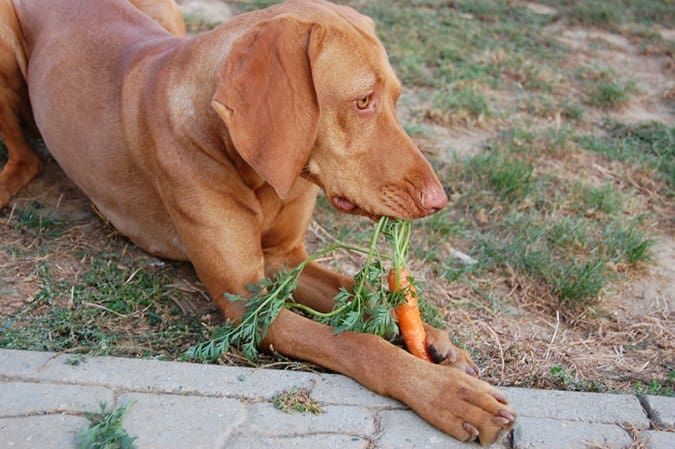
As omnivores, dogs can eat vegetables without ill effect—at least they can eat most vegetables. Many nutritionists believe a mixture of both meat and vegetables is important for a healthy dog. My darling baby boy is a 12-year-old German Shorthair Pointer mix. When he was around 6 years old, he started to put on some weight. Based on a suggestion from a friend, I did some research on what vegetables dogs can eat, cut back on his commercial dog food, and added a handful of frozen green beans to his dinner. The vegetable slowed down the gobbling up of his food, added volume without many calories to help him feel full, and easily fit into my budget. The trick worked! My pup slimmed down.
What Vegetables Can Dogs Eat?
Dogs Can Eat Cabbage, Lettuce, and Many Other Leafy Greens
A good rule for finding leafy greens that your dog can eat is to stick to those that you would consume. Lettuce, spinach, chard, cabbage and kale are all okay for dogs. Besides being rich in vitamins A, C, and K, calcium, iron and potassium, leafy greens are also a good source of fiber. Much like humans, dogs get the most nutrients when the veggies are uncooked. Of course, if you want you can steam your dog’s vegetables for something a little different, or bake them for a crunchier treat. The high fiber in leafy greens can cause some dogs to have an upset stomach after initially added to their diet. Introduce any new food slowly to keep your dog’s tummy safe.
Can Dogs Eat Carrots, Beets, and Other Root Vegetables?
In general root vegetables like carrots, beets, sweet potatoes and parsnips are safe to feed your dog. These vegetables are starchy and high in sugar, which means you do want to limit the amount you give to your dog (especially if his commercial or raw dog food already contains root vegetables – many do).
Get the recipe for homemade sweet potato dog chews.
Can Dogs Eat Stalk Vegetables?
This includes vegetables like celery and asparagus. It may be a little harder to get your dog to enjoy these types of vegetables, but they are safe for dogs to eat. Some don’t like the taste, and some find them hard to grind up in their teeth. To help, cut stalky vegetables into small pieces and/or steam them.
Can Dogs Eat Broccoli, Brussels Sprouts, Cauliflower, Corn, and Cucumber?
All of these veggies are safe for your dog to munch on but, like other vegetables, keep it to small quantities – especially if your dog isn’t used to eating these types of foods. Remember to take the corn off the cob before handing it over to your dog. Although the cob itself isn’t bad for a dog to consume, it is easy to swallow in chunks or whole, which can cause choking or intestinal obstruction. Whenever changing your dog’s diet make sure to check with your vet, go slow, and pay attention to your dog. If you follow these guidelines, adding vegetables to your pup’s food can help him receive a more varied, nutritionally complete profile in his diet.
Dogs Can Eat Squash
Squash of all varieties are safe for dogs to eat. Pumpkin and butternut squash can help dogs with bouts of diarrhea, and most dogs don’t mind the taste of squash. Use up all your excess summer squash from the garden by steaming it up for your dog, or cut up and bake this year’s jack-o-lantern after Halloween for your dog to eat. It’s best to limit your pup’s consumption to the meat of the squash, keeping the seeds and skin away.
Can Dogs Eat Peas and Other Legumes?
This vegetable group includes bean and alfalfa sprouts, mature beans such as kidney, pinto, and lentil, and peas. The topic of legumes in dog food has been in the news lately. The reason is due to a recent FDA update which states there are reports of canine dilated cardiopulmonary (DCM) in dogs eating pet foods containing legumes or potatoes high up on the ingredients list. If the protein of your dog’s diet relies heavily on legumes or potatoes, you should not only avoid giving more of this plant group to your dog, but also consider reducing the levels of legumes in his main dog food, i.e. changing dog foods. A note on green beans: Green beans may be the most widely-fed vegetable to dogs because of their taste and easy digestion. Please be aware that, despite their name, green beans are not actually classified as beans, and therefore don’t warrant the limitations recommended for true legumes.
Vegetables Dogs Can’t Eat
Dogs Can’t Eat Onions, Garlic, and Other Alliums
Alliums are bulb vegetables like onions, garlic, leeks, chives, and shallots. Do not give your dog access to these plants, as they are toxic to dogs. Negative side effects of eating onions or garlic for dogs range from a stomach ache to developing anemia which, at it’s worse, can cause organs to shut down.
- Frozen bags of vegetables are often on sale. Stock up. Have a blend ready to grab in a Tupperware bowl in the freezer.
- If your pup is sensitive to the cold of a frozen vegetable, put a small bowl in the refrigerator for easy treat access.
- For a summer treat, add vegetables to a 1:1 mixture of chicken broth and water in an ice tray. Once frozen, pop out one or two for a delicious hot day treat.
- When cooking, set aside the unused vegetable trimmings that are safe for your dog to consume. A great no-waste alternative to throwing it in the garbage.
- If your dog doesn’t want anything to do with vegetables and you want to supplement what he is getting in his regular diet, you can chop or puree them and mix them into his meals. For treats, adding some dog-safe peanut butter (no sugar, just peanuts) can get your dog started. Eventually you should be able to back off on the addition and feed the vegetable plain.
- Vegetables are a great reward in treat puzzle games. As always make sure you watch your dog when those are in use and that all edible treats are cleaned from the puzzle before storing away.



Beware of dry food….kidney disease is continually high these days….chemicals and scavenger ingredients.
As soon as my Golden Ret. sees me in the garden she goes crazy until I give her something.. she will sit in her baby pool under the umbrella and eat all kinds of veggies. LOL.. Just to see how she gets when I walk past her with my basket to pick the garden its on… she will wait and wait sometime impatiently.
Yes it is safe but as always do not over feed and not a daily diet. Veggies are good as a treat. I do a 1-2 times 3 times a week and different days of the week each week.
How about the fact that most of the cabbage group (broccoli and cauliflower included) are goitrogenic? They suppress thyroid hormones and are not the best choice.
There are a few factual errors in this article. One issue is that dogs are not omnivores. They are carnivores. Second, dogs are unable to easily break down plants’ cell walls so they extract very little nutrition from raw plants. Pre-processing the veges will help. Puréeing or juicing are good techniques. Or cut the veges small and lightly steam them.
Wrong! Dogs are and always have been omnivorous as are there cousins, the coyote, fox and wolf.
Coyote, Fox and Wolf are carnivores not omnivorous,
Yes they are….as they eat the stomach contents of their kills! To get a predigested veggie hit!
All of these eat wild meat and that includes the stomach contents of the herbivores they consume, they will also eat vegetables and berries that they find in gardens and yards. So yes, much more than strictly carnivores!!
Dogs have been domesticated for so long their bodies have adapted. It has long been proven by science that they are omnivores from their teeth being able to grind and how long their intestines are.
Our pup doesn’t like the dry food. I mix a can of mixed veggies with a can of moist food. I keep in the refrigerator. I mix 1/4 cup of this mixture with 1/4 cup of dry food. Take chill off in the microwave. He empties the bowl in about a minute. My problem solved. Hope there is nothing in the mixed veggies to harm him.
Try frozen veggies thawed or maybe keep them frozen for treats. Canned veggies are high in sodium.
I use no salt can veggies – peas, carrots and green beans. I’ve been using green beans for several years with wet and dry food at least once a day. Also cucumbers. I’ve recently been using peas because an article in WDJ said they were better than green beans. I also cut up raw carrots. If I’m cutting veggies for me. She gets a small helping – red peppers, apples
Yes, and all of the vitamins are cooked out of them. Canned veggies are basically a filler for humans, AND for dogs too.
try using frozen (thawed) veggies, even if you use no sodium canned veggies, they are already cooked and have lost some of their nutrients
My understanding, very little or better yet no spinach for a dog.
stonypointer7@gmail.com. it actually says leafy green vegetables are good for dogs. Not only spinach, but brussel sprouts broccoli cauliflower kale asparagus are all good. My dog loves his cucumbers and carrots with celery before his regular meal.
Spinach might be one of those things to leave out. In larger quantities it‘s bad. It’s very high in oxalic acid which blocks calcium absorption which can lead to kidney damage. As for brussel sprouts and broccoli: maybe low amounts or as an occasional treat in case of gastrointestinal irritation and brussel sprouts might give your dog more gas than you bargained for. I know nothing about kale for dogs. Asparagus may be too tough (fibrous)-I‘d cut it up small. I wouldn’t bother cooking it to feed anyway because by the time it’s tender enough it‘s lost the nutrients.
Its my understanding that spinach is relatively high in calcium.
Yes, but also high in oxalic acid which is not good in large amounts.
My dogs wolf all these vegetables cooked. No harm whatever. Been eating them for years.
Too much spinach, chard, sweet potato, or beets will cause kidney stones they are very high in calcium oxalate.
Yes it is safe but as always do not over feed and not a daily diet. Veggies are good as a treat. I do a 1-2 times 3 times a week and different days of the week each week.
My dog comes running whenever I get out the cutting board because she knows there will be raw veggies available. She especially loves raw peppers and cucumbers. Oddly, she no longer will eat raw carrots which she used to love. Maybe she just grew tired of them. I believe that raw veggies are a good addition to her species appropriate diet of raw meat and bones. She came to us as a rescue with several health issues but now enjoys good health due, no doubt, to good nutrition. Our vet bills have been miniscule. In my opinion it’s good both for our dog and our budget to feed a species appropriate diet.
Beware of raw meat as it may give the dog worms.
I did a lot of research before deciding to feed my dogs the way I feed them, which is a partial raw diet. You do not want to feed your dog raw pork nor salmon. The pH in a dog’s stomach acid is not sufficient to kill the flute in the salmon nor the parasites in pork. If you know something other than this and you can cite the source please feel free to correct me. Thank you
Dr Marty has developed a freeze dried raw meat dog food. It is made of people grade freeze fried organ meat from turkey, beef,duck, beef liver, turkey heart, flaxseed, sweet potato, apple,blueberry, carrots, etc. look up this brand online. I use it for my mini schnauzer.
Does that kill hydatid worms? I was told in class to never feed offal to dogs as it can infect them with with hydatid worms. Hydatids then release eggs in the dog faeces, which can lead to fatal cysts forming in humans if ingested. The eggs can survive even if the faeces dries and turns to dust, so you may not eat the poo, but you may take it in later.
Yes. I like, as well.
The promo video was fantastic and made a lot of sense. It’s not for every dog though. I have a Great Dane puppy and when I asked if it were okay to feed, the response from the site was that it has too much calcium. If you can’t find the calcium to phosphorus ratio on a dog food and it’s a giant breed dog – you should ask before feeding. My 6 year old German Shepherd would not touch the food.
Thanks for your comment. I drink a green smoothie every day, and I started making some extra for my 2 Labs. As long as it has a sweet taste, they drink them with enthusiasm, so I add a little honey. I know how good green smoothies have been for me, so I pray they will be good for Max and Hazel….
Er.. no don’t do that, dogs should not have sugar…
No one should, but occasionally it’s fine.
Agree 100%. My Lab mix has been on a raw/semi raw diet with various proteins, veggies, fruits and starches. Sometimes I mix with quinoa, but usually use sweet potato, pumpkin, squash, potatoes, cooked rice, and occasionally cooked oatmeal. He’s eaten this way since he was three. He’s now 12 and has the get up and go of dog about 4.
Salmon and Sweet Potato is the dry dog food I have been feeding my Chihuahua. She really likes it over the small breed food I had been using for years.
No animal should eat dry food. It ultimately gives them liver problems. A dig like a person should be eating organic wholefoods mainly raw diet.
What about edamame. Ie soybeans.
Edamame can cause cancer in mammals by giving the body false readings of hormone levels. Cook carrots or beans in water or broth to entice your dog to eat a low calorie treat, occasionally! Dogs are carnivores, not omnivores! They need amino acid from animal protein to prevent heart disease. Easy on the vegetables! Feed a food that has chicken MEAL, beef MEAL as the 1st ingredient. This means the water was removed BEFORE the recipe was created. If listed as the 1st ingredient, “chicken” is 80% water. That means that the 1st ingredient is really water that will evaporate during the baking process.
I always look for the 1st ingredient as Chicken. I avoid chicken meal. I am surprised that you believe the opposite.
As stated by the person above, chicken or pork (whatever meat) is usually 80% water so you are not getting as much meat protein by weight. However, chicken meal or pork meal is much more concentrated. Easy enough to learn more about this online. The garbage meat referred to by Lauren is known as By-Products (not Meal). Again, google is your friend.
Meat protein (not plant protein) makes taurine, and taurine is what controls the dog’s heart health. The FDA got involved when a cardiologist in CA noticed an extraordinary number of golden retrievers who developed DCM (dilated cardiomyopathy) and then discovered they were all eating grain-free food which gets its protein not from meat but from plants. There is a Facebook group on the subject for anyone wanting to learn more.
My dogs have always been VEGANS!! We currently have a 13 year old 85 pound Irish Setter who eats V DOG and vegetable treats!
I am not understanding why people are claiming that their dogs are vegan. What definition are they using to describe “vegan”? The notion of vegan dog seems predicated on misinformation.
Don’t know if you’re a vet but you might want to brush up on current findings. DOGS. ARE. NOT. OBLICATE. CARNIVORES! which means certain and many vegetables are very good for them. Also if you’re NOT a vet than please quit giving out false Information. Vegetables ABSOLUTELY contain AMINO ACIDS. It’s scares me to think you have pet patients that you actually give advice to, smfh!
I’m a DVM and scientist and dogs are not omnivores. Humans are omnivores. Dogs are what is known as opportunistic carnivores. Misinformation like this is phenomenally irresponsible and downright negligent. Just because someone says “dogs are 100% omnivores” does not make it true.
I can’t believe I’m even having to say this, but this was taught in bio 101. You know, when you were kids.
Look at your teeth. Look at a dog’s teeth. Herbivores and omnivores do not have fangs. Except on Halloween.
Opportunistic carnivores and obligate carnivores have long fangs and tight molar digitation for piercing and tearing flesh, give it a couple quick chomps with their interlocking, peaked molars, and down it goes to be easily digested and nutrients absorbed. No long intestine for them; they don’t need it. They’re carnivores.
Do you produce vitamin D? Yes. Do dogs produce vitamin D? Nope. They have to get it from meat.
What length is your intestines? 20-40 feet. Dogs, around 2-4 feet. Herbivores have extremely long intestines. Obligate or hypercarnivores, like cats, have much shorter intestines, around 12-15 inches. Dog and cat intestines are far more similar to each other than they are to omnivores, by about a factor of 10.
Neither dogs nor cats have the area of the GI tract where cellulose fermentation takes place. So guess what doesn’t break down? Plants. We do, though. Do dogs still sound like omnivores to you?
But, you want them to eat what you want them to eat and you’ll make stuff up and call it “facts” to make it fit what you want. Phenomenally selfish, and I would go as far as to call it abuse. People should have to interview to be responsible for the welfare of a dog. They deserve better.
Did you know that the biggest proponents of calling dogs omnivores are dog food companies? Do you know why? Well, hopefully you’ll be able to figure that out on your own, although I don’t hold out hope. The business of dog food hasn’t been around that long, and profits are good.
My dogs are carnivores. They all eat raw meat, bones, and organs. They are 18, 19, 21, and 23. They are all in perfect health. They are happy. I am a vegetarian, because I can choose to be a vegetarian. If I imposed my species-appropriate diet on my dogs, I would be a negligent, abusive steward of my dogs’ safety. If you can’t see that simple truth, then you are blind to your own avarice and narcissism, and I don’t pity you, I pity your dogs.
Dissemination of false, misleading, and irresponsible information makes you more than wrong. It may make you a murderer.
Please ignore Susan’s misinformation. First off dogs are 100% omnivores meaning they eat meat and plants. It has been proven through science due to their teeth and length of their intestines. Second soy can cause inflammation if it doesn’t agree with their body, everyone is different along with their responses to foods. Too much inflammation will eventually lead to health issues but to say all mammals develop cancer from eating soy makes no sense. In saying that, soybeans are part of the legume family so I would follow the same rules from above when feeding. I would get an IgE blood allergy test done too, just to rule out any other food allergies to prevent constant inflammation from occurring in the body. Third when getting meat in your pet’s food you want it to be whole meat of human grade quality and first on the list. When a meat is labeled as Meal that is the garbage meat all ground together then dehydrated and definitely not healthy for your pets consumption. If you already know all this sorry for the long response, it’s more of a reply to Susan’s comment.
Hear hear !!
Thank you.