


We know it’s okay to be apart from our dogs and to leave them home alone, but for how long, exactly? Is there a limit to the amount of time our dogs should spend alone? How should you deal with separation anxiety in dogs?
A lot of dogs might spend most of their waking hours home alone and seem to do just fine, but is it okay? Are they really fine? I sometimes wonder if, instead, this is something we say to ourselves to assuage our guilt, or to avoid taking a harder look at a cultural norm that could use an update.
Let’s look at how social isolation may affect dogs, and what we can do to minimize negative effects and maximize their well-being.

How Long Can a Dog Be Left Alone?
Let’s start with the most basic of truths: Most dogs will spend time home alone on a daily basis. How long depends on the owners’ lifestyle and schedule. Someone who works an eight-hour day and has a commute, followed by errands and evening activities, could conceivably leave their dog home alone for 10 to 12 hours in a single day and on a regular basis.
Dogs have historically been left alone for long stretches without a second thought. As recently as a couple of decades ago, if a family needed to be away from home for a day or two, how the dog felt about being left behind – whether indoors or outdoors – was not an important consideration. As long as he had enough food and water, most owners felt secure in the knowledge that he was all set.
Few people today would admit to leaving their dogs home alone for 24 or 48 hours or more, but leaving the dog home for 10 to 12 hours is not at all uncommon – and questioning this practice can sometimes lead to social ridicule. If an owner decides that after being gone all day, she’d rather not confine her dog or leave him alone for an additional few hours in the evening, she might be met with less-than-understanding responses. “You’re not coming out because you want to be home with your dog? That’s crazy! You’re letting your dog control your life!”
Here’s the thing, and I won’t pull any punches: 10 to 12 hours is too long for a dog to be alone in a single stretch.
I know, I know. It’s a very broad statement and there is always the argument that, “We’ve always done it this way and our dogs have always been fine!” What this means, though, is that the dogs who appear to be fine have simply learned to cope with something that is entirely out of their control. Being left alone for long stretches of time is not a likely choice that they would make if it was up to them. They’ve adapted to our routines, but it’s far from ideal for them.
We count on our dogs to be there for us when we’re ready to interact with them, but in between those moments, we expect them to do nothing and wait. It’s a tall order, but lucky for us, most dogs adapt incredibly well to anything we ask them to.
People whose dogs have difficulty adapting are the ones who come to us trainers, asking for help with behavior problems such as barking and destructive chewing, or emotional issues such as fear, anxiety, aggression, or over-excitement, to name a few. In fact, many of us trainers and behavior consultants are kept very busy as a result of the lifestyle to which many dogs are subjected!
Some home-alone dogs may experience separation anxiety. For more information about this extreme form of isolation distress in dogs, see trainer Pat Miller’s article on separation anxiety..
Trainers are often asked, “What’s the maximum amount of time a dog can be left alone in a single stretch?” There’s no simple answer to this. We know that in most cases, a dog will manage if he has no choice, but we shouldn’t push the envelope just because we can.
Let’s consider the dog’s basic needs. While not all dogs are alike, most adult dogs should be able to go outside to relieve themselves about three to five times a day (more often if they are sick or elderly) and shouldn’t be forced to “hold it” for more than four to six hours at a time, on average. We know most adult dogs can hold their bladders for more than six hours, but they really shouldn’t have to.
Granted, this is relative. Some dogs, if given the opportunity, will go outside to eliminate every couple of hours, while others – even with the freedom to do so – might still only eliminate three times a day.
You know your dog best and are in a unique position to figure out what his individual needs are. When you’re home during the weekend, does you dog stick to his usual weekday elimination schedule, or does he tend to go out more often?
Puppies need to eliminate way more often than adults, and although we can set up their “home alone” environment to include a space where they can eliminate indoors, there is still the question of how long they should be left alone without human company.
Yes, Dogs Get Lonely
Dogs are social animals and should have the opportunity to interact with people at least several times a day, and with other dogs on occasion, if this is something they enjoy.
It’s even more important to not leave puppies home alone all day. Puppies younger than 14 weeks of age are in a sensitive socialization period and benefit from lots of social interaction. They should be in the company of their family for significantly more time than an adult dog.
Again, for emphasis: Leaving a puppy home alone all day is a waste of valuable – crucial – socialization time that can confer lifelong benefits.
How Long Can a Dog Stay in a Crate?
I have a number of clients who, prior to consulting with me, had resorted to using crates in an effort to prevent their dogs from doing further damage to their homes through destructive chewing or soiling, or to curb barking at the windows. The irony is that the behavior issues were actually created by too-long stretches of isolation. Crating the dogs only made bad situations worse by increasing the dogs’ level of stress and further limiting their ability to interact with their surroundings.
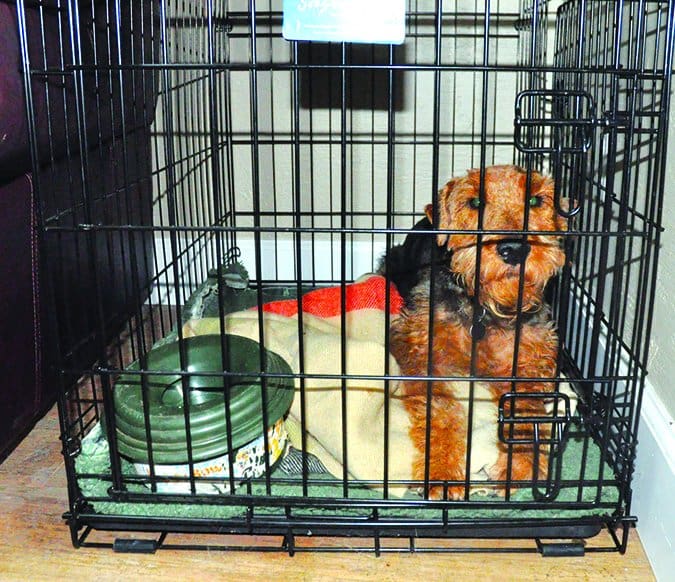
A crate is no place for a dog to spend an entire day. If necessary, confinement in a small space should be temporary and for short periods of time, say, a couple of hours, tops.
There’s often a comparison drawn between crates and “dens” – that somehow a small, enclosed space should instinctively make a dog feel relaxed and safe because it resembles a den. However, dogs are not “den animals” at all. And even if they were, they would be able to leave their dens whenever they please, which isn’t the case with crates.
And if your dog actually seeks out his crate to nap? Does that mean he loves it so much that he’d be okay in it for an entire day? Well, I have a favorite chair in the living room where I sometimes like to curl up and take a nap. My choosing to spend time relaxed in a space without budging for sometimes an entire hour is a far cry from being physically confined to that chair, unable to leave it to stretch, eat, drink, relieve myself, or just plain do something else. It’s time we rethink the use of crates and our dependence on them.
If the principal reason for using a crate to confine a dog during our absence is to avoid destructive or nuisance behavior, a better approach would be to address those behaviors through training, or through management that involves meeting the dog’s physical, emotional, and intellectual needs.
How to Keep a Dog Entertained While at Work
The following are a few ways you can avoid leaving your dog alone for too long. It can be hard to make this work, but if you dig deep and get creative, you’ll find there are actually more solutions available than you might have thought:
Doggie Daycare
Even if your dog is enrolled for just one day a week, that leaves you with only four more to go to cover an average work week! Of course, not every dog is a good fit for daycare, but for dogs who enjoy other dogs’ company, even just one day a week is a good step toward meeting his social and physical needs.
Keep in mind that not all doggie daycare operations are alike. Look for clean, well-designed locations with qualified staff who will manage interactions between the dogs and provide necessary rest periods. Also note that doggie daycare is not the right environment for young puppies.
Come Home for Lunch
If not every day, then as often as you can during the work week. If there are several family members in the household, consider taking turns coming home in the middle of the day to let the dog out to relieve himself and enjoy a short visit.
Hire a Dog-Walking Service
Dog walkers have been around for ages, but in the last decade this industry has seen a surge in numbers, possibly because more people who work outside the home are recognizing the importance of addressing their dog’s needs.
The types of services offered by professional dog-walkers can range from a quick home visit to a neighborhood walk, or even day training (when a trainer trains the dog in your home while you’re at work). Again, a caveat is needed here; there are some horrible dog-walking services out there.
Work From Home On Occasion
Telecommuting is more popular than ever as technology makes it easy for folks to perform their professional tasks from a home office.
Bring Your Dog to Work with You
Obviously, not everyone is in a position to do this. I frequently work with clients to treat their dog’s separation anxiety, and this suggestion is almost always met with an immediate negative response, “No way, I can’t do that.” However, it turns out that sometimes, it is possible.
Unless you’ve actually looked into it by communicating directly with the person who’s in the position to say yes or no, hold off before crossing the idea off your list of possible solutions. It may seem unlikely, but you may be very pleasantly surprised!
Arrange for Someone to Visit Your House and Let Your Dog Out
Ask a neighbor, or your co-worker’s teenage niece who loves dogs, or that kid down the street who does odd jobs. Not everyone is comfortable with the possible liabilities a scenario like this can present, but you may already have someone you trust to handle this type of task.
Naturally, your dog needs to be comfortable with someone walking into his home while you’re out, and in the best of cases, he’ll be thrilled to receive a midday visit!
Solutions Have Higher Cost, But Worthwhile Benefits
While some of these solutions involve an additional expense, consider it a normal part of owning a dog. When calculating a budget for expenses related to caring for a dog, owners may figure in the expenses for food, toys, maybe some grooming, and the occasional vet visit. All too often, though, money for training and other services like daycare, boarding, or dog walking tend to fall erroneously into the “luxury” category. In reality, these are essential services that contribute to meeting a dog’s needs more completely.
Maybe we’ve been asking the wrong question all along. Rather than trying to figure out how to best stretch the amount of time we can leave our dogs alone, we should be trying to help our dogs get more out of every day. This idea might take some getting used to, especially since it suggests that our dogs aren’t happy. Sometimes, though, it’s good to question the status quo and ask ourselves if we can do better.




I adopted a one (1) year old German Shepherd in 2017 and he and I are together (alone) about 23 hours a day. (I am retired, have no family, and only a handful of treasured friends who are in and out weekly). The person here the most is a somewhat un-needed health care worker, three days per week for 4 hours. My Kody adores her (and anyone else he meets!). But, after it taking 2 years to get him over the abuse piled on him for the first year of his life, I immediately tried to find another dog or two to give him a more balanced life. I could see that his bond with me was going to become problematic if he was not distracted from his reliance on me for EVERYTHING in his life. He was not having any of that and I have gone thru countless “meet and greets”, that did not end well due to his aggressive attitude. (All bluff, but the other dogs can’t be expected to know that.) I am also disabled, so walks are out of the question (he weighs 100 pounds). We play ball (with a thrower), and I take him to the Vet, just to sit in the waiting room and meet other people and animals, and to Tractor Supply with me (the only store that allows dogs in the area I live) a couple of times a month. He also goes everywhere with me unless I know he would be in the car for over an hour (I leave the car running with heat or air conditioning, if necessary, and he has a water bowl. If left at home, he has the run of the house and has never caused damage or gone potty in the house, from day one. I have never even owned a crate let alone used one. I share my house with my dogs, all of my house. When we are out, I do need to keep a Herm-Sprenger collar on him just so I know I have COMPLETE control of him, having physical disabilities and a decrease of strength (along with age of 67). He gets so happy to meet new people or animals, that he’s a little rambunctious. The Herm-Sprenger is the SMALL 2.25ml size, with extra links-I tried it on my neck and it didn’t hurt at all-just gets his attention. He loves it when I put it on him as he knows we are going traveling! I worry that being with me so much is not good for him….as my pain has increased, our traveling is decreasing. I want him to be balanced and happy, I love him so very much. Am I being unfair to him in keeping him from having a family instead of just me? I have always believed that extremes of any type are not good for any living thing/person/animal. Can you give me your opinion on this subject, please?
I’m not the write of the article, but I have a GSD, 6 years old now. Gracie and I live in my home and I am not working anymore. My parents’ home has been Gracie’s second home since she was a puppy and she is much loved by my family. Gracie was crate trained as a puppy, she knows the “Go Crate!” command if I need to get her to stay put, for when repair people come or anybody who is not comfortable with a big German Shepherd. They can be intimidating! My dogs have always been GSDs or crossed with GSDs. While they love people and are very selective with dogs, they become attached to their people, whether one or many. Sounds like you are very devoted to your dog, as am I. Dogs are a huge commitment and deserve our love and attention. I don’t regret any sacrifices I have made to make sure my dogs are happy. I think you can tell if your dogs are content — trust your instincts because you know your dog better than anyone.
I don’t think it’s unfair to the dog to have just you. Kody is your dog, and relies on you as much as you rely on him. You guys are family. I think it speaks volumes that you would ask the question if he would be better off with a family – it shows you’re willing to prioritize his well-being and happiness above your own. What better owner could a dog have than that? Of course you should be together and stay together for all your days.
Hello Nancy Tucker,
your article is very nice and informative. I like your article. Thank you for this post.
Hi Nancy Tucker,
All of us have to go through this pain. leaving our loveable pets at home for a long time. We have nothing have to do. Your tips were more effective. Whatever we do we have to make sure of their (pets) safety. I have learned new things from your post.
Thank You
Alison Parker
@DogMexico
As to crates, I adopted a dog with severe separation anxiety. He was one who was very attached to his crate. About the 2nd day after I left him at home to go to work the neighbor told me he barked literally all day. I put him in his crate before I left the next day and waited outside to see if he would bark. He did not.
I like how you suggest coming home for lunch as often as you can to take care of your dog. My neighbor told me that he would like to get a puppy since he lives alone but he does not know how to take care of a pet. I will share this article with him so that he can think about getting a puppy before taking the decision.
Talking a friend recently, we got on the topic of dogs and how they can rule your life. She admitted that although she loves her dog, Hattie, she often feels burdened by guilt when leaving Hattie home alone. She and her husband and kids go skiing every weekend of winter and spring when snow is on the ground.
Is my 4 1/2 (I’m retired and live only with my dog Ethel, 7 1/2) hours of work next door OK? Your guidelines fail to mention any “surveys” of dogs happy with, for example, 4 hours or so in which they are alone.
Such ‘surveys’ would make your article about 100 times more useful!
Yours, Sid / Chicago
Very true but most of the time i carry my dog along with me 🙂
They need our presence. We have been breeding them for centuries to have extraordinary social skills with humans. All of them, even dogs that are said to be “less close to humans”.
There’s certainly good information in this article and I think everyone would benefit from considering their dog’s needs more fully. But I chafe at any recommendation that tells people how long any dog can be in a crate, home alone, etc. Yes, it makes it easy to moralize, but dogs, families and situations vary greatly and what sounds awful to one person may in fact be the most humane option for a particular dog.
My dog and I have done a tremendous amount of work to help him overcome his severe reactivity, attended a lot of classes together, have a great petsitter that visits daily, and use a great daycare once a week. We play games, go for walks, etc. every day. And he spends probably 10-12 hours a day in his crate.
Not only is he doing well, if I were to let him free roam he would be much unhappier. He truly feels safe in there. I know this because if I leave him unattended outside his crate, his reaction to external stimulus is extreme and probably really unpleasant for him. And with me not there to help him out, he could really hurt or upset himself.
This dog came from a chaotic, deprived situation and meeting his needs takes up a good part of my life. And part of meeting those needs includes predictable structure, including a safe place to stay when I’m gone. So please, check yourself before your go condemning others based on a rule of thumb that isn’t necessarily applicable to all situations.
Andy – thank you for writing this! My dog is also very reactive, we work on this continuously. He was crate trained. In TTouch training we found out how much he needs pressure on his body (bandages, thunder shirts) to calm him down. Since I put a doughnut type fluffy bed in his crate he is in there all the time, enveloped by fluffiness on all sides. I have a camera on him when he is in the closed crate and he barely reacts to doorbell or other outside noises. When he has free reign of the house he explodes at every noise, he bites if we try to calm him. So yes, a crate can be a good thing!! We can not take him anywhere with us, he is too reactive for day care. So if we want any sort of social life we have to crate him, four hours max. Left alone in a room he will pace continuously, never settling or resting.