


We know it’s okay to be apart from our dogs and to leave them home alone, but for how long, exactly? Is there a limit to the amount of time our dogs should spend alone? How should you deal with separation anxiety in dogs?
A lot of dogs might spend most of their waking hours home alone and seem to do just fine, but is it okay? Are they really fine? I sometimes wonder if, instead, this is something we say to ourselves to assuage our guilt, or to avoid taking a harder look at a cultural norm that could use an update.
Let’s look at how social isolation may affect dogs, and what we can do to minimize negative effects and maximize their well-being.

How Long Can a Dog Be Left Alone?
Let’s start with the most basic of truths: Most dogs will spend time home alone on a daily basis. How long depends on the owners’ lifestyle and schedule. Someone who works an eight-hour day and has a commute, followed by errands and evening activities, could conceivably leave their dog home alone for 10 to 12 hours in a single day and on a regular basis.
Dogs have historically been left alone for long stretches without a second thought. As recently as a couple of decades ago, if a family needed to be away from home for a day or two, how the dog felt about being left behind – whether indoors or outdoors – was not an important consideration. As long as he had enough food and water, most owners felt secure in the knowledge that he was all set.
Few people today would admit to leaving their dogs home alone for 24 or 48 hours or more, but leaving the dog home for 10 to 12 hours is not at all uncommon – and questioning this practice can sometimes lead to social ridicule. If an owner decides that after being gone all day, she’d rather not confine her dog or leave him alone for an additional few hours in the evening, she might be met with less-than-understanding responses. “You’re not coming out because you want to be home with your dog? That’s crazy! You’re letting your dog control your life!”
Here’s the thing, and I won’t pull any punches: 10 to 12 hours is too long for a dog to be alone in a single stretch.
I know, I know. It’s a very broad statement and there is always the argument that, “We’ve always done it this way and our dogs have always been fine!” What this means, though, is that the dogs who appear to be fine have simply learned to cope with something that is entirely out of their control. Being left alone for long stretches of time is not a likely choice that they would make if it was up to them. They’ve adapted to our routines, but it’s far from ideal for them.
We count on our dogs to be there for us when we’re ready to interact with them, but in between those moments, we expect them to do nothing and wait. It’s a tall order, but lucky for us, most dogs adapt incredibly well to anything we ask them to.
People whose dogs have difficulty adapting are the ones who come to us trainers, asking for help with behavior problems such as barking and destructive chewing, or emotional issues such as fear, anxiety, aggression, or over-excitement, to name a few. In fact, many of us trainers and behavior consultants are kept very busy as a result of the lifestyle to which many dogs are subjected!
Some home-alone dogs may experience separation anxiety. For more information about this extreme form of isolation distress in dogs, see trainer Pat Miller’s article on separation anxiety..
Trainers are often asked, “What’s the maximum amount of time a dog can be left alone in a single stretch?” There’s no simple answer to this. We know that in most cases, a dog will manage if he has no choice, but we shouldn’t push the envelope just because we can.
Let’s consider the dog’s basic needs. While not all dogs are alike, most adult dogs should be able to go outside to relieve themselves about three to five times a day (more often if they are sick or elderly) and shouldn’t be forced to “hold it” for more than four to six hours at a time, on average. We know most adult dogs can hold their bladders for more than six hours, but they really shouldn’t have to.
Granted, this is relative. Some dogs, if given the opportunity, will go outside to eliminate every couple of hours, while others – even with the freedom to do so – might still only eliminate three times a day.
You know your dog best and are in a unique position to figure out what his individual needs are. When you’re home during the weekend, does you dog stick to his usual weekday elimination schedule, or does he tend to go out more often?
Puppies need to eliminate way more often than adults, and although we can set up their “home alone” environment to include a space where they can eliminate indoors, there is still the question of how long they should be left alone without human company.
Yes, Dogs Get Lonely
Dogs are social animals and should have the opportunity to interact with people at least several times a day, and with other dogs on occasion, if this is something they enjoy.
It’s even more important to not leave puppies home alone all day. Puppies younger than 14 weeks of age are in a sensitive socialization period and benefit from lots of social interaction. They should be in the company of their family for significantly more time than an adult dog.
Again, for emphasis: Leaving a puppy home alone all day is a waste of valuable – crucial – socialization time that can confer lifelong benefits.
How Long Can a Dog Stay in a Crate?
I have a number of clients who, prior to consulting with me, had resorted to using crates in an effort to prevent their dogs from doing further damage to their homes through destructive chewing or soiling, or to curb barking at the windows. The irony is that the behavior issues were actually created by too-long stretches of isolation. Crating the dogs only made bad situations worse by increasing the dogs’ level of stress and further limiting their ability to interact with their surroundings.
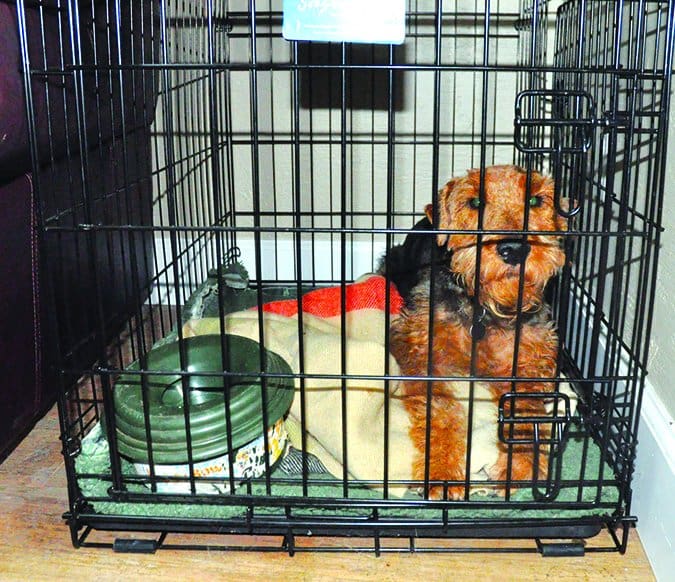
A crate is no place for a dog to spend an entire day. If necessary, confinement in a small space should be temporary and for short periods of time, say, a couple of hours, tops.
There’s often a comparison drawn between crates and “dens” – that somehow a small, enclosed space should instinctively make a dog feel relaxed and safe because it resembles a den. However, dogs are not “den animals” at all. And even if they were, they would be able to leave their dens whenever they please, which isn’t the case with crates.
And if your dog actually seeks out his crate to nap? Does that mean he loves it so much that he’d be okay in it for an entire day? Well, I have a favorite chair in the living room where I sometimes like to curl up and take a nap. My choosing to spend time relaxed in a space without budging for sometimes an entire hour is a far cry from being physically confined to that chair, unable to leave it to stretch, eat, drink, relieve myself, or just plain do something else. It’s time we rethink the use of crates and our dependence on them.
If the principal reason for using a crate to confine a dog during our absence is to avoid destructive or nuisance behavior, a better approach would be to address those behaviors through training, or through management that involves meeting the dog’s physical, emotional, and intellectual needs.
How to Keep a Dog Entertained While at Work
The following are a few ways you can avoid leaving your dog alone for too long. It can be hard to make this work, but if you dig deep and get creative, you’ll find there are actually more solutions available than you might have thought:
Doggie Daycare
Even if your dog is enrolled for just one day a week, that leaves you with only four more to go to cover an average work week! Of course, not every dog is a good fit for daycare, but for dogs who enjoy other dogs’ company, even just one day a week is a good step toward meeting his social and physical needs.
Keep in mind that not all doggie daycare operations are alike. Look for clean, well-designed locations with qualified staff who will manage interactions between the dogs and provide necessary rest periods. Also note that doggie daycare is not the right environment for young puppies.
Come Home for Lunch
If not every day, then as often as you can during the work week. If there are several family members in the household, consider taking turns coming home in the middle of the day to let the dog out to relieve himself and enjoy a short visit.
Hire a Dog-Walking Service
Dog walkers have been around for ages, but in the last decade this industry has seen a surge in numbers, possibly because more people who work outside the home are recognizing the importance of addressing their dog’s needs.
The types of services offered by professional dog-walkers can range from a quick home visit to a neighborhood walk, or even day training (when a trainer trains the dog in your home while you’re at work). Again, a caveat is needed here; there are some horrible dog-walking services out there.
Work From Home On Occasion
Telecommuting is more popular than ever as technology makes it easy for folks to perform their professional tasks from a home office.
Bring Your Dog to Work with You
Obviously, not everyone is in a position to do this. I frequently work with clients to treat their dog’s separation anxiety, and this suggestion is almost always met with an immediate negative response, “No way, I can’t do that.” However, it turns out that sometimes, it is possible.
Unless you’ve actually looked into it by communicating directly with the person who’s in the position to say yes or no, hold off before crossing the idea off your list of possible solutions. It may seem unlikely, but you may be very pleasantly surprised!
Arrange for Someone to Visit Your House and Let Your Dog Out
Ask a neighbor, or your co-worker’s teenage niece who loves dogs, or that kid down the street who does odd jobs. Not everyone is comfortable with the possible liabilities a scenario like this can present, but you may already have someone you trust to handle this type of task.
Naturally, your dog needs to be comfortable with someone walking into his home while you’re out, and in the best of cases, he’ll be thrilled to receive a midday visit!
Solutions Have Higher Cost, But Worthwhile Benefits
While some of these solutions involve an additional expense, consider it a normal part of owning a dog. When calculating a budget for expenses related to caring for a dog, owners may figure in the expenses for food, toys, maybe some grooming, and the occasional vet visit. All too often, though, money for training and other services like daycare, boarding, or dog walking tend to fall erroneously into the “luxury” category. In reality, these are essential services that contribute to meeting a dog’s needs more completely.
Maybe we’ve been asking the wrong question all along. Rather than trying to figure out how to best stretch the amount of time we can leave our dogs alone, we should be trying to help our dogs get more out of every day. This idea might take some getting used to, especially since it suggests that our dogs aren’t happy. Sometimes, though, it’s good to question the status quo and ask ourselves if we can do better.




I work part-time and my husband works full-time. I have always adopted adult rescue dogs because I did not feel it is fair to leave a puppy for 5 and a half hours 4 days a week but my adult rescues are fine with this. I walk them before and after work and they attend my training club with me and also dog shows at weekends.
We had a very bad experience with being sold na extremely aggressive dog by a breeder who did not tell us the truth that the dog had not been socialised or left its own garden and after that I could not go through getting another adult dog. Before I got my puppy I asked my employer if I could work split shifts until my puppy was older. I was lucky in that my job needed people to work early & late so they were agreeable to this as it helped them staff times when others did not want to be there. I worked 8-10.30 then 3.30 – 6pm each day for 8 months whilst I socialised and training my puppy. He was only left for 2 hours at a time and crated when left though my older dog was in the same room so he was not left alone. This arrangement worked very well and he is now a therapy dog and has won talent & obedience competitions due to all the work I put in when he was a puppy. It is so wrong to h ave a dog and leave alone all day-they need mental stimulation as well as human company and walks. I would not have considered getting a puppy and leaving it for more than couple of hours. The trouble is we think of our needs but what about the dog’s?
Like others have said, I can afford my one dog (I used to have multiple dogs, as well as cats). I can’t afford pet walkers, pet sitters, daycare. My dog is reactive and I would not trust a random neighbor to walk him safely. I just moved 8 months ago, and don’t know anyone well enough to remotely trust them with my dog or to be inside my home while I’m away. I work a 40 hour week. Between the commute, 30 minutes for lunch, and the 8-hour day, my dog is home alone, inside with free run of the house, for about 9.5 hours, 5 days per week. Other than that, I give him my all. My job provides the roof over his and my heads and the food we eat. I don’t “love” my job, and I am also isolated and lonely at work. My dog and I are in it together. I will not feel guilty.
Thank you, Natalie. I am in the same boat. I will not be made to feel guilty about leaving my dogs at home when I need to be away by keyboard warriors who do not know me or my situation.
The article states:
“Here’s the thing, and I won’t pull any punches: 10 to 12 hours is too long for a dog to be alone in a single stretch.”
You said you are leaving your dog for 9.5 hours. Seems like you just made it.
My world is my fur family. I’ve had my rescue dogs for 10 years. They are loyal and my best friends. I dont deny them comforts at home. We go for rides “just because”. When I’m home they are near me. I work nights so they are sleeping while I’m gone. I love them with my whole heart. They are my life. Yes i don’t go out or date. My dogs are my life.
I have a 7 month old puppy who loves sleeping in his crate which is beside my bed. That is the only time that he is in it – nite-nite time. Other than that, I have a playpen set up in living room, and he goes in and takes naps in that during the day (as well as on my lap). I do put him in the playpen when I have to run errands (grocery shop/dr appts, etc), but it’s not over a couple hrs at a time. I also leave him in my kitchen at times (after making sure everything is out of his way) like going to visit daughter who is recovering from surgery. There he has his bed, water, kong or chew and a peepee pad. He is doing well, with the exception of training which we start on next month.
I always ask people who leave their fur babies alone for extended periods this question. How long can go without going to the bathroom? Usually the response is around 3-4 hours. I then ask, So what makes you think your dog should hold it longer? The shocked and light bulb going off look is priceless!
My first reaction was that it’s always someone else’s expectations that seem to determine public opinions! Dogs are increasingly taking the place of children with ever increasing must dos or you are a bad ‘pet parent’. That is just plain wrong. We have dog sitters, dog psychologists and almost mandatory play sessions now for dogs. That sounds an awful lot like taking care of children if it becomes common place and EXPECTED.
This article doesn’t take into account that many people cannot financially survive on a 40 hour work week anymore and may have more than one job to make ends meet. The article makes it sound like dog ownership is only for the wealthy that can afford the luxury of coming home for lunch, paying for doggie daycare and being home every night at 5 p.m. That is just not feasible for so many of us that are paying off student loans and working exhausting hours to just pay the rent. I LOVE my dogs but also have bills to pay and must be away from home fore longer than 8 hours at a time. Does that mean I not deserve to have my dogs?!
Agreed! I’m deferring retirement so I know I will have enough money to pay vet bills.
Yes. Dogs deserve better.
No one “deserves”to have a dog to mistreat.
Wow, Kathryn.
We have a dog flap so our dog can go in or out into our secure garden as and when she pleases.
The article states:
Here’s the thing, and I won’t pull any punches: 10 to 12 hours is too long for a dog to be alone in a single stretch.
Rich or poor, if you have to leave a pet 10+ hours, then you shouldn’t own one. Owning a pet isn’t a right. Its a responsibility.
I traded my social life for a life focussed on my dog’s needs. I work all day with one thought in my mind: when can I go home and see him. I feel very guilty when I am stuck in traffic! I usually go home to pick him up and take him grocery shopping even though he waits for me in the passenger seat. He puts his head on my arm and I know he likes being with me. Even driving to places. I am thinking of getting him a sister for company. Although my cat is good company as well.
Keeping multiple dogs together makes it easier to leave them alone (providing they get along).
However, please also consider that it makes it much harder to bring your dogs out & about with you.
I started out with one dog who came everywhere with me. Now that I have added two more to the pack, group outings are chaotic to say the least, and if I leave one or two dogs behind at home, there’s hell to pay when we get home.
Thank you for highlighting this disturbing practice today of locking and storing dogs in cages. I hope to soon see it phased out here in the U.S. and banned, as it is in many European countries. Our dogs have always been adopted from shelters or rescued. The unspoken promise to each dog: they will never lose their home again, and they will never again be forced to live in a cage. Ever since I’ve lived with dogs, the priority whenever we moved was finding a home with a large fenced yard. (Some of the houses left a lot to be desired, but had good yards!) If there was no fence, we had one installed immediately. (Physical fences — not electric shock collar perimeters!) We’ve always had two or three dogs, and they seem to be very content with and derive much joy from each other’s company. Dog doors lead to a large, well-fenced backyard. Our dogs relieve themselves whenever they need to, 24/7. If they choose to enjoy a nap in the morning sun and breeze for awhile, they do that when they please. If I have to be away for a day of errands, indoor webcams indicate they get up, move around the house, drink water, and go outside about every 3 hours. I’m by no means wealthy. We make situations work when they are important enough to us. And nothing is more important to me than my dogs, their health, and happiness.
Okay, here’s a situation. I know a lady who has a little dog (a Yorkie). This dog isn’t properly house trained (and the owner has absolutely no interest in doing the job properly). When the family is gone, if the dog is given the run of the house, she will poop not only on the floor, but also on their furniture (beds, couch, chairs, etc.). The were ready to take her to the shelter when someone (not me) suggested they crate train her (why that was more acceptable to her than to fully house train the dog I don’t know, but it was). It is doubtful that this little dog would get adopted due to a number of behavioral issues–the pooping is just the tip of the iceberg. They crate trained the dog and she loves her crate and will go in it of her own choice. They crate her when they’re gone and everybody’s happy and the dog still has a home. Would you rather they dump the dog at the shelter with the most likely outcome being a dead dog?
I think what seems to be most difficult for many people, based on many of these comments, is that their first priority is their desire to have a dog, not whether their current life/work situation really works best for a dog. As indicated in the article, many dogs do “act out” when left alone, because they are social creatures, like people. Being left alone for hours can be terrifying for many dogs. From the situation you described, it sounds like working with a trainer might be a possibility for this dog and owner to improve their lives. Personally, if I was captured, forced to live in a cage where all I could do for hours and hours every day is stand up, turn around, and lie down again, try not to eat or drink, lest I have to sit in my own waste, and this was going to be life for all the years ahead, yes, I think death would be kinder. If returned to the shelter, there is also the possibility that another adopter or foster family better suited to attending the needs of this dog could give it a good life. So, no, I don’t think everyone should have a dog just because they want one.
Yes! Overcrating and all day crating is abuse, plain and simple. Your dog is not necessarily better off with you than without you.
Absolutely!!!!! Everyone is an expert all of a sudden. Common sense people. You know YOUR dog better than this author and the commenters. You do what works best for your family.
When I was very young in the 70s I worked for a veterinarian group in Socal, in a fairly upscale neighborhood. I had thought that being a vet might be a possible occupation that I would enjoy. I was flabberghasted that SO many people gave their pets such poor care and quality of life. For example, many dogs with severe flea allergies were routinely brought in for steroid shots to treat their red, inflamed, thickened, itchy, smelly skin irritation from the dog’s response to the flea allergy despite the vets’ ongoing patient educational attempts at how to eliminate fleas from the environment. It was a very educational experience in many ways. I realized that dogs were totally dependent on their often ignorant and unmotivated owners and that I was too sensitive to confront this daily and chose another occupation. Which is quite fortunate in hindsight. Some owners are motivated and well intentioned, and education will likely improve their dog’s lives. Others are basically selfish and will continue their negligent habits causing cumulative harm to pets and children.
After I retired I fostered an 8 yo blind English Setter whom I later adopted. I could not leave Amber alone EVER, not even for 15 min. She had such bad separation anxiety she would get diarrhea and then pace in it. I always hired a pet sitter for her when I had to run errands. If the pet sitter was not available, I stayed home. I also had a second adopted dog, Lacey, so Amber was not lonely, she just needed a support person in order to feel secure/safe. Luckily, my pet sitter was also active in rescue work so understood her needs (and her fees were reasonable). I don’t think I could have managed otherwise.
I never leave my 3 year old working line German Shepherd alone for more than 5 hours. I leave for work at 5:30 a.m. and my ex-husband (yep… my EX) works overnights and comes to the house by 10:00-10:30 a.m. and stays with her until I get home at 3:00. I swore that I would “do right” by her when I got her at 12 weeks and I do all I can to ensure she is happy and healthy. I don’t go out at night often if ever (I’m 65…been there, done that), and on the weekends when I run errands, if I’m going to be gone long, the Ex will come stay with her. We divorced, but we’re still close. He understands how much she means to me and is comfortable helping take care of her. She’s very reactive so doggy daycare was out of the question and, quite frankly, I don’t trust anyone with her. She is the joy of my life and if she were mistreated I would never forgive myself. I’ve become “one of those” dog people, but I couldn’t give a rat’s behind what anyone else thinks. She’s my family and she comes first. Thank you for this enlightening article. I will be sharing it frequently!