

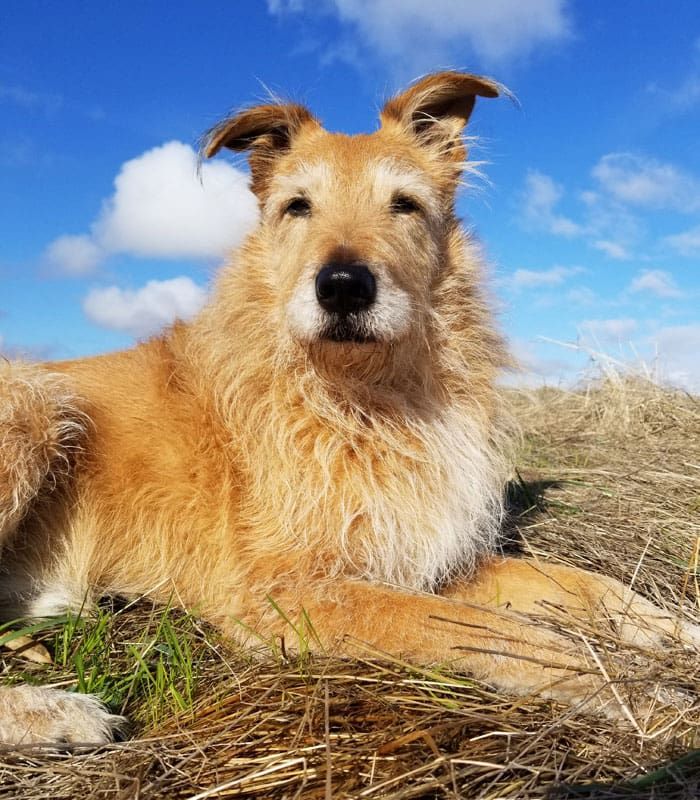
My “very mixed-breed” dog, Otto, turned 12 years old at some point in the past couple of months. For a big dog (currently 72 pounds), that’s getting up there in age! And he’s got some health issues that I have to stay on top of – a benign mass on his liver that we are monitoring, lipomas that have just started blooming in size and number in the past year, and molars that keep fracturing and needing removal (despite the fact that he doesn’t chew on anything hard – no bones for this guy for years). He also has a very subtle, intermittent limp on his right front leg, particularly when he first gets up in the morning.
The good news is that he’s still as mentally sharp as ever, and still getting around well. He can still jump into my car, and will still jump into the back of our truck if the tailgate is down and we happen to walk by it – just in case we were going somewhere for the kind of fun he associates with the truck: paddleboarding, fishing, hiking, camping. I don’t take him on long hikes anymore, because he gets way too stiff and sore afterward, and I don’t want him to tear something when he’s fatigued. He still stays ahead of me and my friends on our regular two- to three-mile off-leash walking routes and is only a little stiff the next day. But it’s hard to keep from hovering and fretting.
Communicating with a deaf dog
This week and next, I’m caring for a friend’s 14-year-old small dog, Leila, while my friend visits family in Europe. Leila has stayed with me and my dogs before, but it’s been at least six years or more; she’s a very different dog at 14 than she was at 8 or so – solidly deaf, for starters. She still chases her tail and barks when she wants attention, skips around when it’s mealtime, and her eyes are bright and happy, and her vision seems good! That’s fortunate, because what’s new to me is that her habitual gait is quite slow, and she sometimes stalls out and stands still, not sure if she wants to go with me and my dogs as we travel the 100 yards or so back and forth between my house and my detached office building on our fenced property.
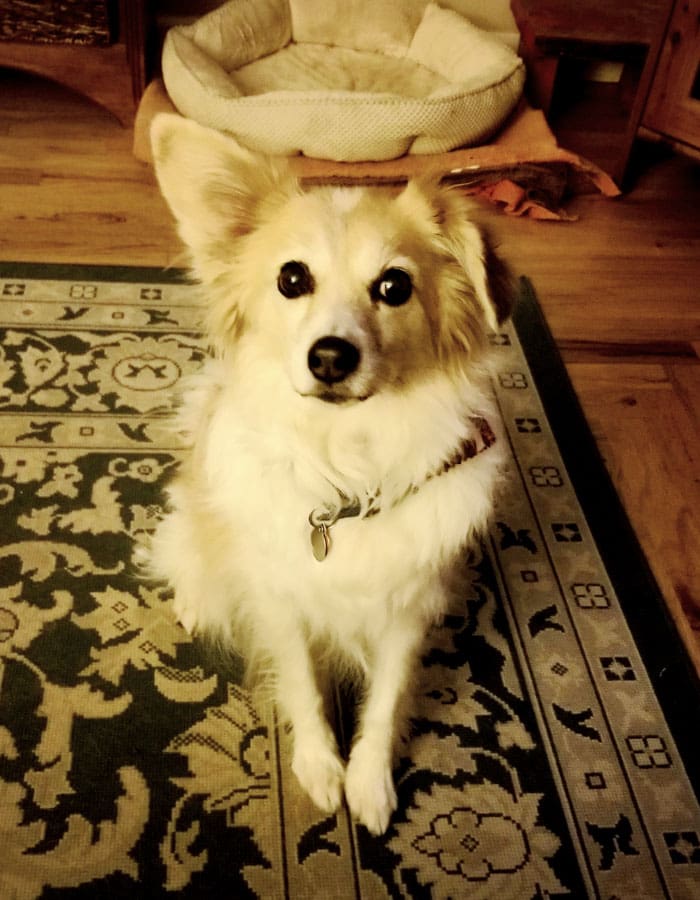
I’m in the process of figuring out what sort of body language and gestures encourage her to come along. We’ve established that she does not want to be picked up, and that she will definitely hurry along if I happen to make a treat available from the depths of one of my jacket pockets. She can trot along, and will for a treat, but left to wander around the property without a destination in mind, she sort of shuffles and snuffles; she’s enjoying all the smells on my property, that’s for sure. But I think I will recommend that she see her vet about something for what looks to me like arthritis pain.
Hoping for many more good years
Observing Leila at 14 is kind of ramping up my anxiety about Otto at 12. How much time do I have before Otto has mobility issues, or can’t hear me? This is stiffening my resolve to diet-and-exercise away those extra two pounds that now appear on the vet’s scale every time Otto weighs in. He’s already great at physical cues (without a verbal reminder or co-cue), so we’ll just keep practicing those.
The cold temperatures just add to my worry. My last heart dog, Rupert the Border Collie, passed away (at 14 years old) in the winter, and so many of my friends’ dogs passed away in the winter, too. I’m so relieved that, even though winter has officially just recently started, we are past the solstice and the days have started getting longer again. We still have many cold days ahead, but at least we’ll have more light.

Here’s looking forward to spring and, we hope and pray, gifts of at least one more year with our precious heart dogs.



it warms my heart to read the comments here of a community of folks whose dogs are as much as a family member as any human.
and winter – ugh – I lost my heart dog on dec 17 2017, four years after her leg was amputated due to cancer. We checked for metastasis every 6 months and had no idea that it was growing back on her pelvis at the site of her amputation. We found it after she fell and was in acute pain. I was devastated. Fast forward 6 months and I volunteered to foster a dog from a herding dog rescue (I also have an Aussie and an old man toy poodle.) By the time we had made the five hour drive home, this new dude was already wiggling his way into my heart. He was – and still is – Velcro. As luck would have it, he came with his own history, having been an owner surrender. Turns out he was found on Dec 18 2017 in California, adopted, and then surrendered. He was found the day after my Grace went over the bridge. I like to think that she sent him to find me. Dutch is my boy, he made that clear right from the time we met. I am beginning to believe that we can have more than one heart dog.
We adopted an 11 year old chocolate Lab one year ago. She is definitely my husband’s heart dog (I love them all!) , and it will break his heart when we have to let her go. Senior checkups every 6 months, really good canned food, and several supplements (as well as pain meds) will help us keep her relatively healthy, I hope. Deafness (teach them hand signals early!), near blindness (ditto verbal cues and noisy balls!), and arthritis are all manageable problems. A great resource for learning about dog food is Dog Food Advisor. They rate dog foods at every price point, and have some very informative articles. (Of course, WDJ does a great job, ESPECIALLY with their latest article “Best Canned Foods”, Dec 1018. It covers much more than just canned food!)
I wish everyone the best with their senior dogs! My sincere belief is that theses gentle souls, put on this earth to help each of us be better human beings, will pass into a better life, and be reunited with us, in the end.
my 55lb mix dog will b 14yo in January. He was pulled from a shelter in 2006, He became a registered therapy dog and has brought joy to many. Always had holistic care and until now was on raw. However dx with oral malignant melanoma (could be his DNA as he has black mouth) and last tumor in May they did not get clean margins. Radiation was suggested but either way his prognosis is not good so I declined putting him thru it. Oncologist has him on Oncept (a sort of immunetherapy) and he gets CBD/medicinal mushrooms/chinese herbs/acupuncture and now I lightly cook his home made food. He also went deaf last year which is sad but altho he no longer likes long walks he is not noticeably stiff but I do give him MediHerb Boswellia mix. He is my life, has seen me thru several losses (senior dogs I have adopted) and the loss of my husband, not sure how I will deal with him leaving me.
I smile at Otto’s picture when WDJ arrives. He is such a handsome boy and is a breed of his own!
I still remember when you called him Uncle Otto because of his care and nurturing and teaching of some younger dogs.
He will always be Uncle Otto to me. The lipomas are of great concern and interest to me because my dog has the as well.
Although there are several WDJ articles on the subject they are a little too technical for me.
Any insight into lipomas and their reduction would be very much appreciated!
I the best of what I have just read is from the person who quoted the old saying: “better a week to soon than a day too late.” I’ll be going through this probably sooner than later with my 15 year old Cardigan Corgi, who is a rescue who was not treated well before I adopted her at age 10. She has arthritis in shoulders and front feet–controlled so far with meds–and is getting quite deaf and is showing signs of dementia. And it’s always the question: when is it time. I’m hoping that she’ll tell me as most of my other dogs have, but the time may come when it will be up to me to make that difficult decision.
I remember my first heart dog, Dillinger, he got sick in February a few months past his 12th birthday, left us in November (Thanksgiving weekend), two weeks after his 13th birthday; then my next heart dog, she was truly my very special girl, Roxie. . . . started limping in August, xrays showed nothing, a few months later, after undergoing PT for arthritis and no improvement and her tripping on her front leg, xrays showed osteosarcoma, she was gone two weeks later, again Thanksgiving weekend, she was just a couple months shy of her 11th birthday; and a mere ten months later, the rescue we had for 3 years, Bennie, passed from another cancer. . . All my dogs to that point were Rottweilers and when they achieved the age of 9 (rescue was approximately age 9), I never took a moment of their lives for granted because I knew the odds were they were going to leave me. I hugged them tighter, spoiled them more and I know they all were well loved. I now have an 17 month old mini Bernedoodle pup, hoping he lives to a ripe old age. . .
We had to put down our black lab heart dog when he was 16. His arthritis had gotten to the point where he could no longer stand on his own and he was incontinent. We tried every therapy available but the reality is his body just started to give out from old age. We did not think it was fair to him to keep going because we didn’t want to let him go. It is very difficult to make that decision when your dog still has that light in his eye. You ask yourself, is today the day? We feel very fortunate to have had so many great years with our boy.
Ugh! It is soo hard. We‘ve had one dog with possible dementia and probably held onto her for too long. When my Kaya finally have me an unequivocal „i‘m done“ we listened and let her go. She was about 14 and a Great Pyrenees. I always wonder if we held on too long, even though she still seemed to want to be here…..
Several of mine did it their way and died on their own terms, but that is rare…..
My biggest regret in caring for my senior Great Dane mix, Gabe, who was euthanized just a couple months before his 16th birthday, is that I wish I had “pulled out the big guns” and started him on prescription pain relief (Carprofen) much earlier. He took the natural products like fish oil, glucosmine, DGP, Wobenzym, homeopathy, had regular acupuncture treatments, etc. for years, and they helped a lot. But as his age and joint issues advanced, he needed something more powerful. Like many others, I worried about possible organ damage from an NSAID. But even my homeopathic and holistic veterinarians told me that while they had never had to euthanize a dog from NSAID damage, they had euthanized many for unbearable joint pain. I think if Gabe had started the NSAID earlier, he would have been able to move about better, retained more muscle mass longer, and enjoyed a better quality of life longer.
I know Otto will always enjoy the best of care and life quality because of Nancy. There is no doubt in my mind that the reason Gabe lived so long for such a large dog (120 lbs.), is because of all I’ve learned over the years from Whole Dog Journal.