

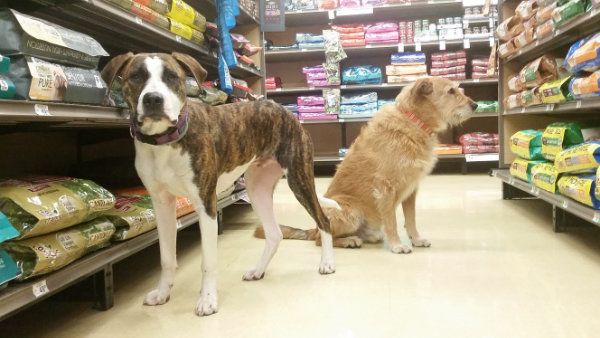
The other day, I happened to go into a pet supply store that I had never been in before, and was looking at their collection of leashes, toys, treat bags, and, of course, food, when I overheard a conversation between a couple who were in the store with their new puppy. I had crossed paths with them several times, and had smiled at and ogled the puppy each time, but they both had frowns on and were looking only at the products as they walked up and down the food aisles. Finally, they flagged down a store employee. Throwing up her hands, the woman said, “You don’t sell the food that breeder told us to get! We don’t know what to get! It’s too much!”
Unfortunately, I had to go; as much as I wanted to, I couldn’t stay to hear what the store clerk told the couple.
But I couldn’t stop thinking about it. If you knew nothing – how would you know what to buy, where to start?
Pet supply store or veterinary clinic employees: I’d love to hear from you. How do you advise people who are looking for food and don’t know what to buy?
Dog owners: How did you choose what you feed?
I’ll go first:
I feed my dogs dry foods from three different companies, mostly. I tend to buy similar formulas – a chicken-based, “all life stages” food – from each of the three companies that I am familiar with and feel good about, and I usually switch which company’s product I buy with every single bag. Why chicken? I am not a huge fan of beef or lamb, as dog foods made with these tend to be lower in protein and higher in ash than high-quality chicken-based foods. And I don’t like the smell of fish-based foods – but more importantly, fish-based foods tend to be volatile (they go rancid quickly, especially at our summer temperatures, even indoors).
Dry food is not all they eat, though. I don’t make a big point of it, but if there are healthy leftovers from the family table that I feel like they would enjoy, they get those.
Also, if a dog food company sends me samples of something new, I often feed that to my dogs, whether it’s a canned, frozen, or dehydrated diet. I’m curious to see what different products look and smell like, how the dogs like it (how palatable it is) and how it comes out the other end (how digestible it is).
Neither Otto nor Woody is sensitive to any particular food ingredient, and neither seems to have digestive trouble if there is a spike or a dip in the amount of fat or protein they get. I’m lucky! Nevertheless, I go with the three main foods I feed because they are all in the same approximate ballpark in terms of protein and fat levels. One food has 25% protein and14% fat; the next has 23% protein and 13% fat, and the last has 26% protein and 15% fat. These levels seem to maintain my dogs at a healthy weight, coat, and energy level with a reasonably sized portion.
So, that’s us. I’ll repeat the question:
How did you choose what you feed your dogs? If you advise others about diet, what do you ask them about their dogs? How would you recommend that other people choose their dogs’ foods?




PWD’s are often allergic to chicken. Breeding dogs can be adversely affected by the phytoestrogens contained in legumes which are common in grain free dog foods. That doesn’t leave one with many choices. I haven’t seen you address this topic in the WDJ. Please do. Cheryl
For convenience, we feed our 3 dogs dry in the morning and switch between several brands – Blue Buffalo being the primary and offen add in a can of chicken & rice or beef/vegetable soup or plain yogurt or canned pumpkin. At night they get Honest Kitchen and maybe leftovers from our meals.
I feed my rescue plotts hound mix Hills Science Diet Healthy Mobility or Purina Pro plan. My dog has had both her rear ligiments repaired (TPLO). For the first couple of years we feed her Natural Balance Fish and Sweet potato but change about 2 years ago after reading about DCM in many dogs that had eaten grain free or limited grain. I contacted them and asked if they were looking into the fact that many dogs were being diagnoised with heart issues and when they changed their diets they improved . There answer did nothing to calm my fears so I decided to change to a Purina or Hills dog food brand. I also give her fish oil with her am food . I also add a small amount of moist food. She has never had a weight issue,
My 6 month old, miniature poodle puppy came to me weaned on Royal Canin Puppy, Small Breed Kibble alternated with Freeze Dried Stella&Chewy’s Duck-Duck-Goose raw patties reconstituted with goats milk and cooked, pasture raised/finished ground beef ( 1 to 2 Tablespoons cooked and mixed with the Royal Canin kibble twice a week). I immediately tried to get him on a kibble from a company that did not have the history of recalls but could not find a similar, tiny kibble that he liked. He hated the higher end varieties such as Fromm because, I speculate, they don’t contain as many artificial flavors and flavor enhancers. Open a bag of higher end kibble and smell it and compare to the more chemical laden stuff and you will find that the better brands that claim to have no artificial ingredients smell like cardboard whereas the chemical brands like Royal Canin, Purina, Hills at least smell like the school/prison cafeteria and so resemble the smell of stew.
Ideally, I would feed 100% raw but that never seems to work out for my 4 dogs because of various ages, needs, and tastes. I have settled into a routine of rich variety for all of them that is mainly freeze dried raw alternated with fresh, frozen commercial raw. For my pup who is now 6 months, he gets mainly freeze dried raw because he does not like the taste of commercial frozen, fresh raw altho I sneak it to him mixed with other things (Small Batch– One of the only brands, only on the West Coast that does not pressure pasteurize their raw so the frozen patties are unadulterated ground meat, bone and organs). I did persevere in finding a small kibble that puppy likes that is higher end (I hope) because I want the option of boarding and training for him and the trainer requires kibble– Stella&Chewy’s baked, small breed size, chicken, “Raw Coated Kibble”. It smells good to me too and is not made of any byproducts. It is a fact that all kibbles have to be supplemented with fresh fatty acids as that is a nutrient that cannot be supplied fresh in a kibble. Once the bag is opened, things start going rancid (even before the bag is opened)– The sprayed on coating of fatty acids oxidizes rapidly and goes rancid especially in the presence of the catalyst of iron/zinc/copper spayed on in the vitamin coating. The baked kibbles seem to be more stable since the vitamin/mineral mix is blended in vs. sprayed on the surface (the high temp extruded kibbles have to be sprayed with the vitamins as a later step so they are not destroyed by the heat).
This is what my puppy eats: Stella&Chewy freeze dried raw patties alternating all meat varieties and alternating with fresh frozen raw Small Batch brand various meats; Canned King Salmon with bones and skin one meal a week; Canned, unsalted sardines in water with bones and skin one meal a week; Soft cooked egg yolk added to two meals a week; Full fat Greek Yogurt, tsp or two added to one or two meals a week; His kibble about two meals a week; Cooked pork, lamb or chicken about once a week mixed with Mercola vitamin/mineral canine mix with steamed vegetables. I also supplement with fish oil capsules (Nordic Naturals variety– The pet specific version capsules do not contain the lemon oil). He also gets cheese and beef for training treats because I can’t find a convenient, commercial product he likes.
Lucky dogs. I feel raw frozen patties and will not buy pressure treated food. I use Raw Bistro and Steve’s pork and Lamb/emu combo. Love the Bones and Co but fat too high. For treats I use single ingredient freeze-dried tripe, duck, beef.
When I rescued my last dog, a Chow mix, in 2012, she had only been fed kibble at the shelter, and she wasn’t too eager to eat it. So I started mixing it with some canned food, and no more problems! I didn’t know about WDJ at the time, so I consulted the Dog Food Advisor site and started her on some of their hightest rated foods. She passed from cancer in 2018 at age nine. My current rescue, a Beagle/Lab mix gets most of the same foods, just smaller portions. She generally has dry and canned foods from Merrick. I started rotating her kibble after reading WDJ; lately she’s had Merrick, Wellness, and Stella and Chewy’s. She also gets occasional beef and chicken scraps from our dinners, and she loves baby carrots. Her vet’s only criteria is not to feed grain-free food. My husband and I grew up in the 60’s and recently discussed the foods our parents fed our dogs back then – they were definitely different!
For many years I cooked for all four animals – two cats, two toy dogs. I did a great deal of research before taking the plunge, and based their food on a good quality complete ground meat (80:10:10), varying the protein sources, including some oily fish, and adding a smallish quantity of mixed vegetables for the dogs. One dog is still fed this way; one dog was diagnosed with acute liver failure 18 months ago, and now gets Royal Canin canned hepatic food with home cooked chicken breast for extra protein. The cats, now both 18, have early CKD so get whichever renal food they have decided is edible this week and home cooked adapted by replacing bone with ground eggshell to reduce phosphorus levels.
When Poppy was first diagnosed with liver failure and was very ill she refused the Royal Canin; I worked out a diet based on oats, chicken and eggs that she liked and showed my vet the spreadsheet analysis, asking him if it was OK to feed it in the short term. He said it looked fine to him, but given how much research I had put into it I probably knew more about the detail than he did! One thing I really like about home cooking for them is that it can be adapted to individual needs – one dog cannot tolerate turkey; one always needed low fat; as they have aged they have all needed fewer calories but plenty of high quality protein.
I am an Animal Science major, so know basic nutrition principles. I have spent the last 19 years researching dog foods IN DEPTH, so I can feed my furry companions the best food possible. Many, many, times I have left a store (or shut down the computer) with an overwhelming sense of WHY ARE ALL THESE BRANDS FULL OF (CRAPPIE) INGREDIENTS THAT MY DOG CAN”T EAT? ( AND< THAT I WOULDN"T FEED TO ANY ANIMAL!) I am very gratefull for the in depth information that both Whole Dog Journal and the Dog Food Advisor have provided, but it shouldn't be that difficult!! Dry foods have WAY too many carbs, but most people can't afford to feed a large dog canned food. (And freeze dried or "raw" is even more expensive!) Well meaning folks are resorting to "homemade" diets because they are overwhelmed, and scared of, commercial foods. Then the animal suffers because the food is not nutritionally balanced. The entire pet food industry needs MUCH more oversight, but sadly that will probably never happen.
Very interesting blog. We have been concerned about our newest rescue which we adopted at 8 weeks and is now 6 months. She is a 10 pound MinPin and a poor, picky eater. Vet recommended Purina Pro Plan One puppy kibble which she will not eat ( have tried their wet puppy food also). After trying any and all puppy formulas, dry and wet, we resorted to Weruva Paw Licken Chicken which our 15 year old Miniature Rat Terrier loves, along with a homemade diet of ground chicken or turkey, carrots, spinach, quinoa, turnip all cooked in a crockpot. Her coat is great, poops twice a day look great also. They get cheese, yogurt, dehydrated chicken and salmon treats, scrambled eggs and any table food we are eating. Hopefully, she is getting enough nutrition for a young pup, but we do worry that she’s not getting everything she needs.
I rotate between 3 kibble companies, and rotate proteins between turkey, fish and beef, I top with canned or honest kitchen, and again rotate beef, pork,turkey and duck. my dogs (Malinois) have no GI problems. I fiqure we humans eat a variety for health, so should my dogs. I avoid chicken only because it is in many dog foods anyway, and is also (according to chinese medicine ) a hot food, which my very active dogs do not need.
I feed at least three different dry kibble brands/multiple proteins to my 7 dogs – not at the same time – rotating. I also add cooked meat or eggs to every feeding. Depending on the dog’s size the amount each one gets is 1/2+ cups to 3/4 cup a day of meat. I add fresh fruit/vegetables,or canned pumpkin and yogurt. I don’t feed kibble that’s less than 30% protein. I supplement fish oil, gloucosomine/chrondroitin, enzymes for their teeth. I buy treats occasionally that look to be healthy – the dogs love the variety. 🙂