

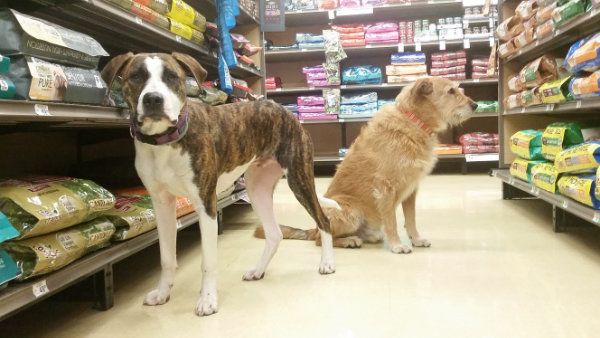
The other day, I happened to go into a pet supply store that I had never been in before, and was looking at their collection of leashes, toys, treat bags, and, of course, food, when I overheard a conversation between a couple who were in the store with their new puppy. I had crossed paths with them several times, and had smiled at and ogled the puppy each time, but they both had frowns on and were looking only at the products as they walked up and down the food aisles. Finally, they flagged down a store employee. Throwing up her hands, the woman said, “You don’t sell the food that breeder told us to get! We don’t know what to get! It’s too much!”
Unfortunately, I had to go; as much as I wanted to, I couldn’t stay to hear what the store clerk told the couple.
But I couldn’t stop thinking about it. If you knew nothing – how would you know what to buy, where to start?
Pet supply store or veterinary clinic employees: I’d love to hear from you. How do you advise people who are looking for food and don’t know what to buy?
Dog owners: How did you choose what you feed?
I’ll go first:
I feed my dogs dry foods from three different companies, mostly. I tend to buy similar formulas – a chicken-based, “all life stages” food – from each of the three companies that I am familiar with and feel good about, and I usually switch which company’s product I buy with every single bag. Why chicken? I am not a huge fan of beef or lamb, as dog foods made with these tend to be lower in protein and higher in ash than high-quality chicken-based foods. And I don’t like the smell of fish-based foods – but more importantly, fish-based foods tend to be volatile (they go rancid quickly, especially at our summer temperatures, even indoors).
Dry food is not all they eat, though. I don’t make a big point of it, but if there are healthy leftovers from the family table that I feel like they would enjoy, they get those.
Also, if a dog food company sends me samples of something new, I often feed that to my dogs, whether it’s a canned, frozen, or dehydrated diet. I’m curious to see what different products look and smell like, how the dogs like it (how palatable it is) and how it comes out the other end (how digestible it is).
Neither Otto nor Woody is sensitive to any particular food ingredient, and neither seems to have digestive trouble if there is a spike or a dip in the amount of fat or protein they get. I’m lucky! Nevertheless, I go with the three main foods I feed because they are all in the same approximate ballpark in terms of protein and fat levels. One food has 25% protein and14% fat; the next has 23% protein and 13% fat, and the last has 26% protein and 15% fat. These levels seem to maintain my dogs at a healthy weight, coat, and energy level with a reasonably sized portion.
So, that’s us. I’ll repeat the question:
How did you choose what you feed your dogs? If you advise others about diet, what do you ask them about their dogs? How would you recommend that other people choose their dogs’ foods?




I’ve become so dazed and confused with all the different thoughts, warnings and recalls about dog food. One of my current dogs has severe allergies (facial and ear flap swelling/hives and bloody diarrhea to rice, pork and poultry) and my last dog died from DCM, so honestly, I am literally scared to feed my dogs. It’s ridiculous. For the last year and a half, I’ve been using the Balance It website recipes and supplement to home-cook for my Weimaraner and German Short Haired Pointer. It’s a monumental task. I cook once a week and refrigerate/freeze the meal portions for the rest of the week. On Saturday, I cook up 20 #’s of ground beef and a colossal stock pot of organic oats or sweet potatoes (takes about 3 hours). On Sunday, I dice about 4 different organic fruits and vegetables and mix everything up and divide into serving portions (takes about 4 hours). I had to buy commercial/restaurant size mixing bowls, ovenware etc., a spare fridge and an extra freezer. It costs me $300-$500 per month depending on what I feed. Yes, I’ve lost my mind and I’m broke but I haven’t had any emergency trips to the vet, no steroids, no Benadryl; so I keep doing it.
Make sure you feed raw bones for calcium/phosphorus.
If you’re okay feeding raw, you can by premise chubs of raw 80/10/10 which is 80% meat, 10% bone for calcium and 10% organs for vitamins and minerals. To this you can add the fruit and vegetable combinations as needed.
I feed my 3 dogs Canine Caviar kibble, rotating the protein sources. I add some cooked meat, canned food, eggs, or fish for the evening meal. I like that Canine Caviar has several protein sources so that makes it easier to rotate.
I pretty much stick to a bell curve approach with feeding my little 4 pack of old dogs. I don’t feed the most expensive food and certainly don’t feed the bottom of the barrel foods either. I stick to middle of the road higher end kibble and switch it up from time to time. I also feed appropriate table scraps. My 15 year old pug mix not only has CHF now but some kidney disease as well so he is on Science Diet prescription food. I’ve been lucky with no food allergies and am grateful.
Our Boxer/Pitt cross gets Tractor Supply 4-health chicken-Rice, lamb and rice, and beef and rice flavors . We also get the 4-health chicken rice dry. She is doing well and no problems. This was recommended by out Vet.
FEEEZE DRY IS MUCH HEALTHIER THAN KIBBLE
STEVES, OPEN FARM, NULO THE BEST OPTIONS
Plus adding fresh Green Beans, carrots
My feeding rotation is a work in progress. I have raised and bred field bred Labradors for over 35 years which I use to hunt upland game-birds. I also take my dogs to the woods with me where I work as a Forester. My dogs are active and I feed foods which have a minimum of 30% protein and 18-22% fat. I like high protein, moderate fat, and lower carbohydrate foods. I’m currently feeding six Labs ranging from 9 months to 12 years in age. They ALL eat the same foods. I simply adjust the amount I feed each dog according to their needs and body condition.
My current rotation includes six formulations from three different manufacturers. Not only do I like to rotate brands, I like to vary the protein, fat, and carb sources as well. I don’t see as much advantage in feeding three different Chicken and Rice formulas, other than the obvious benefit of switching up the vitamin/mineral premixes. My mainstays have been Farmina N&D Prime Chicken and Pomegranate Puppy, N&D Wild Boar and Apple, and N&D’s Herring and Orange from their Ocean Line. I am also currently feeding Dr. Tim’s Glacier and am going to audition Sport Dog’s Tracking Dog & K-9 Hero. This rotation includes protein from Chicken, Wild Boar, Herring, Water Buffalo, Pork, Catfish, and Ocean Fish. Carbohydrate sources include Sweet Potatoes, Oatmeal, Brown Rice, Whole Grain Sorghum, and Millet. Fat sources include Chicken Fat, Herring Oil, Coconut Oil, and Salmon Oil. They say variety is the spice of life!
Feeding six Labs out of the same bag means I switch formulas every 5-9 days, depending on the size of the bag. Bags don’t get stale waiting for me to finish feeding it. I switch cold turkey; no transition, and with no digestive issues.
I also supplement my dog’s diets with toppers including canned sardines, canned salmon, canned oysters, eggs, chicken and beef liver, chicken and pheasant necks, and beef heart. The dogs also supplement their own diets with grass, dirt, tree bark, twigs, mice and other small critters they catch in the woods and fields, and the occasional bone or rank deer leg they find in the woods. Why do I allow them to eat those things? Because they are DOGS! That’s what dogs do! They are natural scavengers.
I haven’t always fed a rotation. My feeding philosophy has evolved over time as I’ve studied and learned. Whole Dog Journal has contributed to my knowledge base, especially with the wisdom of a feeding rotation. I may have upped the ante a bit by striving to vary the protein sources, fat sources, and carbohydrate sources, but it makes sense to me.
I guess the proof is in the pudding. In over a third of a century of raising genetically related dogs my shortest lived Lab died at the age of twelve. That was back in the days when I fed the same popular mainstream sporting dog food full time. Over the years the median age for the Labs I’ve owned is fourteen. My most recent old-timer passed last summer at the age of 16 years, three months, and six days. She was the granddaughter of the very first Lab I got in 1986! Not bad for a Labrador in my opinion.
I feed no kibble. I use a ground beef pet blend and a ground turkey pet blend from slankers grass fed beef. All are lower fat and have added organ meat as well as ground bone. I Also I get a minced pacific salmon from them. From northstar bison I get a bison pet blend W organ meat and bone as well as a ground pet blend chicken. The vegetable component comes from Dr. Harveys. My dog is a 5 year old choc lab about 85# and I feed her 1# of the protein per day divided into 2 meals. Our Aldi’s has grass fed 85/15 organic burger, on sale less than 5.00 /lb. so I will add that to the beef and bison blends to save a little. And from Kroger I will use their ground turkey to add to the pet turkey mix. To the salmon I add 1 large can of salmon , again to help with cost. All are prepared the same. 1 cup of veggie mix for each lb of protein. Beef and bison I make up in 6# batches, the chicken, turkey and salmon are 3# batches. Put the water and meat into a stock pot and heat it until it turns color but not boiling 145 to 160′. Then add the veggie mix, turn off the heat and let it hydrate for maybe 15 to 20 min. Mixing well. Place about 2 1/2 cups into a container and that makes 1 meal. I use 3 cup glass pyrex containers with lids. So if I’m making a 3 lb. batch that is 6 containers.
Into the freezer. I keep 6 thawed in the fridge, when I’m down to 2 I get 4 more from the freezer. I feed her a mix of these throughout the week. She was a rescue, we got her at 1 1/2. This is how I have always fed her and she is healthy.
I have one dog that’s sensitive to fowl in general. So I feed her Only Natural Pet Max Meat Beef since it’s just beef, pumpkin and vitamins/minerals. My other dog is on Farmina N&D Ancestral Grains Lamb. They also get single sourced canned fish, rabbit or pork along with fresh veggies and fruits. I also add probiotics and enzymes.
When we got our Lemon Dalmatian puppy, breeder recommended Life’s Abundance All Life Stages food. After experiencing inconsistent quality i.e. dogs wouldn’t eat some shipped product, and other issues that led to vet visits, the vet inquired about food. He suggested Royal Canin Dalmatian or a sensitive formula. Our Dals are from HUA lines so low purine food is essential. So many products now include pea protein which I need to avoid among other ingredients too numerous to mention. Both dogs have done well with the Royal Canin product. I have been frustrated by the lack of availability recently, but I know the supply chain has had difficulty this past year. I mostly make my own dog treats with simple ingredients such as banana, pumpkin or grind-my-own peanut butter and brown rice flour. Both Dals have had done well with this approach plus a scoop of Probiotic Miracle with meals.
I have three dogs, a German Shepherd, an Irish Terrier mix and a Pug Shih Tzu mix. The German Shepherd scratches like mad if she gets chicken so that is off the diet for all of them. I feed them Honest Kitchen food at night and kibble in the morning. I rotate three or four kibble brands that state clearly they are 75% or higher animal protein. Wellness Core is one and Nulo is another. Within those brands I alternate between their fish kibble and beef kibble. They also get table food if appropriate; veggies, fruit and if we eat meat they get some of that too.
As to your question about how I chose those foods, I use your guide and also research things myself. To advise others, I refer them to your guide so they will learn what to look for and not blindly choose a dog food.