

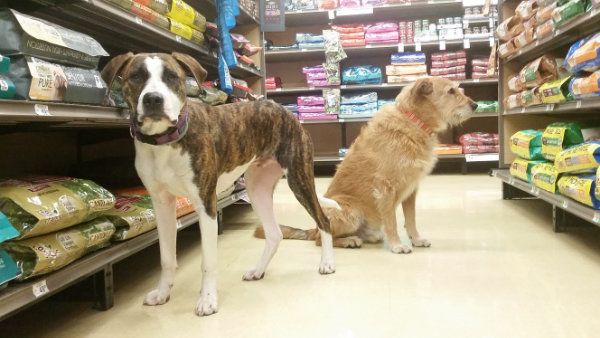
The other day, I happened to go into a pet supply store that I had never been in before, and was looking at their collection of leashes, toys, treat bags, and, of course, food, when I overheard a conversation between a couple who were in the store with their new puppy. I had crossed paths with them several times, and had smiled at and ogled the puppy each time, but they both had frowns on and were looking only at the products as they walked up and down the food aisles. Finally, they flagged down a store employee. Throwing up her hands, the woman said, “You don’t sell the food that breeder told us to get! We don’t know what to get! It’s too much!”
Unfortunately, I had to go; as much as I wanted to, I couldn’t stay to hear what the store clerk told the couple.
But I couldn’t stop thinking about it. If you knew nothing – how would you know what to buy, where to start?
Pet supply store or veterinary clinic employees: I’d love to hear from you. How do you advise people who are looking for food and don’t know what to buy?
Dog owners: How did you choose what you feed?
I’ll go first:
I feed my dogs dry foods from three different companies, mostly. I tend to buy similar formulas – a chicken-based, “all life stages” food – from each of the three companies that I am familiar with and feel good about, and I usually switch which company’s product I buy with every single bag. Why chicken? I am not a huge fan of beef or lamb, as dog foods made with these tend to be lower in protein and higher in ash than high-quality chicken-based foods. And I don’t like the smell of fish-based foods – but more importantly, fish-based foods tend to be volatile (they go rancid quickly, especially at our summer temperatures, even indoors).
Dry food is not all they eat, though. I don’t make a big point of it, but if there are healthy leftovers from the family table that I feel like they would enjoy, they get those.
Also, if a dog food company sends me samples of something new, I often feed that to my dogs, whether it’s a canned, frozen, or dehydrated diet. I’m curious to see what different products look and smell like, how the dogs like it (how palatable it is) and how it comes out the other end (how digestible it is).
Neither Otto nor Woody is sensitive to any particular food ingredient, and neither seems to have digestive trouble if there is a spike or a dip in the amount of fat or protein they get. I’m lucky! Nevertheless, I go with the three main foods I feed because they are all in the same approximate ballpark in terms of protein and fat levels. One food has 25% protein and14% fat; the next has 23% protein and 13% fat, and the last has 26% protein and 15% fat. These levels seem to maintain my dogs at a healthy weight, coat, and energy level with a reasonably sized portion.
So, that’s us. I’ll repeat the question:
How did you choose what you feed your dogs? If you advise others about diet, what do you ask them about their dogs? How would you recommend that other people choose their dogs’ foods?




I search for food that has no chicken MEAL or any kind of meal , lamb ,fish, meat, chicken in the product. I Researched HALO on line. Delivered free from Chewy.
NO table food. They may not be able to tolerate any other ingredients in the Table food. I am always asking Alexa about food. Many different fruits are good in moderation, NO grapes. Many different Vegetables are good. I sometime make their food.
My pack includes a 13 yr old poodle-pom and a 9 yr old ShiTzu Chihuahua mix. The 13 yr old has allergic reactions to every dry food and canned food that I have tried on him. Consequently he eats Darwin’s Raw food in addition to his treats of broccoli, peas, green beans, sweet potatoes and kale stems. I rotate the protein source and occasionally other brands. He is very fit and active. The 9 year old thinks she should have the same delicious food and who am I to argue. I am simply the chef!
With my present dog this has been an ongoing issue .He is now 5 but when he was a year old he had telescoping intestines which was an awful ordeal and needed intense surgery.After that he had to eat Hills ID time passed and after Hills had its recalls we tried blue Buffalo GI .I had an senior adopted dog who I got at 10 and she died of a heart murmurs few years later so I am not a fan of legumes in dog food and there is some in his present formula but overall it works I feed him canned and dry combined . I am hoping to switch him to a food without the chickpeas etc.the trick in his case is keeping the fat low and the protein down too.He never liked dry food and as a puppy he hated eating it I regret that I tried to feed him so many premium foods they were just too rich for him.He eats a can a day and I supplement with about 1/2 cup kibble and add a little chicken eggs or canned tripe .I have learned he can only have one add on a day.Strangely he does well with lean ham ( courtesy of my mother )and not so well with organic boiled chicken.I don’t think he has a food allergy but I find he does better when there is less chickenthough his food is chicken based.Yesterday I gave him small bits of chicken ham some baked wild salmon a teeny piece of aged cheddar cheese in addition to his food and he had a little issue this morning so I know I overloaded him .If I saw that couple I would tell them to stick with what the puppy was given and when he is over a year old make changes .My dog was fed Eukanuba and I thought it wasn’t good enough but I think I would have been better off keeping him on it he obviously has difficulty with high fat high and protein that those highly touted premium foods had .The vet agrees it is very tricky but a food high in fat will set him off.Someone once said to me think of what it would be like if you had to eat steak and heavy foods all the time you wouldnt feel well .I think the high protein and fat values and the rampant chickpeas and lentils are the issue.This is an ongoing problem for me and it has still not been solved completely though he has done well the past few month
I feed my female 95lb American Bulldog an 80/10/10 raw food diet. To this blend I sometimes add fruits and vegetables that are lower in carbs and mostly organic. My dogs latest physical was great, her blood work came back as excellent. She is in good health with a super soft shiny coat and her body composition is full of lean muscle. I believe a raw or home cooked diet, if nutritionally balanced, is superior to anything commercially prepared. Real food is best. I don’t eat a diet of processed foods So why should my dog?
My 7 yo female Boxer, who is my PTSD Service Dog, was just diagnosed with lymphoma. From birth I have fed her raw meat, alternating proteins, mixed with grain free Honest Kitchen rehydrated; kibble that is highly recommended by Dog Food Advisor and Whole Dog Journal and a small amount of canned approved by the above. She also gets raw meaty bones, ie chicken neck and wing, turkey neck, lamb chop, beef neck bones. She has a fantastic coat, energy, good poops etc. However, I am switching to all raw with a base that is low carb, low glycemic because of the starchy carbs in kibble. Cancer craves sugar. I have her on Pet Well Being Life Gold for cancer support and Mushroom Immune. Hoping to give her the best support possible.
What veterinary nutritionist have you consulted. What are the responses, both pro and con?
My 14 year old Spinone is allergic to fish and potatoes, including sweet potatoes. They add fish oil to most dry dog food. Chicken consistently will make her itch. I have turned to Honest Kitchen dehydrated Nut and veggie and Tuckers raw beef patties. She loves it. I also throw in a raw egg or organic chicken heart that come in whole chicken gizzard bags sometimes.
I use the same brand (Purina One) of dry dog food that my Cairn Terror’s (sic) breeder uses and recommends, usually in a low-fat/weight maintenance formula, since our girl is total chowhound and we want her to maintain her figure. With our Golden Retriever, who will turn 2 in June, we started with the same brand as the breeder suggested but found that around six months of age she became very picky and often would not eat for several days, so, at our vet’s suggestion, we switched to a “higher quality” brand, namely Merrick, which Layla loves. As a matter of fact, she now enjoys her Merrick food mixed with Diva’s Purina and is no longer a picky eater. Of course, both our girls occasionally enjoy high quality human leftovers as well.
I use a combination of high quality dry food with home cooked dog food added at every meal. I typically get Merrick, Earthborn or Wellnesss. I select their brands that have not less than 34% protein I believe it is healthier to switch dry food brands rather than stick with just one. I vary between beef, chicken and buffalo as the main protein ingredient. My dog is a highly active 57 pound standard poodle – gets lots of exercise daily so needs a lot of protein. He eats only when he is hungry – and that depends on his activity level. The home cooking includes: 85% lean burger, boneless chicken breast, mackerel, quinoa, rice, sweet potato (cubed), pumpkin, and eggs (including the shell crushed) – all cooked in a crock pot for about 7 hours. About 2 weeks worth; I freeze and take out as needed. I use lots of small training treats when out hiking/playing.
I feed raw, simply because I feel it is the healthiest option. My mother-in-law is a nutritional therapist and so I married into a family that lives on a very strict diet (which I have adopted) and I have learned a lot. It was only logical to apply much of this knowledge to my pets. That has led me to research that points out just how massive the impact of diet is on health (for people, dogs, and really all animals); “let food by thy medicine”.
I don’t judge people who feed kibble because I am very well aware of the cost and effort that goes into feeding raw. I just feel lucky to live in an area where I can source meat directly from small farms at extremely affordable prices and I have the circumstances to handle all the extra work that goes into it (my wife has Lyme disease and mental illness – so I understand that taking on this extra work isn’t possible for everyone).
Agreed! And very well said.
I too feed my American Bulldog a raw blend 80-10-10.
Her vet says her health is excellent.