

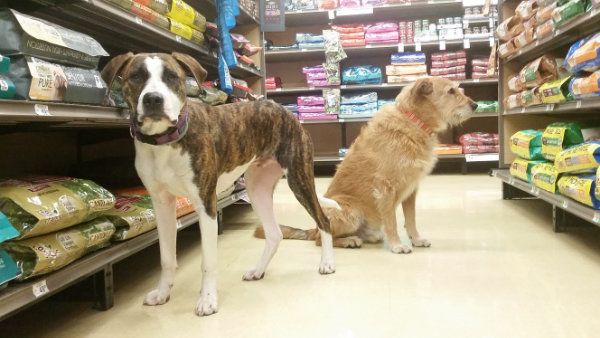
The other day, I happened to go into a pet supply store that I had never been in before, and was looking at their collection of leashes, toys, treat bags, and, of course, food, when I overheard a conversation between a couple who were in the store with their new puppy. I had crossed paths with them several times, and had smiled at and ogled the puppy each time, but they both had frowns on and were looking only at the products as they walked up and down the food aisles. Finally, they flagged down a store employee. Throwing up her hands, the woman said, “You don’t sell the food that breeder told us to get! We don’t know what to get! It’s too much!”
Unfortunately, I had to go; as much as I wanted to, I couldn’t stay to hear what the store clerk told the couple.
But I couldn’t stop thinking about it. If you knew nothing – how would you know what to buy, where to start?
Pet supply store or veterinary clinic employees: I’d love to hear from you. How do you advise people who are looking for food and don’t know what to buy?
Dog owners: How did you choose what you feed?
I’ll go first:
I feed my dogs dry foods from three different companies, mostly. I tend to buy similar formulas – a chicken-based, “all life stages” food – from each of the three companies that I am familiar with and feel good about, and I usually switch which company’s product I buy with every single bag. Why chicken? I am not a huge fan of beef or lamb, as dog foods made with these tend to be lower in protein and higher in ash than high-quality chicken-based foods. And I don’t like the smell of fish-based foods – but more importantly, fish-based foods tend to be volatile (they go rancid quickly, especially at our summer temperatures, even indoors).
Dry food is not all they eat, though. I don’t make a big point of it, but if there are healthy leftovers from the family table that I feel like they would enjoy, they get those.
Also, if a dog food company sends me samples of something new, I often feed that to my dogs, whether it’s a canned, frozen, or dehydrated diet. I’m curious to see what different products look and smell like, how the dogs like it (how palatable it is) and how it comes out the other end (how digestible it is).
Neither Otto nor Woody is sensitive to any particular food ingredient, and neither seems to have digestive trouble if there is a spike or a dip in the amount of fat or protein they get. I’m lucky! Nevertheless, I go with the three main foods I feed because they are all in the same approximate ballpark in terms of protein and fat levels. One food has 25% protein and14% fat; the next has 23% protein and 13% fat, and the last has 26% protein and 15% fat. These levels seem to maintain my dogs at a healthy weight, coat, and energy level with a reasonably sized portion.
So, that’s us. I’ll repeat the question:
How did you choose what you feed your dogs? If you advise others about diet, what do you ask them about their dogs? How would you recommend that other people choose their dogs’ foods?




We’ve talked about legumes a lot in the magazine. You could search for “legumes” in the WDJ site search bar.
https://www.whole-dog-journal.com/food/diet-dogs-and-dcm/
https://www.whole-dog-journal.com/blog/please-don%c2%92t-panic-about-the-%c2%93grain-free-thing%c2%94/
We note in our annual dry dog food review which foods have a preponderance of legumes in the formula. When legumes are used in a formula, we would prefer to see just one (certainly not three or more) and low down on the ingredient list, so they play a minor role — not constitute a major protein source.
https://www.whole-dog-journal.com/food/whole-dog-journals-approved-dry-dog-foods-for-2021/
I read–probably in your journal–that it is a good idea to rotate different brands. I asked my vet, and since she agreed, that’s what I do. I asked two vets at that practice for recommendations when my dog was a pup, and I used your dry dogfood reviews to narrow that down. A couple of these seemed as if they might be too rich for my shepherd-lab mix, so that further reduced the selection. So, now we rotate between about four brands, giving more turns to the ones he finds most palatable. He gets lots of treats for reinforcing behaviors as we hike in the woods, and biscuits in the morning. It seems to be working well, he is in excellent shape and has plenty of energy.
Hi,
I feed my 3 year old German Shepherd a wide ranging mix of foods. The bulk (about 70%) is from fresh and often raw
chicken with bone, beef/buffalo usually raw but not always, ground turkey usually cooked, fresh egg once/twice a week,
cooked fish including salmon and different whitefish. Beef or buffalo liver once a month, cooked lightly. In addition
she gets some lightly cooked veggies like asparagus, brocolli, spinach (small amounts). Once in a while brown rice, or
whole wheat pasta like penne in small amounts, a few blueberries tossed on top of the rest. Pre and pro biotic powder
to help with digestion. Once in a week a 1/2 tablespoon of apple cider vinegar. Mixed with the above is a cup of high quality kibble like Dr Gary’s (made in Ohio) or Orijen. Sometimes, instead of a prepared bowl, she gets a meaty beef bone with nothing else that day.
I generally choose a readily available dry kibble that shows up on WDJ’s “good” list, but then fed through my own bias. for example, I don’t trust Blue Buffalo, because of the way they’ve handled their sourcing, recalls, and customer interactions. I currently feed Wellness (usually Wellness Core original or Wild, but I’m not anti-grain, so their Super-mix is fine as well). They add taurine, a suspected deficiency in most non-grain foods, which is nice. They also handle their recalls very well. I remember them recalling one batch of puppy food because it didn’t meet their moisture parameters. There were no incidents, no customer complaints, and they didn’t have to be transparent, but they were. EVERY manufacturer, boutique or Old Roy, will have the occasional issue. Short of actual negligence or extremely poor judgment, it’s how they handle those issues that matters to me.
Never just kibble – its too processed. I do add it in the mix but put in cooked ground turkey, a little steamed broccoli, and a couple spoonfuls of a hydrated freeze-dried food (either Sojos or Honest Kitchen).
I have 4 dogs, each with different energy levels, and dietary requirements so I often need to change foods for some or all. Cheap big-box-store foods tend to give them all diarrhea. I do monitor their poop quality. My mixed Aussie (6 yrs old, was 10 lbs overweight) developed pancreatitis a few months ago so he is on a low fat, healthy weight product Purina Pro Plan, canned and dry. My 12 yr old German Shorthair, 2 yr old Red Healer, and 6 yr old female Aussie mix get Blue Buffalo dry. I used to free choice the dry food but stopped when the older dog started gaining too much weight. I try avoid foods that have any kind of corn as the first or second ingredient. I live on a farm so the dogs supplement themselves with horse poop, road kill and the occasional wild animal. So far, so good.
Good for you for recognizing that all your dogs have different needs! Lots of people feed all their dogs the same diet no matter what. I’ve been lucky with my two so far, but have had dogs on different diets before. It’s more work but of course necessary!
I too feed my dog three different types of high quality kibble mixed together, supplemented with fresh meats, vegetables and fruit from my own meals. He loves it! I feed a variety of proteins, and he has no food issues! I have a question for you. When I look at protein content and the ingredients (I always read the labels!), there are usually a lot of legumes, which increase the protein content! I can’t wrap my head around the idea that my dog should eat lentils, peas and other legumes in such quantities. It seems dog food manufacturers have found a cheap (and hopefully benign) way to increase protein content. What is your opinion on the prevalence of legumes in dog food these days? Yes! I find choosing a dog food confusing too! Thanks!
Hi Nancy,
I could not help but respond to this article. I normally choose my dog food based on the
Dog Food Advisor’s ratings. I always go with a food they rate as 5 as this is their highest
rating. I also use chicken base all life stages food. I have 3 large mix breeds.
If you are not familiar with The dog food advisor check them out at
dogfoodadvisor.com
Thanks for all your helpful advise.
Gene Mathews
The “Dog Food Advisor” is apparently a dentist and his qualifications to rate dog foods in my mind is questionable. So after reading about him, I no longer use his site. I suppose any of us could initiate a web site to rate foods! I guess the best foods are the ones that work for your dog. All my dogs have always had “high end” dog foods, but I still lost most of them fairly early at ages anywhere from eight to eleven. Then I speak with people who feed cheap kibble and their dogs live much longer. So go figure!!
Herb Kaufman
Herb, I have also noticed that many of my friends’ dogs who get what I consider to be poor diets (and the same meal day in day out) like Iams, Purina, etc. live as long as my dogs that get a rich variety.
The best advice on dog food, in my opinion can be found on Dr. Karen Becker’s podcast. Her video library is on MercolaHealthyPets.com and many also can be found directly on YouTube. Be sure to check out her new, version two “Best and Worst Pet Foods” and her recent interview with Steve Brown. Steve is one of the leading experts on dog foods. Sorry to maybe disappoint you but he is not a veterinarian but I think a retired software engineer. His qualifications are that he is brilliant and passionately interested in feeding his own pets healthy foods and helping all pet dogs. He started Steve’s Real Food For Dogs company but is no longer with that company. He wrote one of the most practical and factual books about dog nutrition “Unlocking The Canine Ancestral Diet”. Note: The first half of this book is practical advice for improving a dog’s diet with the addition of specific, super foods weekly. The second half gets into amounts, math and the biochemistry and is not for the layman. The book is short and I recommend the first half for all dog owners.
My dogs love the variety of healthy foods I give them and they all have very healthy teeth, coats and GI tracts. So, I will keep reading, learning and making their meals interesting. One of the saddest things I think is for a dog to have to eat the same cardboard kibble day in and day out all the while smelling all the delicious things that the human pack gets to eat. Dogs are smart and they know that is unfair.
My ten year old GR was rescued at age five, and developed IBD shortly thereafter. Having a firm stool has never been a constant with her. Along with her oral and injected B12 , enzymes, and pre- and probiotics, I feed her 2/3 freeze dried (usually turkey or beef) and 1/3 kibble, occasionally changing brands of both. I tend to change with the stool change, figuring that maybe she was becoming sensitive to one or more of the ingredients in the current fare.
Farmina chicken and pomegranate. His breeder recommended it and after studying the nutrition content and researching the product against other brands it was Farmina for the win. My Belgian Shepherd loves the stuff, and I supplement with fresh veggies – goofball is partial to asparagus and broccoli and don’t expect to eat the green bans on your plate without sharing – plus some canned food: Weruva, Merrick or whatever I see that meets nutrition standard of quality food. Better food = fewer health problems. And I want him with me and healthy as long as possible.
I feed Farmina chicken and pomegranate to my cat The pet food store that sells it calls it kitty crack