

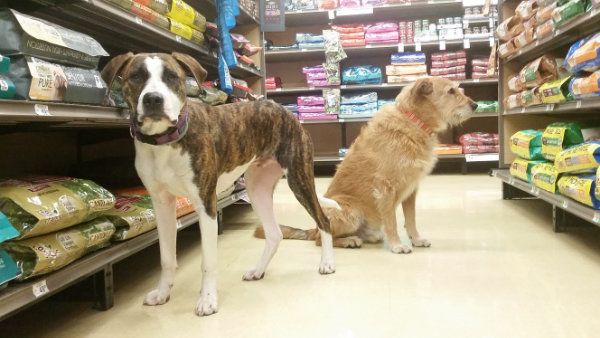
The other day, I happened to go into a pet supply store that I had never been in before, and was looking at their collection of leashes, toys, treat bags, and, of course, food, when I overheard a conversation between a couple who were in the store with their new puppy. I had crossed paths with them several times, and had smiled at and ogled the puppy each time, but they both had frowns on and were looking only at the products as they walked up and down the food aisles. Finally, they flagged down a store employee. Throwing up her hands, the woman said, “You don’t sell the food that breeder told us to get! We don’t know what to get! It’s too much!”
Unfortunately, I had to go; as much as I wanted to, I couldn’t stay to hear what the store clerk told the couple.
But I couldn’t stop thinking about it. If you knew nothing – how would you know what to buy, where to start?
Pet supply store or veterinary clinic employees: I’d love to hear from you. How do you advise people who are looking for food and don’t know what to buy?
Dog owners: How did you choose what you feed?
I’ll go first:
I feed my dogs dry foods from three different companies, mostly. I tend to buy similar formulas – a chicken-based, “all life stages” food – from each of the three companies that I am familiar with and feel good about, and I usually switch which company’s product I buy with every single bag. Why chicken? I am not a huge fan of beef or lamb, as dog foods made with these tend to be lower in protein and higher in ash than high-quality chicken-based foods. And I don’t like the smell of fish-based foods – but more importantly, fish-based foods tend to be volatile (they go rancid quickly, especially at our summer temperatures, even indoors).
Dry food is not all they eat, though. I don’t make a big point of it, but if there are healthy leftovers from the family table that I feel like they would enjoy, they get those.
Also, if a dog food company sends me samples of something new, I often feed that to my dogs, whether it’s a canned, frozen, or dehydrated diet. I’m curious to see what different products look and smell like, how the dogs like it (how palatable it is) and how it comes out the other end (how digestible it is).
Neither Otto nor Woody is sensitive to any particular food ingredient, and neither seems to have digestive trouble if there is a spike or a dip in the amount of fat or protein they get. I’m lucky! Nevertheless, I go with the three main foods I feed because they are all in the same approximate ballpark in terms of protein and fat levels. One food has 25% protein and14% fat; the next has 23% protein and 13% fat, and the last has 26% protein and 15% fat. These levels seem to maintain my dogs at a healthy weight, coat, and energy level with a reasonably sized portion.
So, that’s us. I’ll repeat the question:
How did you choose what you feed your dogs? If you advise others about diet, what do you ask them about their dogs? How would you recommend that other people choose their dogs’ foods?




I give my 70# German Shepard a dog food called Beaver Creek. I picked it because Dog Food Advisor gave it really good reviews. It is also made very close to home and is always fresh with long use times on it. He also gets low fat yogurt with his dog food for breakfast and boiled chicken with his dinner. He might get some leftovers, instead of the chicken, if it’s healthy. That is how I vary his dog food, with the additions. Some other dog food gave him the runs, or made him itch. He gets lots of snacks, cheese, charcuterie, turkey, carrots, steak..of course not all at one time. Needless to say, our dog eats very well. But we do watch his weight very carefully. He is happy, his coat is shiny and beautiful and his poops are small and good shape so he is metabolizing everything very well. I am happy with his diet.
How can I reply to Nancy Kerns’ 5/5/21 article about how i decided what to feed my puppy? I would like to respond.
I have also been a satisfied subscriber for at least 20 years, referred dozens of people to WDJ, and given many subscriptions as gifts.
I feed my border collie a human grade dehydrated food and a frozen human grade raw patty. Also I like Tylees frozen food from Chewys when it’s available. I add a green powder supplement. I rotate the protein sources. My dog’s coat is absolutely gorgeous. People stop to ask all the time what I wash him with and I have to say “it’s the food!” He doesn’t get a lot of table scraps because I put onion in too much of my own food. He came to me with a thin dull coat and digestive issues, which are gone now. If I had more than one dog this could be cost prohibitive but I have just one.
Well, if someone asked me what to feed anyone alive on this planet, no matter how many legs they have, my answer would certainly not be ‘highly processed foods’… What would you think if someone told you that you had to eat that cooked to shreds stuff out of a bag, twice a day, for the rest of your life? Would you think that a healthy diet for you? No? Well then… Most assuredly it’s the same for every other living being.
You’re doing your dogs at least a small favour by feeding them your table scraps. It’s undoubtedly the best they’re getting.
You’re right. Kibble isn’t as natural as canned which isn’t as natural and healthy as a home-prepared or commercial fresh or frozen diet. But the vast majority of domesticated dogs eat kibble. If it was as deadly as some purists make it out to be, we wouldn’t have a pet overpopulation problem.
I used to be more of a purist but I don’t like to judge the food choices other people make. Kibble is convenient and as long as a dog does well on it — long life, good condition — what’s the point in saying it is not “healthy”? If I had small dogs, or maybe just one dog, I would likely feed more fresh food. Feeding a higher-quality, “real food” diet is not practical for many owners. It would be prohibitively expensive for me, with two large dogs — and take more time than I have to shop for and prepare if I made it from scratch.
It feels like I’ve had the fear of kibble drilled into me and my current integrative vet is strongly opposed to dry dog food, even though my dog seems to prefer it (Acana, Farmina and Stella & Chewy’s). She’s also allergic to chicken and highly sensitive to even the smallest changes in her diet. We’ve tried all the fresh frozen brands (Farmers Dog, Ollie) which she initially likes, but then she loses interest after a few weeks or months. She’s currently eating Nom Nom but I can tell it’s also losing its appeal.
I feed V-Dog, vegan food for dogs (the taurine source is synthetic). As omnivores dogs don’t need meat and considering the health effects of meat on people and how biologically similar we are, I prefer to feed plants. That being said, I do occasionally give a tbsp of wet food as a topper (mainly when on meds in rare cases), but mostly top with green beans, fruits and other veggies which they love. We use their kibble for foraging activities and even training, except in tough or new situations (one of our dogs is leash reactive) I do use cooked chicken cut into tiny bits. Lots of plant-based treat options we like better. The difference in their coat and overall health is amazing after just switching from vegetarian food (which I fed a long time before switching over to Natural Balance vegan now V-Dog) to vegan.
Natural Balance is a poor food in my opinion based on the ingredients and I can’t imagine feeding a vegan diet to carnivores. True, dogs are not obligate carnivores like cats so can sustain themselves with some meals of vegetation when they can’t catch a rabbit. The evolutionary study of wolves and all other canines species in the world proves that dogs need meat. A synthetic bag of chemicals mixed with vegetable material is not what they evolved to eat. All other arguments aside, it is a scientific fact that canines did not evolve to eat vegan.
Amen
Agreed!
This vegan dog food idea is nuts and honestly goes against everything about a canines natural design
Absolutely. Just look at their teeth. They were evolved to eat meat and some grains and vegetation. I consider dogs more omnivores, like bears. Bears will eat leaves and berries too but if it’s salmon season they are on an all fish diet and they won’t turn their noses up at a deer carcass either.
Great blog about food. I do something similar although I switch between salmon based food and chicken based food. My dog (Siberian Husky) does really well on these. I also sometimes add Honest Kitchen to these and give fresh veggies like zucchini and carrots (which he LOVES). I wish that there was a way for us dog owners to get small samples of food like you do. I patronize a small family run pet store chain (only a few stores in my county). I used to see samples out on the counter years ago.
Thanks for your thoughtful post Nancy!
This is interesting and something I struggle with. My dog is allergic to chicken. That makes it really hard to find a good quality food. She also has an extremely sensitive stomach to change. Finding a puppy or all stages food with grain and without chicken has been very difficult. Currently she’s on open farms salmon but it is grain free. However; she tolerates it and she’s growing. I’ll probably switch her to something else after a year but the struggle is real.
That is REALLY challenging. Been there, done that. Chicken is ubiquitous. When I had a Border Collie who would chew his skin practically off overnight if he ate something with chicken in it, I finally found a food that didn’t contain chicken and his coat grew in. I fed JUST that food and was careful with treats and food from the kitchen. Then, all of a sudden, he broke out again. I thought it was fleas, couldn’t find any…. finally read the ingredients label on the food he had eaten for years without trouble: they changed the formula and added chicken. ACK!
Similar problem. My Ramses developed a chicken allergy when he was about 10. The Vet said that dogs will often do this if on the same protein year after year. Doesn’t matter if you change brands. Here in the U.S. it’s chicken because that is a cheap protein source for dogs. In Australia it’s…lamb. After a very expensive vet bill for an ear hematoma and a month of eating every chuck roast in my freezer, Ramses got his stitches out and i searched for another dog food. I started with a fish based, no chicken. I also had to be careful with the treats as even the beef ones would have chicken. He got plain Milk Bones for a while. After a year I was able to rotate him on to a lamb with no chicken and then a beef with no chicken but the struggle was hard. It was harder with treats. I had to carry them with me at all times as if a store employee wanted to give him a treat, they had to use one of mine. But no more ear shaking. He lived to be 14 years and 9 months.
You might check Merrick Ancient Grains line of kibble. I find it at Petsmart or Chewy. My vet strongly recommends against grain free foods and they can be difficult to find.
There are several hypothesis for why so many dogs are allergic to chicken. One is that given that so many dry foods are chicken based that statistically speaking, most pups are weaned to a chicken kibble when they still have GI issues such as worms and/or giardia and/or coccidia. The combination of the leaky, irritated gut with the chicken protein puts these pups at higher risk to reacting to the chicken. Second hypothesis is all the vaccines (grown on chicken embryos). Third and least likely hypothesis is that allergy susceptible dogs will react to chicken because it is the most common ingredient in dog food. That is not a great hypothesis because it is not the case that many of these allergy “prone” dogs then go on to have a lamb or beef, etc. allergy when the food is switched to having just these other meats. The fourth hypothesis that I can think of is that most dogs are on chicken based kibble and most of these kibbles contain many bad ingredients that irritate the heck out of the gut. The combination of chicken proteins with carageenan and/or artificial flavors and preservatives, coloring agents and all the other chemicals necessary to turn rendered, extruded protein and carb into something palatable sets the stage for the chicken allergy. It is true that the fatty acid profile of chicken is high omega 6 and so pro-inflammatory in general. Who knows.
My 14 1/2 year old miniature poodle is terribly allergic to chicken and gets bloody colitis if she has even a small amount. She cam to me as an 8 week pup weaned onto a chicken kibble and she had a very significant case of giardia that took various medications and weeks to finally clear. I assumed it was the irritation of the giardia and also the irritation of the medications (poisons) that conspired to precipitate the allergy.
I trained early in the 80s with Wendy Volhard and learned then to read ingredients, be aware of what’s filler, and what is a good protein. And, I can only tell you as a former employee, for 12 years, at my vet clinic, I could not tell clients what I recommended, but what the clinic recommended of the big three manufacturers that we carried. Currently, my Gordon Setter is on Fromm’s Salmon, which I alternate with their duck kibble. With that I supplement with Missing Link Hip and Joint powder since my dog has a bad hip. I also make what I call a chicken goulash that goes with the kibble – into the crock pot goes chicken thighs, sweet potatoes, spinach (frozen), and snips of fresh parsley. I gave up trying to convince dog showing friends to feed better than the food they buy cheaply in bulk.
What three brands do you use ? I normally feed mine dry with some meaty toppers now and then .
My Doberman is sensitive to chicken so I have to stick with lamb or fish but my two chihuahuas can eat anything
So sorry about the chicken allergy! My last dog, a Border Collie named Rupert, was highly allergic to chicken. It’s hard to find food, treats, and supplements without chicken! I know exactly how lucky I am with my non-allergic dogs now.
The three brands I tend to buy: Avoderm’s Chicken & Brown Rice, Canidae All Life Stages Chicken & Rice (I’m keeping an eye on Canidae, since the company sold not long ago), Instinct Be Natural Chicken & Brown Rice.
Nancy, I didn’t know about Canidae. We use the Pure Real Duck and Sweet potato for my Vizsla with allergies and he’s finally stable. How will I know if something major changes with their food or it’s quality after the sale? What should I look out for?
I did not know about Canidae. I have been feeding Life Stages for over 15 years. I hate to hear they sold. How would I know the changes? Many times it not clear that it’s differet
I feed my Dane Tuscan Natural Simply Pure Lamb Dry Dog because he has multiple food allergies as shown in multiple blood test results. You cannot buy this in a typical store, but only in a dog specialty shop. My little Xolo I feed a raw diet.