

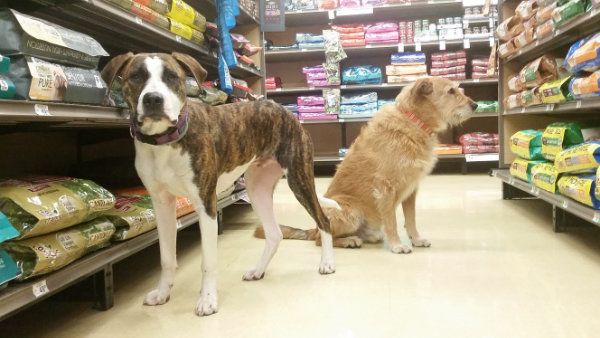
The other day, I happened to go into a pet supply store that I had never been in before, and was looking at their collection of leashes, toys, treat bags, and, of course, food, when I overheard a conversation between a couple who were in the store with their new puppy. I had crossed paths with them several times, and had smiled at and ogled the puppy each time, but they both had frowns on and were looking only at the products as they walked up and down the food aisles. Finally, they flagged down a store employee. Throwing up her hands, the woman said, “You don’t sell the food that breeder told us to get! We don’t know what to get! It’s too much!”
Unfortunately, I had to go; as much as I wanted to, I couldn’t stay to hear what the store clerk told the couple.
But I couldn’t stop thinking about it. If you knew nothing – how would you know what to buy, where to start?
Pet supply store or veterinary clinic employees: I’d love to hear from you. How do you advise people who are looking for food and don’t know what to buy?
Dog owners: How did you choose what you feed?
I’ll go first:
I feed my dogs dry foods from three different companies, mostly. I tend to buy similar formulas – a chicken-based, “all life stages” food – from each of the three companies that I am familiar with and feel good about, and I usually switch which company’s product I buy with every single bag. Why chicken? I am not a huge fan of beef or lamb, as dog foods made with these tend to be lower in protein and higher in ash than high-quality chicken-based foods. And I don’t like the smell of fish-based foods – but more importantly, fish-based foods tend to be volatile (they go rancid quickly, especially at our summer temperatures, even indoors).
Dry food is not all they eat, though. I don’t make a big point of it, but if there are healthy leftovers from the family table that I feel like they would enjoy, they get those.
Also, if a dog food company sends me samples of something new, I often feed that to my dogs, whether it’s a canned, frozen, or dehydrated diet. I’m curious to see what different products look and smell like, how the dogs like it (how palatable it is) and how it comes out the other end (how digestible it is).
Neither Otto nor Woody is sensitive to any particular food ingredient, and neither seems to have digestive trouble if there is a spike or a dip in the amount of fat or protein they get. I’m lucky! Nevertheless, I go with the three main foods I feed because they are all in the same approximate ballpark in terms of protein and fat levels. One food has 25% protein and14% fat; the next has 23% protein and 13% fat, and the last has 26% protein and 15% fat. These levels seem to maintain my dogs at a healthy weight, coat, and energy level with a reasonably sized portion.
So, that’s us. I’ll repeat the question:
How did you choose what you feed your dogs? If you advise others about diet, what do you ask them about their dogs? How would you recommend that other people choose their dogs’ foods?




I own a more natural pet shop and have worked in the natural pet world for the last 12 years. What i ask my customers when they come in looking for food: The age of the dog, the breed, activity level, what foods they currently feed and if there is any health issues they would like to work on ( weight, skin/coat, age related issues, digestion etc. From there I make a suggestion or suggestions. It’s always a balance of what works best for the dog and what works for their budget/lifestyle. Brands i love? Natures Logic, Open Farm, Stella, FirstMate, Small Batch, Primal, Honest Kitchen, Northwest Naturals. I am a fan of incorporating as much fresh foods are works for your dog and your budget but also feel that feeding a minimally processed foods doesn’t have to be all or nothing. Some can be so beneficial.
I started cooking for my 12-year-old German Shepherd and I’m delighted with the outcome. No kibble. 1/3 meat, 1/3 rice, 1/3 cooked vegetables. The meat is cooked and ground in my food processor. Lately there’s been a lot of venison but when that runs out I’ll go back to buying an assortment. Vegetables, also chopped in my food processor, can be carrots, cauliflower, broccoli, green peppers, purple cabbage, etc. The rice is cooked in the broth from cooking the meat and the vegetables. He also gets various supplements. I dehydrate his training treats out of oatmeal, sweet potatoes and carrot peels and cans of salmon. His treats are dehydrated fruit, frozen in a Kong yogurt, celery with peanut butter, pumpkin, an egg or anything that I may be eating. His coat is better and he’s more regular. He’s a happy camper as am I.
About how I chose what to feed my dogs: I began raw food or natural food diet in the 90’s – I read everything I could find on the benefits, risks and recommendations for a well balanced diet. My dogs now eat what I call my “rotation diet” a meal may be fish, or chicken backs, or a veggie mix or kibble. I began rotating foods years ago after I noticed my dogs who ate different foods didn’t have gastro upsets when they were given a new food. I added kibble to the rotation for 2 reasons: kibble is easier to take to dog shows and it is easier for puppy buyers to deal with. I agonized over what to do about introducing my new litter to food. Knowing that my puppy homes would not be willing or able to feed a home made diet, I researched and chose a good kibble.
Regarding my advice to others about diet: I occasionally have someone ask for information. I am careful not to lobby for my approach. Instead, I ask why they are considering it, How much time are they willing to devote to finding the right “recipe” ( combination of foods and supplements that will provide complete and well balanced diet). How many dogs will you be feeding? I have fed as many as 7 Labradors at a time – the numbers definitely make the preparation time consuming. I find the investment of time is worth it but many people will not.
We feed Fromm. When our girl was a puppy it was the first brand that didn’t cause “liquid gold” as we called her BMs. We just stuck with it after that. For most of her life we switched between the flavors. Now we feed the senior, or weight management version. She also gets fruits, vegetables, yogurt, and eggs on a daily basis.