

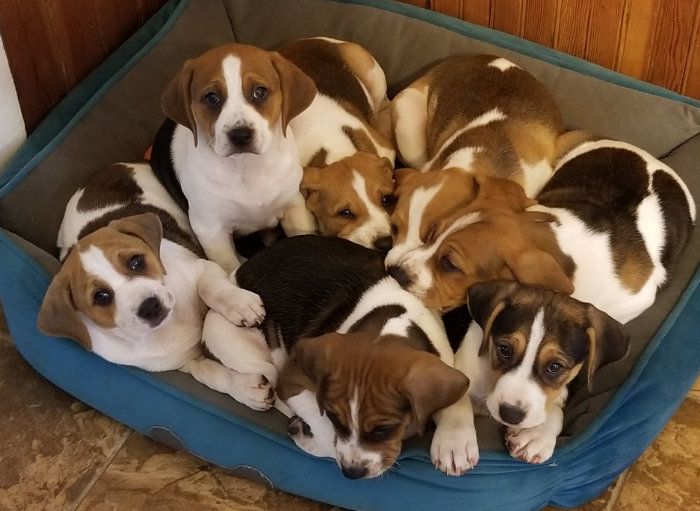
I’ve been fostering dogs and puppies for my local shelter for 15 years. Wow! Time flies – until I thought about it, I didn’t realize it had been that long.
Recently I was talking to another long-time foster provider, Kathy Callahan, trainer and author of 101 Rescue Puppies. I shared with her that, on the day I brought my most recent litter of puppies that I had been fostering for my local shelter back to the shelter to get spayed/neutered and adopted, someone who had seen me crying my eyes out over bringing the puppies back to the shelter said to me, “I could NEVER go to a shelter, it’s too sad!” Well, this snapped me out of that crying spell; I whisked over to “furious” in just a few seconds!
“Sad?!” I snorted. “I’ll tell you what’s sad: The fact that too many people would rather ‘rehome’ their intact dogs or ‘accidental’ puppies to other individuals, who fail to spay, neuter, or contain THOSE dogs, so the cycle goes on. It’s not ‘sad’ if puppies in shelters ALL get vaccinated, neutered, microchipped, and placed in a screened home, it’s SUPER HAPPY NEWS.” Whew! I was seeing RED.
I got hot again when recounting this conversation to Kathy, and fortunately she laughed wryly, completely understanding my emotional whiplash. She said, “I’ll tell you what makes ME see red…” and within the space of a few minutes, we had a Top Five Stupid Things People Say to Foster Providers.
We agreed that number 1 is this: “That puppy/dog loves you so much! You HAVE to keep him/her!” (Rebuttal: One of our most important jobs as a foster provider is to help the dog or puppy/puppies learn to love and trust humans. If they love me and the other people in my fostering circle, they should be able to learn to love and trust other humans, too. Plus, if I keep this one, my fostering days are likely over. You see, I have only so much time, money, and energy for my dogs. One more dog at home will max out one or more of those limited resources, but if this dog gets placed in a loving home after growing to an adoptable age/recovering medically/improving behaviorally, then I can help several more dogs this year!)
A close second: #2 is, “Those two dogs/puppies love each other so much! They HAVE to get adopted together!” (Rebuttal: Usually, when two puppies or dogs are super tightly bonded, this affects their ability to bond to the humans in a household. Tightly bonded pairs tend to look to each other for support, comfort, and direction, and avoid the less-familiar attention of the humans they just met. Separating them may seem harsh for a day or two, but they will almost always start to pay more attention to and seek attention and comfort from humans once they are separated. Only then can real work begin to get them socialized and happy with humans – a prerequisite for finding “forever homes.” It’s far, far more difficult to find families who will take two dogs than one, and almost impossible to find families who want two dogs who want little to do with humans.)

Number 3 is the first one that Kathy first shared with me: “I love dogs too much to foster! I would want to keep every one!” (Rebuttal: Our love for dogs is exactly why I and Kathy foster: We want to help as many dogs and puppies as possible learn the social skills they need to succeed in homes and then find good homes. The idea that someone who doesn’t foster loves dogs more than us is ridiculous. We love dogs so much that we want to see as many of them in homes as possible.)
My trainer friend Sarah Richardson, owner of The Canine Connection in Chico, California, offered #4 and #5: “You’ve put so much work and training into that dog, don’t you just want to keep him/her?” and “It seems cruel to send that dog to another home, now that he/she is so comfortable with you!”
Sarah has had some very long-term foster dogs, including one that she took on from my local shelter following an environmental disaster (the collapse of the Oroville Dam spillways). This dog was on the list to be euthanized by the shelter, likely right after all the evacuated animals were returned to the shelter – but this particular dog (and about 15 others) happened to be taken in by Sarah, who had volunteered her facility as a temporary safe space while the shelter had evacuated due to the potentially collapsed dam. The dog had massive, serious health and behavior issues – and she also loved humans with a joyful spirit that just grabbed at Sarah’s heartstrings. Sarah dedicated herself to saving this foster dog’s life, and spent literal years and thousands of dollars solving the dog’s physical and behavioral issues – and keeping her either safely away from other animals (since predation and dog-aggression were her most serious issues) and happily engaged with enriching toys and activities, to maintain her mental health.
Since Sarah has several of her own dogs, keeping a dog-aggressive dog means neither her own dogs nor the foster dog can ever be completely relaxed and comfortable – or enjoy full, free access to Sarah’s entire home. But letting the dog-aggressive dog be placed in a home with other dogs (or other small animals) sets up that dog for inevitable failure. And so it took years to find a safe, suitable, only-dog home for that dog. Anyone else would have lost hope for finding that dog a home and given up; Sarah was a superhero for holding the line at finding the dog a genuinely qualified spot, and keeping her own dogs and the foster dog as safe and happy as possible until that happened – but she did it. That dog finally found a home with people who love and appreciate her affectionate, playful, joyful spirit and perfect leash manners.

(So, the rebuttal: “When I foster, my goal is not to just get rid of the dog as quickly as possible, it’s to equip the dog with the skills and health he/she needs to succeed for the rest of her life in a home, to help find a home that can meet the dog’s unique needs, and to help the dog and the family learn to love and trust each other. When I foster dogs with significant health and/or behavior problems, accomplishing these goals can take a long time – sometimes, much longer than I had planned or hoped. But it makes no sense to settle and rush the dog into a placement that is likely to fail. And when the right adopter comes along, someone who is ready and able and excited about providing everything the dog needs, it makes all the time and money and energy worth it. And then I can go back to enjoying my own dogs full time, without guilt over the one who was euthanized because no one cared enough to put in the work she needed.”)
Do you foster? What’s the stupidest thing someone ever said to you about fostering? Or, have you inadvertently said something stupid to a foster provider? Spill it, and we can likely rebut it for you. 😊




I have started fostering my 1st dog. This article helped me in so many ways. It put things into perspective and helped validate why I wanted to go through this journey. It also had great tips. Thank you for putting this out there.
Loved the article. As a foster provider, I’ve heard all the same things and have (2) basic responses: Most of the people who advocate for the foster to keep the dog are usually thinking about how “giving up” a foster affects – them. “I could never, it’s too sad (for me), the poor dog is so attached (to me), etc. To those people I remind them that it’s not about you – it’s about what’s right for the dog – as in getting them into a good, permanent home where they can flourish.
To the others who simply can’t understand how a foster deals with the emotion of the process, I tell them that fostering is a bridge from a stray dog/shelter dog/pound puppy to a beloved family pet. We’re just helping them on the journey. Of course I’ve missed plenty of our fosters, but seeing them weeks, months, or years later with their forever families is the most rewarding thing ever,
Nancy- you and your fellow foster parents are angels and I just want to say thank you for all that all of you do to save these precious dogs that need help to save their lives.
I have never ‘fostered’. But I have taken on unwanted dogs, and rehomed some of them later to hoes that I thought would suit them better, if there were problem with other dogs here.
in my dotage, I’ve reluctantly come to the conclusion that I should NOT take on another puppy 🙁 .
So I am thinking when my current dogs go, to try to take on an older dog or two from someone who is in need of surrendering an older dog.
I just cannot imagine life without at l3east one dog, preferable two.
I love this article (though I’m frustrated because it’s so accurate,) and I’m sure I have heard all of those comments (and maybe more that I have just chosen to remove from the cache of my brain as mental trash,) and I always try to make it very clear that the reason I have been fostering neonatal kittens, hoarding case and other undersocialized adult cats, and dogs and puppies with all manner of challenges (though mainly behavioral) almost nonstop for years, is because there are never enough people willing to give up their own lack of self-control of “needing” to keep every animal they come across, to make a Huge impact on the homeless pet problem in the US. The reasons of lack of time, experience, or interest are all fair and reasonable, but this one just kills me.
I feel like it is one huge hurdle that, if we could get the public past it, so many more lives could be saved. I was truly hoping that he huge uptick in fostering during the COVID lockdowns would “stick,” at least somewhat, and that many of those new fosters would catch the foster bug, from all of the reinforcement they received during their journeys, but sadly, that doesn’t seem to be the case, at least in my area. City and county shelters are totally full, and the reality is that they need to make space, so they have to start killing the ones whose stays are too long, or who have medical or behavioral challenges they cannot or are unwilling to address.
I volunteer for my local shelter and a large national private rescue group, and although the private organization has a much larger group of willing fosters (presumably because they are a no-kill group,) there are Tons of people I encounter every day at either location, and of course online, who are so disappointed about the current state of the homeless pet crisis but unwilling to do anything about it. When they ask how they can help, and the answer is, “The most efficient way is to foster a pet for even just a few weeks, or just a weekend; to get notes and videos about that animal’s personality and lifestyle needs, and to tremendously reduce their stress levels, which makes them more adoptable if/ when they return,” their reply is, “Oh, well I couldn’t do that because I wouldn’t have the heart to bring them back,” and it’s frustrating because:
first, they asked how they could help but likely didn’t really intend to; second, because lowering, or resetting, the stress levels in the animal could be exactly what could save that animal’s life if they do return (and is better for their overall health either way;) and third, they could easily use their networks of friends, family, and colleagues to help market that pet to the public through any number of platforms these days, and get him or her adopted, thus negating the need to bring the pet back in the first place. You can tell them about the Cortisol studies, and all of the benefits of being in a home, and how rewarding the experience is, and they just don’t get it.
They often have no pets at home but have never even TRIED fostering, so they really don’t know for sure that they would “need” to keep a pet. It’s entirely possible that they might actually come to realize what many of us have during our terms- the mutual benefit of fostering and need to actually make a difference in as many lives as possible, and decide going forward that they “need” to keep helping more and more animals, so Many get to live and thrive as a result of their kindness and love, not just one.
I had one foster dog for almost five years, and during that time he went through two major surgeries and fairly extensive behavior modification, so the time, money, and effort were all significant, but the end result and the messages I still receive from his family regularly about how much they adore him and need him in their lives still makes every minute, every dollar, and every deep breath invested in him SO worth it! I would not trade that for the world!
So there is my rant, and my soapbox, above all others regarding fostering.
By the way, I have loved all of my fosters and temporary adoptions, but I am grateful that they all have their own loving, happy homes; that I can get updates, photos, and sometimes visits with them; and that I can be at the ready when the next animal needs help, and someone to advocate for them.
Such gratitude for you and ALL who open their homes and hearts to pets in need! I salute you indeed!
Omg. Those are my top 5 as well. Drives me crazy. I’ve been fostering for 20 plus years, and yes, I have foster failed. And that’s ok. I loved those dog’s enough and felt my home was a good fit for them. But if I kept the hundreds of dogs I have fostered, I’d be a horder. One of the dumb questions I get it, “what, that foster is still with you?”. Yes, he/she is with me until we have gotten the dog to where we think they need to be to make someone a great family pet. And no, it is not first come, first served. We work super hard to find the right fit for the dog and for the new family. Many of my fosters stay up to a year with me. We have plenty of time to make sure we are giving the best example of that dog to the future forever family.