

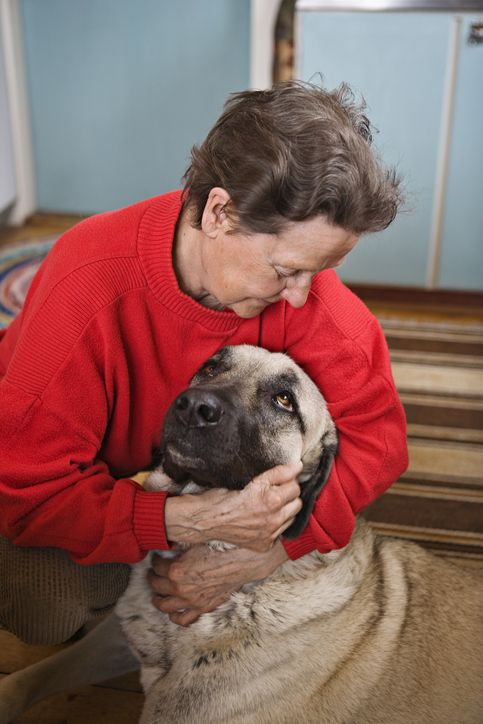
I was volunteering at my local animal shelter one day when the loudspeaker in the kennel area blared, “Kennel attendant for a dog adoption tour, please.” I went to the lobby and was introduced to a couple who, I’m guessing, were in their mid- to late 70s. I was told that they were there to meet a couple of the younger German Shepherd Dogs we had on the adoption row.
My expression probably froze for a moment, but then I put a smile on. “We have a bunch of German Shepherds and GSD-mixes right now,” I told them. “But every single one of them is a big, untrained adolescent! Are you sure you want to deal with such a big, bouncy dog?” I said it with as light a tone as I could muster, but I was concerned. These people did not look particularly strong or agile.
The husband barely acknowledged me, but the wife smiled and said, “Oh yes. We’ve had nothing but German Shepherds our whole lives. We love the breed, and want to help one who needs a home.”
I showed them the various candidates in the adoption kennels, and then a shelter employee took over, taking various dogs to meet them in the big runs outside. I left soon after, so I don’t know which – if any – of the big, strong dogs we had available for adoption they took home. But I’ve thought about the encounter many times over the past few years. It struck me as very unwise, and not particularly self-aware, that the couple would be seeking the same sort of dog they had owned throughout their younger years. I’m super experienced with stressed, large, untrained dogs who haven’t gotten out of their tiny kennels for a week, and, at 20 years younger than the couple, even I get knocked around a fair amount by those dogs in the first sessions we spend together. Even on the occasions when I’ve taken a big rowdy adolescent dog home to foster, it can take weeks or even months to teach them to control their exuberant bodies in the face of exciting stimuli.
When I admitted, a year ago, that one of the reasons I was hesitating over the decision of whether to adopt my youngest dog, Boone, when he was an adorable but thick-legged, big-pawed foster puppy of completely unknown parentage, this encounter with the senior couple was on my mind. I’ll be 60 years old this year – and, with luck, will be 75 or so when the puppy is a senior dog. I had to think about it long and hard: Did I really want to age into my retirement years with another dog who might mature into 70 or more pounds? (Of course, I did adopt that adorable puppy – and, fortunately, it looks like he will top out at about 50 pounds. I can still lift 50 pounds fairly easily, so if he’s ever sick or needs to be lifted in and out of the car, after ACL surgery, say, I can do that!)
Managing the physical size and exercise needs of a big dog is not the only potential challenge for older people adopting a dog. It’s tough to think about, but it’s a reality that people in their senior years are more prone to illnesses or injuries that render them unable to care for their dogs than younger adopters. If you inquire at your local shelter, I will bet folding money that they can point out several dogs who are there solely because their owners passed away without making arrangements for someone else to take the dogs in. In my opinion, it’s irresponsible and selfish to adopt dogs without having a backup plan – and perhaps even money set aside – for our dogs in case of our deaths.
The worst-case scenarios involve dogs whose owners died without making “in case of my death” arrangements for them, and who are completely unprepared for life in any other home. At the shelter, I’ve cared for several dogs who had never been off their property or been touched by humans other than their original (now deceased) owners. The shock and grief experienced by these dogs is awful to witness – and made worse by the fact that, in their shocked and shut-down state, it’s difficult to find someone who will give them another chance at a happy life and adopt them.
Don’t get me wrong: I can’t imagine living without a dog, ever. And I am not saying that we shouldn’t have dogs in our senior years, or even our very last days. I’m just saying that we owe the dogs we take responsibility for the same care and consideration that an owner of any age should have for their dogs. We need to have a solid plan in place for who will take them in the event of our deaths – and perhaps even a backup plan in case the first plan falls through. And we need to be able to fully care for, exercise, and train them, so that, if we are suddenly called away from this earth, our beloved dogs are healthy, socialized to others, and well behaved, so they will be welcome and cherished, not unhappy burdens, to their new owners.




My husband is 81 and I am 73. We have updated our wills to provide for whatever dogs we have and have someone who has agreed to adopt the dogs…..we only adopt old small dogs now. I am still fostering….old small dogs now. I adopted out a 7 year old 7 pound chi to a couple in their mid eighties. Their elderly dog had recently died (only days before) and they still had a 13 year old dog but they liked having 2 dogs. We had 2 meet and greets and all was fine. I explained that in the event of their deaths the dog needed to come back to the rescue. The husband exclaimed “there is nothing wrong with us” he was a retired medical doctor….OK. Fast forward 2 years he recently died and I have been helping the wife with the dogs. They are helping her deal with the loneliness….it is worth the effort…I would do it again. Myself…. I would not adopt out a puppy to an elderly person…..there are so many wonderful senior dogs who need loving homes and the seniors are so easy to love.
Thank you for bringing up a topic that may be painful and hard to acknowledge for some
But shelter have so many Senior dogs who need loving homes and could be perfect matches for older people
I would love to see more shelters market their Senior Dogs To Seniors. Seniors dogs are usually calmer and much easier to handle. It could be a win win for everyone. But some people are very set in their ways about what dog they want without being realistic
I really appreciate your article and will share it with our shelter staff to try and steer our Seniors (people) to our Seniors(Dogs!)
Thanks for a great article! A suggestion- I’d like to see a WDJ article about how to assess who would be a good adopter in general, regardless of age.
The points made in your article are important considerations for senior adopters. But they apply to all ages and ability levels of all adopters. No one should adopt a dog without a plan for its care in case something happens. No one should adopt a dog that is beyond their abilities. Age of course is a factor, but so are other abilities, and so is life. Anything can happen to anyone at any age and everyone should take these things into consideration when adopting. Why limit your focus to senior adopters?
Great points. It’s been on my mind as me and my cohort are aging, but you’re right. It would be great if everyone was realistic about their abilities and everyone had a plan for their dogs in case of the worst “what if?”
I heartily agree with a backup plan. In 2013 we got a Shih Tzu puppy with my planned retirement and relocation in 2014. Our first plan was for our daughter (who has always had Shih Tzus and our boy got along very well with) to take him. About a year ago, they got a Cocker Spaniel puppy that is now about twice the size of our boy and extremely active. Our boy is very anxious around her, so we don’t think it will work out well. So now we need that backup plan.
I’ve also seen a Shih Tzu breeder that if for any reason one of his pups loses his home, he will take him back. I’m pretty sure our breeder would do that also, but we’re now 3 states away.
By the way I’m now 74, and our boy is the best companion!
I also agree 100% with this article. When I was 61, we adopted an adult Standard Poodle from a poodle rescue. Ten years later, when I was 71, our dog collapsed late one night. He weighed almost 80 pounds. I couldn’t lift him so my husband (who was 83) and I gently rolled him onto a sheet to take him to the emergency vet. After our beloved poodle died, I adopted another dog. At my age, I did not want our next pet to outlive us, so three years ago I rescued a 5-year old mutt that nobody was interested in. He weighs around 35 pounds and I can easily lift him. He will be nine years old in June. We have a written contingency plan for his care in case something drastic happens to me. Thank you for the excellent article.
Great article, I also would caution to think carefully about a very small dog for older folks as they can be faster moving and easier to trip over .
This article assumes all people who are 70 years old are the same and they are not. While I agree that individuals of all ages should consider their own limitations prior to getting a dog, I don’t think that you should assume that the couple you describe cannot handle training and giving a home to a young German Shepard dog because of their age. In this case the woman clearly states that they have always had German Shepard dogs in their home so I would conclude that they have an understanding of what is necessary to adopt one of the dogs they are considering.
Too many generalizations are made about people who are old these days and it is limiting to them. Each person, regardless of age, should be aware of their limitations when embarking on challenging endeavors. Please do not make assumptions about us because of our age.
I have adopted now three older dogs as I have aged. A lovely 12 yr old cocker had a good last year w me in spite of matastatic CA, an 8 yr old cocker shared 5 happy years w me in spite of Cushings, and now a 5 year old cocker is my good buddy. I always had big dogs in the past even including two great danes!, and now know a smaller size makes proper care best for my dog and for me.
The senior dogs bring so much love which only enhances the shorter time spent together. Our hearts hurt when their time ends…but w love so much. It is hard for me to not have a dog and even though I miss every one of mine who is over the rainbow bridge I am not sorry for even a minute with each of them.
Let’s hear it for adopting senior dogs! Not only do they desperately need a home, a reliable human, and a calming environment, but also they give you a mental workout to determine what they need, what they may fear (unhappily it may well be part of their past), how to gain their trust … and when the day comes when they show that they trust you (it may easily be months!) your reward is over the top. Spoken from a lifetime of breeding/training my own dogs and then c.8+ years of taking really-really seniors of 8yrs, a12yr-old, recently a 16-year-old “yorkie”! Growing old together works and giving them care, love, and comfort in their last years overcomes the inevitable pain of losing them.
I have adopted now three older dogs as I have aged. A lovely 12 yr old cocker had a good last year w me in spite of matastatic CA, an 8 yr old cocker shared 5 happy years w me in spite of Cushings, and now a 5 year old cocker is my good buddy. I always had big dogs in the past even including two great danes!, and now know a smaller size makes proper care best for my dog and for me.
The senior dogs bring so much love which only enhances the shorter time spent together. Our hearts hurt when their time ends…but w love so much. It is hard for me to not have a dog and even though I miss every one of mine who is over the rainbow bridge I am not sorry for even a minute with each of them.