

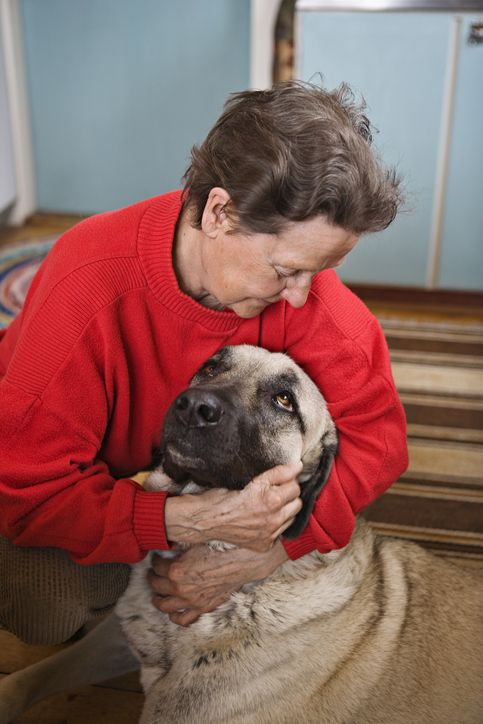
I was volunteering at my local animal shelter one day when the loudspeaker in the kennel area blared, “Kennel attendant for a dog adoption tour, please.” I went to the lobby and was introduced to a couple who, I’m guessing, were in their mid- to late 70s. I was told that they were there to meet a couple of the younger German Shepherd Dogs we had on the adoption row.
My expression probably froze for a moment, but then I put a smile on. “We have a bunch of German Shepherds and GSD-mixes right now,” I told them. “But every single one of them is a big, untrained adolescent! Are you sure you want to deal with such a big, bouncy dog?” I said it with as light a tone as I could muster, but I was concerned. These people did not look particularly strong or agile.
The husband barely acknowledged me, but the wife smiled and said, “Oh yes. We’ve had nothing but German Shepherds our whole lives. We love the breed, and want to help one who needs a home.”
I showed them the various candidates in the adoption kennels, and then a shelter employee took over, taking various dogs to meet them in the big runs outside. I left soon after, so I don’t know which – if any – of the big, strong dogs we had available for adoption they took home. But I’ve thought about the encounter many times over the past few years. It struck me as very unwise, and not particularly self-aware, that the couple would be seeking the same sort of dog they had owned throughout their younger years. I’m super experienced with stressed, large, untrained dogs who haven’t gotten out of their tiny kennels for a week, and, at 20 years younger than the couple, even I get knocked around a fair amount by those dogs in the first sessions we spend together. Even on the occasions when I’ve taken a big rowdy adolescent dog home to foster, it can take weeks or even months to teach them to control their exuberant bodies in the face of exciting stimuli.
When I admitted, a year ago, that one of the reasons I was hesitating over the decision of whether to adopt my youngest dog, Boone, when he was an adorable but thick-legged, big-pawed foster puppy of completely unknown parentage, this encounter with the senior couple was on my mind. I’ll be 60 years old this year – and, with luck, will be 75 or so when the puppy is a senior dog. I had to think about it long and hard: Did I really want to age into my retirement years with another dog who might mature into 70 or more pounds? (Of course, I did adopt that adorable puppy – and, fortunately, it looks like he will top out at about 50 pounds. I can still lift 50 pounds fairly easily, so if he’s ever sick or needs to be lifted in and out of the car, after ACL surgery, say, I can do that!)
Managing the physical size and exercise needs of a big dog is not the only potential challenge for older people adopting a dog. It’s tough to think about, but it’s a reality that people in their senior years are more prone to illnesses or injuries that render them unable to care for their dogs than younger adopters. If you inquire at your local shelter, I will bet folding money that they can point out several dogs who are there solely because their owners passed away without making arrangements for someone else to take the dogs in. In my opinion, it’s irresponsible and selfish to adopt dogs without having a backup plan – and perhaps even money set aside – for our dogs in case of our deaths.
The worst-case scenarios involve dogs whose owners died without making “in case of my death” arrangements for them, and who are completely unprepared for life in any other home. At the shelter, I’ve cared for several dogs who had never been off their property or been touched by humans other than their original (now deceased) owners. The shock and grief experienced by these dogs is awful to witness – and made worse by the fact that, in their shocked and shut-down state, it’s difficult to find someone who will give them another chance at a happy life and adopt them.
Don’t get me wrong: I can’t imagine living without a dog, ever. And I am not saying that we shouldn’t have dogs in our senior years, or even our very last days. I’m just saying that we owe the dogs we take responsibility for the same care and consideration that an owner of any age should have for their dogs. We need to have a solid plan in place for who will take them in the event of our deaths – and perhaps even a backup plan in case the first plan falls through. And we need to be able to fully care for, exercise, and train them, so that, if we are suddenly called away from this earth, our beloved dogs are healthy, socialized to others, and well behaved, so they will be welcome and cherished, not unhappy burdens, to their new owners.



Nancy, you are preaching to the choir and thank you for doing so.
My husband and I have had dogs for 25+ years. We are now retired and dogless. Why you ask? Because we have no children to take a dog if something happens to us, and none of the nieces and nephews have volunteered. We have always rescued the “hard to place” dogs with the promise that our home is their forever home. We will not send a dog back to a rescue or shelter. (Our choice, I know.)
At age 80, our neighbor, Violet, found a “breeder” in Minnesota who would sell her two Shetland Sheepdogs. Like the mantra of several of the above posts, Violet had always had Shelties and she wanted a puppy, not an adult or senior. Neither of her sons were in a position to take the “girls” if something happened to Violet. She approached us, and being the soft touches that we are, we said yes. Violet lived to be 90; we “inherited” two 10-year-old sweethearts whose genetics were terrible. We had the means to care for them and keep them comfortable. I truly wanted to find the “breeder” in Minnesota and give him/her a piece of my mind for the poor breeding and the lack of contract.
It is a discussion I have had with friends who have gotten puppies, and most times, a plan is in place–hooray! I used to work at a veterinary practice, and it was a discussion we had often with clients who adopted birds. The likelihood is very good of that Macaw or African Grey outliving you–what are your plans for this bird, especially since most of the parrots bond to one person. Eye opening to say the least.
Hello All;
I think adopting dogs to younger families is over-rated….parents have jobs, kids go to school…who Really is taking care of the dog? And when, and for how long in the day? Senior adoptive pet parents have time to spend with the pet, Want to spend time with the pet, are often the pet’s true best friend. Yes, arrangements should be made for who will take and care for the pet in the unfortunate situation of a senior pet parent’s demise…but my argument goes for senior pet parents being excellent BFFs for a dog. And yes, the age of the person, and appropriateness of size and age of dog should also go into consideration.
I have always had a plan for my dogs in the event of my untimely passing. Young people die too. I currently have 2 3yr old dogs. I know my Pyrenees mix will probably pass before the pitbull. If all goes well, I will be in my mid 70’s when these 2 pass. I have plans to ONLY foster at that point. I hope that I will still have much to give to dogs and so many dogs are in need. I feel it would be beneficial to all involved. The rescue would have someone who was home all day with the dog. I would have the benefit of a companion and if anything happened to me, the rescue would be there for the pup. Seniors have love and time to give. They should be encouraged to foster and think twice about adopting. I think it’s an all around winning solution.
As a rescue coordinator for an active sporting breed, we get many applicants in their 70’s and up that want to adopt a young dog. I try to make an analogy that our bodies are like our cars. When there are a lot of miles on the car, it is more prone to things going wrong suddenly.
Great article. At ages 76 and 72, my husband and I adopted a retired show dog at his age of 7 1/2 when our 15 1/2 year old dog died. We now have a family of two large retriever cousins only 4 months apart in age. I did not think we’d have two large dogs in our 70s, but I think one has to look at the dog’s energy level and these two are sofa slugs in the house, while still enjoying their outings. One just achieved her RE and I am working on RA with the other. Both are calm and gentle with small grandchildren, despite their size differences.
Even small dogs, when young, can be a lot for older people to manage, as a Schipperke rescue person advised us a few years ago. Her observations were confirmed when we dog sat a rat terrier puppy and found her in our kitchen sink, licking dirty dishes. Happily our big dog kept her tired out.
We co-own our retired show dog and should anything happen to us, he will go back to his breeder, as I would hope our other dog would, in the event no one in our family is able to take them.
I’m 64 and have had German Shorthaired Pointers for 35+ years. At one time I had 6! Now I have one 11 year old and I adopted a pittie mix from a municipal shelter 9 years ago who is now 9.5 years old. I have always had a Pet Trust in my estate plan which outlines care for my dogs and provides funds for the named caretaker. This gives me peace of mind. Nevertheless, when my two pass away, my plan is to foster senior or hospice GSPs through a breed rescue that will retain ownership and pay vet bills. This way, if I become incapacitated or die, the rescue can be there to help care for them when I can I longer.
This was a good article but it could have covered more ground. In my opinion it didn’t go far enough. I wish the majority of the article wasn’t focused mainly on seniors adopting puppies that turn into large, unmanageable dogs. I can understand why you brought up different points because I, myself, have thought about having to give up my dream of a golden retriever when I look for my next dog. I just thought it was unnecessary to mention these “selfish” seniors.
I’d like to add a few points. First of all, as a senior pet owner with a now senior dog, I was happy to get an email from IDA a few days ago which was about a zoom event hosted by them with guest speaker, Leslie Daff, an attorney who deals with pet trusts and wills. It was very informative. I was already thinking about how to leave money for my dog and caregiver if anything happened to me, having already lined up a friend who is willing to take my dog, but I wasn’t sure how to go about all that it would entail. This attorney practices in California in Orange County. I think it’s important to find an attorney who’s used to dealing with pets left behind. She brought up some excellent points about medical records, grooming practices, food and current medications, your pets behavior, etc., all the fine details that you might forget to tell someone. And how important it is to have a backup plan for your backup plan.
The second point is about pet insurance. I think all responsible pet owners should consider having it for any new pet they adopt whether they’re younger or they’re seniors. And they should make sure that insurance would be transferable to the new pet owners should something happen to them. It would place an undue burden on a new owner stepping in, especially if that pet over the years has developed certain illnesses that would be excluded or very costly without insurance. I plan to leave money for my dog and my friend to ensure that my dog’s needs will be taken care of, not to the detriment of my friend. Adopting a senior dog is a great idea for seniors, but in my case, since I’m a senior who does not have unlimited funds, I would only be able to adopt a senior dog who is considered healthy, so that I would be able to get pet insurance and not have anything excluded as a pre-existing condition. This might be something to consider for current pet owners and for the future when they might be looking to adopt a new pet.
Lastly, another way to go is to foster to help rescues pull more pets from shelters. Or foster to adopt from a rescue. It’s a great way to find out if an animal is a good fit for you and your family. A reputable rescue will always want the pet they place returned to them if the adopters are not able to take care of this pet or become deceased, unless you have a friend or family member who will take your beloved family member.
Very good points! Just so you know, this post is my weekly blog post — more a place for me (WDJ’s Editor) to air some dog-related thoughts than our expert articles. HOWEVER, we do have some past articles on the topics you suggest,and, given the amount of interest expressed here, I will look into having some experts freshen up these topics! In the meantime, here are some good articles:
https://www.whole-dog-journal.com/lifestyle/how-to-set-up-a-pet-trust-to-ensure-your-dog-is-cared-for-after-youre-gone/
https://www.whole-dog-journal.com/care/pet-insurance/pet-insurance-for-dogs/
https://www.whole-dog-journal.com/lifestyle/fostering-dogs-what-you-should-know/