

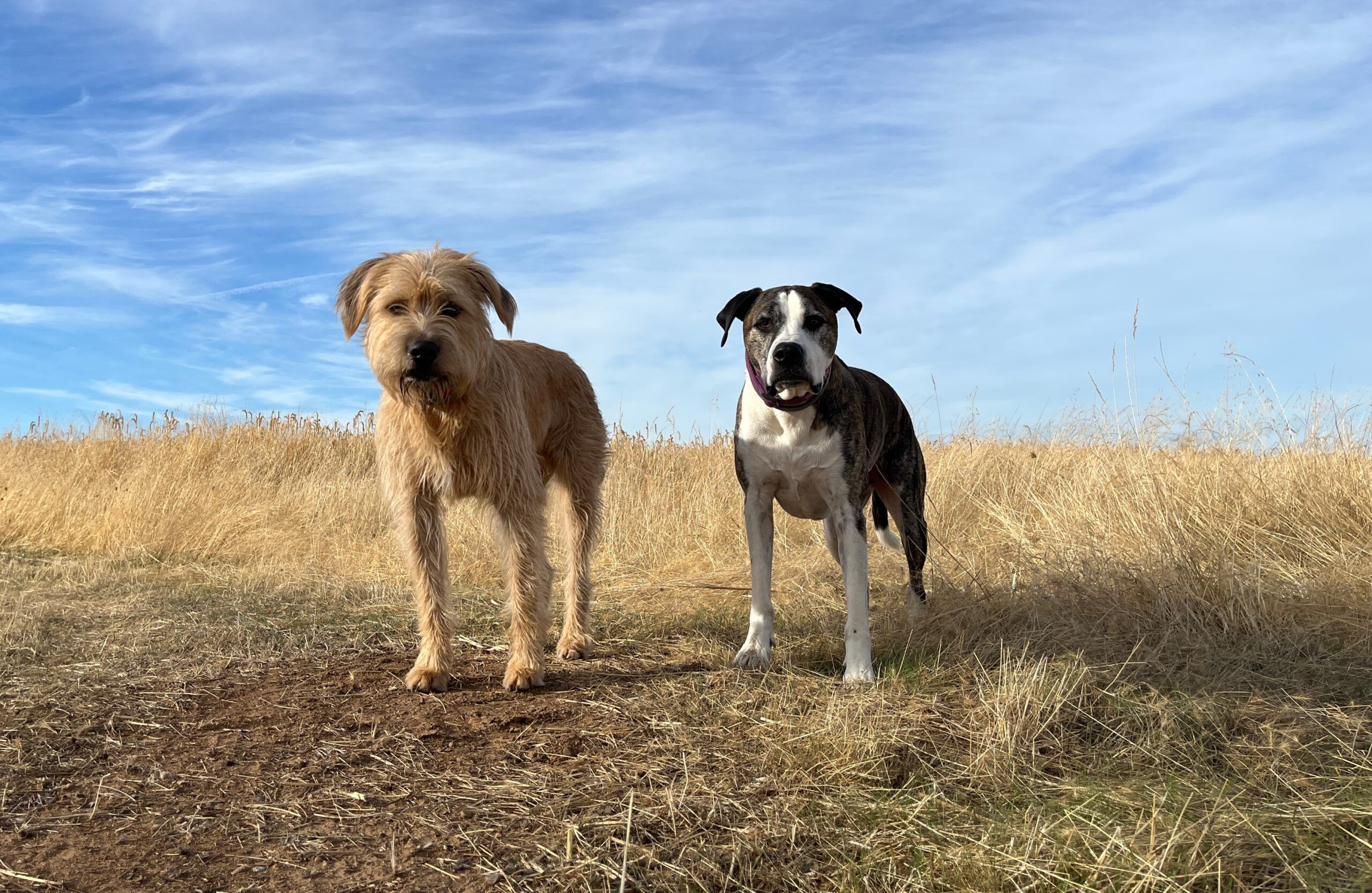
I have a reputation among my friends and family for telling people that their dogs are overweight – so it may come as a surprise that I have been struggling for a few months to reduce my dog Woody’s weight. He turned 8 years old in November, and it was about that time that I first noticed he was looking a little pudgy. Viewed from above, he still has an indented waist, but he’s just thicker everywhere than he used to be. A recent trip to the vet and a formal weigh-in confirmed what I already knew but had been in denial about: He weighs too much! I need to get about 8 pounds off of his now-80-pound body.
Recently, I switched his food to a couple of lower-fat, lower-calorie products, and I’ve cut back the amount I am feeding him. I’m also making an effort to get us out for more walks (I have been struggling with weight gain, too!). I’ve also been pointedly using smaller treats for training and reinforcing his recalls and other good-manners behaviors on walks. But his weight has been staying stubbornly the same.
And, like many owners, I’ve noticed that my dieting dog is becoming increasingly food-obsessed. He clearly feels hungrier on the smaller portions.
My latest idea is to switch both dogs (Woody and Boone, whose weight is ideal) to once-a-day feeding, which has enabled me to cut their total daily portion size much more dramatically while increasing the size of the one meal per day they are eating. We’ve been at this trial for a week so far, and I must say, both dogs are taking the switch to the new regimen very well; they aren’t making a nuisance of themselves at their former dinnertime.
There is some evidence for the benefits of once-a-day feeding; I just hadn’t tried it before, as (again, like most owners), I enjoy feeding my dogs a meal when the family eats. And I should note that the study that provided information about those benefits also noted that because some of the dogs in the study may have been fed once a day for varying lengths of time, the researchers “cannot rule out the possibility that dog owners shifted to more frequent feeding in response to health conditions, and observed associations are due in whole or part to reverse causality.”
Nevertheless, given the mountains of evidence for the benefits of intermittent fasting in humans, I’m going to maintain this schedule for at least a few months – and try to increase our exercise, too – and see if it helps me get some of those excess pounds off of my darling Woody.
If you’ve managed to reduce your dog’s weight to a healthier one, how did you do it? Share your dog-diet tips!



I’ve been lucky. Our 12 year old (today!) lab/hound mix, Clancy, has stayed at 70-72 pounds his entire adult life. We walk a couple miles a day on average, though less now since he has some age-related lameness that crops up with longer walks. He gets a cup of high-quality senior kibble twice a day augmented with cooked veggies and the occasional treat. I wish I could claim his trim figure! I’m in the “if it ain’t broke, don’t fix it” camp as far as his diet. He’s in great shape aside from some arthritis. I give him K9 Excel (omega 3 supplement) and Dasuquin for his joints. Hope I have him with me for many more years!
The problem with techniques such as “Ditch the Bowl” is that when you have a very small dog, they aren’t getting many pieces of kibble to start with. So trying to spread their daily allowance out for training, reward reinforcement, etc. doesn’t give very many! I’ve tried alternating with cut-up green beans, tiny pieces of apples, etc. but when the dog doesn’t get more than 1/4 cup of food per day (high protein, low fat of 7%-10%), you aren’t talking much food at all!
I feel you. Diana pawPrints’ ideal weight is 92 but I allowed her to balloon to 105. In my efforts to slim her down she ended up around 82. I spent six months increasing her food and the result at her last yearly physical? She’s still 82. The vet said she was a “healthy slim” but I know she is not happy at that weight as she is even more food oriented than normal. Like she is starving all the time. Because she sorta was. So I’m working at increasing her food intake a bit more. Freyja was also a bit overweight and has slimmed to a healthy 48. She doesn’t seem to be so food oriented as Diana so I think her intake is just about right. She still looks a bit chunky but I don’t feel any bones so she still has plenty of padding.
Diana is 5 and still active but I will have to watch her weight when she starts to slow down a bit.
Weight changes are so gradual sometimes it is hard to notice the gain or loss until it is really noticeable. That is how it was when Ramses got old. With him he simply lost his appetite the last year (likely due to the cancer.) With Candy it was more due to fluid retention as in the end she had congestive heart failure. We never knew because my parents aren’t as conscientious with their vet visits as I am with mine. Candy had been overweight for years so it was easy to miss that she was losing muscle but retaining fluid.
Last year my dog was diagnosed with Immune Mediated Hemolytic Anemia (IMHA). She spent 8 days at the University of Pennsylvania Ryan Veterinarian Hospital where they literally saved her life. Her normal weight is about 13 pounds, but after being put on steroids for 6 months, she gained about 3 pounds which was about 20% over her normal weight. When she was being tapered off steroids she lost a little bit of weight but needed to lose more. I didn’t want to decrease her food intake since it was the recommended amount for her size, so I focused on exercise. I had to be careful taking her on walks or letting her be around other dogs since her immunity is down and she can no longer receive any vaccines. After checking them out, I decided to purchase a dog treadmill. It was the best decision I ever made. My dog does a brisk walk on the treadmill for 45 minutes every day. I start her on a slower speed and increase it gradually at the beginning and she has worked up to 3/4 miles a day. Her weight is now perfect and she is doing great.
Many years ago the vet instructed my mother to feed the dog cooked vegetables. This is after her border collie had to be put on diet dog food and she was starving all the time. The cooked vegetables helped to fill her up and she did lose weight.
Since then I have always measured out my dog’s daily food allowance. I break it into three parts – feeding one in the morning and one in the evening and the third part (much smaller portion) used as rewards during the day. I also give treats so when I measure out the daily allowance I measure and feed less than the bag instructs. This is to allow for the calories in the treats the dogs eat throughout the day.
PS: It’s really worth the little extra effort. I cook larger amounts of meat and veggies and freeze them in appropriate portions, then defrost in fridge and serve room temperature. NO microvave.
Home cooked lean ground meat and steamed vegetables, an occasional egg – lots of variety, very little fat, a TINY amount of Himalayan salt only – no sugar or spices of course. Home cooked is always the best food. Add some high quality supplements – again: vary. I give a piece of veggie, fruit or meat as a treat. Most commercial treats are garbage and have allergy causing ingredients to boot. I adopt seniors with disabilities and they thrive on this. None of my dogs have ever had a weight problem.
Important: test your dog for food sensitivities and feed accordingly.
I have one dog that is on meds that needs to have food with her medication. I can’t imagine feeding her and not feeding our other dog. I manage weight by a lot of exercise and portion control. Both dogs are ideal weight according to our vet. Female is spayed and almost 12, male is neutered and is 7.
I don’t think I believe that almost all neutered dogs invariably gain weight. I have never had an intact dog and never have had an overweight dog. Except for one Doberman who had a thyroid issue. Once on meds, that resolved, here she lost weight. And we have had many dogs over 35 years.
I have a 9 year old, fixed male Vizsla, Reilly. I had him fixed due to a abnormal testicle. The vet advised removal. So for the past 5 years have been trying to keep his weight normal. He is 66 lbs., a good hunter, but also is always hunting for something to eat!
I am anxious to learn how your once a day feeding works out. I have a rescue Vizsla male, not fixed, that has very high energy, so feeding one once a day and the other twice a day may be an issue. I look forward to your progress and wish you a good new year!
Our Goldendoodle will be 10 next month. I feed her 3 small meals a day of high-quality Senior dog food. it is mixed with Senior canned and dry dog food. Her meals are weighed on a kitchen scale, includes .4oz of pumpkin. We keep a chart; with the time she eats and the number of calories of each meal. She is very active. Her vet agrees that she is in good shape, not overweight and healthy for her age.
My husband walks her most days, we have a large, fenced yard she loves to associate with the neighbor dogs through the fence.
Keeping the time she eats, helps us, her pet parents, determine about when it’s time for her to have another meal. Some days her meals aren’t always at the same time but near.
The Excel chart is broken down of FOOD or TREAT. Excel totals all the calorie numbers so we can see if we are over treating or over feeding. I try to keep her near a weekly average of 1,100 per day.
She is spayed.