

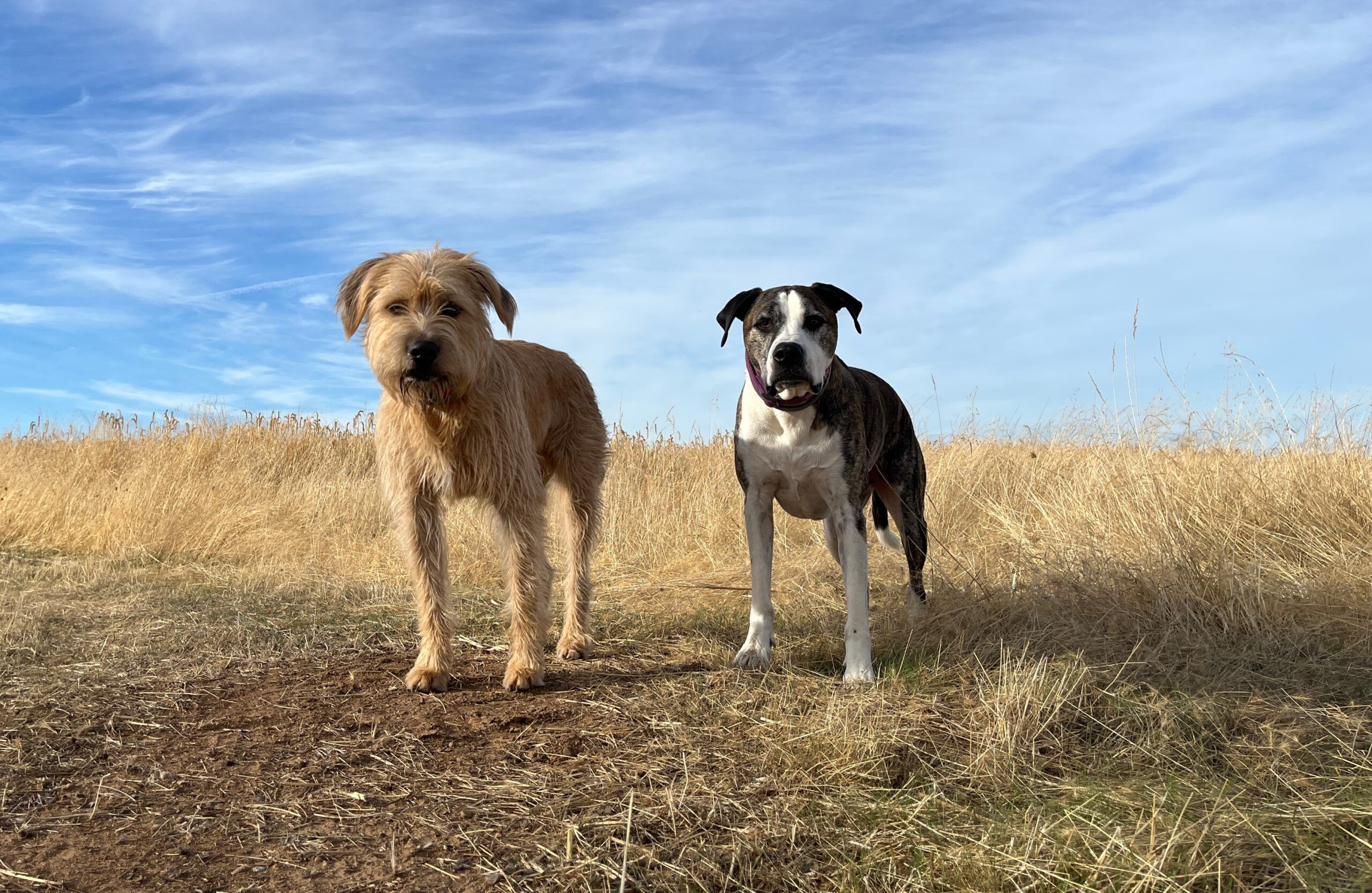
I have a reputation among my friends and family for telling people that their dogs are overweight – so it may come as a surprise that I have been struggling for a few months to reduce my dog Woody’s weight. He turned 8 years old in November, and it was about that time that I first noticed he was looking a little pudgy. Viewed from above, he still has an indented waist, but he’s just thicker everywhere than he used to be. A recent trip to the vet and a formal weigh-in confirmed what I already knew but had been in denial about: He weighs too much! I need to get about 8 pounds off of his now-80-pound body.
Recently, I switched his food to a couple of lower-fat, lower-calorie products, and I’ve cut back the amount I am feeding him. I’m also making an effort to get us out for more walks (I have been struggling with weight gain, too!). I’ve also been pointedly using smaller treats for training and reinforcing his recalls and other good-manners behaviors on walks. But his weight has been staying stubbornly the same.
And, like many owners, I’ve noticed that my dieting dog is becoming increasingly food-obsessed. He clearly feels hungrier on the smaller portions.
My latest idea is to switch both dogs (Woody and Boone, whose weight is ideal) to once-a-day feeding, which has enabled me to cut their total daily portion size much more dramatically while increasing the size of the one meal per day they are eating. We’ve been at this trial for a week so far, and I must say, both dogs are taking the switch to the new regimen very well; they aren’t making a nuisance of themselves at their former dinnertime.
There is some evidence for the benefits of once-a-day feeding; I just hadn’t tried it before, as (again, like most owners), I enjoy feeding my dogs a meal when the family eats. And I should note that the study that provided information about those benefits also noted that because some of the dogs in the study may have been fed once a day for varying lengths of time, the researchers “cannot rule out the possibility that dog owners shifted to more frequent feeding in response to health conditions, and observed associations are due in whole or part to reverse causality.”
Nevertheless, given the mountains of evidence for the benefits of intermittent fasting in humans, I’m going to maintain this schedule for at least a few months – and try to increase our exercise, too – and see if it helps me get some of those excess pounds off of my darling Woody.
If you’ve managed to reduce your dog’s weight to a healthier one, how did you do it? Share your dog-diet tips!




My two dogs are 8 years old and getting pudgy. Feeding them lower calorie food once a day and smaller portions of dry food replaced by Green beans and pumpkin are helping. I purchased a state park pass and am walking with them more often. I think we’re all getting in better shape!
I have a Beauceron whom was very bony and was eating 2 pounds plus a day of raw food. I could not put weight on her and the summer she was turning 4 years old she gained 14 pounds in less than 2 months! It took a couple of years to lose that weight, first reducing her food until she stabilized, then going a bit under that.
I always use a scale to measure my dog’s food, so I know exactly what they get, therefore if they gain or lose a bit, I can adjust their food accordingly. Lately I reduced her food by 1/2 an ounce per meal and she seemed to have stabilized, she was feeling a bit pudgier (she is 9 1/2 y.o. now), so I tackled it right away. I learned how difficult it can be to get them to lose those extra pounds and I rather not let it become a big project.
I also believe that slow is best and the best advice is PATIENCE. You know what to do, you’ll get there.
I have fed raw since 1997 and have had 63 dogs since 1990. All have been golden retrievers, a breed with high cancer risks (especially hemangiosarcoma), high orthopedic risks, and an average lifespan of 10 -12. Of course, there are many exceptions, in both directions – younger than that and older than that; just like the fact that women generally live longer than men has many exceptions, but which holds true despite that. I’m proud to say that the average lifespan of my goldens is 14.3 years, and it’s been an ascending arc. I had a lot to learn, but I have tried my best to. For the first 12 years of my teaching career, I also worked as a vet tech/receptionist, part time, because I was a teacher and broke. My experience was that most dog owners allowed their dogs to be obese, not just overweight, and a fit dog was a a rare thing. I always praised owners with fit dogs. The vets were pretty lax in the weight department – what I thought was overweight, they thought was fine, obese to me was overweight to them, etc. Often they only brought it up with the owner if the dog was morbidly obese. Most of the dogs were de-sexed, because the vets were trained to be kind of militant on that point. The purpose was reducing pet overpopulation, and it certainly works for that. But it was presented as healthier for the dogs, and that is simply not true. To be fair, most of the vets were trained that way. They believed it. In order to get people to do it, they made outrageous claims as to health and behavior benefits that have no real evidence to support them (a panel at UC Davis Veterinary School discredited many of these studies in 2012, and subsequent studies have mostly surprisingly different results). I think there is good support for the hypothesis that cancer is a metabolic disease, enough that I keep my dogs lean. I’m super helped in this endeavor by their being intact and fed minimally processed foods, but I’ve seen a number of overweight intact dogs, too, so it’s no magic remedy. But overall, every issue with dogs is usually caused by people doing stupid things, careless things, even cruel things. These people would very likely NOT be subscribing to WDJ. You need to be mindful with dogs, though I’m blown away by the people who are so exact that they weigh and measure everything. Wow!
I do green beans in their food. I feed once a day, in the morning, and to their small portion of canned food, I give some cooked chicken breast, a blob of canned pumpkin, their joint and omega supplements, and cooked snipped into little pieces frozen green beans, all added to their individual containers. I let the portion of green beans thaw on a plate while I do other things, and then snip them up with kitchen shears into small pieces into a bowl, and microwave for about 90 seconds and then add them to their food. The whole mess gets mixed up with some warm water and then added to their food dishes with some kibble, the amount varying with the size of the dog. I have 3 of them so it’s an assembly line process getting everything done, but it works for us.