


The last time my senior dog, Otto, had a wellness examination, our veterinarian recommended that I start giving him a medication that treats arthritis pain – at least on the days when he exercises more than usual, like when I take him on off-leash hikes. She recommended a newish drug, Galliprant, a nonsteroidal anti-inflammatory drug (NSAID) that works with a slightly different mechanism than most NSAIDs prescribed for dogs, and is supposed to have less of an impact on dogs’ kidneys and livers. I ended up taking home a bottle that contained 30 chewable tablets of the medication.
I’ve been giving the medication to Otto occasionally, on days when we’ve taken a hike, or when he seemed particularly stiff or gimpy in the morning. This has been happening more frequently with the cold weather, and I was down to just a few tablets, so I picked up the bottle the other day to call in a refill.
As I waited on the phone for the veterinary receptionist to help me, listening to the clinic’s “hold” music, bottle of medication in my hand, I idly scanned the label, looking to identify the prescription number. To my horror, I saw this:
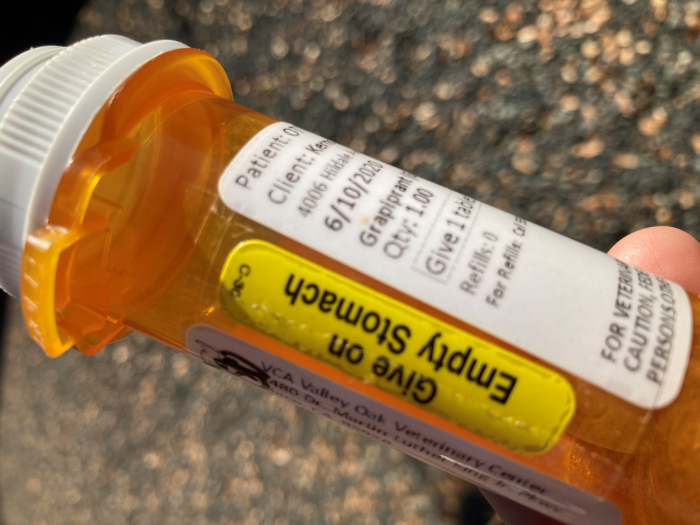
“Give on Empty Stomach.”
I have been giving the medication to Otto in the morning, with his breakfast – despite a yellow banner on the label that said to give the medicine to him without food.
I don’t know when or why I started giving him the medication with food. Did I not listen to my vet’s instructions? Was I distracted when we were discussing the medication? All I remember hearing is “one tablet given once daily.” Why didn’t I review the label instructions before I gave him any? How could I not notice the yellow label?!
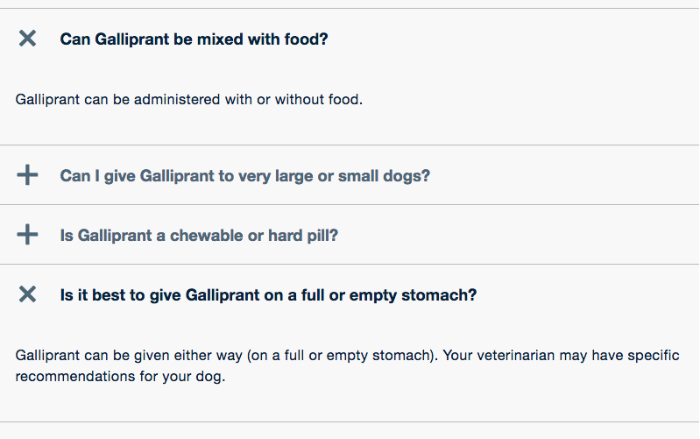
Fortunately, as it turns out, this particular instruction wasn’t critical. When the receptionist came on the line, I told her I was looking for a refill but also wished to speak to the veterinarian briefly about the “empty stomach” instruction. When the doctor became available, she reassured me that the medication could be given either way – but that in her personal experience, she thought it was more effective given on an empty stomach. As long as it was working for Otto, she wasn’t concerned.
Still feeling like a bad dog mom and not to be mollified that easily, I pulled up the drug’s website, which states pretty clearly that it doesn’t matter whether the drug is given with food or not. So now I feel better.
But the issue scared me enough to pass along this advice. Take this opportunity to check the label of any medications your dog receives, right now! Check the dosage and number of pills, the number of times a day your dog is supposed to receive them, and the expiration date (if applicable) of any medication he receives only “as needed.”
Still troubled about my (as it turns out, harmless) screwup with Otto’s medication, I mentioned my error to a couple of friends – and one admitted she once, a few years before, dosed her dog with half of the medication that the label called for, at least half-way through the bottle. It was a two-week prescription, and only when it seemed like the bottle wouldn’t be empty in a week’s time did she examine the label more carefully. The dog was supposed to get two capsules, twice a day, and she had been giving only one capsule twice a day. She admitted her error to her vet, who told her to come and pick up more of the medication, so the dog could receive the full dose for the entire recommended period, as a half dose wasn’t likely to be effective.
Learn from our mistakes! Check those labels!


Also be very careful about the dosage. My former vet had prescribed 6 milligram tablets of a med for my small dog and the tech gave me 60 milligram tablets. Thank god I researched and found out that dosage was wrong and would of killed my poor dog. Scared me to death. So now I always double-check.
GREAT TIPS, everyone! Keep them coming!
Yes also who has heard about the fact that heartguard brand MUST be chewed or it is not effective? Its in fine print on the box and package insert but if a person only gets a few at a time, such as those who might not want to treat all year round, one would not know and I have never had a vet tell me that they needed to be chewed. I would venture to say that maybe even most vets do not know this little tidbit of information. I switched to tri-heart for this reason as it does not need to be chewed. My dog does not chew anything and inhales treats and food. I also only give her a few a year during the high risk transmission months in Maine. Best advice is to read package inserts whenever possible. There is a lot we are not told, even with regard to human meds.
Make sure you also recognize what the medicine is supposed to look like… often times the pills will be different because of different manufacturers…but it could just be the wrong pill
Instead of having the vet refill, check Costco or your favorite drug store, and check good RX …….could be a lot cheaper.
Second this. Tramadol, Gabapentin, Carprofen are all people meds. Some are given to dogs off label, so you could get their Rx filled in a regular pharmacy. I have a local Costco so when Ramses went on one of the meds that’s where I went. It was cheaper but for one they had them in a pill that disintegrated when I cut it so returned them. They didn’t have one in the dosage he needed. Since they dispense for people you need to check on the form, capsules, pills, etc and if they will have to be cut to be the correct dosage. For poor Ramses, at least a third of the pills crumbled into pieces so fine it was impossible to gauge what was half a pill. For the price, losing a third of the prescription wasn’t saving any money but costing me money.
I’d add to that: be mindful when you’re giving medication. One morning I was distracted and mistakenly took my dog’s medication! I called the poison control hotline and was reassured that it wouldn’t be a problem for me but I sure felt stupid. Now I make sure to focus on what I’m doing.
Ideally, take NSAIDs after eating and avoid taking them on an empty stomach. This will help minimize the risk of the medicine upsetting your stomach.
No medicine is harmless for dogs stomach (nor ours), so we can only tread in between, trying to help the ailment and not make a problem elsewhere…songive it and take it with food.
I think you were being a good dog Mom by rote as it is most typical to give medications WITH food to prevent gastric upset, particularly arthritis medications. Just my opinion.
Thanks. Loved the content
Wonderful, what a web site it is! This website
gives useful data to us, keep it up.