

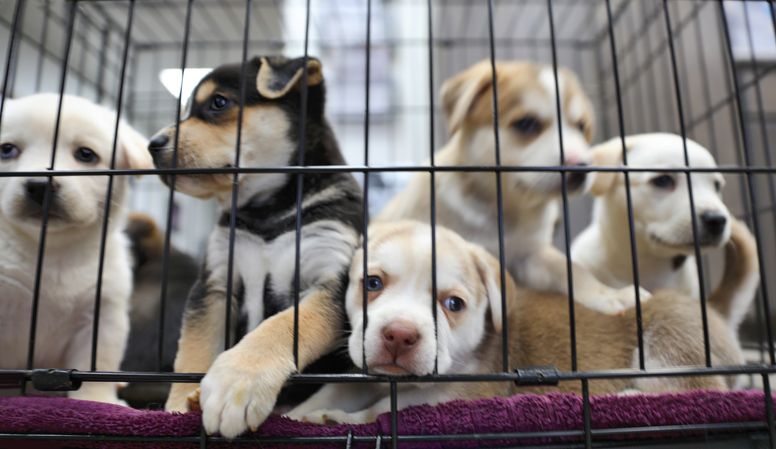
Seen on my local Nextdoor page: “Is this your dog? If so, contact me ASAP. I do not want to take her to the kill shelter in town.”
Overheard in Petco: “Yes, we got her from a kill shelter in Stockton…”
Said directly to me in response to hearing that I am fostering a mama dog and her five puppies from my local shelter, “Thank you so much for saving their lives! That’s a kill shelter, isn’t it?”
Every time I see or hear this phrase, I want to SCREAM.
Dogs and cats who either lack a home, or are unsuited for or unsafe in any home, are put to death – humanely euthanized – in many shelters in this country. It’s society’s burden, with many factors responsible for the necessity to euthanize animals that no one wants and no one wants to pay for – but it’s not the fault of the shelters that bear the awful responsibility of that act.
Every shelter or rescue group that cares for and finds homes for animals plays a role in helping reduce the country’s overall euthanasia rate – but do not for a moment give praise – or financial contributions – only to the ones that are able to pick and choose how many and what animals they care for and thus do not have to euthanize animals themselves. Because it’s not like the shelters that must do it want to. Someone has to; that’s a sad, hard fact. The shelters and rescue groups that don’t euthanize are able to avoid this task because there are other ones that can’t avoid it.
Pat Miller wrote a great article for WDJ years ago, explaining the differences between the types of shelters. Briefly, to recap, some shelters limit the number and type of animals that they take in; others have contracts that require them to deal with as many animals (and some unadoptable animals) as wash up on their shores, via owner surrender (or animals supposedly “found” by members of the public), law-enforcement seizures, and animal control pickup of stray or dangerous animals. It should be obvious, but few people seem to be aware that a “limited admission” shelter that takes in only a small number of animals, and only when they want to, should not be singled out for praise (and charitable contributions) for not killing any of the few animals they take in, when the municipal shelter in the same community is contractually required to take in exponentially more animals daily – and often on a budget that would choke the limited-admission shelter to death.
For example: I just looked up the numbers for 2020, the last year for which comparable numbers were available for a limited admission shelter and the municipal shelter in the same city near me. The limited-admission shelter, built and run by a nonprofit, took in 184 dogs in 2020, and euthanized just two. Awesome. In the same year, the city shelter took in 606 dogs and euthanized just 38. Considering their budgets were likely comparable – the nonprofit, limited-admission shelter being popular in the community and garnering many donations on the strength of its “no-kill” status – I’d be more inclined to celebrate the municipal shelter for its ability to save as many dogs as they did!
I’m not suggesting we celebrate euthanasia. I am incredibly frustrated with the swelling numbers of animals being brought to shelters and desperately wish that there was more money available for all municipal shelters so more animals could be saved. But the responsibility for the deaths of unwanted animals belongs to all of society, and castigating the agencies that must carry out this horrible task is unfair. Especially when the same staff members who must bear the “kill shelter” label work so. damn. hard. to save lives, too.




I live in NY. I’ve had 2 GSD’s from a friend’s litter (unregistered) and one I rescued from the side of the road where she was dumped. My current guy came up from Louisiana on a transport and was adopted from our well known Humane Society in Monroe County, Lollipop Farm. He’s a black mouth cur and is perfect! No issues to resolve!
I have a best friend who is heavily involved with Schipperke rescue and worked as a humane society officer in the Florida Keys. One of the things I vividly remember her telling me is that some of the no kill shelters kept dogs and cats in cages for years rather than euthanizing. There is no quality of life in that situation but the public thinks that this is better than euthanizing. I would beg to disagree…
While technically no shelters in California are kill shelters, the reality is that they do not have unlimited space and sometimes if they have to find room more unadoptable dogs have to provide that space.
Freyja Grey was from such a shelter. I just happened to looking at that shelter website because a blog I visit asked who celebrated and knew their dog’s birthday. Diana pawPrints, her Mom and siblings were rescued from that shelter. I spotted Freyja on the top of the page with two other dogs. All three were “red carded”. You can guess what that meant. Diana and I drove up the following day (3 hours up) and came back with Freyja. She is a sweet and affectionate girl. But also 55% husky for those that can guess why she was returned to the shelter twice, once within 24 hours. Destructive behavior. This was in June 2021 when we were locking down for Covid. My guess was she was left alone while her people were at work and when they came home and surveyed how their brand new dog has spent her time that was it. I suspect they knew little about dogs. You don’t adopt a dog that has spent time in a shelter and figure things will be perfect one they are home. There is an adjustment period.
Well, I’m retired, I have a fenced yard with double gates at both ends and I don’t leave the house for more than a few hours a week. I’ve also owned dogs for 30 years. So Freyja got very, very lucky. Yes, there were some adjustments. (I lost a few pieces of clothing and she tipped a few trash cans) but for the most part she has been a joy. She is an anxiety pooper so when at my parent’s house I do have to check an area of the living room if there has been some change or upset in the house. Other than a few quirks she has adjusted beautifully. My parent’s dog Dolly is her BFF and she has even learned to enjoy the dog park. June 29 will be her 2 year Adoptiversary.
So while the shelters in California may be no kill shelters, that doesn’t mean dogs aren’t euthanized for one reason or another. Illness or behavior issues that cannot be corrected and are a danger to people or other animals is one thing but euthanizing dogs simply because the space is needed is just inexcusable. If not for a late night blog post and lucky, Freyja may have had to make way for another dog. She has no idea how lucky she is. Or maybe she does.
Point very well made, and taken. Shelters over run by dogs being returned (think COVID), lost or worse, abandoned. It’s all so very sad and heartbreaking. I’d like to add that pet parents perhaps need to reframe their verbiage when making the difficult decision to let go. “I laid my companion to rest” instead of the proverbial “I put him/her down”. The latter is highly insensitive, aggressive and distasteful. We as a society need to think and do better.
As a long time breeder of purpose bred dogs and a person who rescues my breed I get bothered by the term backyard breeder. I am I supposed to do it on my kitchen table?
I health test all my dogs and submit DNA for all the genetic diseases that my breed has markers for.
I am bothered by rescues and shelters that put intact animals back on the streets. I grew up in a time where all our dogs were intact and litters did happen to those who let their dogs roam. I do not see that in my town of 50,000.
I would love to be a P. I. that could track down the source and situation of litters dumped at shelters in greater numbers that I can remember.
I mostly agree with what you said, but that isn’t always the whole picture. It is probably the rule, but there are exceptions. I did Doberman rescue in the Atlanta area for several years. I started with one woman who was rescuing under an all-breed license and quickly learned that the other Doberman rescue in town (now defunct) only took healthy dogs 3 years and under. (The rule, I guess) So we took the rejects and many of them required costly medical care in addition to the typical exam, shots and spay/neuter. So I lived on about half my salary and spent the other half caring for our dogs that were usually older, and/or had health issues. Occasionally I’d wind up with an oddball–like the time we got a call from a shelter about 90 minutes away about a woman who became homeless and her two Dobes wound up in the shelter. I agreed to take them and a volunteer drove to pick them up (we eventually grew and became a licensed rescue and it is still in operation). At any rate, when the volunteer arrived and told them she was there for the two Dobes, the shelter worker asked her, “Aren’t you going to take the Border Collie too?” “Border Collie? I’ll check.”
She called and asked me if she was supposed to pull the Border Collie too. It turned out the homeless woman had 3 dogs. I said, “Why not, the more the merrier, bring him back with you.” We had him for quite a while because people contacting Doberman rescue are looking for Dobermans, not Border Collies, and it was a hoot to watch him trying to herd the Dobes in the backyard, but eventually with the help of a Border Collie rescue, we were able to place him. Then there was a Yellow Lab, that my trainer wound up adopting, and the call from a shelter that had removed 3 senior dogs due to neglect–they lived in the crawl space under the house and the owners tossed out slop for them like they were pigs. The shelter wanted to place all three dogs together because they seemed bonded and needed to be further evaluated. They approached small breed rescues first but none would take the Dobe, so they called me and I took all three: a Dobe, a Pomeranian, and a Poodle. The Dobe was heartworm positive so we started treatment and after separating the dogs for a time to see how they would do, listed the two little ones on Petfinder and they were quickly adopted to great homes. I wound up keeping the Doberman. She was a delightful older gal and I named her Queen Elizabeth because something about her reminded me of the British monarch.
When I was doing rescue, most shelters wanted to get the dogs out either to adopters or rescue and we frequently got calls from shelters all over the metro area. But some shelters are horrible. There was one in North Georgia that had planned to euthanize ALL the animals there so that they could have a long Thanksgiving weekend. A North GA rescue caught wind of their plan and put a plea out to rescues all over the region to please take one or more animals. We agreed to take the Doberman and several other dogs and cats had rescues willing to take them but no one who could pick them up before Thanksgiving due to their work and the short notice. So I filled my van with animals that had somewhere to go but no way to get there and other rescuers with work flexibility did the same. I was elated when I got a call late in the afternoon that the last load of animals had departed and the shelter was now empty. I know this is the exception but there are some bad shelters out there that do deserve the label “kill shelter.” I guess my point is we shouldn’t stereotype because there are all kinds of shelters, some that work very hard to place the animals and others that are just there for the paycheck. Same with rescues–most only euthanize if a dog demonstrates human aggression, but some are very picky as to the animals they accept and others will accept any of whatever breed or perhaps size they work with regardless of age or health.