


It’s at this time of the year that my dog Otto’s health insurance company sends out a renewal letter. And, of course, the older he gets, the more the annual premium goes up.
It only makes sense. He just turned 14 years old. His healthcare costs have increased. In addition to twice-annual well-dog visits, he gets an annual chest x-ray and abdominal ultrasound; he’s had benign growths removed from his liver, and had (a few years ago) a nearly symptom-free case of pneumonia, so we monitor abdomen and organs (for abnormal masses) and his lungs (to make sure they are clear of excess fluid). Plus, I give him a very expensive daily pain-relief medication for his osteoarthritis; it’s metabolized in a way that stresses the liver less than other nonsteroidal anti-inflammatory drugs, so it supposedly helps with his slightly compromised liver function. (It works, so I’m not messing with it, no matter its cost!)
But, yikes! Today, I had to do some math to see if the increasingly high cost was still worth it. I looked at what I spent this year as a guide:
Total cost of Otto’s vet bills in 2021: $3,025.00
What I actually paid:
| Total cost of Otto’s insurance premiums in 2021: | $2,557.37 |
| Deductible: | $250.00 |
| 10% of costs (insurance reimbursed me for 90%): | $302.50 |
| Total cost (so far*) in 2021: | $3,109.87 |
*This includes the cost of his daily medication and the premiums for the entire year, and presumes we have no more vet visits through the end of the year.
If we make no more visits to the vet this year, I will have paid $84.87 more with insurance than if he had not been insured. But, as everyone knows, just one emergency vet visit, with, say, just one blood test and a prescribed medicine or two, can easily cost $500 or more. If Otto has to go to the vet once more this year for even something quite minor, the insurance will have been worth the cost.
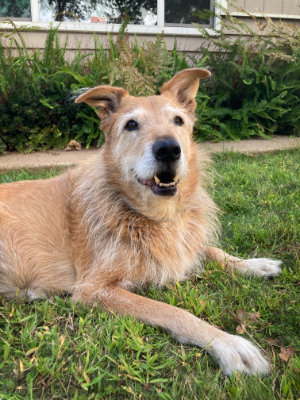
But the peace of mind of knowing that, no matter the cost, I could likely afford 10% of nearly any bill that he might incur… that’s priceless.
The fact is, knock wood, 2021 was one of our most event-free years in a while. The insurance paid off in a major way in the previous two years, when he needed more medical care.
In 2020, Otto incurred $4083.17 worth of veterinary care (including two major dental procedures). I spent $2,252.27 on his insurance premiums, $250 on the deductible, and paid just $408.32 for all those vet bills, because the insurance reimbursed me for 90%. My total was $2,910.59; insurance saved me more than $1,000.
2019 was the year when he had his liver surgery, with two nights spent at the specialty hospital where he had surgery. His total veterinary expenditures that year came to $7,152.45. I spent $1,745.27 on his insurance premiums, $250 for the deductible, and $715.30 for the vet bills (the insurance reimbursed me for 90%) for a total of $2,711.57. Having him insured saved me more than $4,400 that year.
Funny/not funny: Because of the rising price of his insurance premium each year, in 2021, even though he received less medical care than in either of the two previous years, I’ve spent more than in either of those years.
But if Otto hadn’t had insurance in either of those years, I might still be paying off credit card bills!
The increase in the annual premium has gone up steeply; in 2018, the monthly premium for Otto’s coverage was a full $100 less than I’ll be paying in 2022. The difference is more than what I was paying for my younger dog’s coverage.
Yes, I just used the past tense. Despite what I’ve just said about the clear benefit of having Otto insured, two years ago, I actually stopped paying for Woody’s health insurance. (This added to the cost of Otto’s coverage, as I had been getting a multiple-pet discount of 5% prior to cancelling Woody’s coverage.)

I’m taking a calculated risk with this tactic. I first bought health insurance for Woody when he was just a pup, and it was a good darn thing. He was an accident-prone adolescent, and I’ve lost track of exactly how many emergency vet visits he had in his first three years (I can think of five off the top of my head, though I think there must have been more). But after he turned about 3 ½, his medical visits reduced sharply (so far! knock wood!). His annual well-dog visit is pretty minimal, and he hasn’t needed a dental yet.
If I had been paying insurance premiums at the current rates for both dogs over the past three years, it would have tipped the balance; I would have been paying more for the insurance than what the two of them have incurred in costs. But, like I said, it’s been a calculated risk. If Woody had suffered from bloat, a torn ACL, or some other major health problem, then I would have been better off with insurance for both dogs.
When Otto dies, I’ll for sure buy health insurance for Woody again; he’s getting to the age that he’ll need a dental and should start having more tests at his annual vet visits.
As much of a fan if pet health insurance as I am, I can’t imagine affording health insurance if I had three or more pets; even with the multiple-pet discounts, it would add up to a lot. At that point, I’m guessing that most people would be better off saving money each month in an account dedicated for direct health care costs.
What accommodations have you made concerning health insurance for your dogs? Has it been worth it? Not worth it?




However, what no one tells individual like myself back in 2014 to get insurance. Then comes 2016 my Golden was only 23 months old. He was diagnosed with MG-myasthenia gravis and ME-mega esophagus. Once your dog is diagnosed “you can not” insure the dog unless your a lucky individual & loaded.
My year 2021 & today 2022, another lump on his lymph node under his chin alone is costing a lot. Eventually, I will have no options to put down a a soon to be 7 year old Golden.
Scott
My pittie was 2 when I rescued him and we got insurance right away. I’ve never had an issue and insurance has always paid. The premiums have gone from about $60 to $140/mo in the last 7 years. Still, the peace of mind knowing I can afford any treatment is totally worth it. I got the 90% plan with $100 deductible. I will probably go to the higher deductible this year to get the premiums down a bit. Thanks for the article!
Oh and we’ve been with Healthy Paws. Love them!
I am very happy with Nationwide pet insurance. I have insurance for a 10-yr.-old dog, a 12-yr.-old cat, and an 8-yr.-old cat. My dog has a lot of health issues and meds, and my older cat passed away in September due to intestinal cancer. It was not a cheap vet year. I just did my calculations. My vet costs were $3,600. The cost of their 3 annual policies, and their 3 annual deductibles was $2,500. Total ~$6,100. I got back ~$3,100. So my out-of-pocket costs with the insurance was ~$3,000. I saved ~$600. in 2021. WELL WORTH IT. It’s such peace of mind to not have to panic when you’re getting hit with an unexpected surgery, tests, etc. Best decision I ever made. I will say the Nationwide pet insurance was offered through an employer. Getting it through your employer is a much better deal than just going online, last time I looked. And I think the coverage is better too. I highly recommend it.
What is the osteoarthritis medicine (non-NSAID) that you use for Otto if you don’t mind me asking?
I have insurance for my 4 yo Flatcoat and when she had a illio-psoas injury they paid for the MRI, and the physical therapy…which was really helpful. Of course my premiums went up.
I too wish they covered breeding/whelping emergencies and I don’t understand why they don’t, given that the even the worst breeders might give their bitches better care…. I have bred one litter and the cost of doctor care was quite high…don;t let anyone tell you that breeders make a lot of money…I didn’t even come close to breaking even.
But the worst part for me is that the puppy I kept, because I wanted him, but also because he has a moderate heart defect, will probably need cardio care and it will not be covered because he showed a murmur in his 8 week wellness check. I still added him to my insurance because you just never know….
I’m still wondering if you have a rider for dental care or its part of your premium. Most plans I know of do not cover dentals.
oops..just saw the same question above.
Yes, a very timely discussion. I adopted a (best guess) 4-year-old black German shepherd three months ago. I knew he had dental problems (recommendation by SPCA vet was extraction for all four canine teeth) and he had some soreness of his left leg when extended. The day after I adopted him, I went online looking at pet insurance. I also scheduled his first vet appointment and was also put on a waiting list to have him seen by a veterinary dentist (he was just coming into the specialty practice).
I spoke with a rep at one of the pet insurance companies (one that was highly recommended, including being on both WDJ’s and Your Dog’s list of preferred companies). Pre-existing conditions were what kept me from signing up. The dental wouldn’t be included nor would any problem with his left leg. He also occasionally licked his paws and his ears had some gook in them. The vet appointment was in three weeks. The waiting period for pre-existing conditions for the pet insurance was 30 days. Do I delay his first visit to my vet to go beyond the 30-day waiting period, i.e. no medical record? The insurance rep said if indeed he did have allergies it would most likely be considered a pre-existing condition. Having had a dog with severe allergies (food and environmental) before, I know how costly that is (daily Apoquel, every-other-week immunotherapy shots, prescription diet, special shampoo — and more).
I ran the numbers, and at $2,500+ per year (to start) in premiums, I’ve yet to sign up, thinking I’ll “self-insure.” The root canal on all four canine teeth cost almost $12,000. Yes, a lot, but I went ahead (this dog, Sully, is so ball-focused that if he couldn’t catch/hold a ball in his mouth he would be devastated). I was able to get CareCredit to cover most of the expense. Yes, I still have to pay the very costly bill, but I can do so over 12-months — interest free (as long as it’s fully paid within the 12 months).
The problem with his left leg? He has hip dysplasia in both hips. The dental problems were caused most likely by tennis balls (please do anther story on how bad these balls can be). Sully is a gorgeous dog, he’s brilliant and hand-down, the best dog I have ever known. Pure delight. But his two bad hips suggest that he did not come from a reputable breeder. Will there be more health problems? Probably, but how bad (and how expensive)? A crap shot. And has been said already here, insurance is a business; they exist to make a profit, i.e. the house always wins. But true, not with every insured pet.
I hadn’t been aware of how high the annual premiums can get as the dog ages. Yes, naive on my part, so I’m grateful for the eye-opener. Will Sully have degenerative myelopathy? The odds say yes. The GSD I had — the one before the one with severe allergies — did. If I had had insurance with him, it’s my understanding the visit to the veterinary neurologist (six hours away) would not have been covered, but the MRI and all the other (expensive) tests, would be. The medication he was put on was also not cheap, but that would have also been covered. My dog with DM was 10 years old when he was diagnosed. A year later, he was doing really well. Then the seizures started; he had a brain tumor (confirmed by another MRI). No options left, no matter what the cost.
So if I self-insured (put away the money I would have paid in monthly premiums) with that dog, I would have had more that $15,000 in “my bank” by the time he was 10 years old. More than enough to cover his neurology vet bills. But as someone else pointed out, what happens if a fairly young dog has a major medical issue? My last dog had hemangiosarcoma — he was only 5 1/2 years old. Also a rescue, and I’d bet he had been a puppy mill puppy. Unbeknownst to me when I adopted him, he was a medical mess. His gene pool was probably more like a cesspool.
I adore Sully like no one else in this universe. I am saving up for two hip replacements for him. And I’ll feel a bit of a cushion with CareCredit. Sully is a one-in-a-gazillion dogs. Will I be as lucky with his future (yet unknown) medical expenses? Right now, I’m crossing my fingers.
If I had a puppy I would definitely get pet insurance. An older rescue dog? Those pre-existing conditions are a lot to swallow. And do those conditions portend other medical problems are likely to come for that dog? This is probably why I’ve never been to Las Vegas nor am I in the insurance business.
After my last dog died from DCM (diagnosed a year after I adopted her at age 5; passed away a month later after $3K in vet bills) I decided the next dog I got would be insured. I got a puppy at 10 weeks of age and enrolled him with Trupanion the day I brought him home. BEST decision I have ever made. My premiums are less than $800 a year (and do not increase with age) and he has had GI issues from nearly day one. After meeting my $700 deductible, Trupanion paid over $9K in diagnostics and medication before his first birthday. This chronic condition is now covered for the rest of his life. He is also covered for integrative and holistic therapy (e.g., acupuncture). Filing a claim is easy and the money is reimbursed to my bank account within a couple of days. Customer service is outstanding. Now, if he develops some other condition, such as allergies, that would require another $700 deductible, after which that condition is covered for life. I think that makes a lot more sense than annual deductibles. I pay for office visits and wellness. I did my research before choosing Trupanion and I can’t recommend them highly enough. They have been a Godsend.
When my first dog was 13, and otherwise extremely healthy, she was diagnosed with a fast growing cancer that had reached her brain. The vet wanted to run tests to see if it could be managed and give her a few more months. Considering the cost and her age, we said no. She’d had insurance when she was young but the company had shut down when she was 8 and I hadn’t bothered to sign on with another provider. I hated that I’d taken cost into consideration at the end of our beloved dog’s life.
Next dog was presumably 2 when we adopted her and I got her a policy right away. Thank God! Just 2 years later she was diagnosed with inflammatory bowel disease. Insurance reimbursed us just under our $8000 max two years running, meaning we’d only paid $2000 each year for exploratory surgery, quarterly blood work, ultrasounds, etc. That plan did not cover prescriptions or, of course, expensive foods, so we spent thousands more. Premiums went up for inflation only. Two months after a renewal (year 3 with IBD) her liver values soaring, she was taken off prednisone and she crashed. Two weeks in the pet ER to be stabilized, then home for palliative care. She crashed again a week later, and when the insurance company got the euthanasia bill, they prorated our premium and sent a refund, in addition to the euthanasia reimbursement. even though the bills they’d paid already exceeded the premium for the full year!
Needless to say, I can’t imagine now not carrying insurance. My two current dogs (siblings) were a year old at adoption and just turned 5. They have had very few issues, but if I’d waited to insure them then any diarrhea in their history would have meant something like IBD would be excluded. Plus, our great company now offers a well pet benefit – if a dog has no claims, the deductible is reduced the following year.
I am aware that if our dogs stay healthy we may ultimately lose money on the insurance, but you know what? Insurance is based on the premise that some policy holders will lose money. My extra premiums are going to support another pet owner who is not so lucky – and I feel good about that!
This discussion is timely. Most of the dogs I have taken in have either been older, riddled with health issues, or both. Trying to get health insurance for then was not really possible. The expense was too high, if even possible, and the exclusions many.
Two years ago, I took in a 2 month old pup. He had his own issues after being shot in the face and abandoned, left with a broken jaw, a draining tract, and a head full of shot. His expenses were immediately large, yet he was a puppy, so I decided the pre-existing conditions were known and we had a life that might be worth giving insurance a try. His insurance was around $43 a month or so.
Almost a year ago, I adopted an English pointer from the shelter. She had a large gash on her chest that she had pulled stitches out of twice already and needed debriding. She was determined to be over 10 years, older than originally guesstimated. I had immediately added her to the insurance plan, knowing she was going to never be covered for a number of unknown conditions. I had as many tests and X-rays run as possible, in addition to having tumors I suspected were dermal hemangiosarcoma removed. My suspicions were correct.
I had an ultrasound done on her abdomen and a 7.5 cm lesion was found on her spleen. The internist said the spleen needed to be removed and I agreed. She had to heal from some other conditions, but several months later, after having an echocardiogram and heart bloodwork done to verify she did not have a compromised heart, a dental was done by the dentist (including removing a growth under her tongue she sending out for biopsy), then the splenectomy was finally performed. Let’s just say by this point, my vet expenses probably exceeded $10,000 on her. None of what I had done would have been covered on her insurance, so I didn’t bother to submit any claims. Her premiums at this point were around $110 or so a month. I did not think that was bad for an older dog, but with a deductible of $750 and 70% coinsurance, I was beginning to wonder how long I could go on with all of this.
Travis (my two year old now) got sick with bloody diarrhea and I did file a claim on him. His policy is much better and they did pay for things that were covered. The office visit / emergency visit were exclusions.
I took in a third senior EP (around 11+ years old) two months ago. It was not a planned event, but I had a brief past history with him in 2012 and he was in need. He was emaciated, anemic, full of hookworms, arthritic, high liver enzymes, and lousy dental care. There have been numerous tests run and a dental. His liver and cholesterol values are high and we are still exploring the reasons. The ultrasound didn’t show anything worrisome. I didn’t even try to add him to the policy.
Last month, I received the renewal rates for both Travis and Star. Travis’ policy was going up a little more than $10. Star’s was up around $55 per month or so. I could not afford that plus the ongoing medical bills and preventive care. I contacted the insurance company and dropped Star.
I hated doing it. I have had those emergency visits for many different reasons. Yet, I could not commit that large of a percentage of my net income to the insurance for my two dogs when I know one of them is pretty much not going to be covered for almost anything.
That being said, I am not unhappy with the insurance company. I have been on the human end of that business for years and understand a lot about the costs and limitations.
I just wish I could have kept it up for Star and afforded it for all three dogs. I’ve filed one claim in 2 years and don’t want to think about how much I have spent during that time on vet expenses and premiums. I also lost one to hemangiosarcoma during the past two years that was getting regular ultrasounds and other specialist care and medications.
Pet insurance is a tough go for those of us who take in older and/or sicker dogs.