


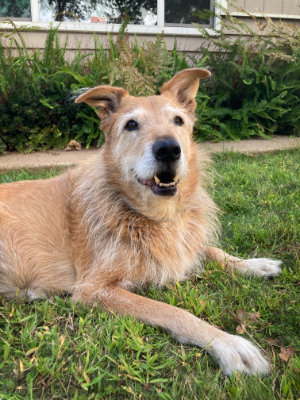
It’s at this time of the year that my dog Otto’s health insurance company sends out a renewal letter. And, of course, the older he gets, the more the annual premium goes up.
It only makes sense. He just turned 14 years old. His healthcare costs have increased. In addition to twice-annual well-dog visits, he gets an annual chest x-ray and abdominal ultrasound; he’s had benign growths removed from his liver, and had (a few years ago) a nearly symptom-free case of pneumonia, so we monitor abdomen and organs (for abnormal masses) and his lungs (to make sure they are clear of excess fluid). Plus, I give him a very expensive daily pain-relief medication for his osteoarthritis; it’s metabolized in a way that stresses the liver less than other nonsteroidal anti-inflammatory drugs, so it supposedly helps with his slightly compromised liver function. (It works, so I’m not messing with it, no matter its cost!)
But, yikes! Today, I had to do some math to see if the increasingly high cost was still worth it. I looked at what I spent this year as a guide:
Total cost of Otto’s vet bills in 2021: $3,025.00
What I actually paid:
| Total cost of Otto’s insurance premiums in 2021: | $2,557.37 |
| Deductible: | $250.00 |
| 10% of costs (insurance reimbursed me for 90%): | $302.50 |
| Total cost (so far*) in 2021: | $3,109.87 |
*This includes the cost of his daily medication and the premiums for the entire year, and presumes we have no more vet visits through the end of the year.
If we make no more visits to the vet this year, I will have paid $84.87 more with insurance than if he had not been insured. But, as everyone knows, just one emergency vet visit, with, say, just one blood test and a prescribed medicine or two, can easily cost $500 or more. If Otto has to go to the vet once more this year for even something quite minor, the insurance will have been worth the cost.
But the peace of mind of knowing that, no matter the cost, I could likely afford 10% of nearly any bill that he might incur… that’s priceless.
The fact is, knock wood, 2021 was one of our most event-free years in a while. The insurance paid off in a major way in the previous two years, when he needed more medical care.
In 2020, Otto incurred $4083.17 worth of veterinary care (including two major dental procedures). I spent $2,252.27 on his insurance premiums, $250 on the deductible, and paid just $408.32 for all those vet bills, because the insurance reimbursed me for 90%. My total was $2,910.59; insurance saved me more than $1,000.
2019 was the year when he had his liver surgery, with two nights spent at the specialty hospital where he had surgery. His total veterinary expenditures that year came to $7,152.45. I spent $1,745.27 on his insurance premiums, $250 for the deductible, and $715.30 for the vet bills (the insurance reimbursed me for 90%) for a total of $2,711.57. Having him insured saved me more than $4,400 that year.
Funny/not funny: Because of the rising price of his insurance premium each year, in 2021, even though he received less medical care than in either of the two previous years, I’ve spent more than in either of those years.
But if Otto hadn’t had insurance in either of those years, I might still be paying off credit card bills!
The increase in the annual premium has gone up steeply; in 2018, the monthly premium for Otto’s coverage was a full $100 less than I’ll be paying in 2022. The difference is more than what I was paying for my younger dog’s coverage.
Yes, I just used the past tense. Despite what I’ve just said about the clear benefit of having Otto insured, two years ago, I actually stopped paying for Woody’s health insurance. (This added to the cost of Otto’s coverage, as I had been getting a multiple-pet discount of 5% prior to cancelling Woody’s coverage.)

I’m taking a calculated risk with this tactic. I first bought health insurance for Woody when he was just a pup, and it was a good darn thing. He was an accident-prone adolescent, and I’ve lost track of exactly how many emergency vet visits he had in his first three years (I can think of five off the top of my head, though I think there must have been more). But after he turned about 3 ½, his medical visits reduced sharply (so far! knock wood!). His annual well-dog visit is pretty minimal, and he hasn’t needed a dental yet.
If I had been paying insurance premiums at the current rates for both dogs over the past three years, it would have tipped the balance; I would have been paying more for the insurance than what the two of them have incurred in costs. But, like I said, it’s been a calculated risk. If Woody had suffered from bloat, a torn ACL, or some other major health problem, then I would have been better off with insurance for both dogs.
When Otto dies, I’ll for sure buy health insurance for Woody again; he’s getting to the age that he’ll need a dental and should start having more tests at his annual vet visits.
As much of a fan if pet health insurance as I am, I can’t imagine affording health insurance if I had three or more pets; even with the multiple-pet discounts, it would add up to a lot. At that point, I’m guessing that most people would be better off saving money each month in an account dedicated for direct health care costs.
What accommodations have you made concerning health insurance for your dogs? Has it been worth it? Not worth it?




We had never had pet insurance before, so when we got a couple of puppies, I thought I’d give it a try. For me-definitely NOT worth it (I have since cancelled my coverage). One of the puppies had a congenital condition which required surgery. I spoke with the company and they assured me they would cover the congenital condition (I had expected them to say no, so I was very pleasantly surprised). I submitted the paperwork requested and a week later, I was being asked for more paperwork (including two years of veterinary records–for an 8 month old puppy). I called our vet’s office and the response from them was “why do they want this? They never ask for this”. I felt guilty for wasting these special people’s precious time as they scrambled to get all the things the company asked for together and organized and get them to me. I went round and round and round with the company–I hadn’t submitted the stuff; yes, I had submitted everything; no I hadn’t submitted everything and my claim was denied. I finally made an angry phone call and they asked me to submit the information again (the fourth time I’d submitted it) and then when it came time for a renewal, they raised the premium for my other dog (who had NOT had a claim) and gave me a discount for Riley (because , according to them, he hadn’t had a claim). So does that make sense? My other dog didn’t have a claim and they raised her premiums, Riley had a claim and they gave me a discount–because they didn’t now he’d had a claim? I promptly cancelled my coverage. I was so frustrated with this company that I didn’t ever bother to submit the claim for the physical therapy after the surgery. I didn’t want to have people waste more time running around trying to get the information demanded by this company and I figured they wouldn’t pay it anyway. I did eventually get a check from the company (which really surprised me), but only after I cancelled my policy. This was nothing but a frustration, a hassle, it wasted a lot of my time (and the time of people whose time is much more valuable than mine), and the company (which was the highest rated and most recommend company) was exceedingly difficult to work with and I had to submit information four times before they finally processed the claim. Never again. I may regret my decision as my dogs get older, but right now, I feel happy to be rid of this organization.
I use an integrative/holistic vet. Do all of the integrative supplements or treatments get covered? I’m thinking of things like a fecal transplant, acupuncture, etc.?
Depends on the company, depends on the policy. If the answer’s not in the marketing material, call the company and ask.
I have had pet insurance through Embrace with all of my dogs, and when I look at the cost of insurance over the life of each dog vs. how much has been reimbursed, I have never lost money. And I agree it’s not only peace of mind, but it allows you to have testing or “just in case” evaluations when you know that the insurance will cover it. For example, I had a dog receiving chemo (with insurance reimbursement) and they wanted the cardiologist to evaluate whether there was a heart problem – I didn’t blink twice about having this done. Another dog had some gastric problems and they wanted to rule out Cushing’s, even though they thought he “probably” didn’t have it. Expensive test – go ahead! I also have had reimbursement for acupuncture and chiropractic and other treatment by my holistic vet.
Another comment is that I think the author is spending way too much on her insurance. I have giant dogs with short life spans and many potential health problems and I pay less than that for all 3. I do a $500 deductible, and my newest dog gets 90% reimbursement after the deductible is met. If I don’t put any claims in on a particular dog, the deductible goes down by $50 each year. No lifetime cap, but $20,000 cap per year. I don’t have wellness covered, because I don’t need it.
My strategy is to apply for insurance the minute the dog comes to me. Then there is nothing preexisting. The waiting period is 2 weeks, and with a simple orthopedic waiver, same for orthopedic problems. This year, my new puppy developed PUPPY Strangles a week after my waiting period was over, and everything was covered. They don’t have any “congenital” exceptions or fixed prices so they reimburse what I send in, very quickly with sending the claim in on my phone.
I couldn’t be happier with my pet insurance.
I have Embrace as well and am also very happy with them. Our previous dog was diagnosed with IBD at approximately four. Our insurance saved us upwards of $20k over the following 2.5 years. If we’d not gotten the insurance as soon as we adopted her, her frequent bouts of diarrhea would have been deemed a preexisting condition and the IBD treatment likely would not have been covered. People tend to focus on accidents, but chronic illnesses are often more costly.
what pet insurance covers dental? Mine doesn’t
Preventive dental care is typically covered under “with wellness” or wellness add-ons to regular illness/accident policies. Many veterinary practices also offer third-party “wellness packages” that cover dentals, and split the payments into monthly for convenience.
Although dental wellness is only covered by preventative care, a few pet insurances cover dental illnesses that many dogs going for cleanings have. If your vet deems that the cleaning is for a dental illness such as gingivitis or periodontal disease (It is likely that most pets going to dental cleaning that does not have their teeth regularly at least have a mild form of either or both), then the insurance will cover it regardless whether or not you have a wellness plan.
Insurance is always going to cost more *on average* than the healthcare costs it covers. Insurance companies are businesses, something has to pay for their administration costs and profits. The point is to be covered if you have expenses you couldn’t otherwise cover, or would have to take high-interest options to finance. In addition to cost of premiums, there is also a time and “hassle” price to collecting on insurance for covered incidents to consider.
So if you’re lucky enough to be able to afford covering a major pet medical expense if you really had to, you’re better off without it, just like not carrying the “comprehensive” collision repair portion of car insurance if you could afford to repair/replace it. If you’re somewhere in the middle, carrying as high a deductible as you could comfortably cover makes sense.
The exception: If you have some reason to think your pet would be more likely to make use of insurance than “average”. For instance, for a friend with small dog who’s a food gobbler and impossible to completely stop from eating anything and everything he finds on our city streets on leash walks, insurance makes sense given his higher odds of ingesting something dangerous (a single cigarette butt could make a small dog dangerously ill).
Nationwide Whole Pet. Been super happy with it.
The took over VPI if I recall correctly. They are the reason I *don’t* have vet insurance. I think they didn’t like my “grandfathered” VPI policy and looked for all sorts of ways to deny me reimbursement.
Nationwide has been the underwriter for VPI since nearly the beginning of the company, and later bought out the founders. The name change was a recent development, but VPI was likely already owned by Nationwide when you had the old policy.
Again: I’m a veterinary medical writer for a pet insurer, so I know the industry pretty well. I’m not in sales or underwriting, though, so I cannot advise on those areas. I’m in a research and communications unit.
“In 2008, VPI was purchased by Nationwide, which didn’t offer pet insurance policies at the time. VPI operated as a subsidiary of Nationwide for several years under its former name. However, a 2015 company-wide restructuring saw the VPI brand officially retired. Nationwide now advertises pet insurance under its own name, although Veterinary Pet Insurance Company remains the underwriter for most policies.”
Nationwide didn’t own VPI until I had had the policy for five years.
They may have been an underwriter but they didn’t start meddling and changing things until 2008. Ramses died at 14 and 3/4 so he was under VPI his first five years and Nationwide for his last 9 years. The difference between Nationwide and VPI was very noticeable and not in a good way. I still would not recommend Nationwide.
Gina can you advise what the better insurance companies are?
I recognized it–that is the plan we have, as well, and it is awesome and quick to pay. And I don’t recall any clause about pre-existing conditions. How do you even know what those might be with a rescue dog?
When you got your policy, you should have received a document outlining any pre-existing conditions, if any. Typically you can find your policy details by signing in to a company’s online portal and going to “policy documents” or some such. If not, call the 800 number and they’ll help you.
Again: I’m a veterinary medical writer for a pet insurer. (Oh, and heck yes, I have pet health insurance, and no, we don’t get a discount because we work there.)
Gina, thanks for your comments. Your contributions have been helpful here.
When I first insured Otto, Nationwide asked to see his past vet records, and so said he had two pre-existing conditions: allergies (he was treated for this just once, and since then, I’ve managed his mild spring environmental allergies with bathing and Benedryl) and “Laryngitis Or Tracheitis” (which he had once).
So far, all of Woody’s ailments have been accidents/injuries. Keeping my fingers crossed that he will have no conditions judged as “preexisting” before I can get him insured, too.
Your math and your reasoning is sound. But I’d sure like to know what insurance you have that pays 90% with a $250 yearly deductible.
The first thing I did with Diana pawPrints and Freyja was to DNA test them with Embark and pay extra for the genetic testing. Thankfully they are all clear on all of the current tests for anything genetic. That doesn’t mean they won’t get cancer or break a bone, but they are clear of the diseases associated with certain breeds of dogs. It was worth the money and eased my worries. Mixed breed rescues are always a mystery. This took some of the mystery out and also allows me to monitor them for the future. I think Diana may have seasonal allergies but also might simply be allergic to fish.
I started Ramses with VIP, which was eventually bought out by Met Life to become National. The process was tiresome, they were always denying something and the most they covered was 60%. The rates would go up almost every year despite the fact that for 12 years he was healthy and had no more than the one annual physical and vaccinations. The deductible seemed high and I almost never met it. While they did pay some for the surgery to remove a lump (mast cell) and they did cover some of his medications I was still paying a lot out of pocket. His cremation was also covered under the policy but only 60%.
I also did the math and decided not to insure Diana and Freyja.
I have a CareCredit card which works for both human, medical and dental and the vets that accept it. If there is a cost under $200 I pay it but if it’s over I use the card. Over $200 then the payments can be spread out interest-free over a year. As long as I meet the monthly minimum payment and pay it off before the end of the period there is no interest. Like PayPal for medical needs. I just used it for Diana’s annual physical/vaccinations and it will be about $38 a month for six months as I like to pay it off early. Yes, something major and catastrophic would push those monthly payments higher but I could take the entire year to pay it off. I also have accounts I could draw from in an emergency.
I have simply never found an honest, reliable insurance company in which the math would work for me. Because that is not how they work. If you are saving money on Otto someone else is losing money on their dog. In fact, more than one person as the company has to make enough profit to pay their investors and stock holders.
BTW a sad fact about our own healthcare system. In Ramses’ last year he was on several medications for pain and such. He wasn’t eating well and losing weight so the vet prescribed him an anti-nausea medication that is used for cancer patients. I went to the pharmacy and it was over $400! I called the vet and told her I can’t afford that. She said she had a coupon and sent it to me. I showed the pharmacist and was able to get him his medicine. The cost? $40. And you can bet the drug company still made money on that $40. It still makes me angry that cancer patients would be gouged for money in what is basically extortion; pay or you’ll die.
I never had pet insurance. Yes, we had a beagle who had 2ACLs replaced and was quite probe to getting into trouble. Our bassett cost us $7000 for two broken femurs….
We are now up to 12 dogs….
Several years ago 2 of my girls (labs probably from a backyard breeder who threw them away at 4 months of age) had cancer, one an iniperable nasal cacer, ther other hemangiosarcoma. We did chemo which they tolerated well…they both succumbed to their cancer…in retrospect, i am not sure i would do it again…..
My bassett is now 10 or 12, can’t see well anymore. If she got something serious not sure if i would not let her go….she does not do well in strange surroundings and with strangers….
We have a bunch like that…my little roundlingds
I tried Galliprant but my dog was unable to tolerate it (gastrointestinal disaster).
Has any one else had this issue and resolved it Successfully?
There are other meds. Have they tried Tramadol?
I have Bernese Mountain Dogs and am a firm believer in getting them on pet insurance early and for life after incurring $15,000+ for one diagnosed with cancer. My approach has been to gradually increase the deductible as they get older and gradually decrease the percentage covered as well. This has served to keep the premiums in check but still provide me with significant coverage should they tear an ACL or have other major medical needs. It also removes the $$$ concerns from decisions about whether to do expensive diagnostic testing and/or lab work to sort out what might be going on. It’s a personal decision but for me it’s the right one.
Agree. I would never have a Berner without insurance and have never lost money over the life of the dog with insurance – and I’m on my sixth.