


It’s at this time of the year that my dog Otto’s health insurance company sends out a renewal letter. And, of course, the older he gets, the more the annual premium goes up.
It only makes sense. He just turned 14 years old. His healthcare costs have increased. In addition to twice-annual well-dog visits, he gets an annual chest x-ray and abdominal ultrasound; he’s had benign growths removed from his liver, and had (a few years ago) a nearly symptom-free case of pneumonia, so we monitor abdomen and organs (for abnormal masses) and his lungs (to make sure they are clear of excess fluid). Plus, I give him a very expensive daily pain-relief medication for his osteoarthritis; it’s metabolized in a way that stresses the liver less than other nonsteroidal anti-inflammatory drugs, so it supposedly helps with his slightly compromised liver function. (It works, so I’m not messing with it, no matter its cost!)
But, yikes! Today, I had to do some math to see if the increasingly high cost was still worth it. I looked at what I spent this year as a guide:
Total cost of Otto’s vet bills in 2021: $3,025.00
What I actually paid:
| Total cost of Otto’s insurance premiums in 2021: | $2,557.37 |
| Deductible: | $250.00 |
| 10% of costs (insurance reimbursed me for 90%): | $302.50 |
| Total cost (so far*) in 2021: | $3,109.87 |
*This includes the cost of his daily medication and the premiums for the entire year, and presumes we have no more vet visits through the end of the year.
If we make no more visits to the vet this year, I will have paid $84.87 more with insurance than if he had not been insured. But, as everyone knows, just one emergency vet visit, with, say, just one blood test and a prescribed medicine or two, can easily cost $500 or more. If Otto has to go to the vet once more this year for even something quite minor, the insurance will have been worth the cost.
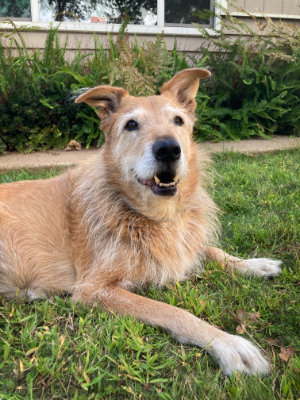
But the peace of mind of knowing that, no matter the cost, I could likely afford 10% of nearly any bill that he might incur… that’s priceless.
The fact is, knock wood, 2021 was one of our most event-free years in a while. The insurance paid off in a major way in the previous two years, when he needed more medical care.
In 2020, Otto incurred $4083.17 worth of veterinary care (including two major dental procedures). I spent $2,252.27 on his insurance premiums, $250 on the deductible, and paid just $408.32 for all those vet bills, because the insurance reimbursed me for 90%. My total was $2,910.59; insurance saved me more than $1,000.
2019 was the year when he had his liver surgery, with two nights spent at the specialty hospital where he had surgery. His total veterinary expenditures that year came to $7,152.45. I spent $1,745.27 on his insurance premiums, $250 for the deductible, and $715.30 for the vet bills (the insurance reimbursed me for 90%) for a total of $2,711.57. Having him insured saved me more than $4,400 that year.
Funny/not funny: Because of the rising price of his insurance premium each year, in 2021, even though he received less medical care than in either of the two previous years, I’ve spent more than in either of those years.
But if Otto hadn’t had insurance in either of those years, I might still be paying off credit card bills!
The increase in the annual premium has gone up steeply; in 2018, the monthly premium for Otto’s coverage was a full $100 less than I’ll be paying in 2022. The difference is more than what I was paying for my younger dog’s coverage.
Yes, I just used the past tense. Despite what I’ve just said about the clear benefit of having Otto insured, two years ago, I actually stopped paying for Woody’s health insurance. (This added to the cost of Otto’s coverage, as I had been getting a multiple-pet discount of 5% prior to cancelling Woody’s coverage.)

I’m taking a calculated risk with this tactic. I first bought health insurance for Woody when he was just a pup, and it was a good darn thing. He was an accident-prone adolescent, and I’ve lost track of exactly how many emergency vet visits he had in his first three years (I can think of five off the top of my head, though I think there must have been more). But after he turned about 3 ½, his medical visits reduced sharply (so far! knock wood!). His annual well-dog visit is pretty minimal, and he hasn’t needed a dental yet.
If I had been paying insurance premiums at the current rates for both dogs over the past three years, it would have tipped the balance; I would have been paying more for the insurance than what the two of them have incurred in costs. But, like I said, it’s been a calculated risk. If Woody had suffered from bloat, a torn ACL, or some other major health problem, then I would have been better off with insurance for both dogs.
When Otto dies, I’ll for sure buy health insurance for Woody again; he’s getting to the age that he’ll need a dental and should start having more tests at his annual vet visits.
As much of a fan if pet health insurance as I am, I can’t imagine affording health insurance if I had three or more pets; even with the multiple-pet discounts, it would add up to a lot. At that point, I’m guessing that most people would be better off saving money each month in an account dedicated for direct health care costs.
What accommodations have you made concerning health insurance for your dogs? Has it been worth it? Not worth it?




Three dogs, all insured since puppyhood, now one year, four years and seven years old. Insurance since April 2019.
Cost of vet care: $51,436.
Cost of premiums: $7260
Total cost: $58,695
My cost: $12,613.
Savings: $46,082
I decided to buy insurance after a previous dog developed epilepsy at three years old. Unfortunately, he only lived two years after diagnosis, but the cost of his care/medications was well over $16,000. Insurance turned out to be a wise decision. My seven-year-old developed a mast cell tumor in 2019 and a melanoma a year ago, hence the costs listed above (he’s doing fine). My one-year-old managed to incur a $350 bill during the 15-day waiting period before the insurance kicked in (thought he swallowed a coin, he didn’t), and because he’s so young, the deductible is $500, so insurance paid for none of it. Do I regret insuring him? No way! I pay auto insurance and homeowners insurance and have never filed a claim on either (other than the 1994 earthquake in Northridge, CA. I had $9000 in damages and a $10,000 deductible). Do I regret having auto and home insurance? Nope.
I am always amused when I hear people debate whether or not they “break even” on pet insurance. Do you worry about breaking even on any of your other insurance? To exist, insurance companies must make money. If everyone broke even or was ahead, the company couldn’t exist. Insurance simply takes dollars out of the equation in terms of making health care choices.
I don’t have insurance for my dog, and now that she is almost 2 years old, perhaps I’ve waited too long given how the industry defines, “pre-existing” conditions. Nevertheless, I would like to know which companies seem to be the most straight forward to work with and I’m also wondering if there is any evidence that the effect of pet insurance on the market will naturally drive up the cost of care?
I insured my Old English Sheepdog (OES) rescue at 4 mos. He received a “green light” from the insurance company, meaning he was a completely healthy puppy and there would be no pre-existing conditions. I also insured my 7 year old Aussie rescue, with a higher deductible to keep the premiums a bit lower. She did have a pre-existing condition (severe arthritis in bi-lateral stifle joints due to her former owners not repairing her serious CCL tears several years before). I still felt insurance would be beneficial should she be diagnosed with cancer, heart disease, or another serious condition. The OES’ monthly premium was $35, the Aussie’s $48, equaling $83/month for both dogs. Here was the snag. I did not realize until about a year or 2 later that this insurance’s deductible was a per incident/illness, not an annual one. Each dog went to the vet for various simple matters, but nothing for the same condition, so the insurance never kicked in. Even when my Aussie reached 10.5 yrs old and began having symptoms of DM (Degenerative Myelopathy), she saw the vet more often and had hydrotherapy and laser therapy treatments. However, the out-of-pocket costs never totaled more than her deductible. In the 4 years since the OES puppy arrived, I have spent $3,480 on premiums PLUS the costs of vet visits for both dogs and rehab treatments for the Aussie. Takeaway: Choosing an insurance policy with a per incident/illness deductible was a poor idea. My Aussie is gone now and my OES is still very healthy (knock on wood!) Should I switch to a company with an annual deductible? Now that he is no longer a puppy, his premiums would be 2-3 times as much and those early “simple matters” would now be considered pre-existing conditions. So, I am staying with the same company and will still have the peace of mind that if he has an accident or illness that costs, say $10,000, it will be worth it in the end.
I had a very poor experience with a pet insurance company, so I’m pretty much finished with the whole idea of pet insurance. This company really left a terrible taste in my mouth. However, we chose a policy with $0 deductible. You will pay a higher premium. I’m not sure if anyone can tell you which will be better for you (and I’m not sure you can know). We chose this deductible since our two were puppies and both healthy, the premiums were as low as they were ever going to be.
Nancy, could I ask what osteoarthritis meds does Otto take?
Galliprant. At his weight, a month’s supply costs $170.
We have had dogs for many years and our current (2.5 year old) dog is the first one we’ve bought insurance for. We chose Trupanion, in part because the deductible is per condition (vs per year) and we also chose $1000 deductible to keep premiums down. We figured if she ever gets a chronic condition, it would be covered 90% after one deductible payment. (Of course, if there are two conditions in one year, you have to pay two deductibles, so, there is no perfect scenario.) This past year, she injured a tooth and needed a root canal. It pretty much evened out, with the insurance reimbursing us an amount that was about the same as we’d paid in premiums over 2 years. That was fine with me because the root canal was not nearly as expensive as many other situations could be (e.g. when our uninsured late elderly dog had emergency surgery, it was over $7000 and he, sadly, didn’t even survive). Trupanion assured me they would cover followup from the root canal, e.g. periodic x-rays that the veterinary dentist suggested, with no more deductible because it is the same condition. So, I feel like the insurance was a good call to give us some peace of mind though, of course I think all of us hope for our dogs’ sakes that we never really need to use it!
My 13.5 year old golden passed away last week. He was diagnosed with osteosarcoma when he was 10 years old. He required a limb amputation and chemo, total cost of over $12k, had he not been insured from puppyhood we would have had to go into debt to pay for the cost of his care and would still be paying it even now. His policy from that time period wasn’t great but it paid the majority of the costs associated with his cancer. My now 4 year old golden girl was insured as a pup too and while her premiums are high I know that if I were to terminate her insurance and try to add it later it would be prohibitively expensive, if, I could even get her insured. She has not had any major health issues but being a golden, no matter how I try with diet and all she will be prone to cancer. My peace of mind is well worth it. We adopted a golden from the China meat markets a couple of years ago. He already had health issues so insuring him wasn’t even an option since most everything would or could be considered a preexisting condition, as such we self insure him with a savings account. I know that if any major problem arises we will not have enough to cover it but it is a cushion. I would never be without insurance if it was an option.
I’ve had pet insurance on 2 of my animals (dog & cat) .and for the dog was a godsend when he got inoperable liver cancer. We took him to Ohio State University Veterinary Hospital for treatment for several years. Unfortunately, we thought the cancer, which was on hold, would take him, but he had a massive stroke and passed a year ago. The cat just has specialized medicine which is reimbursed 90% which has helped too. Maybe IF we get another animal, I still will insure it. I recommend insurance for all who have animals or a special account for them because you never know what will happen
I’ve been insuring my dogs since 2000 when VPI was the only game in town. At one time I had 6 dogs and every one was insured. Best decision over the years, because it meant I never had to make a choice between my resources and their lives. Peace of mind is “priceless.” I can also say that insurance has changed a lot in the last 20 years and competition among companies has helped keep premiums very constant but benefits are much much better. Shop around is my beat advice, and also read the WDJ articles on pet insurance (they help a lot!).
If I’ve ever questioned my decision to have insurance, all it takes is one more Go Fund Me plea from a desperate family trying to save their dog’s life. I never want that to be me.
Ramses had VPI since he was a puppy and it was great. Then they were taken over by Met Life (National) and it was horrible. They just compounded my grief with their denials. They are why I don’t have insurance on my current dogs.
VPI was not “taken over” by MetLife. Nationwide Insurance has been an underwriter since almost the beginning of VPI and became the owner many years ago, even though it was still called VPI for quite a long time after the original founder bowed out.
During a branding change a handful of years ago, the top folks at Nationwide HQ decided to change almost all divisions to the Nationwide name.
Ramses had VPI starting in 2003.
“In 2008, VPI was purchased by Nationwide, which didn’t offer pet insurance policies at the time. VPI operated as a subsidiary of Nationwide for several years under its former name. However, a 2015 company-wide restructuring saw the VPI brand officially retired. Nationwide now advertises pet insurance under its own name, although Veterinary Pet Insurance Company remains the underwriter for most policies.”
The first five years under the original company were great. The last 9 years under Nationwide became increasingly worse every year. Ramses had no major medical problems until he was 13.
I work for Nationwide’s pet insurance division. That’s the “simple” explanation. In fact, Nationwide has had its finger in the pie almost since the founding of VPI, 40 years ago. In 2008, Nationwide owned a significant portion of VPI and decided to up its share and buy the entire company.
I’m very sorry you haven’t had the best of experiences. Long before I worked for Nationwide (I’m not in sales or claims — I handle communications in the veterinary relations department ) I had VPI and thought it was awful. I now have our Nationwide percent-of-invoice plans on my dogs and just love them. (And no, we don’t get a discount!)
Another option. Be you own Pet Insurance. Something like a HSA on the human side. From day one of ownership create a separate account for your pets health. With inflation, let’s suppose the premiums are $250 a month. That’s $3,000 per year. Pay for most of your pets care out of pocket until a catastrophic event or until you have a sizable amount saved ($15,000 in 3 years unless you adjust your monthly deposits by the CPI or other inflation indicator). If you want to make this money work, invest in a Federal and State tax free mutual fund which today gives a 3% return or an effective rate of 6% for some tax brackets. Of course this requires you to budget and be consistent.
Even with “discipline” your plan requires that your pet have no serious accident or illness in those first couple of years. If your pet stays relatively healthy, you’re in great shape.
But unless you have an open credit line you’re able to use before your emergency fun gets built up, you’re SOL if your pet gets really, expensively sick or injured.
Point well taken. Statistically about 1/3 of all pets at one time their life have vet bills over $10,000. So it’s a personal tolerance for risk. The other question is how long do you maintain health insurance on your pet. My 14 yo beagle hound has lost most of her teeth, has bad arthritis and spinal stenosis. She still enjoys life but if she got very ill I would show her respect and not push aggressive treatment. Now for the 2 year old good and faithful dog the answer would be different depending on the disease, pain and suffering.
The comment on accident insurance has different set of economic factors since it is less expensive.
$3000 per year is $9000 not $15000 as you stated
Oops. Thanks for the catch.
I’ve done something similar but different. I have three retirement accounts and a pension. There isn’t much in any of them, about $10,000 in Met Life, $30,000 in my STRS pension 2 and about $30,000 in my Roth IRA. My pension covers all of my needs including my own medical and dental insurance so I’ve just sat on the other two accounts. I don’t have to draw out from the TSAs until I’m 72 and I never have to touch the Roth. So I’ve decided to use a CareCredit card for the dogs for their vet bills that are over $200 to pay off interest free over a year. Anything under I pay out of pocket. But should something catastrophic happen, I know I have $30,000 in the Roth I can draw from immediately and when that is gone I can start drawing from the other two. I know not everyone can do this but I had pet insurance for Ramses, if you can call that pitiful coverage insurance, and to me it never paid off. Not even when he eventually developed cancer at age 14. They didn’t even cover the full cost of cremation.
I think the costs, deductions, etc of pet insurance varies widely and there is no way to compare one to another.
I agree with you. We did carry insurance on our Greyhound, initially it wasn’t too onerous – Greyhounds are one of the breeds that is less expensive to insure. It can vary dramatically by breed. But premiums increased significantly every year and we would have lost a significant amount of money had we continued the policy even though she did have health issues later in her life.
Everyone’s financial situation is different but my impression is that over the lifetime of a dog few people actually benefit from the coverage. We won’t ever be getting another dog, I can’t go through that heartbreak again, it’s been almost 6 months and I still haven’t recovered. But if we were to adopt another dog I would create an account and fund it with approximately $50,000 to draw from for her care both medical and general. Not everyone can afford to do so but each has to factor in the inevitable expense that you will be responsible for. They don’t go to college but their proper care and support is almost as expensive as it is for a child.