

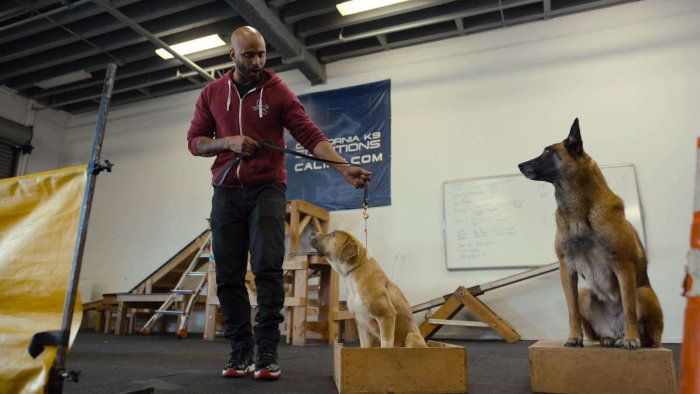
A few weeks ago, I started seeing posts on social media from dog trainers I know and admire, warning people about a new show on Netflix called “Canine Intervention.” The show features a dog trainer named Jas Leverette, who says, “I help the dogs that no one else will.”
I watched the first three (of six) episodes that currently appear on Netflix, and my first thought was, “Here we go again.”
The show is scripted and filmed like any reality TV show: Fairly ordinary situations are filmed in a way that dramatizes the problems people are having with their dogs, making the dogs seem incredibly dangerous and destructive, and the trainer is engaged in such a way as to appear near-heroic. He’s shown dispensing pithy pearls of dog-training wisdom, with other brief animal-behavior “facts” appearing in type on screen. Within each hour-long episode, the dog’s problems are improved or resolved.
That’s a good thing, right? We all want people to enjoy their dogs more, and to learn how to train them! So why are so many trainers upset about the show?
There are three major issues: The first is that Leverette is a self-described “balanced trainer.” This has come to mean someone who uses food treats, toys, and praise to reinforce behaviors that they want from a dog – and physical “corrections” to punish unwanted behaviors. Though Leverette also describes his training as “modern,” up-to-date training professionals understand that while force-based training can be effective, there are MANY reasons it’s best avoided:
- Not everyone can make appropriate corrections with the timing required to make them effective
- Not everyone wants to use force with their dogs
- Most significantly, poorly timed or inappropriate corrections are nearly guaranteed to worsen the dog’s behavior and increase his frustration, triggering defensive aggression.
But the usual justifications for the use of force are trotted out. In the first episode, a guy described as a tech-business owner has adopted a pit bull-mix who displays aggression with strangers and visitors to the tech-guy’s home. Leverette says, “If we don’t fix this, this dog is not gonna have a long future…. She won’t have a second chance….” The owner agrees. “This is life or death, pretty much, for her.”
This sort of language triggers educated dog trainers. If an owner is motivated, there are always more ways to train a dog in order to “save” them, without having to resort to pain-inducing tools and methods. And in cases of aggression, it’s well-established that the use of pain, force, and fear in training often worsens aggression.
Don’t get me wrong. Leverette is not shown flagrantly inflicting pain on the dogs; he’s a much more skilled trainer than that. It’s just that his methods call for making the dog do what he wants, when he wants – even if the dog is “flooded” and completely “over threshold,” physiologically aroused past a state of being able to learn. Instead, the dogs simply learn to give up and give in to the force being used.
By the way, it’s never called out or shown explicitly, but when you first see each “problem dog,” they are generally wearing wide collars. When Leverette begins work with them, they are wearing very thin cord-like slip collars. This allows the dogs to be controlled with a lot less overt force; it’s too painful and choking to pull or “act like a fool” (as one owner describes his dog’s problematic behavior) with a narrow cord on your throat. Look carefully and you can see that with these collars, resistance is futile for all but the most defensive dogs; they have to submit. This doesn’t mean they are learning anything, however.
Second, Leverette uses a lot of language that more educated trainers eschew as outdated, meaningless, and immaterial to the science of behavior modification. He issues “commands” instead of talking about “cues” for behavior. Families are described as “packs” and owners are encouraged to be “pack leaders.” Though this sounds kind of cool, exactly how this is accomplished is never well articulated. “Dogs need to trust their pack leader,” Leverette says in the first episode. Um, okay… What, exactly, should an owner do to make their dog trust them? How will we know when a dog trusts us? And how will “trust” make him understand what I want when I cue a behavior? It’s just fuzzy language that sounds good, but can’t actually be described in concrete or useful terms.
In his training, Leverette promotes the use of a plywood platform that he calls a “box.” “In my system, the box is an important training tool to teach new behaviors,” he says in the first episode. “It’s also a first step in establishing the pack leadership that’s necessary,” he says, while the on-screen caption echoes this: “Obedience depends on a dog’s trust and respect for their pack leader.” Again, this is ridiculous. All sorts of animals can be trained to do all sorts of behaviors without much knowledge of their handlers at all. (Want examples? See here, and here, and here. I could do this all day!)
Demystified, the use of Leverett’s box is simply using a platform (a mat can be used just as effectively) as a “station” – a place where the dog is heavily reinforced when he returns to it or remains there. Using a platform, box, mat, or Hula-Hoop on the ground and giving the dog a high rate of high-value rewards will reinforce the behavior of going to and staying in that spot – it has nothing to do with trust or leadership whatsoever. You can train a wild animal or bird to do it, if you want to. (Read this article to see how our Training Editor Pat Miller teaches a dog to “go to your mat.” Or this one, for another perspective.)
My third objection: Anyone who actually trains dogs – including Leverette himself – knows that while a skilled trainer can change a dog’s behavior dramatically in a very short time, it takes much longer for the dog to really learn. The goal is to get them to understand what is desired of their behavior when given specific cues and to motivate them to work for the reinforcements they understand will follow if they performs the desired behavior. In an hour-long TV-show format, even if the passage of time is accurately reflected (as when Leverette takes the dog in the first episode back to his business location for a several-week intensive “board and train” experience), when the dog is returned to the owner much improved, it would appear that the trainer is some sort of miracle worker. Most ethical trainers will tell you: With some instruction, if you worked with your dog for the number of hours each day that I can assure you that the TV dog trainer actually worked with the dog, you’d likely look like a miracle worker, too.
As with that other famous TV dog trainer, it makes for good TV when dogs can be shown displaying dramatic, aggressive-seeming behavior – and then transform in the hands of the trainer into much calmer dogs. But we know that pain (from choke, pinch, or shock collars, including the very thin slip collars that Leverette uses on dogs in the show) can be used to quickly suppress a dog’s dramatic response to whatever stimuli has them worked up – and that pain cannot change how they feel about that stimuli. Without having experienced a change in how they feel about the stimuli that stressed them in the first place, if, back at their owner’s home, there is no painful consequence for responding in a dramatic way, then the behavior will return. Suppressed responses will need to be maintained by continued painful consequences.
In contrast, true behavior modification changes how the dog feels about the stimulus, by initially managing his exposure to it while reinforcing his calm behavior and choice to (eventually) ignore the stimulus. He learns a more desirable (to us) behavior and classical conditioning comes along for the ride, as he (eventually) finds a previously stressful stimulus to be enjoyable as he gets reinforced for his better (more desirable to us) choices.
It’s clear that Leverette is knowledgeable about behavior modification; with the dog who bit several of the owner’s friends (in the first episode), he’s shown doing some desensitization with the dog. But the process isn’t explained in accurate terms; it’s all dumbed down into populist garbage talk (in my opinion); when the captions read at one point, “A dog without a pack leader is a dog who will ignore obedience commands,” I wanted to throw things at the TV! Come ON! But I understand that the way I would put it wouldn’t be simplistic enough for TV: A dog who hasn’t been reinforced with things that are valuable to him for responding to consistent cues with specific behaviors won’t respond to those cues!
I have to say, there were some things about the show that I liked. I am very appreciative that Netflix made a show featuring a person of color (Leverette is African-American); many of his clients, too, are people of color. It appears that he mentors, trains, and hires other POC, and is committed to spiritual practice, his community, and his family. He seems like a genuinely good guy. It also seems like Leverette is much more focused on the practice of dog training – actually teaching cues and specific behaviors to his canine students – than the last popular dog-guy on TV, though he, too, was full of all this pack-leader “dominance” baloney. And YES, all this “dominance” talk is absolute hooey. Read this informative statement about training and “dominance” from the Association of Professional Dog Trainers.
It’s entirely possible that the TV production company that made the show has run roughshod over Leverette, forcing him to reduce his actual training philosophies and techniques into the catchy little sound bites and captions that so offend me and the trainers I know. Whether he believes them or not, though, my fear is that when inexperienced dog owners see and hear dog training reduced to ambiguous statements about “leadership,” all they absorb is that they aren’t being tough enough with their dogs. It’s no different than saying, “You just have to hold your mouth right!”
The problem with “TV trainers” in general is that TV producers want drama – and good dog training is not dramatic! Teaching people to effectively communicate with their dogs, to give the dogs clear direction and quick feedback when they’ve done the “right” thing, may not reduce to a TV-worthy caption or resolve nicely in an hour. But I wish someone in television production would figure out a way to present truly modern dog training in a way that gave viewers basic instruction in easy-to-accomplish, dog-friendly training. It might not garner the kind of ratings that training celebrities’ dogs might earn, but by demystifying the process and breaking it down just like a puppy kindergarten class, it might actually help WAY more dogs and people.




Thank you to Rachel Simpson for her excellent comments. She said all I wanted to say and did it very well. But the main reason I’m writing is to respond to Nancy’s wish that there was a way to make modern training methods fun to watch. It reminded me of a video I saw years ago…many of you may have seen it. It was of a woman introducing a ferret to clicker training with the goal of having it touch a red ball. Click, treat, over and over, with no response from the ferret, and then suddenly, you could see its eyes light up, and its whole demeanor changed. It went for that ball and bopped it with its nose over and over again. “I got it! I got it!” It was hysterically funny, but also clear evidence of the joy animals get from positive training. Clicker training would be a great subject for a TV show. I haven’t seen this Leverette guy, but I’ve seen Cesar Milan in action. and watching him force dogs into submission is, at minimum, cringeworthy. It’s not the method per se, it’s about changing people’s concepts of what training is. It’s not about the role of a king and his subjects, or a Caesar and his slaves. It’s a partnership, and watching dogs participate in their own training would be highly motivating to viewers and a ratings winner for the networks. There’s nothing more beautiful than witnessing the bond it creates between the owner and his dog. Or his ferret, or his cat, or even his child. At its most basic, positive reinforcement is all about a way to communicate with the world. Sorry, didn’t mean to get so dramatic!
Admittedly, I have only perused Kearns article, but intend to read it. Susan Friedman thoughtfully emphasizes another downfall of positive punishment, negative reinforcement, and negative punishment. The potential for the handler to be reinforced when any of these strategies are utilized is great, as we know we can get behavior when employed. This incentivizes the handler to continue to use these strategies, perhaps with even more commitment and force. Which brings to front and center the humane treatment of our learners and our moral and ethical responsibility to utilize least aversive and most reinforcing strategies. We know we have more humane/effective strategies to get behavior. I believe it is our responsibility to be outspoken in our support and training of them.
Thanks to Nancy Kearns for once again opening this door.
I was disheartened to see him on the Ellen Show a couple of weeks ago . I had never heard of him but I was turned off by what he was saying . I have used positive reinforcement training for many years with my own dogs , grooming customers and shelter dogs and it is the only way to go.
I have not seen this program, and I’m not sure if I will. I think it’s very sad that good trainers that manage to get on television, such as Victoria Stilwell or Zack George, don’t last. No high drama there, just people and dogs learning how to live together happily.
i want to thank Nancy Kerns and The Whole Dog Journal for always providing good, sound training advice from brilliant professionals, such as Pat Miller. i’ve learned a lot here over the years, and have often referred others to your articles for advice. Hopefully, some of them became subscribers, as well.
There’s a line from Pat Miller that I love to quote. It appears at the beginning of her chapter in Donald McCaig’s last book, Mr. & Mrs. Dog; “The question, then, is this: Would you rather hurt your dog to train him – or feed him treats? Seems obvious, doesn’t it?”
I only got through the beginning of the 1st episode and couldn’t watch anymore. I agree that there is knowledge there but…. right off the bat he got right into the poor dog’s space and elicited a reaction then darted away. That, to me, was just stupid and insensitive. Not to mention his choice of words.
Have you seen the show ‘Dog Impossible’ on Amazon Prime? I found that one to be really well done and he explained what and why he was doing things very clearly.
If you have seen it, what are your thoughts?
Dog Impossible is a horrible show that should never have been aired for the public. Allow me to quote the letter sent to Nat Geo (the original home of the show) written by Marjie Alonso, the Executive Director of the IAABC (International Association of Animal Behavior Consultants) on behalf of their board of directors:
“To the leadership team of Nat Geo Wild Dog Impossible:
The International Association of Animal Behavior Consultants (IAABC) applauds National Geographic’s mission to offer intelligent, relevant and captivating non-fiction entertainment. This is a crucial objective, especially as an introduction to children and viewers largely relying on television for their scientific information.
However, your stated mission is in direct conflict with your show Dog: Impossible. In fact, the irresponsible treatment of the dogs and people on this show flies in the face of all best practices in animal training and behavior. Rather than promoting science and scientifically-proven methodology, Dog: Impossible sacrifices learning science for more dramatic television.
Matt Beisner appears to have no credentials or education in training and behavior, yet he refers to himself as a behaviorist. His claim that ‘energy is the one language that every animal on the planet speaks’ makes clear he is not one.
His statement, ‘You don’t need tricks, you don’t need treats, you don’t need force,’ shows just how unaware of his own actions he is. His misuse of scientific terminology leads viewers to believe they are learning demonstrated, safe and accepted strategies in helping their dogs. In fact, Mr. Beisner is forcing these dogs from start to finish of each episode. His own ‘tricks’ are that of over-stressing dogs until they’re in a state referred to in psychology and science as ‘learned helplessness.'”
The letter goes on for quite some length detailing the abusive techniques employed and the obvious signs of distress exhibited by the poor dogs being “rehabilitated.” It closes with this:
“The IAABC urges Nat Geo WILD to stop promoting this public miseducation. The tactics employed in the name of entertainment are unnecessarily harsh and potentially dangerous to the public, and they teach yet another generation of Nat Geo watchers absolutely incorrect and harmful practices.
It remains a mystery why your network is so intent on harming dogs. After years of Cesar Milan, to now bring in a man equally unskilled, who equates terrified, angry or entrapped dogs to his own addiction history is remarkable. Are we really satisfied conflating ego with compassion, self-focus with an understanding of animal behavior? Is this the “science” your mission stands for?
The damage Nat Geo is doing to dogs by choosing this type of programming is astounding. We can only assume that the producers are unaware of this, as it’s hard to imagine such harm and cruelty would be deliberate.
Would you show a reality program on heart surgery with a photogenic “self-taught” practitioner, simply stating the star was not a doctor before showing him mutilating a real patient?
I leave you with the clearest image of suffering and abuse from your trailer: the Aussie, stressed to the breaking point, thick ropes of drool streaming from its mouth, being choked by a slip lead to compensate for the host’s inability to even effectively muzzle a dog. This dog is at the point of collapse. This dog is being tortured, and that is not hysteria. That is an assessment by any educated measure.
Please stop this cruel and dangerous programming. To do otherwise is to support that self-taught heart surgery and all the consequences it would bring; that this show is currently bringing to families struggling with their dogs.
Professionals refer to Cesar Milan’s influence on dog training as “job security” because so many dogs ruined or made far worse by his teachings are brought to us by well-intentioned, often weeping owners desperate for real help. Often it is too late.
We do not want more work due to this same phenomenon.
We’d be happy to provide you with any education and resources you need to inform your producers about what would qualify as responsible, effective, safe and thoughtful work with the same “red zone” dogs you sell so well.
Thank you for your consideration.”
‘
I’m just curious which aspects you found so objectionable.
Seriously? You mean besides the plethora of objections raised in the letter I posted?
I actually know Matt personally because he and the Zen Dog helped me with my dogs, one who had gotten us kicked out of every doggy daycare in Los Angeles. Bagel destroyed my apartment on day two after his rescue, flooding it. (Yes, he had been crated. He broke down his crate.) Bagel and my other dog sent me to the ER with a concussion.
I tried other trainers who want to use harsh training methods, including prong and choke collars. The Zen Dog discourage such collars and other punitive methods, recommending instead the Halti which allows the dog to decide for itself without hurting either itself or its handler. They are all about respecting the dog, recognizing when the dogs are done, whether that’s two minutes, 10 minutes, or 30 minutes, so I was surprised by your comments about learned helplessness. They are explicitly against “methods” (honestly, it’s not even about methods) that would induce learned helpless. (Yes, I am familiar with what that is, thanks to an episode in which Cesar Milan forced a Jindo [Bagel is an Akita-Jindo], misreading its learned helplessness for “submission,” when all that the Jindo had been afraid of was the slippery floor. The Jindo community had a lot to say about that.). The Zen Dog helps the dogs’ humans learn what triggers their dogs, avoid such triggers, or help their dogs when it is not possible to avoid the triggers.
No, the Zen Dog doesn’t use treats. They haven’t needed to do so. Instead, they work to earn the dog’s trust, which is why so many people who have dogs that don’t get along with other dogs or people other than their humans have appreciated the Zen Dog and cannot wait for it to reopen.
I’d like to share with you three stories that show how much they value earning the dog’s trust.
The first is of a colleague who could not travel at all because her dog bit everyone. When the dog first arrived at the Zen yard, it was understandably anxious. The Zen Dog dedicated an entire yard (there are several different yards) and one handler for just this one dog, and the handler just sat waiting until the dog came over half an hour later and trusted the handler. This was not a training session. It was just for overnight boarding. Which doggy daycare would do that?
The second is of Bagel. One day, a new handler came out to receive my dogs, and as he led them inside, he nudged Bagel with his leg. The Zen Dog discourages physically touching the dogs to get the dogs to do what humans want. Surprised and a bit disconcerted because I didn’t want Bagel to be around someone who could get him to lose his trust in human beings again, I texted the Zen Dog about what had happened. That handler was let go. Also, during the firework seasons (yes, we have two or three seasons of neighborhood fireworks all throughout Los Angeles), a seasoned handler sat through the night with Bagel who is terrified of fireworks.
I cannot think of other places that would have gone to such lengths for the dogs entrusted to them.
I was admittedly a bit surprised by certain moments in the show because those moments were not in line with what the Zen Dog does, and I couldn’t help but wonder if it was the production company.
No, Matt doesn’t have a degree in animal behavioral psychology. I am ok with that because he and the Zen Dog handlers were the only ones out of many, including trainers with degrees, whom Bagel trusted. Matt and the Zen Dog team do not put themselves out there as behaviorists with degrees. They are very honest about how they came to help dogs and their humans.
Rather than likening Matt and the Zen Dog to surgeons, likening them to parents or guardians would be more accurate. A surgeon for dogs would be a veterinarian, and indeed, I wouldn’t trust my dogs with someone without a veterinary degree, preferably in fact from UC Davis. But parents don’t attend schools to become parents who understand that their children are not extensions of themselves and who respect their children for the individuals who need provide security, stability, trust, love, etc. to become adults who can enter the world unafraid to form healthy relationships.
Perhaps it would be better for NatGeo to pull the show if it’s presenting such a distorted picture that does disservice to the Zen Dog and the dogs who benefit from their care.
I hope you now have a better understanding of why I spoke up for the Zen Dog.
I couldn’t agree more, but I have to say that Brandon McMillan’s (of “Lucky Dog” fame) training practices are far more objectionable. He presents his training on MasterClass and uses a lot of cringe-worthy compulsion.
The one thing I noticed was his lack of knowledge around service/guide dogs. According to the ADA, an emotional support dog is NOT a service/guide dog. Even to get the designation of one requires a letter from a physiatrist but it does not give them (handler and dog) the public access that a certified service/guide dog has. It is the same here in BC, Canada. An emotional support dog is not a service/guide dog and has the same access as a therapy dog/animal.
Thank you, Nancy. However, I have one nit to pick with this otherwise excellent article.
Behavior modification does, indeed, attempt to change the dog’s emotional response to a stimulus (the trigger that causes the fearful/aggressive reaction). That calls for classical conditioning to be front and center in one’s approach, not to have it “come along for the ride.” So I will not prioritize rewarding good behavior as much as I will treat upon low-intensity exposure to the trigger in order to counter-condition the dog and promote a positive association with the thing that currently has a negative association.
Also, we know that pain can and does change the way a dog feels about a stimulus. It can turn good feelings bad, but more to the point, it can reinforce already existing negative associations and make a dog more sensitive and more reactive to a trigger.
Thank you for this excellent clarification.
Thanks for your article. Of course, dog trainers are going to see all the flaws in another trainers program and what they leave out, because they know about training. The problem here is not the trainer but the very idea that Netflix believes you can give the average person some kind of training tip in 60 minutes. That’s ludicrous. Besides that the problem is not the dog but the owner who does not know anything about how to control or manage a dog’s behavior that they shouldn’t have gotten in the first place. There is nothing wrong with the use of “tools” in dog training as long as it is a qualified trainer that knows their proper use and when to use them. In the hands of a person that has no clue, they are torture devices. But hey, so is the idea of someone getting a dog, without researching the breed or a rescue with an unknown background, and trying to change that particular dog’s innate behaviors. I believe it is just as cruel to get a high drive dog for a home pet and then wonder why this dog never wants to calm down and just lay around the house and then try to force him to do just that. Maybe Netflix should instead have a show to teach people how to properly care for and exercise their pets and show them that they are actually a different species and not little humans.
Woudn’t that be great? But, I can hear the executives thinking, “Where’s the drama in that? We could never get good ratings with a show like that!”
What can knowledgeable people who train appropriately do to stop a program like this one before it earns a “following” of ignorant, innocent dog owners? Would a letter writing campaign to netflix help?
I don’t have Netfllx and thank goodness for that, nor do I have a station that carries Caesar Milan. For these small mercies I am grateful and glad to be too cheap to add extra channels to my program. Seeing programs like these would make my blood boil.