

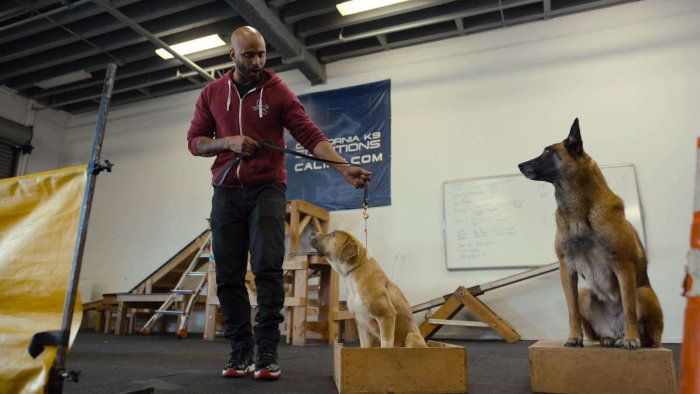
A few weeks ago, I started seeing posts on social media from dog trainers I know and admire, warning people about a new show on Netflix called “Canine Intervention.” The show features a dog trainer named Jas Leverette, who says, “I help the dogs that no one else will.”
I watched the first three (of six) episodes that currently appear on Netflix, and my first thought was, “Here we go again.”
The show is scripted and filmed like any reality TV show: Fairly ordinary situations are filmed in a way that dramatizes the problems people are having with their dogs, making the dogs seem incredibly dangerous and destructive, and the trainer is engaged in such a way as to appear near-heroic. He’s shown dispensing pithy pearls of dog-training wisdom, with other brief animal-behavior “facts” appearing in type on screen. Within each hour-long episode, the dog’s problems are improved or resolved.
That’s a good thing, right? We all want people to enjoy their dogs more, and to learn how to train them! So why are so many trainers upset about the show?
There are three major issues: The first is that Leverette is a self-described “balanced trainer.” This has come to mean someone who uses food treats, toys, and praise to reinforce behaviors that they want from a dog – and physical “corrections” to punish unwanted behaviors. Though Leverette also describes his training as “modern,” up-to-date training professionals understand that while force-based training can be effective, there are MANY reasons it’s best avoided:
- Not everyone can make appropriate corrections with the timing required to make them effective
- Not everyone wants to use force with their dogs
- Most significantly, poorly timed or inappropriate corrections are nearly guaranteed to worsen the dog’s behavior and increase his frustration, triggering defensive aggression.
But the usual justifications for the use of force are trotted out. In the first episode, a guy described as a tech-business owner has adopted a pit bull-mix who displays aggression with strangers and visitors to the tech-guy’s home. Leverette says, “If we don’t fix this, this dog is not gonna have a long future…. She won’t have a second chance….” The owner agrees. “This is life or death, pretty much, for her.”
This sort of language triggers educated dog trainers. If an owner is motivated, there are always more ways to train a dog in order to “save” them, without having to resort to pain-inducing tools and methods. And in cases of aggression, it’s well-established that the use of pain, force, and fear in training often worsens aggression.
Don’t get me wrong. Leverette is not shown flagrantly inflicting pain on the dogs; he’s a much more skilled trainer than that. It’s just that his methods call for making the dog do what he wants, when he wants – even if the dog is “flooded” and completely “over threshold,” physiologically aroused past a state of being able to learn. Instead, the dogs simply learn to give up and give in to the force being used.
By the way, it’s never called out or shown explicitly, but when you first see each “problem dog,” they are generally wearing wide collars. When Leverette begins work with them, they are wearing very thin cord-like slip collars. This allows the dogs to be controlled with a lot less overt force; it’s too painful and choking to pull or “act like a fool” (as one owner describes his dog’s problematic behavior) with a narrow cord on your throat. Look carefully and you can see that with these collars, resistance is futile for all but the most defensive dogs; they have to submit. This doesn’t mean they are learning anything, however.
Second, Leverette uses a lot of language that more educated trainers eschew as outdated, meaningless, and immaterial to the science of behavior modification. He issues “commands” instead of talking about “cues” for behavior. Families are described as “packs” and owners are encouraged to be “pack leaders.” Though this sounds kind of cool, exactly how this is accomplished is never well articulated. “Dogs need to trust their pack leader,” Leverette says in the first episode. Um, okay… What, exactly, should an owner do to make their dog trust them? How will we know when a dog trusts us? And how will “trust” make him understand what I want when I cue a behavior? It’s just fuzzy language that sounds good, but can’t actually be described in concrete or useful terms.
In his training, Leverette promotes the use of a plywood platform that he calls a “box.” “In my system, the box is an important training tool to teach new behaviors,” he says in the first episode. “It’s also a first step in establishing the pack leadership that’s necessary,” he says, while the on-screen caption echoes this: “Obedience depends on a dog’s trust and respect for their pack leader.” Again, this is ridiculous. All sorts of animals can be trained to do all sorts of behaviors without much knowledge of their handlers at all. (Want examples? See here, and here, and here. I could do this all day!)
Demystified, the use of Leverett’s box is simply using a platform (a mat can be used just as effectively) as a “station” – a place where the dog is heavily reinforced when he returns to it or remains there. Using a platform, box, mat, or Hula-Hoop on the ground and giving the dog a high rate of high-value rewards will reinforce the behavior of going to and staying in that spot – it has nothing to do with trust or leadership whatsoever. You can train a wild animal or bird to do it, if you want to. (Read this article to see how our Training Editor Pat Miller teaches a dog to “go to your mat.” Or this one, for another perspective.)
My third objection: Anyone who actually trains dogs – including Leverette himself – knows that while a skilled trainer can change a dog’s behavior dramatically in a very short time, it takes much longer for the dog to really learn. The goal is to get them to understand what is desired of their behavior when given specific cues and to motivate them to work for the reinforcements they understand will follow if they performs the desired behavior. In an hour-long TV-show format, even if the passage of time is accurately reflected (as when Leverette takes the dog in the first episode back to his business location for a several-week intensive “board and train” experience), when the dog is returned to the owner much improved, it would appear that the trainer is some sort of miracle worker. Most ethical trainers will tell you: With some instruction, if you worked with your dog for the number of hours each day that I can assure you that the TV dog trainer actually worked with the dog, you’d likely look like a miracle worker, too.
As with that other famous TV dog trainer, it makes for good TV when dogs can be shown displaying dramatic, aggressive-seeming behavior – and then transform in the hands of the trainer into much calmer dogs. But we know that pain (from choke, pinch, or shock collars, including the very thin slip collars that Leverette uses on dogs in the show) can be used to quickly suppress a dog’s dramatic response to whatever stimuli has them worked up – and that pain cannot change how they feel about that stimuli. Without having experienced a change in how they feel about the stimuli that stressed them in the first place, if, back at their owner’s home, there is no painful consequence for responding in a dramatic way, then the behavior will return. Suppressed responses will need to be maintained by continued painful consequences.
In contrast, true behavior modification changes how the dog feels about the stimulus, by initially managing his exposure to it while reinforcing his calm behavior and choice to (eventually) ignore the stimulus. He learns a more desirable (to us) behavior and classical conditioning comes along for the ride, as he (eventually) finds a previously stressful stimulus to be enjoyable as he gets reinforced for his better (more desirable to us) choices.
It’s clear that Leverette is knowledgeable about behavior modification; with the dog who bit several of the owner’s friends (in the first episode), he’s shown doing some desensitization with the dog. But the process isn’t explained in accurate terms; it’s all dumbed down into populist garbage talk (in my opinion); when the captions read at one point, “A dog without a pack leader is a dog who will ignore obedience commands,” I wanted to throw things at the TV! Come ON! But I understand that the way I would put it wouldn’t be simplistic enough for TV: A dog who hasn’t been reinforced with things that are valuable to him for responding to consistent cues with specific behaviors won’t respond to those cues!
I have to say, there were some things about the show that I liked. I am very appreciative that Netflix made a show featuring a person of color (Leverette is African-American); many of his clients, too, are people of color. It appears that he mentors, trains, and hires other POC, and is committed to spiritual practice, his community, and his family. He seems like a genuinely good guy. It also seems like Leverette is much more focused on the practice of dog training – actually teaching cues and specific behaviors to his canine students – than the last popular dog-guy on TV, though he, too, was full of all this pack-leader “dominance” baloney. And YES, all this “dominance” talk is absolute hooey. Read this informative statement about training and “dominance” from the Association of Professional Dog Trainers.
It’s entirely possible that the TV production company that made the show has run roughshod over Leverette, forcing him to reduce his actual training philosophies and techniques into the catchy little sound bites and captions that so offend me and the trainers I know. Whether he believes them or not, though, my fear is that when inexperienced dog owners see and hear dog training reduced to ambiguous statements about “leadership,” all they absorb is that they aren’t being tough enough with their dogs. It’s no different than saying, “You just have to hold your mouth right!”
The problem with “TV trainers” in general is that TV producers want drama – and good dog training is not dramatic! Teaching people to effectively communicate with their dogs, to give the dogs clear direction and quick feedback when they’ve done the “right” thing, may not reduce to a TV-worthy caption or resolve nicely in an hour. But I wish someone in television production would figure out a way to present truly modern dog training in a way that gave viewers basic instruction in easy-to-accomplish, dog-friendly training. It might not garner the kind of ratings that training celebrities’ dogs might earn, but by demystifying the process and breaking it down just like a puppy kindergarten class, it might actually help WAY more dogs and people.




I don’t have television or even Netflix any longer, so thankfully I won’t be tempted to try and watch the show, but my stomach dropped when I read your article. I heartily agree with your thought of “oh, no, here we go again.”
When that other infamous “trainer” was so popular, a lady who claimed to be a trainer pinned my 4-month-old pittie mix by her neck at a beach. My dog and a friend’s young pittie mix were playing roughly, as bully breeds often do, growling and having the time of their life. They were fast friends, minding their own business. When I saw Inca pinned to the ground, I saw red. My trainer/friend who was coming to my house and working with Inca and me trained under Jean Donaldson in San Francisco, so I knew that Cesar’s methods were crap.
The incident turned into a shouting match when I told the woman to get her hands off my puppy and that Inca did not have a clue what the lady was doing to her since I didn’t train that way. She commenced to tell me I better get my dog under control or she was going to be a very aggressive pit bull that I would have trouble with the rest of her life.
I laugh about it now. Inca became a Delta Society/Pet Partners therapy dog at age 2 and remained so until she was a little over 10 and seemed bored, so I retired her. She’s 14 1/2 now and going strong with her pit-mix “brother” who is still a Pet Partners therapy dog at age 12.
I do all I can to gently tell people why shows like this are not the bee’s knees. Thanks for the heads up!
If dogs aren’t being harmed then I see nothing wrong with using different styles. Personally I am tired of seeing the “new” dog training that is almost exclusively treat based. For every action whether positive or negative, the answer is give them a cookie. I spent over $2,000 on several dog trainers who used this method and all I got was a fat dog. I will never forget my very fear-based shelter dog went nuts and started barking aggressively at an old man who came in to pick up his dog while I was picking up mine. The man did nothing but walk in the door. The trainer quickly said “give her a cookie.” And I said, “why? To reward bad behavior.” No one ever explained how the dog knows the difference. I finally just started training her myself and I have a “good enough” trained dog. That means being told “no”, getting praised for good behavior, and getting time outs/ignored for bad behavior. My dog wants attention all the time so ignoring her is a punishment for her. I don’t ever hit her (I do yell at her once in a while and she knows that tone of voice). I’m sure trainers would think I’m awful but I think feeding dogs to get desired behaviors is lazy; it isn’t training, it’s bribery. I know one trainer who uses all kinds of methods and is well respected. She worked with a previous dog of mine (in another state) and I always remembered her saying “I want my dog to do what I asked of it because I asked; not because it is going to get food.” She actually trains them; she doesn’t bribe them.
Estrella, I think you don’t fully understand the use of rewards in dog training. Whole Dog Journal has great articles and books that explain this. A simple comparison I find helpful is to think about why a human goes to work and does the work asked of them: they get paid in money, or something similar. Some people volunteer and do that work because there is another reward that works for them in that situation. Either way, most people would not do the work unless they got a reward for it. Different rewards work for different dogs, so finding the one that the dog in front of you desires is key. Eventually the dog won’t need a food reward as frequently as at the beginning of learning something new. It’s not just a new idea, it’s based on scientific evidence that it works.
Dear Ms.Moon,
Unless you are the kind of dog owner who really does not care about your relationship with your dog, then maybe it doesn’t matter what methods you use.
There are dog owners who keep dogs for other reasons than companionship, or as a working partner. Some people have dogs to guard their homes, some get dogs to make a fashion statement. Personally, I do not like either situation, but I understand that these owners really don’t care how their dog feels, or how it understands anything.
However, in most of the cases of the population of readers of this publication, I would like to think that the relationship we have with our dog is of utmost importance in our lives with them. And if there is one thing that i have learned over the years, it is that the use of positive punishment (adding an aversive to stop a behavior) is a really good way of developing a feeling of mistrust between a dog (or any other animal) and its owner.
i do not claim to be a great dog trainer by any means. i can be lazy and inconsistent, and my dogs may be considered “spoiled” by some folks. But i do understand the basics of learning theory, and I do have a solid, loving relationship with my dogs. And I don’t bribe them. i allow them to learn something. When they get it right, they’re rewarded. It’s too bad that this is not enough drama for television.
Would you keep your job if you weren’t paid? Is your boss being lazy by paying you or should you do it just because he/she wants you to? Every living being responds to reinforcement (rewards). Animals are no exception. Everything you do is based on the reward you get for it. If anyone forces you to do anything against your will, would you call that a loving trusting relationship? Do you think you should be punished for wanting attention? Dogs are social animals. Of course they want attention which is actually human interaction. That’s in their very nature. And yes, punishment does cause harm, psycho-emotional harm. I suggest you study basic learning theory. Rewards and learning is as basic as it gets.
I am sad for you and your dog that you had such a bad introduction to positive reinforcement-based training.
I do agree that, with many trainers, food rewards are over emphasised, and not enough instruction is given as to how to use life-style rewards and game reward.
I wonder is it is not time that WDJ published another article re all the variety if thong that one CAN use as rewards/reinoforcements in training our dogs
Nancy, thank you for this review. We have seen the previews for this program and were curious but turned off by the language. Glad we didn’t spend any time with it. Thank you.
Great article Nancy! Having been a reality TV “star” (unrelated to dogs and short lived I may add) the networks are ONLY looking for ratings and to draw in the audience. Although some reality shows are supposed to be “documentaries” rest assured that all are scripted at some point. Reality TV is sensationalized to keep the viewers tuned in to the excitement. It’s a shame that in this case, the dogs suffer, owners try the methods which is a recipe for disaster. It’s very worrisome that you’ll get the let me try that approach from some people and that can lead to fall out quickly. We know that a troubled pup is not “cured” within an hour just as crimes are not solved in that time frame on TV, but many watch till the end to know who, what, why, where, and when the killer was found.
Reality TV is certainly not a new phenomenon by any means. It actually started back in the 1940’s with Cash and Carry in 1946 followed by Candid Camera debuting in 1947. Talent shows became the next reality TV where contestants shared their talent and the audience voted for their favorite. Original Amateur Hour and Talent Scout graced our TV screens and opened the creative doors for game shows. In 1954, the Miss America Pageant was broadcasted. These were more of a “feel good” show. What is America’s (and other countries for that matter) fascination with reality TV? Are our own lives that boring that we need to tune in every week to check in on what the latest conflict is going on in someone else’s life?
Hoping to see more positive, force free training shows it the air to help continue our mission to a kinder, gentler, more humane way to communicate, train, and live with our pups.
Thanks for this review. It’s tragic for so many dogs that owners are impatient and insist that everything must happen quickly. It results in a dog’s life endured as a prisoner, with every aspect controlled and dictated by the wardens.
Thank you for this article, my experience with animals is that harsh, painful methods and agression do not work with the training and handling of animals.
When Cesar Chavez, the Dog Whisperer first came to become a nationwide leader in dog obedience world, people as usual also complained about his disciplinary style of training. However, he has become one of the most respected dog obedience trainer everywhere. We forget that dogs still have dog pack instincts and some do require more aggressive style training due to their aggressive disposition. A lot of the dogs that Cesar trained would have ended up euthanized due to their aggressive nature, so we as dog lovers should not be judgy when we see certain dog trainers use a different style approach than what we are comfortable with. We tend to think that dogs are for petting and snuggles, but in reality there are some breeds that are meant to be working dogs or guard dogs and the ‘love training’ does not always work for these dogs. There is a fine line in any training program and Leverette in my opinion is using it.
You mean Caesar Millan, not Cesar Chavez. Millan is the “whisperer.” Cesar Chavez is a civil rights activist.
Gloria – you are 100% wrong. Cesar Milan is not a leader nor is he well-respected among dog training professionals or behaviorists. His philosophy is 35 years out of date at this point.
NO dog requires an “aggressive style of training.” In fact, using harsh and physical “corrections” on a reactive dog too often results in the dog becoming more fearful, more reactive, more aggressive.
Gloria, the problem with Cesar is that he has been bitten multiple times by forcing a dog into a situation it is not yet comfortable with. I am not a dog trainer, but as a therapy dog handler have learned what I perceive as excellent skills. And what I have learned is that a handler and especially a trainer should NEVER push a dog to the point it bites. Yes, some dogs bite, which is why the trainer is working with it and why we all need trainers and behaviorists. But Cesar, as the trainer, should never be bitten and especially on a TV show. He should have been able to read the dog’s body language to know he was pushing too far, too fast.
As a pit bull lover, I do appreciate what he’s done for the breed. But as my comment below indicates, too many people used his early methods in a dangerous way that can lead t o later aggression. I’ve also seen videos where he has literally hung the dog by its collar, choking it into submission. I personally would never want to choke my best friend.
I am not a trainer, just work with a bunch of great ones, but I disagree! I have one of “those dogs,” and I can say with complete confidence that if I HAD used those aggressive style training techniques my dog would not be alive today. He has made tremendous progress because of the kind, respectful approach we’ve learned to take with him (much thanks to all of the trainers that have helped us). I know several people who feel the same about their sensitive dogs. I also volunteer at an animal shelter and get to see first-hand how well the “challenging” dogs do with a gentle, respectful approach. My dog will always be complicated and need special care, and he will always do best with a non-threatening approach. Admittedly, there are some dogs that are so broken that we won’t ever be able to help them, but I believe those are very few, and that they won’t be helped by aggressive techniques.
Dear Ms. Camacho,
Respectfullly, you are incorrect on 2 counts; first, Cesar Chavez is not a dog trainer, but a civil rights activist who worked to protect migrant field workers. Second, Cesar Milan is not one of the most highly respected dog trainers in the world, he just happened to be lucky enough to be in the right place at the right time with the celebrity crowd, and got himself a shot at being a television celebrity as well by creating high-drama situations with the “bad dog” on camera, and impressing the ignorant public with highly edited productions.
I don’t get Netflix so haven’t seen the show but have seen him and his trainers a few years back at a dog event in San Jose. The dogs “performing” were all wearing either choke, pinch or shock collars and many looked shut down.
Wonder if Victoria Stillwell is still on TV?
Thank you for this thoughtful and eloquent critique of the show – I was personally only about 30 minutes in before I stopped watching. Too bad that the good things about the trainer and the show are eclipsed by the negative.
You got farther than I did. I couldn’t get past the first episode. What I really didn’t see was how he got to where he got with that dog. Suddenly, it’s a week or 3 weeks later and the dog is adoring him and doing everything right. What happened to get the dog to that point? I, too, noticed the comments on pack and pack leader. I applaud his enthusiasm but I hope the uninformed general public watching this does more than follow blindly, again, like another TV personality.