

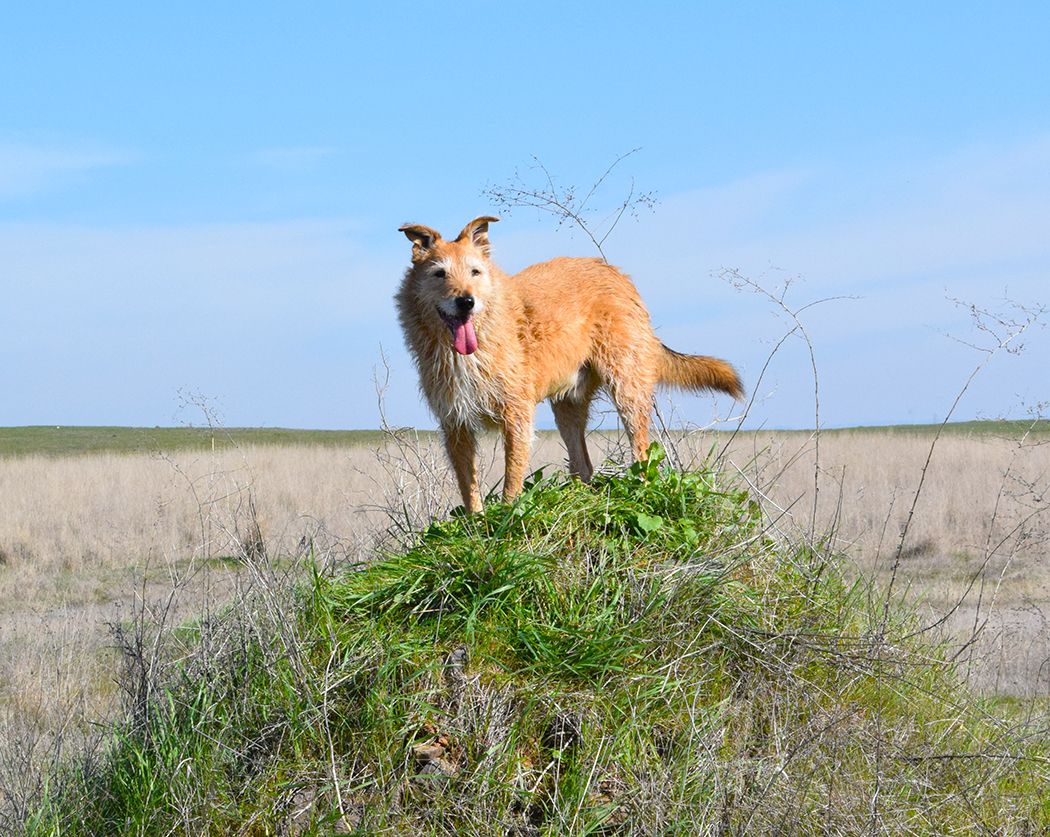
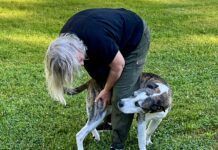
It never fails: Every time I take my senior dog Otto into public, people ask what breed he is. And I have to smile and shrug. My standard answers:
“He’s a Disney dog!”
“He’s an Oroville Chickenhound!” (He was found as a stray pup, about four months old, in someone’s chicken coop, and brought to my local animal shelter. When I adopted him at the estimated age of 7 months, I couldn’t believe that such a cute pup had been languishing there for three months. It may have had something to do with the fact that his cage card indicated that he killed chickens.)
Mostly what I say is, “He’s very mixed.”
However, this tend to make people ask “Why don’t you get one of those DNA tests that tell you what he is?”
And I have to say, “I have! Five times! And the results are mixed!”
Otto’s DNA Journey
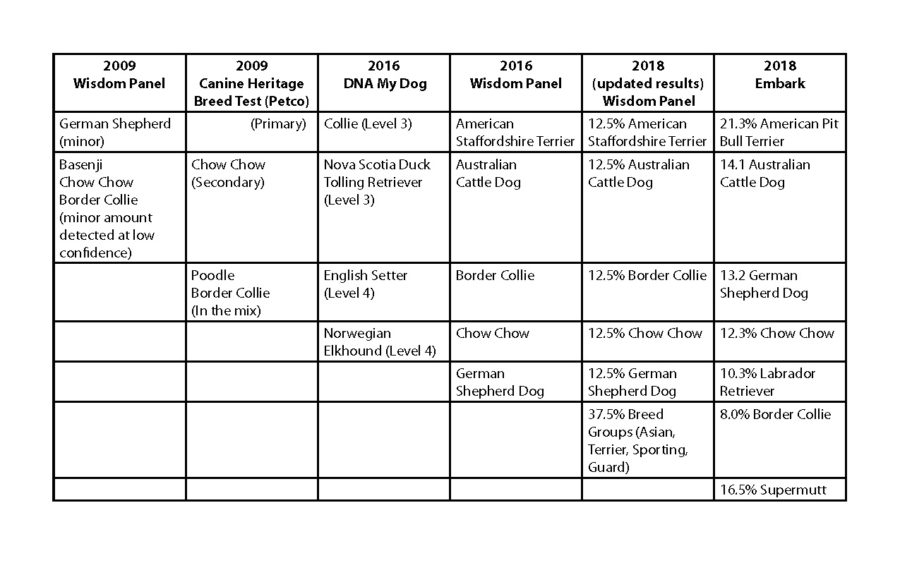
In 2009, I sent Otto’s DNA to the two companies that seemed to be the most reputable at the time, Wisdom Panel and Petco’s Canine Heritage. The technology was new and the results were a sketchy on details, but both companies detected Chow Chow and Border Collie. Wisdom Panel thought there was also German Shepherd and Basenji; Canine Heritage thought there was also some Poodle. I thought any of that was possible, with the exception of Basenji.
In 2016, I planned to write an updated article about DNA tests, and I again sent Otto’s DNA off to two companies that offered mixed-breed identification, just to see what they had to say.
One of the companies was DNA My Dog. Its results agreed with my “very mixed” assessment, but the breeds they suggested that might be present bordered on ludicrous: Collie, Nova Scotia Duck Tolling Retriever, English Setter, and Norwegian Elkhound. Given the rural and economically depressed area in which Otto was found, I think it’s unlikely that any of those four breeds have ever set foot in the area—or at least not in the same generation!
The other company I sent a sample to in 2016 was Wisdom Panel. Shortly after the company received the sample, I received a message indicating that they recognized that they had tested the same dog previously, and that they would test the new sample anyway. Cool! That lent the endeavor credibility.
Wisdom Panel’s 2016 results offered a lot more detail than in 2009. “Basenji” had disappeared (it had been pretty unlikely), and the previously detected Border Collie, Chow Chow, and German Shepherd were still present. However, topping the list were two breeds that had not been reported by any of the companies previously: American Staffordshire Terrier and Australian Cattle Dog. At that time, the company didn’t offer estimates of the contributions of potential ancestors by percentage; instead, it offered a theoretical family tree. Otto’s showed no possible purebred ancestors until at least the great-grandparent level.
I think I might have written a blog post about the results, but I know I didn’t get around to writing a feature article about DNA that year.
Some New Information
In 2018, I asked one of our contributors to write an updated article, instead. I revisited the Wisdom Panel website, knowing that they promised to occasionally “refresh” their results as their technology improved. I also sent a sample of Otto’s DNA to a new player on the mixed-breed identification block, Embark.
In 2018, Wisdom Panel was expressing the contributions of various breeds in the dogs’ DNA as percentages. All of the results in Otto’s 2016 report were the same, but percentages had been added. They indicated that there were about equal amounts of Am Staff, Cattle Dog, Border Collie, Chow, and German Shepherd in Otto.
This was very interesting in light of the results I received from Embark’s 2018 test of Otto’s DNA. Its results were very similar—with a notable exception. Embark identified Otto’s bully breed ancestor as American Pit Bull Terrier, and also indicated that he was more APBT than anything else, as much as 21.2%! This company also found Cattle Dog, German Shepherd, Chow, and Border Collie in Otto, but added some Labrador.
While I have to admit that I’m looking forward to any future testing or updates available, I’m going to stick with calling Otto “very mixed.”
Has anyone else had your dog tested by different companies? How did your results vary?

Here’s a great example on why I’m not so trustful of these things.
A client had a Registered Great Dane where there was an accidental breeding with their other dog. This dog was 1/2 Great Dane (the mother of this dog was a registered Great Dane and dad unknown) So they know for sure the litter was 3/4 Great Dane. They kept a pup and at 6 month it was over 70lbs. They were curious so did a Wisdom DNA. It came back that the main breed was Corgi…lol can you believe it! Dane was second breed.
What a great answer lol “Disney dog”
I have had both of my rescues tested by Wisdom Panel. The first was listed as a shepherd/lab mix, but she was all black and doublecoated, and seemed smaller than either of those breeds. A groomer noticed spots on her tongue and suggested she was part Chow. Her tests came back Chow, Fox Terrier, and mixed. Her personality was all Chow. Had my newest pup, about a year old, tested soon after adopting her. She tested 1/2 Beagle, 1/4 Lab, and 1/4 Staffy. She is all black with a white bib, and definitely has the beagle “bay” and both the beagle and lab hunting instincts..especially for rabbits!
I have one dog who I adopted from a shelter. They told us her breed was a German Shepard mix with Labrador and I believe them but she also looks like she has some bulldog in her. I’m not sure if I should take the tests to see what type of breeds she is because I know I will still love her either way, but should I do it?
Regarding “DNA your dog” company—3 years ago I submitted my 20 pound dog’s saliva…primary breed—Great Dane. Welllll, she is smooth coated, long tail, folded ears. I don’t remember the other breeds besides terrier types.
Conclusion—I will wait a few years before again spending money on DNA testing my dogs…or at least until WDJ runs a conclusive article.
Leann
I sent my Lucy’s sample to wisdom. She appeared not to be a high mix about 1 year old. We got her from a friend that took her in. She was running free in a semi-rural area. She had fully developed Heart worms … probably she was dumped because of the HAs. She underwent treatment and recovered nicely. She is now about 3 years old . She is truly a wonderful dog and extremely intelligent and very fast to learn. My son gave me a Wisdom DNA test. It came back as 50% mini schnauzer and 50% Shih Tzu … we had a designer dog and did not know it 😊. Would not have mattered what she was, she is a wonderful little 19# beauty that just wants to please.
In 2010 I had my 2 dogs tested by Wisdom Panel. One, Libby, was a rescue who looked like she was mostly Aussie. My other dog, Darby, I got as a puppy. Mom was supposedly 1/2 lab, 1/2 border collie and looked it. Dad was caught in the act and was a registered border collie. Darby looked like a border collie but it seemed like something else was in the mix too.
Libby’s results came back as primarily border collie, with minor as a boxer. Darby’s results came back as intermediate Australian Cattle Dog with a minor Belgian Tervuren. I contacted Wisdom because I didn’t believe Darby’s results. They agreed to retest him. The second test came back as equal parts Australian Cattle dog and Curly-coated Retriever as intermediate breeds. No primary breed.
I tested Darby’s DNA again in 2012 with Canine Heritage Breed Test. This time again no primary breed but Bouvier des Flandres as an intermediate with Dalmatian, Collie, Shetland Sheepdog, Rat Terrier in the mix. Border collie never showed up. So I was not a big believer in DNA tests at that point. Every test was different.
Just a few months ago I tested my latest rescue dog, Dulci. She looks like a small border collie with a head of a papillon. I assumed that DNA testing had come a ways since 2012 so tried Wisdom Panel again. Primary breed results were better … 37.5% border collie made sense. The others in the mix didn’t: 12.5% Staffordshire Terrier, 12.5% Lhasa Apso, and 37% terrier and sporting groups. Both parents and grandparents had border collie. So results were better than 2010 or 2012, but I still think DNA analysis has a ways to go before we will ever know what is in our mixed breed dogs.
We rescued a “lab mix puppy” He totally looks like a full black lab. Our vet swore he was mostly lab as did our trainer. Everyone that sees him comments” I love labs”. Wisdom DNA report shocked us. 37.5% Amstaff, 25% Great Pyranees, 12.5% each of doberman, golden retriever and weimeraner. Sent picture to Wisdom and asked to retest, nothing made any sense. Only “non lab” look on him is a very, very small diamond shape white spot on his chest. White chest mark is an Amstaff trait. We have since seen so many “labs” that look just like our puppy, all black with tiny white mark. All were told by agencies and shelters that the puppies were a lab mix.
I adopted a 4 month old puppy from my local humane society. He was listed as an american husky,he is now 2. I did the embark and wisdom test, they both said he was primarily siberian husky with some collie, pitbull or Staffordshire terrier and a little Springer spaniel. I think they were both pretty accurate.
We adopted an Australian Shepherd(tri color) when he was 7. On our walks in the woods people would ask what kind of dog he was – we were told 100% aussie but many people said “He can’t be”. We agreed – his face in particular did not have that typlical aussie look. So we got his DNA tested *Wisdom Panel) and learned he was 100% aussie on his father’s include and 75% on his mother’s side. The other 25% was any one of a number of choices.
Wisdom Panel also tested for the MDR1 gene mutation (common in aussies) and he learned he does not have that mutation. This was helpful for the vet when he had to get an MRI because this mutation makes the dog more sensitive to a wide range of medications.
So this is another good reason to get your dog’s DNA tested.
Nancy Brown