

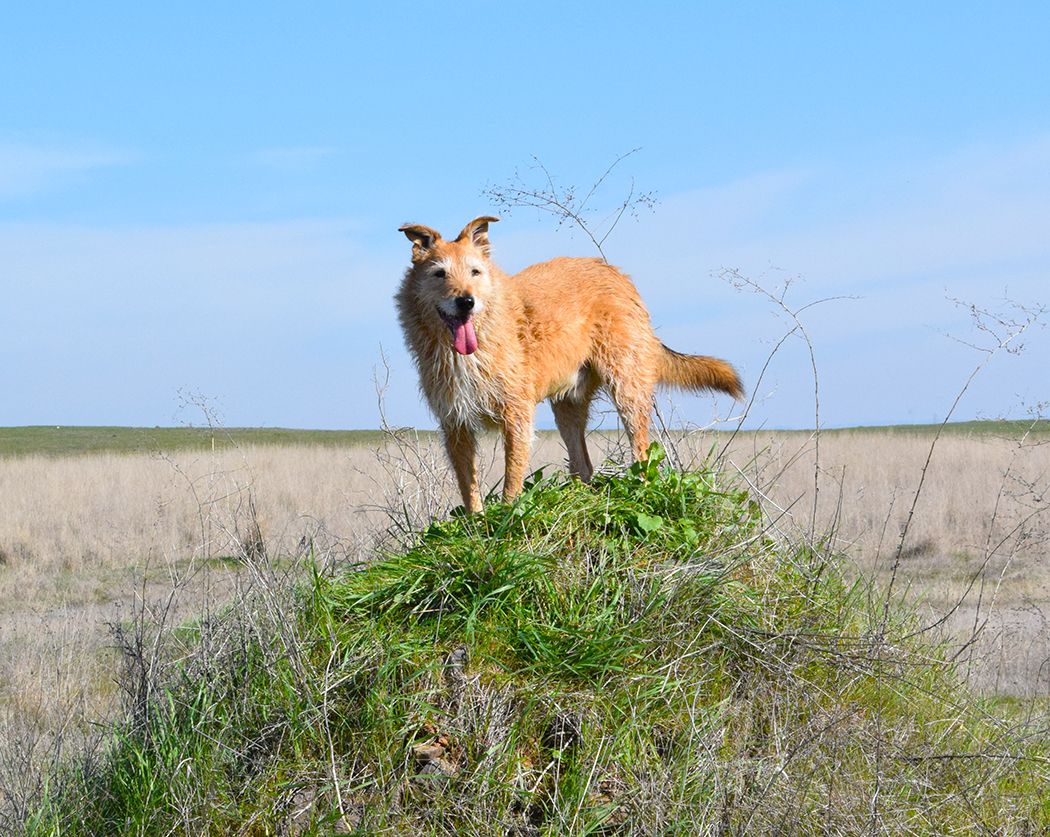
It never fails: Every time I take my senior dog Otto into public, people ask what breed he is. And I have to smile and shrug. My standard answers:
“He’s a Disney dog!”
“He’s an Oroville Chickenhound!” (He was found as a stray pup, about four months old, in someone’s chicken coop, and brought to my local animal shelter. When I adopted him at the estimated age of 7 months, I couldn’t believe that such a cute pup had been languishing there for three months. It may have had something to do with the fact that his cage card indicated that he killed chickens.)
Mostly what I say is, “He’s very mixed.”
However, this tend to make people ask “Why don’t you get one of those DNA tests that tell you what he is?”
And I have to say, “I have! Five times! And the results are mixed!”
Otto’s DNA Journey
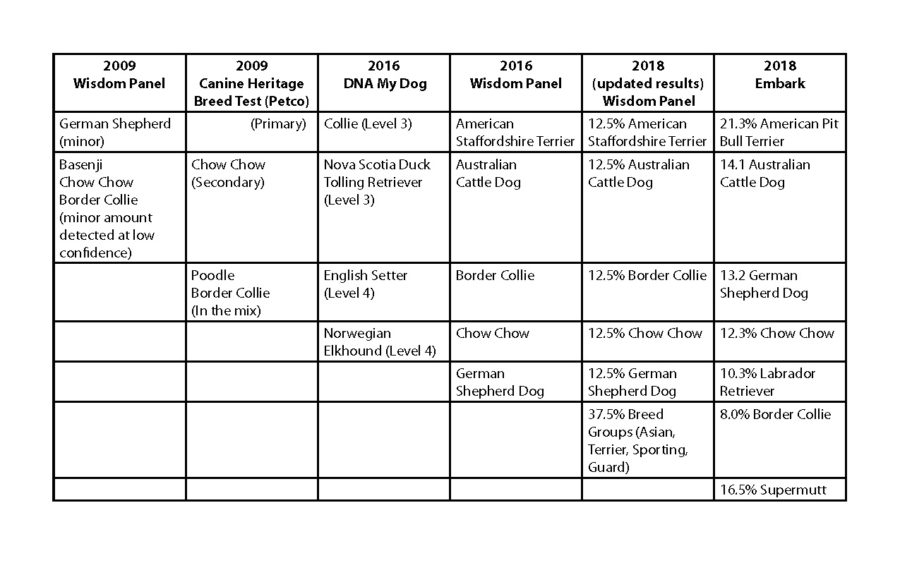
In 2009, I sent Otto’s DNA to the two companies that seemed to be the most reputable at the time, Wisdom Panel and Petco’s Canine Heritage. The technology was new and the results were a sketchy on details, but both companies detected Chow Chow and Border Collie. Wisdom Panel thought there was also German Shepherd and Basenji; Canine Heritage thought there was also some Poodle. I thought any of that was possible, with the exception of Basenji.
In 2016, I planned to write an updated article about DNA tests, and I again sent Otto’s DNA off to two companies that offered mixed-breed identification, just to see what they had to say.
One of the companies was DNA My Dog. Its results agreed with my “very mixed” assessment, but the breeds they suggested that might be present bordered on ludicrous: Collie, Nova Scotia Duck Tolling Retriever, English Setter, and Norwegian Elkhound. Given the rural and economically depressed area in which Otto was found, I think it’s unlikely that any of those four breeds have ever set foot in the area—or at least not in the same generation!
The other company I sent a sample to in 2016 was Wisdom Panel. Shortly after the company received the sample, I received a message indicating that they recognized that they had tested the same dog previously, and that they would test the new sample anyway. Cool! That lent the endeavor credibility.
Wisdom Panel’s 2016 results offered a lot more detail than in 2009. “Basenji” had disappeared (it had been pretty unlikely), and the previously detected Border Collie, Chow Chow, and German Shepherd were still present. However, topping the list were two breeds that had not been reported by any of the companies previously: American Staffordshire Terrier and Australian Cattle Dog. At that time, the company didn’t offer estimates of the contributions of potential ancestors by percentage; instead, it offered a theoretical family tree. Otto’s showed no possible purebred ancestors until at least the great-grandparent level.
I think I might have written a blog post about the results, but I know I didn’t get around to writing a feature article about DNA that year.
Some New Information
In 2018, I asked one of our contributors to write an updated article, instead. I revisited the Wisdom Panel website, knowing that they promised to occasionally “refresh” their results as their technology improved. I also sent a sample of Otto’s DNA to a new player on the mixed-breed identification block, Embark.
In 2018, Wisdom Panel was expressing the contributions of various breeds in the dogs’ DNA as percentages. All of the results in Otto’s 2016 report were the same, but percentages had been added. They indicated that there were about equal amounts of Am Staff, Cattle Dog, Border Collie, Chow, and German Shepherd in Otto.
This was very interesting in light of the results I received from Embark’s 2018 test of Otto’s DNA. Its results were very similar—with a notable exception. Embark identified Otto’s bully breed ancestor as American Pit Bull Terrier, and also indicated that he was more APBT than anything else, as much as 21.2%! This company also found Cattle Dog, German Shepherd, Chow, and Border Collie in Otto, but added some Labrador.
While I have to admit that I’m looking forward to any future testing or updates available, I’m going to stick with calling Otto “very mixed.”
Has anyone else had your dog tested by different companies? How did your results vary?

My mixed girl’s results came back with a huge percentage undetermined, which was hugely discouraging. But the Pekenese threw me since she’s a long legged girl my other dog can walk under. So we tell people she’s an “All American Mule Eared Wonder Dog”.
My dog was tested as a puppy in 2009 and it came back 25% rottweiller, APBT, and staffy and 75% mixed breed dog.
I always identify him as 100% pure-bred American Shelter Dog, including on his dog license!
Help me out here: I thought there was no such breed as “Pit bull” yet Embark uses the term. (I remember the WDJ article of a few years back that discussed the problems and dangers with shelter dogs being labeled “pits” when in fact they might have no Am Staff type genes.) But they are the only ones who do. This is disturbing because I have an acquaintance who got a new puppy, told her rental management company and they immediately asked for a DNA test. No doubt they are looking for a “pit bull’ result so they can label the dog or fine her or make her get rid of it.
Shouldn’t I let her know not to use Embark lest she might lose her precious puppy?
There is a breed called American Pit Bull Terrier but it is not recognized by the AKC. There is also the Staffordshire Bull Terrier and the American Bully. American bully breeds are different than the English bully breeds.
I don’t believe the management company can require a DNA test unless they are willing to pay for it.
When the puppy gets its shots and is licensed, have her declare it a “labrador mix”. Once that is on the license they can’t do anything about it. I doubt animal control will require a DNA test. They usually accept whatever the owner identifies as the breed.
I believe Embark is the most accurate. There is no way to be sure that Wisdom won’t also list American Pitt Bull Terrier. Insurance companies do not like German Shepherds, Rottweilers or Chows as will as all of the bully breeds. Chances are one of those is going to come up in a mutt mix, even if it is a small percent. So if she has any DNA done she should keep it private and just put “Lab mix” on the license. Labradors are acceptable dogs to insurance companies and rental companies.
i’ve purchased quite a few of these for-profit tests but feel most comfortable with Darwin’s Dogs (DNA testing for UMass study about how DNA influences appearance, behavior and health). Their results for all 3 of our dogs seemed to be the most through (and believable!)
At 3 months, I was told that Scout was an Australian Cattle Dog, Australian Shepherd mix.
I would’ve bet the barn that yes, she was ACD, maybe Border Collie or McNabb. I decided to have her DNA tested and the results came back that she was ACD and Lhasa apso! And the test said the Lhasa apso was a large part of her heritage, which is not evident at all.
I tested my dog, Wilbur, through Wisdom Panel about 10 years ago. The results came back as 12.5% each of Bernese Mountain dog and Dachshund with smaller percentages of Doberman, Bull Terrier, Mini Bull Terrier, Catahoula Leopard Dog, and Alaskan Malamute. A recent test from Embark pegged Wilbur as 30% lLabrador Retriever, 14% English Springer Spaniel, and smaller percentages of Chow, Akita, GSD, Golden Retriever, Chesapeake Bay Retriever, and “suoermutt”. Wilbur came from the county shelter in Redding, CA, where he had been picked up as a stray, so the Embark results make more sense to me.
We went through Wisdom when we tested our boy Loki. He’s a rescue from a local GSD shelter but he’s huge and we wondered what else was in there. It came back that he’s 66% GSD and the remaining 1/3 is evenly split between Great Dane and Great Pyrenees. All of them make perfect sense given his size and behavior.
Have had all 3 of our most recent southern rescues tested. Mostly what was expected, and some unexpected results. We did it out of curiosity, but also to be aware of any possible genetic problems regarding diseases and medications to avoid. We used Wisdom Panel.
We adopted our newest dog from a breed-specific rescue because we wanted another Rhodesian ridgeback (we’ve had a few). We knew the dog we adopted was a mix, but we love her and so at Christmas I gave myself the gift of a DNA test for her from Embark. It came back zero ridgeback, haha! We love her and don’t care that she’s half Doberman, quarter GSD and quarter mastiff. She definitely has many traits similar to a Doberman, and at 16 months and 93#, I can say I believe there might be a bit of mastiff in there, too. 🙂
About 10 years ago, I had my 100 pound dark gray dog tested. It came back German Shepard Long haired Dachshund. Um, no.