

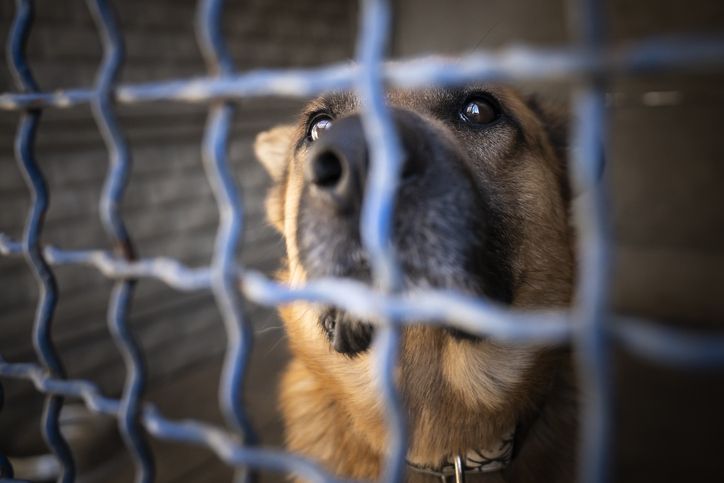
When you have a career that involves dogs, everyone you know sends you memes and articles about dogs. Unfortunately, those little gems, meant to amuse or enlighten me, often aggravate me instead.
Take, for example, this article from People Magazine: a profile of a dog who has been waiting for almost six years to be adopted from a rescue facility. You see, the rescue is a no-kill shelter, and the dog has some behavioral issues that are described as “severe.” An employee of the rescue is quoted as saying, “I think that the ideal adopter would be an adult-only home with definitely some dog experience. She (the dog) wouldn’t do well with dogs, cats, or kids in the home because of her touch sensitivity. And she can resource guard as well.”
I think the intended effect of this article was supposed to elicit sympathy for and interest in the dog, but it made me see red. Personally, I can’t understand how it makes sense to spend years trying to find a home for a dog who doesn’t want to be touched and can’t live with other dogs, cats, or kids.
Most of us want dogs for some positive trait: an ability to be a great companion, to give and receive affection, to go with us when we explore or exercise, and/or to participate in the sports or hobbies that we enjoy. Sometimes, in spite of our best efforts to buy or adopt a dog with the traits we want, we end up with a dog who needs a lot of help in order to resemble the dog we had in mind . . . and I’m obviously aware that many problematic behaviors can be improved if not eliminated through caring training, management, and (sometimes) medication. But who actually goes looking for a dog who can’t be around anyone else or go anywhere safely? Very few people want a project – a dog who is going to require very careful handling and management in order to keep from biting them or someone in their home.
And while the concept of a no-kill shelter sounds like a good thing, the reality is, this often means a life sentence in prison for dogs like the one in the People article.
I have always struggled with the concept of spending a ton of money, space, and time on unfriendly, unsocial dogs when there are so many friendly, social dogs looking for homes. But maybe I’m just crabby. What do you think? Who can convince me that housing unadoptable dogs for life is a worthwhile endeavor?




Dog rescue should be just that “dog rescue”. The people running these shelters should be aware of the condition and problem of the dog. Then a reasonable plan for the care of the dog. In my opinion a dog that is overly aggressive, a danger to owners, injured or ill without hope for recovery are in need of humane treatment. In most cases this is euthanasia. We have a rescue group in our area that attempts to save every dog even against Veterinary advice. They have caused parvovirus and distemper outbreaks in our county by bringing in sick dogs from outside our community to shelter. They have wasted money trying to save injured dogs after Veterinarians have advice against treatment. The dogs end up suffering before dying or end up maimed and unadoptable. These resources could be used for spay clinic, dog behavioral training, etc.
In medicine some of us have switched from the term “DNR”, do not resuscitate, to “AND”, allow natural death. Could a better term than “Kill Shelter” be used? Compassionate Shelter?
If there is anything I have learned so far in my dog journey, it is from the words of a shelter attendant in 2006: This dog will be completely different away from the shelter. He was terrified of the other dogs, he didn’t trust people, and when they got him out for me to meet in a quiet place he flattened on the concrete and refused to walk. I agonized for days about whether I would be doing him a favor or a disservice to bring him home to 5 other dogs, a cat, and 2 mostly-adult human children. Once he was in our home, he bonded with me instantly and became best friends with the extended family. We had him over 9 years before he succumbed to undiagnosed hemangiosarcoma. He has been one of my 2 heart dogs so far; I grieve for him and am grateful for him every single day. I cannot imagine not having known him and not having shared that bond because his non-agressive but fearful behavior in the shelter marked him as unsuitable.
I don’t know the answer to the dilemma; I guess it is one evaluation at a time, and more education to people on how to be a responsible pet parent so shelters become places only for the occasional accidental escapee whose family is desperately hunting for them but hasn’t found them yet.
The real answer is extensive breed-specific education of the public, generally, and especially for anyone who wants to purchase or adopt a dog. Most people don’t have a clue as to what is involved – emotionally or financially. They don’t understand the necessity of a lifetime commitment to an animal that is completely dependent, and exists only to love their owner, that their owner and the family is the center of the dog’s life. They don’t understand that different breeds have different requirements for exercise and outdoor space. they don’t understand the emotional devastation they impose on a dog when they leave it at a shelter or abandon it in a canyon or forest to fend for itself.
I don’t know how this massive education can take place, but until the greater public begins to understand the needs of dogs and specific breeds, this tragedy of “untouchable” shelter dogs will likely continue.
Nancy – I find your article very destructive and disheartening. Point blank — you are wrong. There are many many dogs in shelters who are considered “untouchable”, and, who completely transform when fostered in loving and patient homes. Shelters – even no-kill shelters – are highly stressful environments – and contribute to neuroses and bad behaviors. Every life is worth saving and some dogs need more patience and positive, loving obedience training. Dogs, like people, are born good. Their self defenses and fears arise when in an environment of yelling , physical abuse or being left alone outside (or in a shelter cage) for long periods of time. The vast majority from these environments just need patience and love.
Our own dog was a 3 year old rescue, living in a house with 5 other dogs — she was so timid and shy and afraid that as a result, when I first met her I was doubtful whether we could accommodate her fears. She could not be around other dogs -she tucked her tail and ran in the other direction when meeting other dogs on our walks. Long story short, within 2-3 weeks, she began to feel safe and then gradually, completely transformed. Now, 7 years later, she is the queen bee of our household and the joy of our lives.
Never, never judge a book by its cover — every dog will respond to love and is worth saving.
Nancy, you are 100% correct on this. This is warehousing and sentencing a dog to imprisonment. No animal should have to live like that. I have seen this type of “rescue” first hand and have never felt anything but sympathy for the misguided agencies that see this as compassion.
Agreed. Until there is a home for every dog that needs one, it’s really hard to justify the kind of actions taken by the people at the shelter in the People article. What a miserable existence for that poor dog who is probably on meds to control dog reactivity behavior. The proverbial farm for hard to handle dogs just does not exist for 99.9% of dogs in a timely manner. Once everyone is willing to accept this fact, things will be better for all dogs.
I agree 100% I worked in the shelter for 10 years. Unfortunately I’ve had to euthanize thousands of animals. While this was never pleasant, I often felt that it is better to relieve suffering, than it was to continue it. Many of these animals suffer from severe anxiety and behavior problems, that even a professional, such as myself would have difficulty managing. I do believe that some of these dogs could live content lives, but it would require large spaces for them to exercise and be simulated in, and interacting with a trusted trained professional who could help them adjust to a world that they’re not comfortable in, unfortunately this would take a great deal of time, money and space.
💯
Nancy, thank you for your article, and for voicing what so many of us that are involved in rescue know to be true. A 100% no kill shelter is impractical and downright irresponsible. I live in Texas where spaying and neutering is not embraced as much as it should be, and the over crowding of shelters is heartbreaking. An unadoptable dog should not be forced to live it’s life in a shelter.
This poor dog has only gotten worse in the current environment. Living in an animal shelter is a death sentence. No, I am not a dog killer, but one must do what is humane. Because very adoptable. Dogs that are in desperate need of homes are being put to sleep because too many are trying to be saved. That will never find a forever home. We need to be humane, not heroes.