

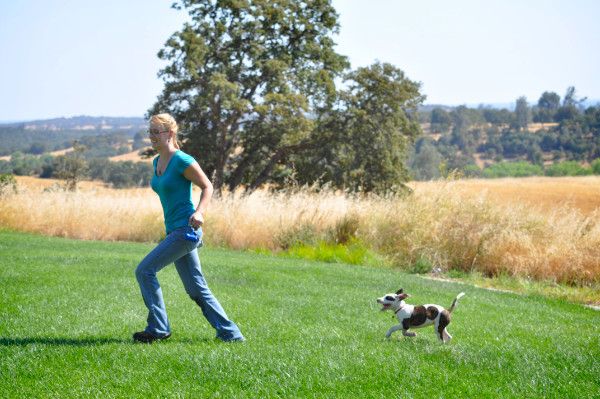
I think it’s been pretty well established that lawns are environmentally unfriendly. They require massive amounts of water. Fertilizers, pesticides, and fungicides get carried off by rain (or overwatering!) into storm drains and streams and can contaminate wildlife and environments many miles away. According to the U.S. Fish and Wildlife Service, homeowners in the U.S. use up to 10 times more chemical pesticides per acre on their lawns than farmers use on crops.
Worse: According to a 2013 study, “Detection of herbicides in the urine of pet dogs following home lawn chemical application,” the detection of lawn chemicals in the urine of pet dogs was widespread – and that lawn chemicals persisted on the grass for at least 48 hours after application, and even longer under certain environmental conditions. It’s been established that exposure to herbicide-treated lawns has been associated with significantly higher bladder cancer risk in dogs.
And yet: What’s better than playing with a dog, or watching a dog or dogs play by themselves, on a blanket of nice thick green grass? Especially in the heat of summer?
I just read an article in the New York Times (“America’s Killer Lawns”) that provided some helpful ways to make lawns less toxic.
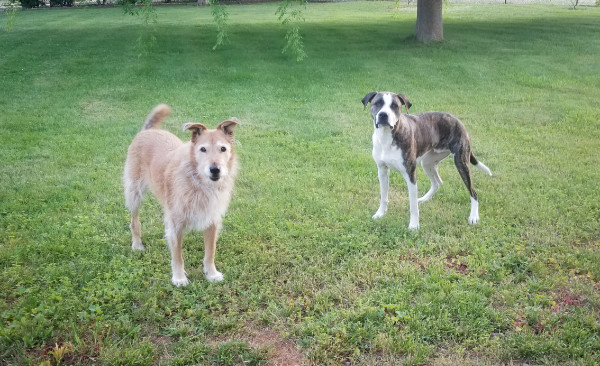
No beautiful lush lawn at my house…
For what it’s worth, I’ve never had a gorgeous lawn – probably because I’ve never engaged the services of a lawn-care company, not used fertilizers, herbicides, fungicides, or pesticides on my grass. I wouldn’t feel good about using any of those things, even though I’ve certainly enjoyed playing or exercising on publics lawns and sports fields that almost surely DO use those chemicals. Every home I’ve lived in as an adult came with an existing crappy lawn, one containing as many weeds as grass species (my husband insists on using air-quotes when discussing our “lawn,” because he doesn’t think the collection of plants that dwell in front of our home constitutes turf in any way). At our last home, we stopped watering our “lawn” during the worst summer of California’s drought, and neither restarted nor, I have to admit, replaced it with alternative landscaping. It looked perfectly Dust Bowl-esque in the summer, just awful.
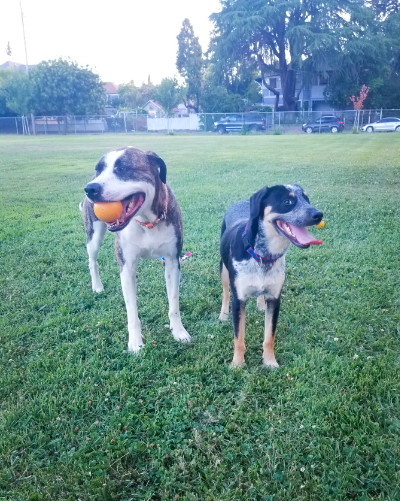
Like our past homes, our current home came with a front yard featuring lots of grass, as well as lots of other weeds and clover. It’s partially sun-baked and partially deeply shaded. Some species of plants thrive in one location and not in the others. But for the two summers we’ve lived here so far, we have kept it watered and mowed, and both the dogs and I really enjoy it, even if it’s not thick or lush or smooth or even. It’s cooler and softer than anything else outside in the summer! Also, it covers a wide swath of space; if we removed it, I have no idea what we’d plant or how we’d begin to landscape or hardscape it. For now, anyway, it is what it is.
Lately, I’ve been watching videos of a trainer I know working her young puppy on a smooth green carpet of permanently installed artificial turf outside her home and have been coveting a training space like that. But I don’t know that I would ever pull the trigger on an expense like that, either.
What about you? Do you maintain a lawn for your family’s enjoyment? Or do you live lawn-free? If you have given up grass, do you miss it?



We have a lawn but it’s not pretty. It has a variety of weeds mixed in. We have never used a lawn service because 1) couldn’t afford it and 2) don’t trust their claim that it is safe once dry. On the occasions I do decide to spray or put something on the grass I section it off with a barrier. We wait the time the product states (usually 24 hours), water the next morning and then that evening, at the earliest, we open it up. It’s usually 2-4 days before we are back in that space.
For twenty years now, I’ve maintained an half acre of city property with a dose of corn gluten every three or four years in the front yard, and mowing for the whole plot. The lawn is filled with whatever grows and it seems to be a lot tougher than just grass. The dogs run the back yard, and except for a path that runs the perimeter of the fence, you couldn’t tell they were there. Water is never an issue because we’re in central Ohio. So far the worst draughts have never made a serious impact on the naturally selected lawn. And the dogs are joined by a diverse population of critters – insects, snakes, birds, and all our four-legged wild life. That makes for a lot of drama, but more importantly, we’re supporting the earth.
We have lots of sand, lots of weeds and a few areas of grass. Due to several large oak trees and various other kinds of trees there is a lot of shade so grass is sparse in those areas, however weeds do just fine there. I refuse to let my husband put out weed killer and try to discourage him from fertilizing what grass we have due to our little dog loving to spend her days outside. Apparently some of these chemicals say they are safe but I don’t trust them.
We have a lawn but it’s not pretty. It has a variety of weeds mixed in. We have never used a lawn service because 1) couldn’t afford it and 2) don’t trust their claim that it is safe once dry. On the occasions I do decide to spray or put something on the grass I section it off with a barrier. We wait the time the product states (usually 24 hours), water the next morning and then that evening, at the earliest, we open it up. It’s usually 2-4 days before we are back in that space.
Hi! Yes, clover or check out Gardener’s World Series on BBC to see how to plant a wildflower meadow – low maintenance and wonderful for the bees! You could have a small grass area in the middle – Low maintenance – looks great and wonderful for the environment! Big Fan – SPM
I will definitely check out the series on wildflowers. I have been trying to get a patch of wildflowers going for several years without success. Thank you for sharing that tip.
St Augustine grass here in HOA Florida. Hate my dogs being exposed to all these chemicals that are required to keep this high maintenance nightmare. I try to walk them in the street but that comes with grey paws from street soot ( guessing that can’t be good either).
No playing in the yard & dog park is seasonally filled with weeds that have clingons Not the best. Lots of paw washing & playing in the house for my toy breed
We lived on a farm for 30 years and never worried abut our lawn. Our dogs lived way past 18 and our cat lived to 22. We recently moved to a neighborhood and I thought I would try and have a nice lawn. I put weed killer, and fertilizer on the lawn and kept the dog off the lawn for 24-48 hours. Our 7 year old German Shepard got Hermangioma Sarcoma and was dead in 7 weeks. I feel it was because of the chemicals. We now have a beautiful German Shepard rescue and we play happily among the weeks. No more chemicals on my lawn…ever!
Anyone think organic? It’s also expensive but an alternative.
I’ve used those chemicals and my large shepherds have all lived to 14 years. None died of bladder cancer. I’ve read about the study. We can’t protect them from everything, but we can be informed and do our best in all areas of their care.
Front lawn gets fertilizer/weed killer treatment. Back yard – where the dogs are – is fenced in and never gets any chemicals or watering. We live with mix of grass – weeds – clover – even wild strawberry plants that never get big because they get mowed. Every couple of years I throw some grass seed onto areas and then water that area for a week or two.
Artificial turf burns dog’s paws in the summer! I think it feels even hotter to my hand than the asphalt next to it. I would not install, unless you install a cooling system.