

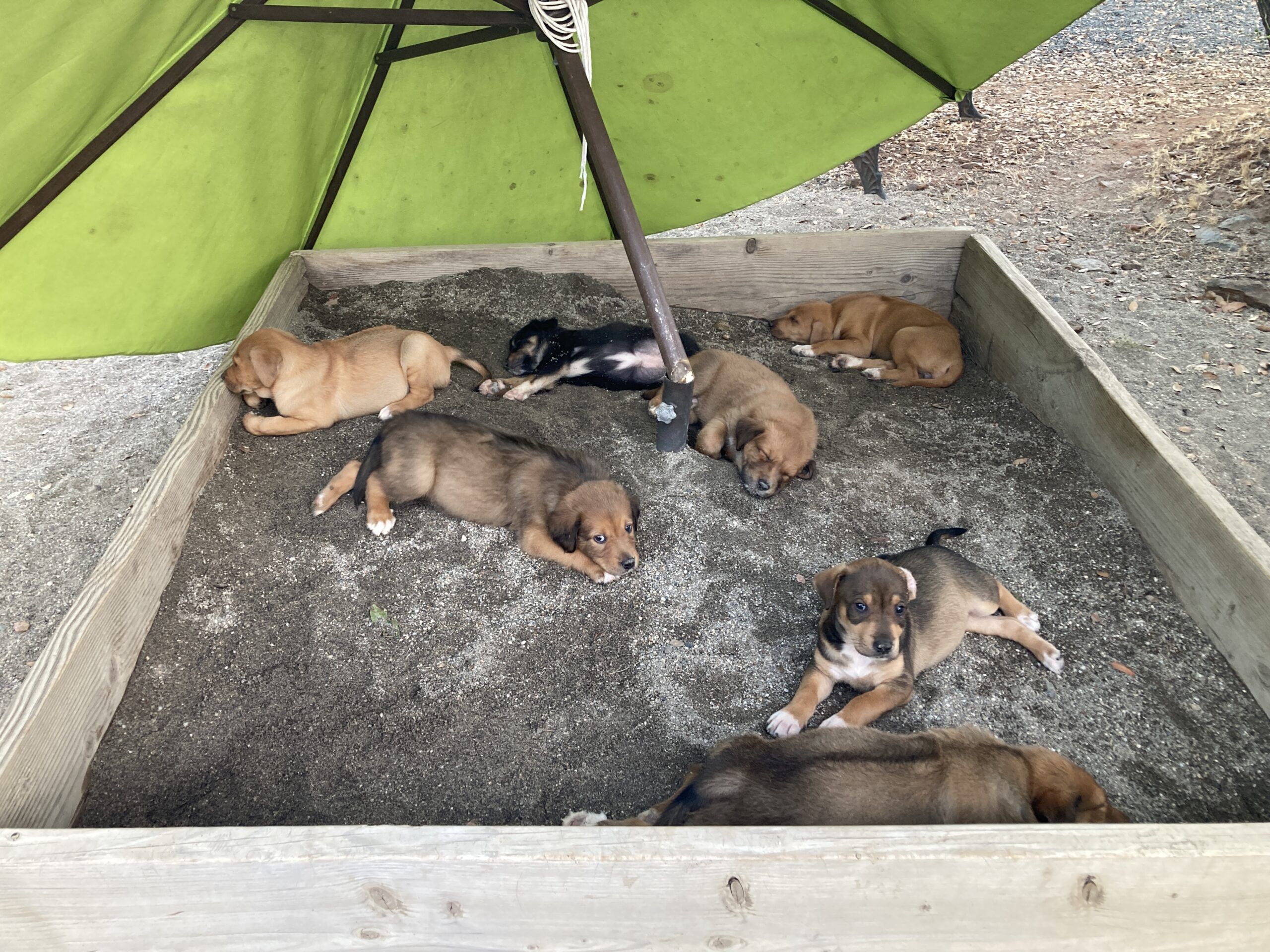
Whether or not the dog DNA tests that purport to reveal the breeds that have gone into your mixed-breed dog are accurate, they are fascinating.
Late last summer, I fostered a medium-sized dog who was, according to her owner, a mix of Rhodesian Ridgeback and Australian Shepherd. Luna had a crazy pattern of backward-growing hair and tight swirls down her back, in a violin-shaped pattern – but neither her size, shape, or coat color looked particularly like a Rhodesian Ridgeback. And certainly nothing about her resembled an Aussie in any way.
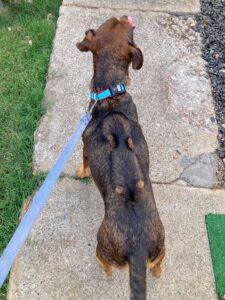
Luna’s seven puppies were a further mystery. Since she had belonged to a man who was homeless, and she frequently wandered around town without him, the pups she had may have had any number or type of fathers.
After the pups were spayed or neutered, I was thrilled to be able to find homes for all of them with friends or friends of friends (Luna got spayed and returned to her owner). And several of the new puppy owners had mixed-breed dog DNA tests done on their pups.
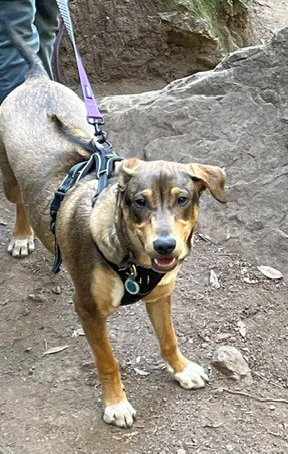
Of all the pups, Rocket looked the most like his mama, down to her identical color, short coat, and crazy, violin-shaped ridge. His owners were the first to have his DNA done – and so the first to be surprised by the findings! These results are from the Embark dog DNA test:
24.9% Australian Shepherd
23.4% Collie
19.5% American Pit Bull Terrier
12.4% Labrador Retriever
8.1% American Staffordshire Terrier
6.5% Golden Retriever
5.2% Rhodesian Ridgeback
This finding lent some credence to Luna’s owner’s claim that Luna was part Australian Shepherd, even though she looked nothing like one. The bully breeds (American Pit Bull Terrier and American Staffordshire Terrier) were not a surprise; almost every dog I’ve known who is from this area and has been tested (including my two disparate-looking dogs) has contained one or the other (or both) of these two ubiquitous breeds. But the presence of Collie was one surprise, mostly because none of the pups looked at all like Collies at the age of 12 weeks or so, when they got adopted. The other surprise was the low contribution of Rhodesian Ridgeback! Such a funny result, given the strong presence of the ridges on the pups.
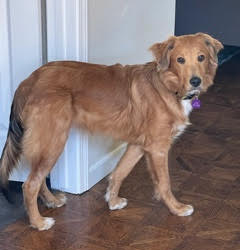
Dashi was the next pup whose results came back. He was one of the only pups to lack a ridge down his back, and he had a thick, longer coat. He also has big, floppy, unattached dewclaws on his hind feet. I was sort of expecting a little Great Pyrenees in his breed DNA test results; I thought it was even possible he had a different dad than the rest of the pups. His results were from Wisdom Panel.
22% Collie
18% Australian Shepherd
17% Labrador Retriever
14% American Staffordshire Terrier
10% American Pit Bull Terrier
7% Golden Retriever
3% Miniature American Shepherd
3% Rhodesian Ridgeback
2% Boxer
2% Chow Chow
2% Shetland Sheepdog
Holy smokes! Collie and Aussie at the top of the charts again! And all the same breeds as found in Rocket, in slightly different amounts – and with some unusual other breeds thrown in. And again, with such a low contribution of Ridgeback!
I forwarded these results to the owners of the other pups, and asked if anyone else had ordered DNA tests for their pups. The folks who adopted one of the pups who looked the most like a purebred Ridgeback had ordered tests from both Embark and Wisdom Panel – my kind of people! (I, too, have results from both companies for both of my dogs.) Astra is the color of a Rhodesian Ridgeback, has the right kind of coat, and has a prominent ridge.

Wisdom Panel DNA Test
24% Collie
19% American Staffordshire Terrier
18% Australian Shepherd
11% Labrador Retriever
10% American Pit Bull Terrier
5% Golden Retriever
4% Miniature American Shepherd
3% Rhodesian Ridgeback
2% Chow Chow
2% Shetland Sheepdog
1% Boxer
1% Chesapeake Bay Retriever
Embark DNA Test
26.6% American Pit Bull Terrier
24.9 Australian Shepherd
21.4% Collie
12.4% Labrador Retriever
10% American Staffordshire Terrier
4.7% Golden Retriever
So interesting that the two different dog breed DNA testing companies found similar breed contributions, but interpreted the amounts of the breeds so differently. Embark seemed to identify American Pit Bull Terrier as the dominant bully-breed contributor in its two tests of the siblings, and the American Staffordshire Terrier as playing a more minor role; Wisdom Panel had these roles reversed in its two tests. Embark also indicated that the pups had more Aussie than Collie in them; Wisdom Panel put Collie over Aussie.
Curiously, the company that found the most Ridgeback in any of the pups (Embark, with 5.2% in Rocket) found no Ridgeback inheritance in the pup who looks most like a Ridgeback (Astra)!
These tests may be scientific, but it’s imperfect science. Based on the commonalities between these four tests on three sibling pups, I’d say both companies are definitely getting at the contributing breeds, but I wouldn’t hang my hat on the percentages.
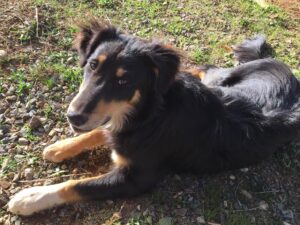
And, for what it’s worth, when the pups were with me, I didn’t see any Collie looks whatsoever. But now that they are about 9 months old, several of them look very similar to Collies! I was dubious about the results months ago, but now I’m sold. One puppy, Gabby, belongs to my ex-in-laws. She has very strong Collie looks – with a gorgeous, long, tri-color coat – and a crazy ridge down her back!

DNA analysis is a new and evolving science for both humans and dogs. So results should be taken with the proverbial “grain of salt.” But another major factor is that genotype (genetic makeup) and phenotype (appearance) are not consistent, accounting for individual traits in closely related individuals.
If this were not the case all siblings would be identical twins since they share the same DNA. Gene expression, which accounts for differences, is far more complex and not well understood by geneticists. Breeders of pure breed dogs who have repeated matings of the same sire and dam know that the litters produced may or may not be consistent in many traits, and mixed breed dogs with very similar DNA profiles can appear quite different from each other.
The true paradox is that in the long view of anthropology, all mixed breeds were once pure (small indigenous packs of wild dogs) and all pure breeds were once mixed (selectively bred by humans in the last couple of centuries to produce specific traits.)
If the basic assumptions that produce the data are flawed, then all that flows from them will also be flawed. That two programs can have such diverse results seems proof this is so.
Wisdom Panel has recently ‘improved’ its breed analysis, but IMO, they went backwards as the new results are clearly inaccurate.
I think these panels may be useful in cases where genetic makeup is important to know but difficult to determine such as selecting rescued dogs for specific work. I take the results with a grain of salt: like hydraulic computer models, they represent a ‘best guess’ effort.
I would like to see the results obtained by the reputable breeders of different purebreds. WDJ has consistently failed to do any control testing of these genetic breed panels by doing this. I think these panels are far more reliable for genetic conditions than determining breed heritage.
Several of my pup’s littermates have DNA panels too. Embark & Wisdom. If you read the results like Kim Brophey (Meet Your Dog), they match. They all said 1/3 Rottweiler x 1/3 herding mix x 1/3 hunting mix. The details aren’t very important. 🙂
I find running a DNA panel to be a fun way to speculate about my dog’s heritage. My current pup has a strong build with a long body but very short legs. Embark said he’s Lab/Am Staff/Chihuahua with some terrier/min schnauzer mixed in. I found with a previous dog that I got very different results from two companies, with Embark seeming to make more intuitive sense.
I do not believe the genetic panels regardless of which company does them.
I think the results depend a great deal on the DNA database the company uses for comparisons. Also, the results seem to reflect a false degree of precision. For humans trying to track down their ancestry via DNA, that’s certainly true. It’s generally thought that one of the big genealogy companies has a better database for identifying Ashkenazi Jews, for example. With the pups, it’s fun, but is it science?
I had a golden checked by embark they said she was 50% pug. What a joke! I had seen her
whole litter and her parents. She looked and acted like a golden. I had her for many years.
I do not believe the genetic panels at all anymore
They have for sure gotten better over time. Results from my dog Otto’s first tests, done over 10 years ago, were ridiculous and sublime. But the most recent tests, from about five years ago, made more sense – and the two companies concurred about what was “in the mix,” though, again, they disagreed on the percentages. See https://www.whole-dog-journal.com/blog/mixed-results-researching-your-dogs-dna/
Interestingly, Embark and Wisdom Panel disagree about which bully breed predominates in my dog Woody (just as with the pups described in this post). https://www.whole-dog-journal.com/blog/dna-tests-for-dogs-fun-interesting-but-probably-not-worth-the-money/
I have been skeptical for years on the DNA testing. I agree with you. And unfortunately for dog owners I’m not 100% sure DNA testing on dogs can be accurate?
DNA results and how the dogs look are definitely interesting. I have a dog that the rescue thought was at least 1/2 Bearded collie. We saw the mother and she looked kind of like a Bearded collie. Our Skye has mottled grey/black/white fur, but it is somewhat long and wiry and she has a beard and ears that can go down or prick up. But she always had some strong protective instincts and stubbornness that seemed like another breed. I finally (after 13 years!) did an Embark DNA. She’s mostly Cattle Dog with Great Pyrenees as the next highest percentage. Then other herding breeds and a tiny bit of husky and chow. Not a drop of Beardie blood in her. I asked them to rerun it to be sure. Now that I’ve let go of the Bearded collie identity I thought she had for so long, I can see the input of the breeds they identified.
Try Wisdom. I think they are a bit more accurate.
Wisdom Panel, whom I had sent a photo and told where he was from, said my dog was Canaan, Basenji and Border Terrier mix. I then sent no info to Embark and results said 100% South Asian Village Dog, and he is a village dog from Southern India.