

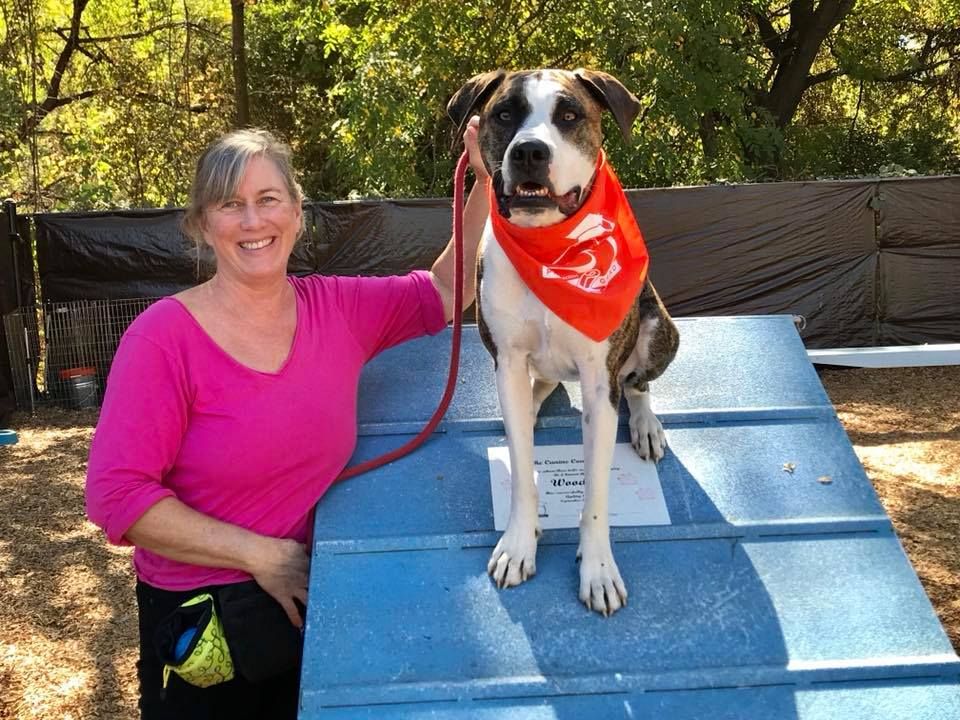
I’ve been thinking a lot lately about how different the experience of dog ownership is today than it was in my youth.
In the April issue, I wrote an article about the various flea preventatives (oral and topical, prescription and over-the-counter) that are available to dog owners. I mentioned in that article that many young pet owners have never even seen a severely flea-infested dog, whereas when I was a teenaged and then a young adult dog owner (in the late 1970s / early 1980s), pretty much all the dogs I was familiar with had at least some fleas. The preventatives that we have available to us today are so much safer and more available today than they were back then.
That article also mentioned how these parasite control treatments have made it so much more appealing to live with dogs in our homes, on our sofas, and on (or in!) our beds. My parents loved dogs and we had a lot of them when I was growing up in the 1960s and’70s, but only a couple of our dogs (an intact purebred Cocker Spaniel and an intact purebred Miniature Poodle) were largely kept in the house – and this was probably more about keeping them from getting bred by random intact male dogs (though that happened more than once). But, as a child who wanted all the dogs to sleep in my room, I recall my mom citing everything from the possibility of fleas and worms to ringworm and mange as reasons the dogs could NOT sleep with me. Today, many (if not most) family dogs sleep in the rooms or on the beds of the dog-loving kids in the family, if not the parents’ room or bed!
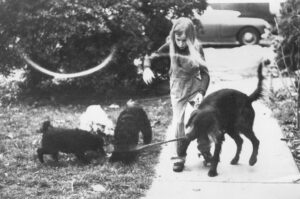
Obviously, spaying/neutering was highly uncommon before the 1970s. Euthanasia rates at what are now called shelters (then commonly referred to as “dog pounds”) were very high – as much as 10 times higher than they are today. We can thank nearly ubiquitous spay/neuter – and of course, much more responsible and enlightened social attitudes about managing our dogs’ reproduction – for the reduction in the euthanasia of unwanted dogs.
I love the fact that dog-friendly, positive-reinforcement-based training is so common now. It was absolutely not the norm when I was growing up. If a dog was formally trained at all, it was with yanks on a choke chain, with no exceptions.
But I’m sad about the fact that canine separation anxiety is so common today. I never heard of a dog who panicked when left alone before I was 30! I don’t know why so many dogs seem to suffer from some amount of this anxious behavior now.
Dog-dog aggression also seems more common. Though it seems insane now, 50 years ago, most suburban dogs, some urban dogs, and nearly all rural dogs were uncontained most of the time. They wandered at will and worked out their own relationships with other dogs. I remember a few dog fights between neighborhood dogs, but I don’t recall any of the participants being labeled as incorrigible or repeat offenders.
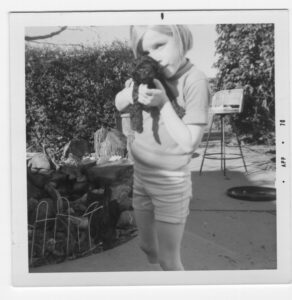
About that “wandering at will” – getting hit by cars was so common when I was a kid, that veterinarians used an acronym (HBC) for the cause of a dog’s injury or death. My family alone lost at least a half-dozen dogs to traffic on the rural road we lived on from when I was about 6 years old until I was about 12. Today I think, how stupid and avoidable was that? But at the time, every family we knew had lost a dog by HBC. That’s so nuts!
Healthcare for our dogs when I was growing up was strictly limited to vaccinations and treatment for injuries or illness – and the diagnostic tools and treatments that were available seem rudimentary compared to today. If a dog survived being HBC, the vet was likely to x-ray him or her. Ultrasounds, CT scans, MRIs – these are all commonly employed with great frequency today, but those tools only started to be made available to dog owners in non-university based veterinary hospitals in the past 20 years or so. Today, dogs are undergoing cataract surgery and liver transplants and treatment for every type of cancer imaginable!
This is both amazing and wonderful – and a guilt-inducing phenomenon for dog owners who can’t afford extensive treatments or high veterinary bills. “Economic euthanasia” is an evergreen problem that causes trauma and stress to owners and veterinary staff alike.
What are the most remarkable changes you’ve seen in your dog-owning lifetime?



Definitely “professionalisation” if that is a word! Gone from training at a dog club run by and for dog owners at £1 a class to 6 weeks for £100 by someone who does it for a living. And at these classes it was assumed that all of the dogs would need to get used to going to the groomers (“my Jack Russell is having a spa day” really?), vet nurses would clip their nails, dog walkers would walk them or they’d go to daycare, all would be insured to the hilt, eating raw or freeze-dried “natural” foods that no dog in the wild would ever consume and cost a fortune, they will be bred by professional licensed breeders (when I want a hobby breeder, deeply invested in the breed, has all the health tests, then raises in the house, next to the TV, with the grandkids round at the weekend) … Some of this is welcome, but like you say I see and hear of more SA, more “reactive” or aggressive dogs, more dogs with a complete inability to communicate with other dogs, more allergies, more auto-immune diseases, more dogs that basically are ill-equipped to thrive in our crazy human world.
I see more and more people who treat dogs as children. Precious children who they never intend to run free, get dirty, dig holes etc. They are members of the family whose needs and feelings need to be met but they aren’t children. They aren’t born blank slates either, that is why there are breeds.
I’d never seen a prong collar or electric collar in the UK before this year, now some training franchises are using them regularly. There is absolutely no need for them. I don’t know whether this is part of the desire to have everything immediately, always looking for a quick fix even though we know that these are rarely long term solutions, they actually create more problems and more work.
I love all the new sports/hobbies like mantrailing, scentwork, hoopers to go alongside obedience/agility/working trials. The internet allowing me to hear from people all over the world is an eye opener and makes me question the accepted norms and reminds me how tame our wildlife is in comparison! The access to research online is amazing, but then the sharing of total nonsense with no scientific backing which gets believed and absorbed as “the truth” is terrifying.
I like the fact that we are moving from “what can we make them do” to questioning whether it is really necessary and who it benefits. Some countries animal welfare laws are a huge step forward.The vitriol between the different camps is very wearing, force-free vs, balanced, experience vs academic etc. No-one listens to understand, they listen in order to make their defence, that stops growth and we need to figure out how to avoid throwing the baby out with the bath water.
I got my first dog ( a JRT rescue) nearly 30 years ago…he would find varius ways of escaping every time I left the house. By today’s standards we would probably identify his behavior as separation anxiety. But back then, he was just an escape artist…and the only solutions I was aware of were crating, tying up, or an electric fence (none of which helped, of course)… So, maybe separation anxiety existed back then too, just under a different name. I can only hope that we, as owners and trainers, are evolving as fast as the situation is changing.
My late doggie Kila had undergone two TPLO surgeries when she was 2 or 3. One ligament gave out followed by the other a few months after that first surgery. Committing to the surgery and recovery allowed her to have full function of her back legs for the rest of her life. She passed away at the age of 7, afflicted by bone cancer. Even in her lifetime, paying for two such surgeries was quite uncommon, so I would say, in my state anyway, seeing more and more owners considering corrective surgery for their doggies is one amazing change in the culture of dog ownership. Another incredible thing is how much new info comes out every year. We had made a decision to spay her before she turned 1, but I believe research came out over the last couple years suggesting that spaying that early made the dog more susceptible to torn knee ligaments in the rear legs, which was the catalyst for the TPLOs for our doggie.
When I was growing up in the fifties I had a rat terrier mix, and we lived across the street from a park, where she was walked daily. We didn’t pick up her poop–people just didn’t do that then. Even 40 years ago, I used to let my dog out every morning, and she’d go out for 10 minutes, and come back home…probably after pooping on someone’s lawn. Now, as I walk my 2 dogs, the normal is to clean up after them, and I can’t believe we used to leave the stuff lying around Ugh!
I remember when canned dog food was primarily made from horse meat. This was in the 1950s (I think). My mother had German Shorthaired Pointers and that food made them so gassy!! I grew up with dogs that were pretty much not obedience trained, except only for the show ring.
Today I am a Professional Dog Trainer with 20+ years of experience. I am very happy to see all of the improvements in dog care & training, especially the positive reinforcement trend. Things have gotten so much better, but there are still many, many uneducated dog owners and people who neglect and abuse our canine friends. I wish I could make it all go away.
I’m 56, a little younger than the author. We always had dogs, at least two, and mine was named George. He was intact, and a wanderer…got out whenever a female was in season, at least once a month. My dad said George was like a king bee… had to pollinate the neighborhood. There were SO many dogs walking around with George’s face! He was mainly an outside dog…until he saved my baby sister from a cottonmouth snake in our backyard. After that, George went in and out as he so desired. We lost him to heartworms, but then, he was 18 years old when he died. I wonder how long he would’ve lived had heartworm preventatives been available back then?
When I was little, for fleas, we used vinegar and pinesol in the dogs’ bath water and who remembers the Hartz flea collars? I thanked God when the flea preventatives came out…my ex and I had huskies in the early 90s, and fleas were a B back then!
While I know a lot of people despise choke chains, I think that sometimes they are a necessary evil as a tool, but am glad to see their use lessen. Ditto for physical discipline–whooping your dog with a newspaper isn’t even a thing anymore, is it?
But my absolute favorite thing when it comes to now vs then? The acceptance of dogs as a member of society. I absolutely adore the dog friendly restaurants, businesses, and acknowledgment that they get today.