

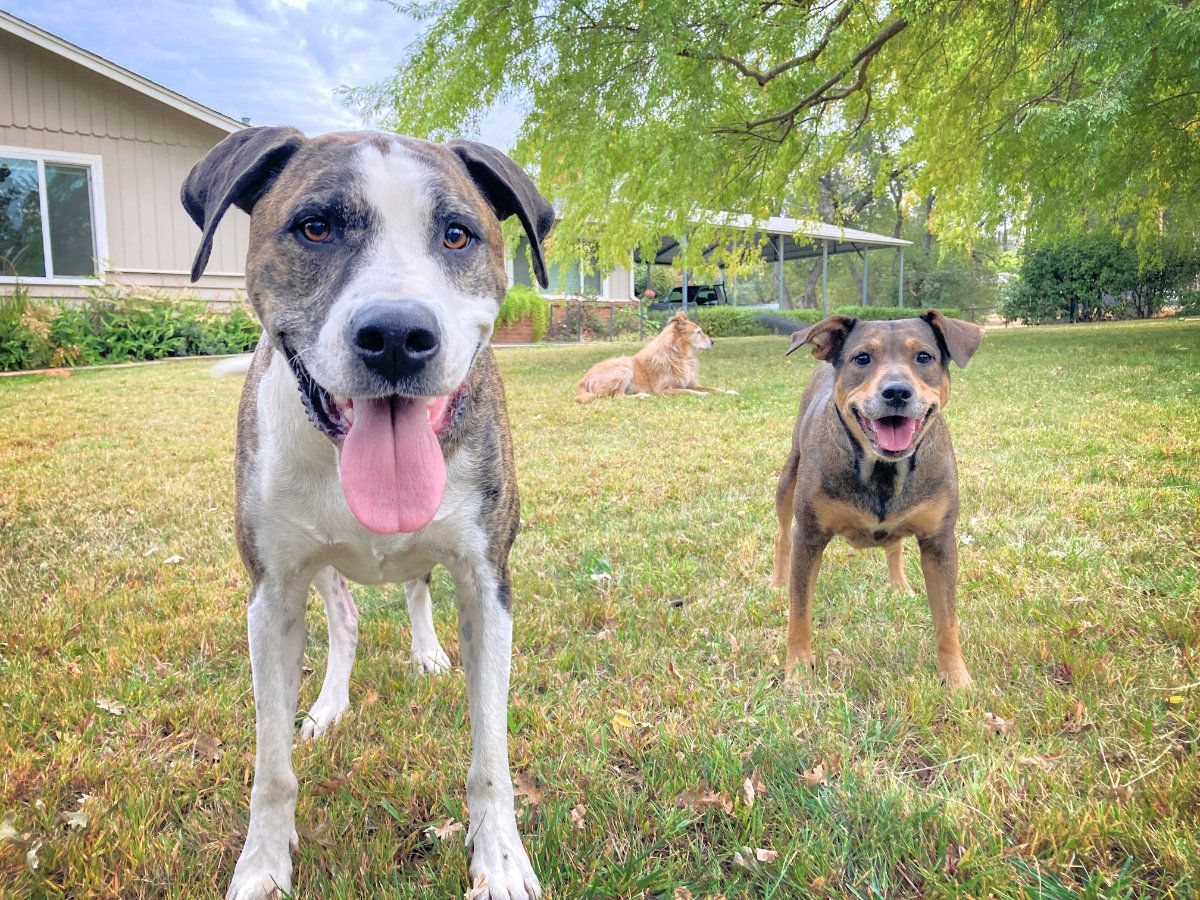
An author recently asked for the rationale behind an edit I made to her article. The sentence originally referenced something that worked well “in dogs and people.” I changed the sentence to read “…in dogs and humans.” I explained that “Dogs are people, too!” – but I don’t blame her for her confusion. Language constantly evolves to reflect the knowledge and ethics of the day, and we’ve taken some steps at WDJ that she was unaware of – and some of my writers have taken steps that I’m still not quite ready to take.
In most dictionaries, the definition of “people” implicitly means “humans” – so perhaps my edit was not necessary. But even dictionaries have to be taken with a grain of historical salt! I saw one definition that I scoffed at: “People: Human beings, as distinguished from animals or other beings.” (First off, humans are animals! And what “other beings” was the dictionary referring to?)
But I have a hard time differentiating between “personhood” and “people” – and I agree with the modern behavior scientists and ethicists who think we should extend our definition of “personhood” to our animal companions. There’s a great quote from the famed primatologist Jane Goodall: “You cannot share your life with a dog, as I had done in Bournemouth, or a cat, and not know perfectly well that animals have personalities and minds and feelings.” Goodall started her career in an age when scientists were forbidden to attribute any sort of emotions or intentions to the non-human animals she was observing – this was termed “anthropomorphism” and was deprecated as indicating a lack of objectivity – and she found this limitation ridiculous.
Today, the idea that our animal companions should be referred to with the same terms as inanimate objects (“it”) is preposterous. This is one of the reasons we have always used gendered pronouns for dogs in the magazine (he, she, and if we don’t know the gender, they). And it’s clear to anyone who loves dogs that they also feel love, jealousy, rage, fear, anxiety, sorrow, joy, mischievousness, and more.
If we acknowledge that all dogs (and all animals) have a “personality” – a unique set of behavioral traits, expressions, reactions, and emotions – why can’t they be “people”?


WOW!! From what I first perceived as a relatively light-hearted lead, “dogs are people too,” morphing into this extraordinary, oh-so-deep discussion, and from so very many different perspectives. This is one I must share with several friends.
Perhaps I am viewing the entire subject all together waaay too simplistically, but I don’t know that “naming” other animals as “people,” or not, is truly relevant. It seems to me that all “animals,” including humans, have their individual attributes associated with their own species. Albeit many of which are shared intra-species. For instance, puppies will do what puppies do (chew on anything, go potty anywhere, jump on everybody, etc) until they’ve been taught basic manners that allow them social acceptance in the world of humans.
However, the same essentially applies to young humans, who are also known as “children.” Chickens are going to act like chickens. Yes, they are a bird, in some ways very similar to, but not the same as, say…a hawk, or a penguin, or a humming bird.
Yet, as Nancy has already pointed out, each and every comment is absolutely valid. Thank you all so much!
Hmmm. Perhaps this subject warrants some more careful thought.
Or not – ? 😊
I am not a linguist so do not know what terms other languages have but person doesn’t seem to cover the animals we live with that have personalities and souls. I would not refer to a cockroach or amoeba as having a soul. A virus has no personality.
But my dogs are not soul-less beings. They have personalities. They have likes and dislikes. They have their individuality and their quirks. I certainly don’t need to expound to the choir.
But I’m not sure person is the term to use as it has too long been associated with human animals and there are also legal implications. Perhaps we need a new word, but I have no idea what it would be, nor would I attempt to categorize which living beings get to be persons and which do not. I think the decision between dogs and amoeba might be easy but there are plenty of living things that would live in a grey area of are they or aren’t they?
My dogs have feelings, they have emotions, they have personality quirks, likes, dislikes, they express themselves as best they can and having lived with them I am perhaps better at interpreting what it is they want or don’t want, like and don’t like. No one can convince my my dog does not have a “soul”. If you want to call that personhood, then so be it.
I’m with you; every pet I’ve ever had has def had a soul. But if you talk to scientists who study insects, they will tell you they all have different personalities and imo, souls. I suspect even microbes have distinct personalities, & souls. Animists believe that rocks and rivers have souls too. Nobody can tell me that clouds don’t have souls. It gives me solace to think of creatures throughout the universe who have souls. Otherwise it’s just a soul-less place to live.
Chambers Century Dictionary
Person . . . a living soul or a self-conscious being . . .
Personality . . . individuality . .
So I see nothing at all ‘wrong’ with referring to dogs as persons.
Chambers Century Dictionary
Person . . . a living soul or a self-conscious being . . .
Personality . . . individuality . .
People . . . a set of persons . . . a set of animals as if forming a nation . . .
There is nothing wrong with calling dogs people — they certainly have personality, and are definitely self-conscious.
Chet of the Chet and Bernie mysteries by Spencer Quinn refers to dogs as “the nation within” since they are a nation within the nation of mankind/humans.
when I was growing up in the 60s and my mom was introducing her kids, she always named them in order of age as follows: chris, petie, marybeth, john & boots (GSD). boots was always the kid with the funny nose!!
Yes, they are my Babies…but I am not a ‘Furmom’!
Every creature, from mice to elephants, is a sentient being. I have worked with many species for a long time, and I love them all. HOWEVER, we (and they) will be a lot worse off if they are granted legal status as “people”. Only the animal rights RADICALS are promotimg this. Animal WELFARE advocates have worked for multiple decades, without fanfare or recognition, to provide the best care for their patients, companions and helpers!
Well, I object to the term ‘creature’ — but them I am not a creationsit,. Animals!, We are, we are human animals ‘Homo sapiens’. Dogs are canine animals “Canis familiaris’.
Then I’ve never thought of ‘people’ as necessarily implying only ‘Homo sapiens’ animals nor implying any legal status.
When I hear Stephen Colbert ask his guests “What is the most dangerous animal” I always say to myself “humans.”
Okay, you hit a nerve with this blog and conversation string. I have railed against the term anthropomorphism for decades because it looks at intelligence, emotions and behaviors from the wrong direction as it implies so called ‘human’ emotions to dogs and other animals. But what we observe when we see happiness, joy, worry, concern, affection, apprehension, etc. in dogs and other animals are ANIMAL emotions, not ‘human’ emotions. And since humans are animals, it stands to reason that the emotions and behaviors that we express are animal emotions and behaviors. Some animals, snails for example, don’t have very complex behaviors and emotions but they have them. They fear for their safety, they feel positively towards good habitats, food sources and mates. The farther you go up the evolutionary ladder in animals who have developed large brains, sentience and especially complex social lives … the more complex those animal emotions and behaviors are. So let’s just do away with the term anthropomorphism because it’s incorrect and misleading. It harkens back to the biblical chain of creation with humans perched at the top which was a popular scientific philosophy back in Darwin’s day. And Darwin proved pretty conclusively that thats not what’s happening at all. Humans express animal emotions and in very very complicated ways as we all well know! Let’s allow other animals to express their complex emotions and behaviors, too, but let’s just not call it anthropomorphism.
I sort of like “people” for how inclusive it is. Word meanings are always evolving and I’ve kind of embraced the idea that “people” has stretched to include our dogs.