

Last month, my sister-in-law and my almost-13-year-old niece, Ava, spent two weeks in France, visiting my sister-in-law’s mother and stepfather, who live in Paris. Ava has been a dog lover since before she could walk, so I gave her an assignment, to take photos of dogs in Paris.
I’ve always been interested in the cultural differences between how dogs are handled and treated in different countries and I discussed this with her a bit; she and her mom stopped at my house on their way to the airport, because I dog-sat their little dog, Alice, while they were gone. But, in truth, I wasn’t actually concerned with the photos that Ava might get for me; I had an ulterior motive. Mostly I was trying to give Ava a photography job that would (I hoped) keep her engaged with the living scenery when traveling, to keep her eyes open. Ava has an artistic eye, and as someone who studied photojournalism, I know that being given an assignment to take pictures can sharpen and focus your awareness on your surroundings.
Ava did take and send me some pictures of dogs and dog owners. We’re going to be looking at them and discussing her trip to France at the end of this week, when our family will get together again to celebrate her 13th birthday. But here’s the funny thing: Ava must have told her grandmother that she was taking photos of dogs for me. This morning I received a photo and email from her grandmother, Olivia.
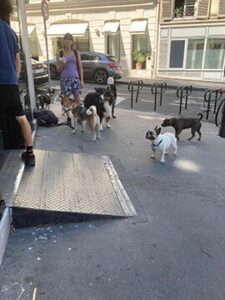
“I heard you need pictures of dogs in France,” Olivia explained. Well, I guess my covert mission needed to be exposed, and I’ve written back to Olivia to recuse her from the assignment and sharing the actual purpose of my assignment for Ava with her.
But after writing the email, I looked at Olivia’s snapshot again. She had actually captured several very interesting things. The longer I look at this photo, which she captioned as “a dog walker in Paris,” the more I see. Look: What do you see?
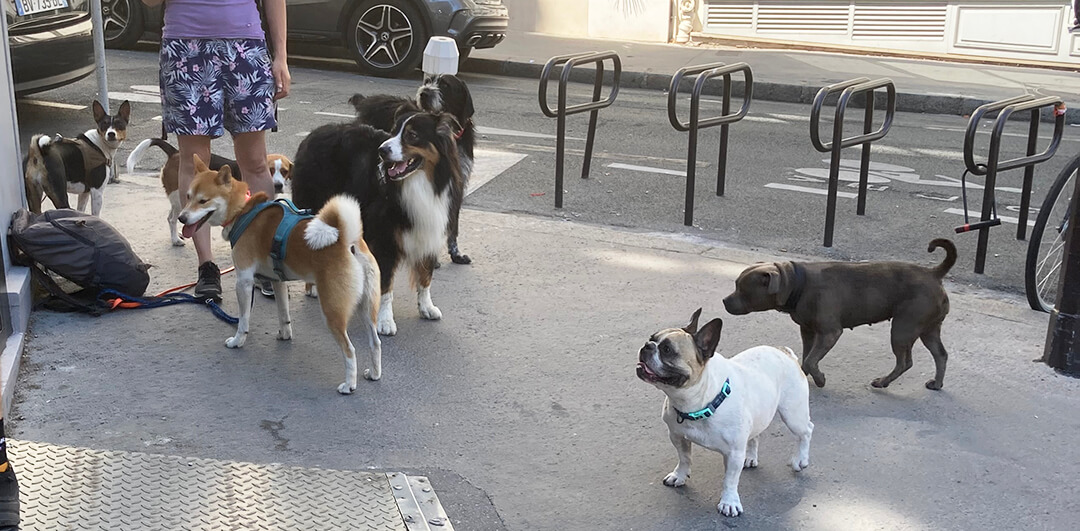
Here are the things that are most interesting to me:
Of the seven dogs visible in the photo, only one (possibly two) is leashed. Despite this, they are all just hanging out in a relaxed fashion, waiting for their walker, who appears to be taking a snack break.
The two dogs on the right may or may not be with the walker; they are slightly removed from her, whereas the other dogs are arranged in a circle around her. So those two unleashed dogs may simply be waiting for their owners to come out of the store or restaurant. They are unleashed but perfectly safe and comfortable waiting on the sidewalk.
All but one of the dogs resemble purebreds. The dog on the far right might be, too; I’m not familiar enough with all the bully-type breeds to know what she is or might be.
All seven of the dogs are in good weight and look fit. Even French dogs look more slender than their American counterparts!
The white dog on the right appears to be a French Bulldog – but he or she has much more of a nose than the French Bulldogs you see here. I love that the dog’s face isn’t as smushed in the exaggerated way the dogs here often appear.
How do dogs become so habituated and well-behaved that they can safely be taken out with a dog-walker off leash in the middle of a busy city? Are dogs being lost and hit by cars at a rate we Americans would find unacceptable? I’m fascinated – and I just might have to go to Paris to find out! I’m pretty sure I could stay with Olivia…





bonjour,
i am an ex-new yorker living in paris for many years. i have a standard poodle. i have never seen a group of dogs without leashes with a walker. my dog goes to a large wooded area with a walker outside of paris. dogs are not allowed in most green spaces in Paris. People are not so great about picking up their dogs poop. officially all dogs must be on leash in Paris. not everyone obeys the rules. i am not surprised that the dogs dont seem overweight in Paris. Most people in Paris are not overwight either, just as in Manhattan most people are not overweight. Manhattan is not Amercia and Paris is not France.
The main difference I have noticed between parisian and Manhattan dogs are that here in Paris most male dogs are not castrated.
Dogs are not allowed in supermarkets…small neighborhood shops may let their regular ckients bring their dogs.
i could say more but i will end here.
if any of you comes to Paris with or without your dog do not hesitate to contact me.
brenda
Thank you for the reality check Bremda.
i see a fascinating article in our future (please?). interviews with several French people found on the street with their chill, well-behaved dogs, eliciting details of puppy training goals, as well as adult dog care and feeding routines (do they buy kibble/feed butcher scraps/homemade food??). a dog can readily pick up on our overall expectations for him/her, and if we can shape an attitude that will help our dogs be confident and self-controlled, i for one would love the information!
Yes. In Italy I noticed how well-behaved the dogs were as well. And yes, they were allowed almost everywhere.
In Switzerland, a few years ago, we remarked how well-trained the dogs were, walking off-leash with their family. Similarly, the children were equally well-mannered and, of like the dogs, all were trim. It’d seem the child-rearing and canine training are another important variant in the understanding of the behavior of their furry companions.
This is fun! I haven’t read past the “what do you see” or any of the comments as I’m noting down what I see about the dogs in the picture and also how it varies from many cities in the U.S. and expectations. Thanks for the great project from a bully breed-mix therapy dog handler that is fascinated by behavior, body language and all things dog. Articles like this apply so well when I have to respond when volunteering with my dog to people who say, “I didn’t know pit bulls could be therapy dogs.” Duh.
Americans seem to want to control every aspect of their dogs lives, which is unnatural. They also dress them in ridiculous clothes, feed them junk and too much food so they get fat and sick. I do think this is cultural. There is also a lack of respect for animals in general. The dogs you see in this photo aren’t like that because they aren’t treated that way. And Americans tend to be backyard breeders resulting in unhealthy animals. Purebred dogs have gotten a bad rap in favor of mutts. Mutts are fine – I have 3 – but purebreds are necessary if we are going to have specific breeds; some who do specific jobs. It is just sad what Americans have done to dogs which are just the most lovely creatures. They deserve far better.
I agree with the comments that living with a dog in big European cities is very similar to living in big American cities or anywhere else for that matter. Lived in Europe from 1967-2008 (UK & Germany) and had a small dog for much of that time. Dogs are permitted to go into more stores than in the US, that’s true. Other than that, not much difference – a dogs a dog and an owner is an owner, some responsible in dog care/training some not – regardless of where you live.
As far as Europeans not breeding their bulldogs, pugs, etc. to not having the extreme pushed in noses (with all of the attendant problems), in Hamburg, Germany, I had a long conversation with a shop owner with a purebred pug who looked more like a U.S. puggle, in other words, he had a snout. The dog did agility work and had no respiratory issues. Why have we Americans allowed the breed standard to be so unhealthy?
AKC. They could put a stop to these extremes but instead, reward them with ribbons. I don’t understand why dogs are bred so that they must give birth through Caesarean section because they are unable to do so naturally. To me, that is insane. I don’t care what a dog looks like, if it isn’t healthy and cannot function naturally (I.E. birthing) then to me that dog should NOT be bred anymore than dogs with a a propensity to develop blindness, cancer or hip dysplasia should be bred.
In this country I think the number one problem is the back yard breeders in it for the money. The dogs they produce might technically be pure bred, but they will disregard anything about healthy, fitness, etc and then you get a lot of puppies that grow up to be unhealthy dogs.
I’d like to see a study if the dogs in Europe have longer lifespans than those in the U.S. I think I read somewhere that U.S. Golden Retrievers now average 6 years and have a high incidence of developing cancer.
If I had a dollar for every client after talking to them I heard sirens in my head that their dog is from a backyard breeder or puppy mill!
So many of them have temperament issues and health issues. The buyers think they are buying a puppy from a good breeder because they have papers. The signs are ALWAYS there. The puppy is sickly, they weren’t allowed to meet the bitch or sire, or the one that gets me, they met in a parking lot to pick up the puppy! I WISH we could put a stop to the backyard breeding and puppy mills.
I think everyone has agreed that dogs in Europe are allowed in almost everywhere. So they are taken in almost everywhere and are extremely well socialized. We’ve taken our two dogs everywhere we’re allowed to (including some local mom-and-pop stores that allow dogs in the store), but there are so many places dogs aren’t allowed here. So socialization certainly plays a part. Plus, I think breeders are different in Europe. I know their kennel club does not tolerate breeding “extremes” (as you noted with the French Bulldog that looked like it could actually breathe!) and I think they also breed for temperament–placing temperament more important than “looks”. I’ve seen some show dogs that have won ribbon after ribbon and win every show in sight, but who are neurotic, fearful, and act in an aggressive manner. Why are those dogs being bred? Because they “look good”. I wish we here in the U. S. were as forward thinking as most Europeans are!
Really? How many dogs shows have you been to? How long do you think dog shows would last if they were as you describe. If a show dog shows any aggression or other negative behavior, he or she is automatically disqualified. Show dogs are not bred to “look good.” They are bred to improve the in health, temperament and structure of the given breed, and they are judged in the ring for those traits. That’s why judges put their hands on the dogs. They’re feeling for correct structure that isn’t visible under the well-groomed fur. Of course they look good! They’re the best representatives of their breed. Just like a professional baseball player is the best in his sport. I’m so tired of people condemning ALL breeders and ALL purebreds because of the behavior of a few outliers, and then making statements based on what they “think” and on seeing a “few show dogs.”
If only you were right, Carole.
Sghow dogs in America are bred to meet the AKC breed standard, which emphasizes physical conformation. Obviously dogs that display overt aggression are disqualified but it is the very rare breeder that prioritizes temperament.
This is why we have a Newfoundland: AKC Standards: First sentences: General Appearance: The Newfoundland is a sweet-dispositioned dog that acts neither dull nor ill-tempered. He is a devoted companion. A multipurpose dog, at home on land and in water,Temperament: Sweetness of temperament is the hallmark of the Newfoundland; this is the most important single characteristic of the breed.
I am totally fascinated by this and by everyone’s responses that have lived there. Wow, to not have to leash my boys and be able to take them into a store or bakery!!! I better not let them know they’ll be catching the next boat/plane to Paris!
As a dog walker (and trainer), I walk dogs in the suburbs. I have never been able to walk dogs in a pack. Almost every dog I walk the owner will tell me, they are “not good with other dogs”. Sometimes it’s over excitement, sometimes, fear, and sometimes downright aggression. So, the only time I walk more than one dog at a time is when they are from the same household.
And, yes, many are overweight and neurotic!
This is very sad. It’s kind of the same reason I don’t go to a dog park. It appears that many Americans don’t socialize their dogs, then they toss them in with the other dogs at dog park and it’s hit or miss if trouble starts.
I would also be interested to know if the dogs in the photo are spayed/neutered. I’d be willing to bet they’re not, which would throw out the theory that intact males are only interested in one thing. The US is the only country where people automatically sterilize their dogs without ever asking why. It’s only done for convenience because owners can’t be counted on or don’t care to keep their dog from breeding. It’s really not that hard.
Maybe Europeans respect their dogs and don’t disregard their needs by turning them into “furbabies.”
Robert, it’s a sad fact but I too would not have been able to do pack walks when I was dog walking! I train dogs now, and a majority of my clients are undersocialized dogs that don’t know how to function outside of their homes!