

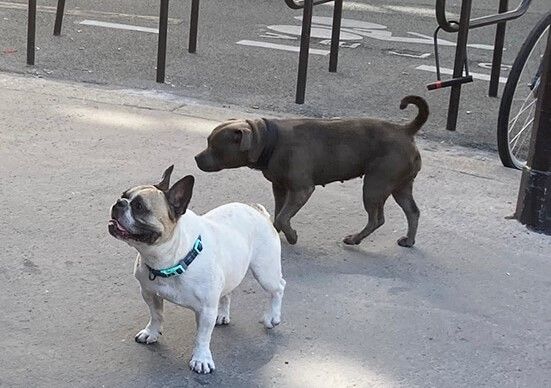
Last month, my sister-in-law and my almost-13-year-old niece, Ava, spent two weeks in France, visiting my sister-in-law’s mother and stepfather, who live in Paris. Ava has been a dog lover since before she could walk, so I gave her an assignment, to take photos of dogs in Paris.
I’ve always been interested in the cultural differences between how dogs are handled and treated in different countries and I discussed this with her a bit; she and her mom stopped at my house on their way to the airport, because I dog-sat their little dog, Alice, while they were gone. But, in truth, I wasn’t actually concerned with the photos that Ava might get for me; I had an ulterior motive. Mostly I was trying to give Ava a photography job that would (I hoped) keep her engaged with the living scenery when traveling, to keep her eyes open. Ava has an artistic eye, and as someone who studied photojournalism, I know that being given an assignment to take pictures can sharpen and focus your awareness on your surroundings.
Ava did take and send me some pictures of dogs and dog owners. We’re going to be looking at them and discussing her trip to France at the end of this week, when our family will get together again to celebrate her 13th birthday. But here’s the funny thing: Ava must have told her grandmother that she was taking photos of dogs for me. This morning I received a photo and email from her grandmother, Olivia.
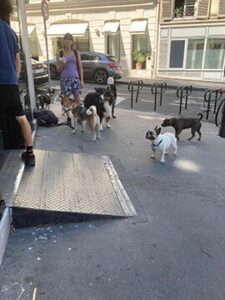
“I heard you need pictures of dogs in France,” Olivia explained. Well, I guess my covert mission needed to be exposed, and I’ve written back to Olivia to recuse her from the assignment and sharing the actual purpose of my assignment for Ava with her.
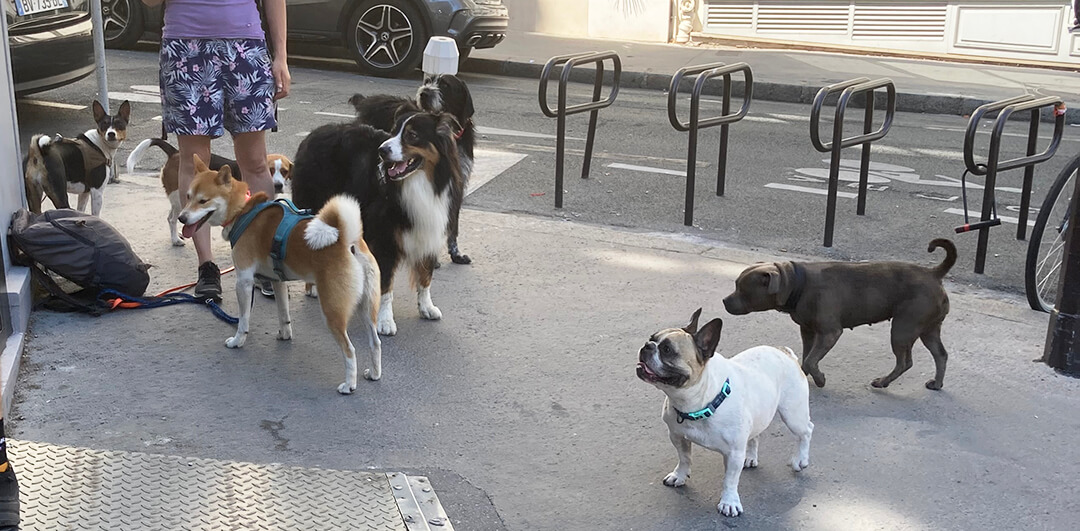
But after writing the email, I looked at Olivia’s snapshot again. She had actually captured several very interesting things. The longer I look at this photo, which she captioned as “a dog walker in Paris,” the more I see. Look: What do you see?
Here are the things that are most interesting to me:
Of the seven dogs visible in the photo, only one (possibly two) is leashed. Despite this, they are all just hanging out in a relaxed fashion, waiting for their walker, who appears to be taking a snack break.
The two dogs on the right may or may not be with the walker; they are slightly removed from her, whereas the other dogs are arranged in a circle around her. So those two unleashed dogs may simply be waiting for their owners to come out of the store or restaurant. They are unleashed but perfectly safe and comfortable waiting on the sidewalk.
All but one of the dogs resemble purebreds. The dog on the far right might be, too; I’m not familiar enough with all the bully-type breeds to know what she is or might be.
All seven of the dogs are in good weight and look fit. Even French dogs look more slender than their American counterparts!
The white dog on the right appears to be a French Bulldog – but he or she has much more of a nose than the French Bulldogs you see here. I love that the dog’s face isn’t as smushed in the exaggerated way the dogs here often appear.
How do dogs become so habituated and well-behaved that they can safely be taken out with a dog-walker off leash in the middle of a busy city? Are dogs being lost and hit by cars at a rate we Americans would find unacceptable? I’m fascinated – and I just might have to go to Paris to find out! I’m pretty sure I could stay with Olivia…





I used to travel to Italy and Spain (my country of birth) with the only dog amidst my rescues that had the traveling bug, a frisky miniature Schnauzer. She could enter many places but not all of them. Restaurants only outside in the terrace, and supermarkets were a hit or miss (there are some regulations on the dogs/places with food interaction). Europeans walk a lot since many errands are done on foot and a furry one is a happy companion. It is, indeed, a different culture.
I’m not sure this a USA vs Europe thing. I’ve noticed this for years when I visit larger urban areas – Chicago, Seattle, NYC. Dogs that are acclimated from puppyhood to the urban environment and all that comes with it are going to be calmer and less reactive to people and other dogs. This snowballs in a positive way – puppies meeting less reactive adult dogs are less likely to learn or have the need to be reactive themselves.
This is something I’ve been wondering about myself. My first German Shepherd grew up in DC and never seemed bothered by people, other dogs, loud noises at all. Since moving to Florida (much more suburban “city”), they have been much more anxious with the above. I thought maybe it was the dog that was the anomaly, but you might be right that it was the way she grew up.
Maybe in Europe they have not stereotyped certain breeds to be dangerous like in the US? Or, maybe the Europeans are not as quick to threaten to sue someone over a dog altercation as in the US? Or, maybe the European culture is more relaxed, tolerant, and understanding overall? I haven’t been in Europe for thirty years sadly. My recently planned trip was canceled by Co-vid. I can’t wait to go back!
In Europe dogs are very incorporated to their families. Most people live in apartments, no houses with a yard, so it’s a bit like in NYC, dogs are much more socially “tolerant”, they don’t get triggered but so much action around them (dozens of different voices, kids running, bicycles flying by, cars honking…). Also yes, the sue happy mentality is foreign to them (but then lawyers get paid an hourly rate and not a percentage of the carnage). It’s truly a different way of living.
England has a ban on Pit Bulls, not Staffies, Pit Bulls. And the only criteria they use to determine if it is a Pit Bull is visual. If it looks like one, it is one and is humanely euthanized.
Unfortunately in many European countries there are breed-specific laws and certain breeds of fog can only be outside and walked with a muzzle. However, dogs are much better behaved than dogs here. I think part of this is due to most western european countries being walking countries. People walk everywhere and thus take their dog(s) along.
I have wondered the same. Dogs in Europe are allowed everywhere ( on trains, in restaurants). They are certainly well socialized!
I was in France with my dog and she was allowed almost everywhere. Cafes, grocery stores, bakeries. It was wonderful!
I am totally interested in this too! I have relatives in Europe and I always wonder how their dogs get so well behaved in public! I’m also interested in culture differences about crate usage and housetraining process too. Looking forward to reading the results of your project!
To be honest I’ve never seen a crate in Europe other than for professional use. I understand they may have their benefits but a big no for me.
I have a crate at the foot of my bed, and bring one along when traveling with my dog. I can’t remember the last time I closed the crate, but it is definitely one of her preferred spots. Two of my previous dogs had orthopedic injuries and needed to be confined post-surgery. I was glad they loved their crates because it made that healing time comfortable for all of us. I will always crate train my dogs, and allow them this comfy, quiet option as resting spot.
I have a now, 11 yo Australian Shepherd. I didn’t crate train her as a puppy because being a volunteer in three rescues, I didn’t see what I liked about working dog owners who left their dogs crated all day while at work. But then when I moved to Florida, I decided to crate train “Rain” because she loves everyone and a lot of people don’t want a dog near them. I used treats to train her, and it only took a few times for her to catch on that when I said, “crate”, she would go in. Now when people she doesn’t know come to the door, like service men etc., she automatically goes in her crate, which is next to my bed.
Thank you, I always remarked how controlling we have became to our canine friends. In some countries it’s simply not allowed to have dogs of the leash. I leave in the small village in UK and most dogs are leashed. I do get strange, apprehensive looks from passers by. Dogs cannot learn and became comfortable about life, while being constantly restrained. It’s a sad life for most of them. Even golden ‘cage’ is still a cage…
We do want to share our lives with animals but cannot be bothered to learn about their needs, it’s all about us.
Love your stories.
Unless this has changed, one of the biggest differences between dogs living in the USA and those living in France is that dogs in France are permitted to enter stores selling food, supermarkets, etc, and restaurants, with their caretakers. So it would be unlikely that any of the dogs in the photo, standing out in the street, are out there waiting for their person to come out of any store which sells food,
Unless this has changed, one of the biggest differences between dogs living in the USA and those living in France is that dogs in France are permitted to enter stores selling food, supermarkets, etc, and restaurants with their owners. So it would be unlikely that any of the dogs in the photo, standing out in the street, are out there waiting for their person to come out of a store selling food!