

The other day, I was working away on my computer, both dogs snoozing in my office while my Spotify playlist blared from the computer speakers. Suddenly, the music cut out – an interruption in my rural internet service or something – and it’s a good thing it did, for in those few moments of silence, I heard something that stops most of us dog owners in our tracks: the unmistakable sound of a dog’s repetitive licking that signals trouble.
“Hey!” I exclaimed, jumping up from my computer chair to see which dog was licking, and where. I clearly woke up Woody – it wasn’t him. But Otto, who had been laying in a door-less crate in my office, hung his head with a “Shoot! Caught in the act!” look. I asked him to come out of his crate for a quick exam.
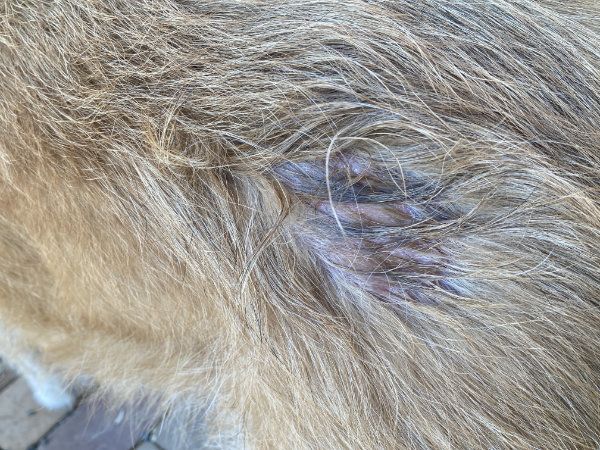
He stepped out and the problem was immediately apparent: He had been licking a big raw spot on his hip – a spot that had not been there earlier in the day.
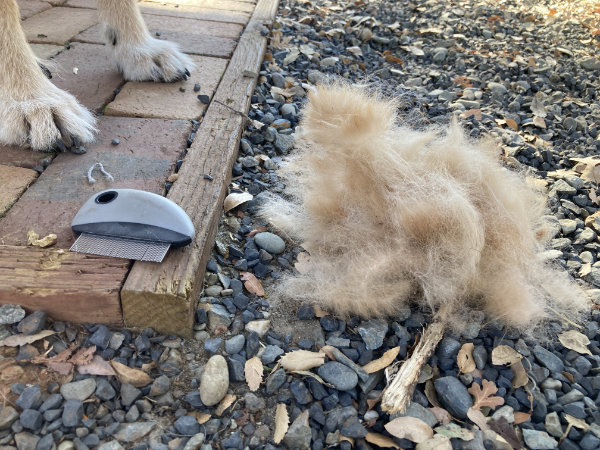
I asked Otto to lay down in the middle of my office floor and checked his tummy for fleas. In my experience, if a dog has fleas, you will see them running across the hairless or sparsely haired tummy first. On Otto: Nothing. I grabbed a flea comb and started combing. Flea combs have tiny teeth, packed very close together. You can work quickly to examine a thin-coated dog with one. But scruffy Otto has a fine undercoat, and flea combs pull a lot of loose hair out. I had to examine each comb-full of hair closely – I had to get my reading glasses to do so! – to make sure I spotted any flea or “flea dirt” (flea feces).
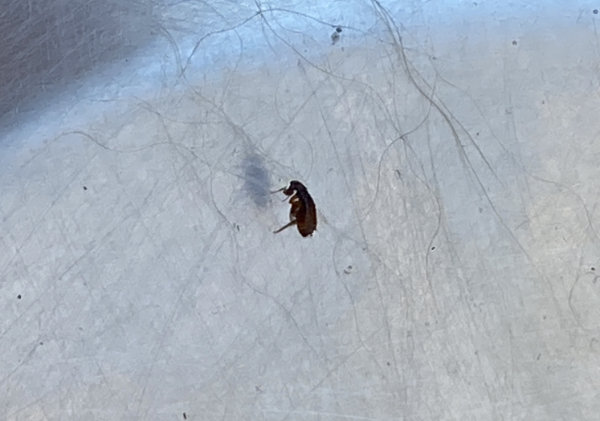
After about 20 minutes of combing, I found a single flea. Oh my lord, Otto.
My “heart dog” of yore, Rupert the Border Collie, had been severely allergic to flea bites, and if he was ever bitten by one, this is exactly what would happen: Within hours, he’d transform from a “regular” dog to anxious, neurotic, obsessed, and compulsive. He’d go crazy with scratching and chewing himself, as I raced to get him whatever was needed to stop his itching: something to nuke the fleas, something to stop the itching, something to calm him down.
Otto has not, for most of his life, been that sensitive. Since I foster fairly frequently, we’ve had the occasional flea incursion that had to be put down quickly. In instances of a transient flea invasion, Otto would get only mildly itchy. He’s never been covered with fleas, but, once or twice, we’d had a mild population boom. (I used to have a couch on a covered porch and the dogs liked laying on it. So did a neighborhood cat. Boom – all of a sudden, the couch was a flea farm. It went to the dump shortly afterward.) At 13 years old, though, Otto’s immune system seems to be twitchy.
Using an old pair of horse’s ear clippers I have, I clipped the hair surrounding the hotspot; when the hair touches skin that’s abraded and open, it constantly introduces bacteria to the site. Shaving the surrounding hair makes it look awful, but heal more quickly.
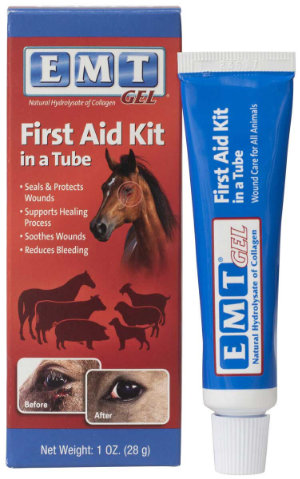
Next, I gently cleaned the site with a mild liquid antibacterial soap, and rinsed it well. Next, I dried the area all around with a clean towel, and used a hair dryer on “cool” to dry the hotspot itself. Finally, I used a favorite remedy, EMT Gel, to lightly coat the wound. We discussed this gel in an October 2013 article, “Alternative Treatment and Supplement Recommendations,” where author CJ Puotinen described it this way:
EMT Gel’s key ingredient, bovine collagen (also described as “a natural medical hydrolysate Type I collagen”), acts as a tissue adhesive, providing a matrix for new cell growth while sealing and protecting wounds and significantly reducing pain, bleeding, scarring, wound weeping, and the risk of infection.
I also have been giving Otto a dose of Benadryl in the morning and at night, to help stop his allergic itching.
Next, I flea-combed Woody; I didn’t find a single flea on him. If fine-coated Coco had a flea on her, I would have seen it walk by; no combing necessary. I’m hopeful that the flea came onto our property on a passing cat or squirrel or something. Nevertheless, I also made an immediate trip to Petco and bought fresh Seresto collars for the dogs. Since fleas aren’t usually a problem for us, I don’t use flea-pesticides year-round, but do use the Seresto collars when we hike in the local areas that are laden with ticks.
As long as Coco is here, Woody’s Seresto collar will have to go on at night and off during most of the day; Coco and Woody chew on each other constantly in play, and I neither want her to get her mouth stuck on his collar or, for a $50 collar, have her chew it off of him (this happened once when I was fostering Odin, another young dog who liked to playfully bite and chew on Woody’s neck and face. $50, down the tubes!).
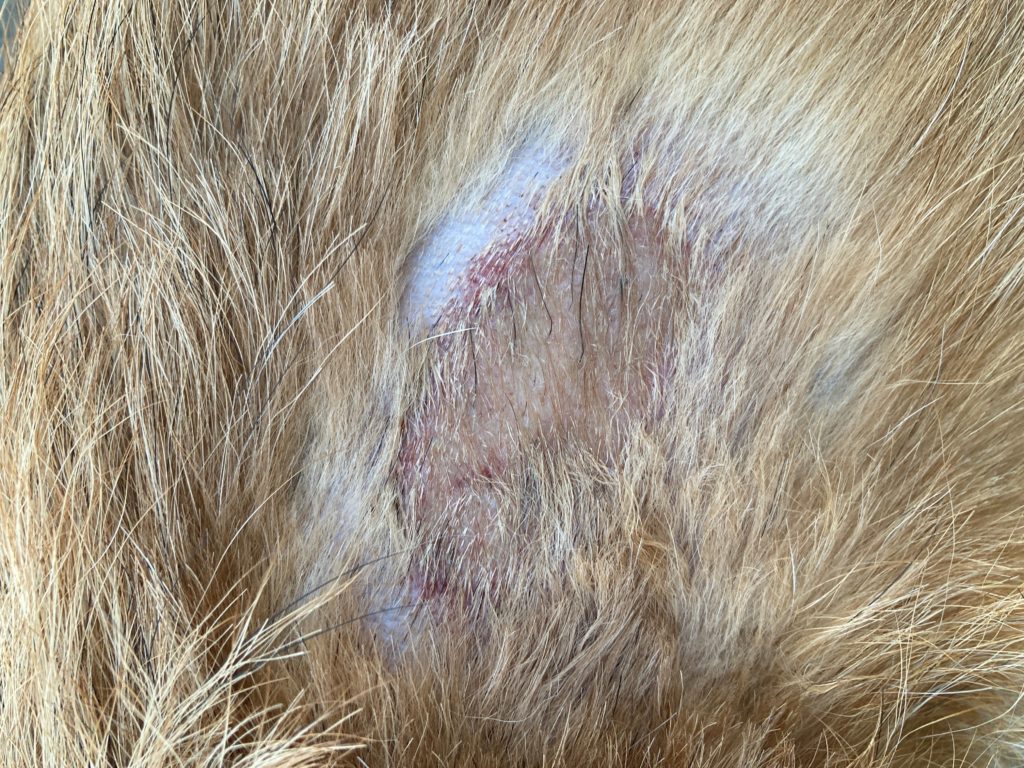
Fortunately, just a day or two later, the hotspot is healing nicely, and Otto’s licking has ceased. I’m hoping that any other fleas that might have been present were killed before they could have an opportunity to lay eggs. I’ll keep the flea-killing collars on for a few weeks, just in case.
Do you have a highly flea-allergic dog? How do you treat hotspots?




We use Advantage topical for our dogs. I don’t like using any of the flea medications but what is the alternative. I’ve tried home remedies which haven’t worked for my dogs.
I’m old enough to remember when we didn’t have all the flea products we have now. What a nightmare when our 2 dogs and 2 cats all got fleas at once! It got so bad my husband and I got flea bites all over our backs! We have experienced first hand what flea bites feel like!
The only thing we could do was give everyone flea baths, vacuum, vacuum and more vacuuming; all bedding washed and hope for the best!
I’m thankful for the topicals as they’ve kept our pets flea free for many years. I envy people who say they’ve never seen a flea on their pet. Very fortunate indeed!
I don’t know that it is the fleas that cause hot spots.
Several years ago we took on an older dog who had a history of hot spots as well as other health problems. Once we got him off the Commercial Dry food he came with, he had no more problems,.
But we here have paralysis ticks that are either very expensíve trip to a vet or death, so we use Tick preventative the whole time, except for mid-winter. The dogs have had no adverse effects worth either the by mouth ot spot on treatments.
I gave up collars years ago because they gave me terrrible headaches and sinuses. I dont know WHAT they did to the dogs.
A friend used to recommend potato flour to relieve and cur hot spots.
None of my dogs had had a hot spot since I got that advice so I cannot really comment on whether it works well or not.
First off, what you use for your dogs is your business – you know your dogs better than anyone. I don’t use ingestible flea/tick medication but do use a topical with no side affects. I have considered the collars but have a 10 month old chocolate Lab – so that wouldn’t work. My dogs all wear the quick release safety collars (like cats have) and I’ve found them lying around the yard more often than I can count!
I’ve never had hot spot issues with my dogs but one of my sweet Labs battled a lick granuloma for YEARS. It started out as a dust mite allergy but became behavioral when we adopted a dog we had been fostering. NOTHING worked on her. She got acupuncture, cytopoint shots, steriods, essential oll, everything. I finally found medi-mitts (since it was a foot) and these worked great for her. She left them alone and her spot would heal better than anything else. She died a year ago at 15 and I still have one of her mitts – I take it out and sniff it every now and then. Pretty strange, huh?
“But” isn’t telling the problems you yourself and your dogs have had with various treatment fair “comment”?
I agree — probably best to say WHAT treatment (if you remember 🙂
In a pinch, when you don’t have access to one of the medications mentioned, take a tea bag, wet it down, squeeze most of the water out of it and hold it on the hot spot for several minutes. The tannic acid in the tea helps dry out the skin. This is not a cure, but a temporary treatment until you can get the dog or cat to a vet.
Our lab mix has severe allergies, environmental and food. He does very well on apoquel after trying other meds. He has scars from lick granulomas on his feet. We watch he carefully for signs of problems starting again.
Love all of the “amateur veterinarians” indignantly commenting on Nancy’s use of flea collars. Both of my dogs have worn the Seresto collars, with their vet’s blessing, for several years. It is much less messy than the topicals like Frontline. Have never had any adverse reactions, and living in the South, flea and tick protection is a must! Thankfully, my dogs have not had “hot spots” but my Beagle mix started chewing on her back paws and nails several months ago. Her vet diagnosed allergies and she now takes 1/2 tablet of Apoquel each day. Her nails have improved and grown back. She loves that each tablet comes to her in a Pill Pocket!
Good for you. I guess since you haven’t had any problems that means no one else has, either? I am not an “amateur veterinarian” and I would never attempt to treat any of my animals without consulting a vet. HOWEVER, I do know several people that have LOST their dogs after using these collars. I would never take that chance. I believe far more dogs have had serious problems than people realize. I am extremely thankful that people step up and let others know when problems arise like this. Vets sell them; I truly do not understand why. If an editor of a site like Whole Dog Journal writes an article mentioning her use of a product that is known to cause fatal side effects, it makes me take a step back. Obviously some others feel the same way. For me, this site has lost credibility because of that article. And I will continue to real every post by those AMATEUR VETERINARIANS that share their experiences because those posts may save my dogs life one day.
Good for you. I guess since you haven’t had any problems that means no one else has, either? I am not an “amateur veterinarian” and I would never attempt to treat any of my animals without consulting a vet. HOWEVER, I do know several people that have LOST their dogs after using these collars. I would never put one of these collars on my dogs. I am extremely grateful that people let others know when they have serious problems with a drug or flea collar – or anything that causes bad reactions. Otherwise we are at the mercy of the manufacturers, who are mostly in it for the money and do not want the public aware of adverse reactions.
sorry did not mean to post twice. First one did not indicate it had gone through so I tried again.
I have just finished the treatment of hot spot from fleas from stray cats HS was on side of tail of German Shepherd Drove him & me mad First washed disinfected all beds and Vecumed floors Bathed dog in flea & tick wash ( oatmeal) Rinsed with Malaban (malathion) left on 5 mins then hosed off used NEEM oil on flea trails belly / inside legs etc Put Homeopathic ointment on HS OK for a few hours then itchy I rubbed with Betadine sponge put CBD oil balm on Also had to put flea & tick collar KILTIX not as severe / Toxic as Seresto dead bodys came off in the bedding washed daily in Hot water Amonia disinfectant dried in hot sun (Elizabethan collar did not work he went bezerk) Licked the first balm did this x 3 times daily or when itched 4th day now all good hair in place dog eating OK now too He was given Tyrosine Vit B chews to get through the ordeal Anyone using Seresto and the like Look up Wiley research Project JAKES Survey Flea and Tick Serious Adverse findings There are other safer alternative treatments that don’t kill the dog in the process My 3yo baby died 1 week after Flea / Tick / Heart worm monthly chew IVERMECTIN & SALT 1 week after the 3rd dose
When I had a dog that got hot spots, I used Sulfodene. By the second day it was all dried up and healing without fur removal etc.
I’ve used Seresto collars for several years now. I’ve found 1 tick on my dog in those years. The only area they didn’t work was in Florida where my in-laws had many feral cats in the area and their house was also infested. Those fleas seemed to be immune to everything! Some of the adverse effects seen with the collars are because of fake collars being sold on the internet. These fake collars have been known to cause severe reactions. Bayer even put out a youTube video in order to help people tell the difference between fake collars and real ones.
Seresto commercials even include a disclaimer that states that they may cause neurological side effect in dogs and death can result. They know about the issues and yet they still sell them. Maybe fake collars are being sold, but the real ones still cause deadly issues.