

The other day, I was working away on my computer, both dogs snoozing in my office while my Spotify playlist blared from the computer speakers. Suddenly, the music cut out – an interruption in my rural internet service or something – and it’s a good thing it did, for in those few moments of silence, I heard something that stops most of us dog owners in our tracks: the unmistakable sound of a dog’s repetitive licking that signals trouble.
“Hey!” I exclaimed, jumping up from my computer chair to see which dog was licking, and where. I clearly woke up Woody – it wasn’t him. But Otto, who had been laying in a door-less crate in my office, hung his head with a “Shoot! Caught in the act!” look. I asked him to come out of his crate for a quick exam.
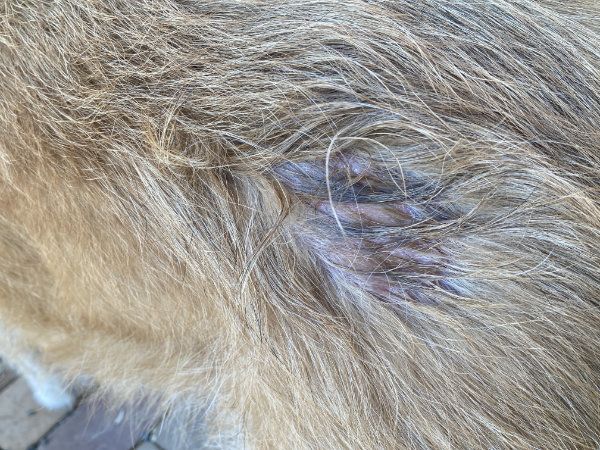
He stepped out and the problem was immediately apparent: He had been licking a big raw spot on his hip – a spot that had not been there earlier in the day.
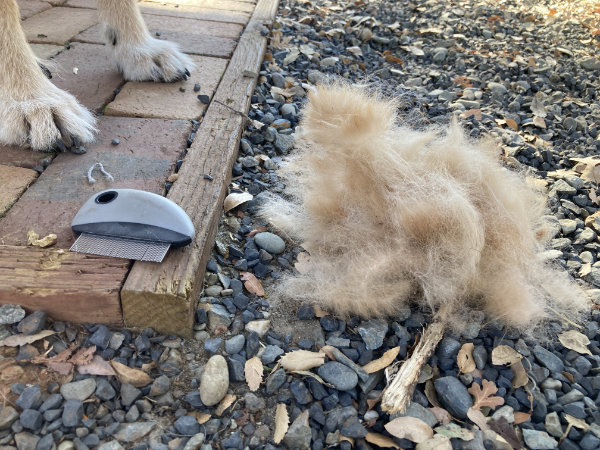
I asked Otto to lay down in the middle of my office floor and checked his tummy for fleas. In my experience, if a dog has fleas, you will see them running across the hairless or sparsely haired tummy first. On Otto: Nothing. I grabbed a flea comb and started combing. Flea combs have tiny teeth, packed very close together. You can work quickly to examine a thin-coated dog with one. But scruffy Otto has a fine undercoat, and flea combs pull a lot of loose hair out. I had to examine each comb-full of hair closely – I had to get my reading glasses to do so! – to make sure I spotted any flea or “flea dirt” (flea feces).
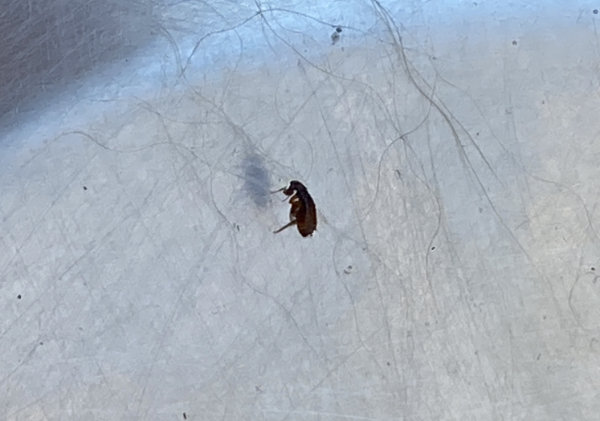
After about 20 minutes of combing, I found a single flea. Oh my lord, Otto.
My “heart dog” of yore, Rupert the Border Collie, had been severely allergic to flea bites, and if he was ever bitten by one, this is exactly what would happen: Within hours, he’d transform from a “regular” dog to anxious, neurotic, obsessed, and compulsive. He’d go crazy with scratching and chewing himself, as I raced to get him whatever was needed to stop his itching: something to nuke the fleas, something to stop the itching, something to calm him down.
Otto has not, for most of his life, been that sensitive. Since I foster fairly frequently, we’ve had the occasional flea incursion that had to be put down quickly. In instances of a transient flea invasion, Otto would get only mildly itchy. He’s never been covered with fleas, but, once or twice, we’d had a mild population boom. (I used to have a couch on a covered porch and the dogs liked laying on it. So did a neighborhood cat. Boom – all of a sudden, the couch was a flea farm. It went to the dump shortly afterward.) At 13 years old, though, Otto’s immune system seems to be twitchy.
Using an old pair of horse’s ear clippers I have, I clipped the hair surrounding the hotspot; when the hair touches skin that’s abraded and open, it constantly introduces bacteria to the site. Shaving the surrounding hair makes it look awful, but heal more quickly.
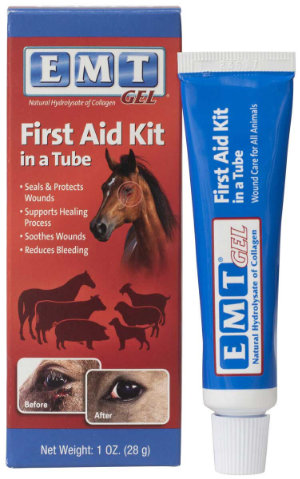
Next, I gently cleaned the site with a mild liquid antibacterial soap, and rinsed it well. Next, I dried the area all around with a clean towel, and used a hair dryer on “cool” to dry the hotspot itself. Finally, I used a favorite remedy, EMT Gel, to lightly coat the wound. We discussed this gel in an October 2013 article, “Alternative Treatment and Supplement Recommendations,” where author CJ Puotinen described it this way:
EMT Gel’s key ingredient, bovine collagen (also described as “a natural medical hydrolysate Type I collagen”), acts as a tissue adhesive, providing a matrix for new cell growth while sealing and protecting wounds and significantly reducing pain, bleeding, scarring, wound weeping, and the risk of infection.
I also have been giving Otto a dose of Benadryl in the morning and at night, to help stop his allergic itching.
Next, I flea-combed Woody; I didn’t find a single flea on him. If fine-coated Coco had a flea on her, I would have seen it walk by; no combing necessary. I’m hopeful that the flea came onto our property on a passing cat or squirrel or something. Nevertheless, I also made an immediate trip to Petco and bought fresh Seresto collars for the dogs. Since fleas aren’t usually a problem for us, I don’t use flea-pesticides year-round, but do use the Seresto collars when we hike in the local areas that are laden with ticks.
As long as Coco is here, Woody’s Seresto collar will have to go on at night and off during most of the day; Coco and Woody chew on each other constantly in play, and I neither want her to get her mouth stuck on his collar or, for a $50 collar, have her chew it off of him (this happened once when I was fostering Odin, another young dog who liked to playfully bite and chew on Woody’s neck and face. $50, down the tubes!).
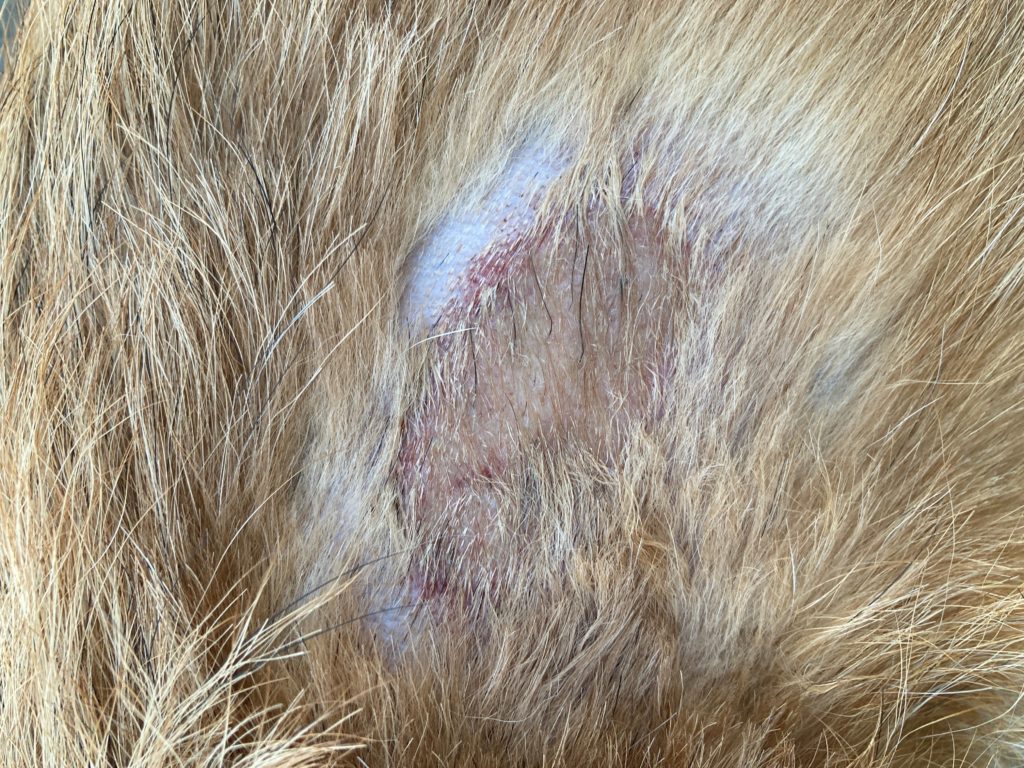
Fortunately, just a day or two later, the hotspot is healing nicely, and Otto’s licking has ceased. I’m hoping that any other fleas that might have been present were killed before they could have an opportunity to lay eggs. I’ll keep the flea-killing collars on for a few weeks, just in case.
Do you have a highly flea-allergic dog? How do you treat hotspots?




My first dog, Caesar, would get them fairly regularly in the summer. He was on flea meds but that doesn’t mean an occasional flea couldn’t bite him. For immediately relief he got Benedryl per the vet’s directions. I never did identify exactly what was the cause, but when he was given antibiotics for a yeast problem in his ears his itching cleared up. The vet suspected his allergy was environmental and seasonal.
Ramses didn’t have hot spots so much as just itching. He turned out to have developed a food allergy when he was around 10 years old. The vet suggested I eliminate chicken from his diet. That did the trick. He went on a fish based kibble and was fine. He also loved beef. But treats were a problem as it was difficult to find treats that didn’t have some chicken in them. I avoided all poultry, including duck and turkey because we never did know if it was just chicken or all poultry he was allergic to and I didn’t want to test it on him and have him itchy again.
Diana pawPrints has only had one hot spot in two years. Not sure what it was caused by. But she is on topical flea treatment (much safer than oral or collars) and I am careful to rotate her kibble each year so she doesn’t develop any food sensitivity.
I’m going to be making a note of some of the treatments mentioned so that if she does develop a not spot in the future I will be able to treat her quickly.
My 20 lb. Scruff, Leya, is prime to hot spots in the warm months. Like a lot of us, I ran off to the vet and we would do the steroid routine. I found that if I used vetricin on her as soon as I even suspected a hot spot, we were good. I think if she gets any kind of bug bite, she immediately gets a hot spot. Have not found fleas on her so far, so whatever finds her tasty will raise a hot spot.
I have a male German Shepherd Dog now age 6 who had recurrent hot spots. With each outbreak, I would bring him to the vet who would shave around the hot spot, treat the spot topically, and ask me to put a cone collar on him until he was fully healed, which took weeks, and it took months more for his double-coat to regrow in the shaved area. Then…he would get another hot spot and the cycle would repeat. I couldn’t find a cause, like fleas, so I began to suspect a food allergy and we did a year-long elimination diet; it was painful, no treats, limited and unappetizing food, but he seemed to improve…for a while. Finally, I asked for a referral to a canine dermatologist. The doctor, Emily Rothstein in CT, is superb. She did a careful history, saw a pattern, and suggested we try a new monoclonal antibody treatment called CYTOPOINT®. Within a few days after his injection, his itching substantially decreased and now I take him for an injection whenever I notice an increase in frequency or duration of his scratching and licking, so about every 2-3 months. Now he has returned to eating everything. Next time I won’t wait to see a specialist for a recurrent problem, not that a specialist will solve every issue nor will this antibody cure every hot spot.
Do you know what he was allergic to? Was it environmental? I’m happy the treatment worked but I would want to know exactly what my dog was exposed to that was causing it.
My girl was skin & blood tested fir allergies (food/environment). Fleas—no issue. Grasses, trees, mold YES. Everything she lives in. Food showed beef, peas, white potatoes. Bad me had her on Apoquil (sp) then allergy drops that didn’t help that much. Started her on Cytopoint (sp) and it eliminated hot sports and her extreme discomfort! One injection lasts up to 5 months. Doing the best that I can (with diet and detox’s). She is 16💕.
The side effects of cytopoint injections can also be deadly. Please go on line & read about Apoquel & Cytopoint & I’m sure you will not give your dog one more injection after you’ve done your research. It’s terrible!!!!!
Just about ALL medications have side -effects. Different dogs can react differently to different medications.
Speaking of Allergies, I have used Polaramine (dexachlorophenamine maleate) with success on some of my dogs. Dosage by weight but otherwise similar to human dose.
Bur seriously I really would look to diet.
With Fletch (our old rehomed dog), when I found him losing too much weight on the amount of feed he was getting, I started adding just one handful of his old dry food to his meals, ALL he problems — itches, hot spots, sore feet, weird behaviour –, came back. So we increased our t order, and he recovers fairly soon
My bulldog gets cytopoint shots. We try to keep it minimum due to the nature of the shot. She usually get 2-3 a year. Which in turn stops me from seeing the vet sometimes 2-3 times in 14 days. So again just as the editor said in a reply above. Use the information to best treat YOUR dog, while some work for dog A it might not work for dog B. And as another person brought up the chemo analogy and the risks outweighs the side effect.
Also do you take Tylenol ? If so you might wanna rethink it. Considering it has the #1 cause of overdose deaths in the United States alone.
Food for thought
Thanks for this. I especially like the information about skin bacteria and the need for clipping. My senior American Water Spaniel just developed a hot spot due to my lapse in applying Frontline. Fortunately it’s a minor one and the Genta spray from the vet has helped to heal it. I could find no fleas on him, but with his very fine curly brown undercoat, it’s difficult. Nexgard put a stop to it almost instantly, although it’s a product I’m not especially comfortable using regularly. During this, he was seen for his periodic wellness check and the vet said it’s healing up nicely.
I have a little 6 pound rescue Maltese that had a hot spot a few months ago. I haven’t ever had to deal with hotspots. I bought some over the counter spray and it worked well. She just had another one earlier this week and I was able to catch it quickly and spray and it was fine in a day. No fleas so I can’t figure out what is causing them. Just curious I use seresto collars because I don’t like putting meds in my dogs if I don’t have to what alternative do you use?
Sadly, the chenlmicals in flea collars are absorbed into the dog’s body through the skin. So in reality, you are not avoiding meds or chemicals just because your dog isn’t given them orally.
Rita O
I understand that. But the collars release the pesticide in them over time, not all at once. So if you remove the collar, you *reduce* the dog’s total exposure.
MY dog does not have adverse reactions to this product. I’m not going to introduce him to some NEW product just because OTHER dogs have had adverse reactions to THIS one.
Again, his adverse response to fleas is far worse than any response to any pesticide he has been exposed to.
Bingo.
Don’t use seresto collars. They can poison your dog.
Seresto collars are horrible for you and the dog. Keep your dog flea and tick free and healthy by using supplements like Earth Animal flea and tick control, natura petz or Bug Off Garlic by Springtime, Inc. Chemicals are completely unnecessary. I have used Bug Off garlic for years and have never seen a flea!
My remedy for hot spots is to take my dog to the vet and get a shot of Convenia (a fairly pricey antibiotic, but they offer rebates) and a short course of steroids – this combination brings really fast relief. But I’m going to look into that EMT gel!
BTW, I’m not a fan of Seresto either, because the second collar failed to work and the manufacturer declined to refund my money. So I will not be purchasing ANY of their products.
Be very careful of Convenia. If your dog had a reaction it stays in their system for up to 2 weeks with no way of reversing the side affects. I had a first hand experience it’s called Covenia because it is convenient where you do not have to give an antibiotic every day. That’s where the name comes from . With giving daily antibiotics you can stop as soon as any adverse reactions happen. With Covenia it is in their system. There has been deaths from convenia. Be very careful .
I don’t like “Soresto “Dog Collars they are Poison read the Label’s, LOL
I totally agree.
So you don’t think people (or animals) should ever be given chemotherapy if they have cancer? Talk about toxic chemicals. One needs to weigh the risks versus the benefits.
In most parts of the country, ticks are a real problem. Tick-borne diseases (and there are many much more serious than even Lyme disease) can be fatal, e.g. sudden renal failure. While I’m not thrilled with Seresto collars, it’s what I have used for flea and tick prevention for my dogs. I guess I could opt to never let my dogs outside — then I wouldn’t need any of those products — but that’s not much of a life for a dog.
Over the past several years, I think WDJ has become a very credible, reliable source of information. While I don’t agree with everything I read there, it’s my choice how I use the information. Just like I don’t want my dogs to live in a bubble, neither do I.
I was fine with this article UNTIL the author mentioned she used the Seresto flea collar! Are you aware of the neurologic side effects many dogs have with this product? It can cause not only seizures in dogs but many have DIED as a result of these collars. For a magazine that promotes dog health and natural remedies, I am appalled that you would feature an article that promotes the use of these products. Your site has lost all credibility with me.
Hear, hear! Thanks for speaking up–I had the exact same reaction when I hit that point.
The collars work quickly for my dogs without causing side effects. Otto has had a bad reaction in the past to certain topical flea products. I personally like the fact that if a dog has a reaction to a Seresto collar, it can be removed and the dog washed; this is a fast way to reduce the potential adverse effects of a pesticide. If a dog has an adverse response to a topical product, again, the dog can be thoroughly washed, but it is my understanding and experience that this reduces the amount of the offending substance that has reached the dog’s bloodstream only a small amount; the damage was mostly done. And of course, when people use oral or injected flea products, there is no way to “undo” the application.
That said, why would I use pesticides at all? Because they work much more quickly than anything natural — and in MY dog’s case, the flea bites cause more adverse effects than the collar. You all have to do what’s best for YOUR OWN DOGS. My use of Seresto for my dogs is not a recommendation of Seresto for all.
I would NEVER use one of those collars on my Australian Shepherd. She’s very sensitive to vaccines and stuff like those cl
My Border Collie mix is also extremely allergic to fleas. When I find a hot spot – out come the scissors (he freaks out with clippers) and two of my favorite products: #1 Tomlyn hot spot spray – the only one I can find with lidocaine in it. This automatically kills the pain and itch which prevents him from being motivated to lick more. Once that’s sprayed on the spot, I coat the wet spot with a puff of #2: Sturtevant’s Canine Antiseptic Powder. I use the powder for 2 reasons: it helps heal the spot and I can tell if he starts licking again because the powder ‘scab’ disappears. This usually heals things in about 24 hours.