


On March 2, USA Today published an article about the Seresto collar, originally developed and brought to the market by Bayer Animal Health in 2012. The article highlighted the fact that the United States Environmental Protection Agency (EPA) has received nearly 1,700 reports of animal deaths associated with use of the collar. Worried pet owners have been flooding their veterinarians’ offices with calls about whether to remove their pets’ Seresto collars.
Dog owners should be aware that every effective pesticide will cause adverse effects in some animals; that’s the nature of products that are meant to kill parasites. But there are a number of things you can do to reduce the potential for harm to your dog:
- Don’t use any flea- and/or tick-killing or –repelling pesticides unless your dog needs that protection. If you are lucky enough to have never observed fleas in your home or on your dog, you may have no need for flea-control products; don’t buy them unless you need them! In some parts of the country, fleas and/or ticks are a fairly constant threat to pets and pesticides are needed to control and manage infestations. (I put the collars on my dogs when I am planning to hike with them in areas where ticks are numerous, or when my dogs get exposed to a dog with fleas. The rest of the year, they go without!)
- Use an integrated pest management (IPM) plan to control persistent flea infestations, so you can use pesticides less frequently in the future. This link provides a good source of information on how to do that.
- If the pets in your home repeatedly get infested with fleas, try to identify the source of reinfestations. Indoor/outdoor cats are often the culprits, as they may rest in places frequented by flea-infested mice, rats, squirrels, or chipmunks, picking up fleas there and inadvertently bringing them back home to reproduce.
- If you have used a particular flea/tick-control product and your dog had an adverse reaction to that product, note the information in any place that will help remind you to avoid that product or its active ingredients in the future. My granddog Cole had an adverse reaction to Frontline once, vomiting once or twice on the day after the spot-on was applied and exhibiting diarrhea for a day or two after that. About a year later, my son, misremembering which product had caused the adverse response, inadvertently used Frontline on Cole again (after getting fleas from a visit to a friend’s infested home), with the same response. Aghast, he called me to confirm that Frontline was the culprit. Now we both remember, and avoid that product for Cole.
- It’s easy to respond if your dog, like Cole, has an acute adverse response to a particular pesticide. (In the case of an adverse response to a spot-on pesticide, you can give your dog a series of baths to help eliminate all of the pesticide that was not yet absorbed into his skin. If your dog has an adverse response after you have put a Seresto collar on him, remove the collar and bathe him well.) But if your dog has chronic health problems, you may need to more deliberately consider whether any of the topical or oral pesticides you have administered to him may be connected to his health problems. We wouldn’t recommend giving dogs with cancer or those who suffer from seizures any pesticides whatsoever. Instead, we’d use whatever IPM tactics were at our disposal to control fleas if necessary, and would avoid tick habitats at all costs.
- If you have used a particular pesticide product on your dog with great success (fleas disappeared, walks in areas known to be infested with ticks did not result in any or just a few tick-attachments) and without any adverse events, stick to that pesticide if you need one in the future. Don’t introduce an entirely new pesticide that may pose potential side effects for your dog without a solid reason to do so.
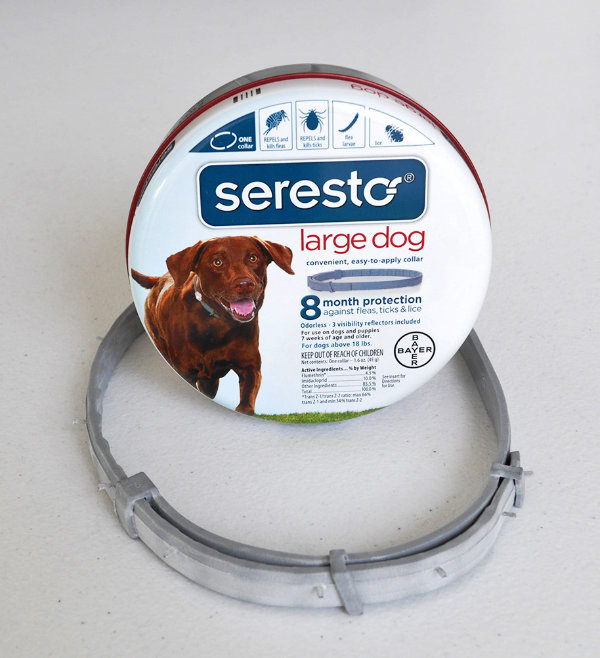
That last tip is why I’m not going to stop using Seresto and start using some new product. Neither of my dogs has had an adverse response of any kind to the collars. If either one had, I would avoid that product, but I’m not going to expose them to a new pesticide; I have evidence that Seresto is not causing them harm, but I’d be starting from scratch with a new pesticide.
It’s easy to forget what life was like before we had effective, relatively safe, long-lasting pesticides to kill fleas and ticks on our dogs. Many dogs suffered much more than their modern counterparts. Tick-borne diseases kill many dogs annually, and make many more suffer from chronic effects; without the measure of control offered by pesticides, these numbers would be much higher. Also, prior to the modern age of pesticides, it was very common to see dogs whose front teeth were worn to the gums from just chewing their own bodies in an effort to relieve the horrible itching caused by flea bites. While we would like people to use pesticides more sparingly and carefully, we wouldn’t like to go back to having none of these substances at our disposal.




my 80 lb retired racing greyhound started having seizures after 4 doses of Simparica
( sarolaner) chewables! These were prescribed
by a Vet who thought it the best way to give
flea/tick medicine because the dose was measured. Later I learned that abnormal neuro symptoms may be caused while
using this stuff —it’s on the box. Now I’m
scared to give him flea prevention chemicals
I too wondered if these collars that are killing dogs are fake Soresto. I read that the police confiscated a large truck full of collars not long ago in the U.S.
I bought a collar from a discount pet online store and my dog got strange lumps on her skin after putting it on. Now I buy mine directly from PetSmart. When I bought from the online store it was shipped from some Asian warehouse so I think that collar was fake. I have never had a problem with the Soresto collars before that one and my GSP continues to have good results with the one I got from Petsmart.
you know that because these collars are expensive, there are many sellers selling fakes for cheap, and the packaging is identical to BAYER packaging. thus those dogs dying might be reacting to the counterfeit collars with unknow ingredients. Bayer will check the upc number on your collar’s package and tell you vendors that they supply – sometimes cheaper is not cheaper, you get either dangerous item or useless item
SINCE 2012 i’ve been using seresto on my many adopted – foster – unadoptables! most are 9lbs to 12 lbs. NO NEGATIVE REACTION TO SERESTO COLLARS, HOWEVER I DO CHECK TO SEE IF THERE IS A RASH, I DO NOT LET DOGS EAT EACH OTHER’S COLLARS. SO CARE IS NECESSARY. ONLY 1 COLLAR/8 MONTH’S PER DOG/ THE CORRECT WEIGHT RANGE.
DOROTHY
For fleas I use a homemade Shampoo that works well on both dogs and cats. I mix and store it in milk jugs.
3oz glycerine (6 tablespoons)
3oz mild liquid detergent (6 tablespoons) I use Lemon Joy.
1.5oz white vinegar (3 tablespoons)
24.5oz water (3 cups + 1 tablespoon)
A few drops Pennyroyal or Eucalyptus to the mixture helps repel fleas. This recipe was published in a newspaper many years ago and it works well on my keeshonds. Collars , topicals don’t work with the heavy coat; they vomited oral chew doses back up.
Wash dogs, leave on soapy and as you rub them you will see dead fleas in the water.
Just to check in from Europe I’ve been using Seresto for five years (he’s five) on my 25 lb Havanese with no ill effects thus far. Now I’m a bit worried if I’m slowly poisoning him. I buy mine from either the vet or a reputable website catering to pets where I buy his food. I pay 36 euros about $40 US for the larger size now that he’s outgrown the under ’10 kilos’ band. Why is it so expensive in the US? Any chance of posting a link to the article about Seresto?
The diatomaceous earth you want to use is “Food Grade”, I purchase it in 50 lb bags. It is also useful for killing and the prevention of intestinal parasite. The amount depends on animal size. I find certain Cedar oils work well for short periods of time(sprayed on fir and rubbed in). I also use Cedar chip or shavings around the outside of my home and dog bedding. I find that with four shepherds and two cats, all indoor / outdoor (dog & cat doors) in GA, I am able to avoid all those toxins and fleas. I stopped using pesticides, after I all most lost one of my shepherds’ 10 years ago.
I agree with you. Very smart.. essential oils are a great deterrent. Cedarwood, citronella and oregano oils in a glycerin base. I use it on my dogs fur. I use the seresto collars and I do believe the counterfeit ones are the culprits of the sick dogs. There are ways to detect a counterfeit vs the real deal.
I will continue to use it as well. My dog had an allergic reaction to Nexgard and wound up in the ER. The Soesto works for my dog with no side effects. Thank you!
I had a collie for 3 months. Her owner did not want her anymore She always wore these restos collars. She had a carcinoma nose. She bled for several Through her nose and mouth. of her
I’ve never used the collar but have heard of the bad reactions.
I use topical on my dog. Advantage Multi. I used Revolution on my previous dog but it didn’t work fast enough to keep the fleas from biting him before they died so I switched. The last year of his life I used nothing as he was 14 and seemed to have developed sensitivity to a lot of things and I wanted to minimize the chemicals in his body.
When the orals came out (and he was younger) I tried them once and he vomited so I have avoided orals. I have an objection to feeding my dog a systemic poison. I think of all of the flea preventatives I just sense that is the worse. And I don’t want to shorten my dog’s life for my convenience.
Every dog is different just as every human is different. Diana has no adverse reaction to the Advantage Multi so I’ll use that. It’s the only topical I can use that also prevents heartworm and I won’t feed her the heartworm poison pills.
Back in the old days, we would use Sevin dust, or mix it in water and bathe them with it. We live in rural Mississippi, so we have severe flea and tick problems, as well as moderate mosquito problems. We live on a hill, so there is not much standing water for them to breed. Ticks are our main issue. We spray the yard a couple of times in warm weather to keep them under control. Deer, raccoons, and semi-feral cats make sure we have an adequate supply of the little pests! We have been using NexGard when it is needed, with no ill effects at this time.