


On March 2, USA Today published an article about the Seresto collar, originally developed and brought to the market by Bayer Animal Health in 2012. The article highlighted the fact that the United States Environmental Protection Agency (EPA) has received nearly 1,700 reports of animal deaths associated with use of the collar. Worried pet owners have been flooding their veterinarians’ offices with calls about whether to remove their pets’ Seresto collars.
Dog owners should be aware that every effective pesticide will cause adverse effects in some animals; that’s the nature of products that are meant to kill parasites. But there are a number of things you can do to reduce the potential for harm to your dog:
- Don’t use any flea- and/or tick-killing or –repelling pesticides unless your dog needs that protection. If you are lucky enough to have never observed fleas in your home or on your dog, you may have no need for flea-control products; don’t buy them unless you need them! In some parts of the country, fleas and/or ticks are a fairly constant threat to pets and pesticides are needed to control and manage infestations. (I put the collars on my dogs when I am planning to hike with them in areas where ticks are numerous, or when my dogs get exposed to a dog with fleas. The rest of the year, they go without!)
- Use an integrated pest management (IPM) plan to control persistent flea infestations, so you can use pesticides less frequently in the future. This link provides a good source of information on how to do that.
- If the pets in your home repeatedly get infested with fleas, try to identify the source of reinfestations. Indoor/outdoor cats are often the culprits, as they may rest in places frequented by flea-infested mice, rats, squirrels, or chipmunks, picking up fleas there and inadvertently bringing them back home to reproduce.
- If you have used a particular flea/tick-control product and your dog had an adverse reaction to that product, note the information in any place that will help remind you to avoid that product or its active ingredients in the future. My granddog Cole had an adverse reaction to Frontline once, vomiting once or twice on the day after the spot-on was applied and exhibiting diarrhea for a day or two after that. About a year later, my son, misremembering which product had caused the adverse response, inadvertently used Frontline on Cole again (after getting fleas from a visit to a friend’s infested home), with the same response. Aghast, he called me to confirm that Frontline was the culprit. Now we both remember, and avoid that product for Cole.
- It’s easy to respond if your dog, like Cole, has an acute adverse response to a particular pesticide. (In the case of an adverse response to a spot-on pesticide, you can give your dog a series of baths to help eliminate all of the pesticide that was not yet absorbed into his skin. If your dog has an adverse response after you have put a Seresto collar on him, remove the collar and bathe him well.) But if your dog has chronic health problems, you may need to more deliberately consider whether any of the topical or oral pesticides you have administered to him may be connected to his health problems. We wouldn’t recommend giving dogs with cancer or those who suffer from seizures any pesticides whatsoever. Instead, we’d use whatever IPM tactics were at our disposal to control fleas if necessary, and would avoid tick habitats at all costs.
- If you have used a particular pesticide product on your dog with great success (fleas disappeared, walks in areas known to be infested with ticks did not result in any or just a few tick-attachments) and without any adverse events, stick to that pesticide if you need one in the future. Don’t introduce an entirely new pesticide that may pose potential side effects for your dog without a solid reason to do so.
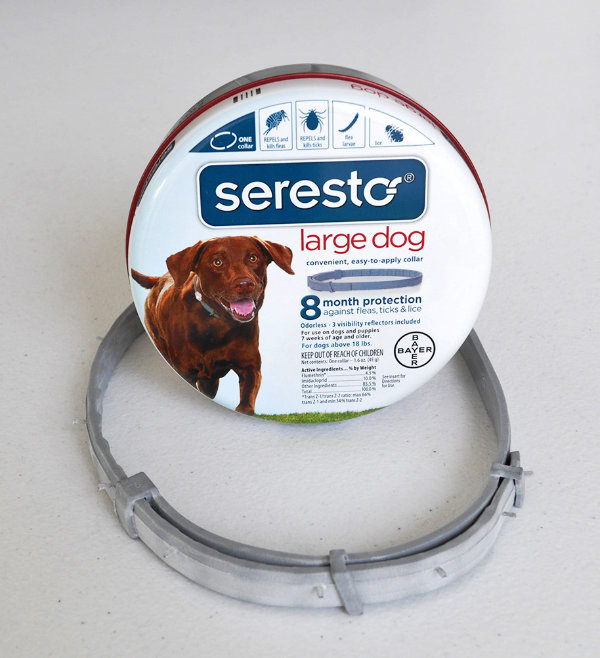
That last tip is why I’m not going to stop using Seresto and start using some new product. Neither of my dogs has had an adverse response of any kind to the collars. If either one had, I would avoid that product, but I’m not going to expose them to a new pesticide; I have evidence that Seresto is not causing them harm, but I’d be starting from scratch with a new pesticide.
It’s easy to forget what life was like before we had effective, relatively safe, long-lasting pesticides to kill fleas and ticks on our dogs. Many dogs suffered much more than their modern counterparts. Tick-borne diseases kill many dogs annually, and make many more suffer from chronic effects; without the measure of control offered by pesticides, these numbers would be much higher. Also, prior to the modern age of pesticides, it was very common to see dogs whose front teeth were worn to the gums from just chewing their own bodies in an effort to relieve the horrible itching caused by flea bites. While we would like people to use pesticides more sparingly and carefully, we wouldn’t like to go back to having none of these substances at our disposal.




Nice post and very well written. My vet recommended me Flea and Tick Collars or chewable treatment. So, I choose chewable treatment for my dog. I never use this collars because I always doubted that kind of treatment. But after reading this post, my thoughts are cleared. Thank for sharing an informative post. Great job!
Hi All,
I use alternative Flea and Tick control like Bravecto for Dogs. And It’s recommended by my vet. Before this, I tried Seresto Flea and Tick Collars for my cat. It’s work awesome and i liked it. But my dog snatch it and never worn that is why I use alternative. this is very essential for furry friends. Thank you for sharing such an informative article with us. Great!
This is good. Pest control is essential nowadays. Thank you for sharing this post, and looking forward to the latest one.
I have used soresto collar for years. I was duped a few years ago into buying the collar at a bargain price. When it didn’t work I realized it was fake. If you are not paying over $$40 dollars for the collar it is fake! It will not kill fleas!
I believe my dog got bladder cancer from the Seresto Flea and Tick Collar. Bladder cancer caused by pesticides and the collar is the only pesticide she has ever been exposed to.
Sometimes the damage or reaction is instant and sometimes the reaction can take a long time to build up. There are so many natural ways to ward off fleas and ticks here in the USA and i have never used any chemicals. Unfortunately my friends 2 dogs died from the collars and he started a fb page to make people aware of the danger. I would encourage anyone who has has issues or worse… a pets death to please look into joining the fb page, discussions and potential class action lawsuit against Bayer Elanco.
I use a natural liquid food additive called Flea Free from Natural Pet Products in Florida. It repels fleas, ticks, mosquitoes and mites. It is made in Florida, USA for the past 30 years with great success. Since Florida is a major bug state their whole line of products are well tested.
When Seresto came to market, I purchased and then read the possible side effects, i returned it immediately. We had one dog die from a “safe for pets and children” and another with with an aggressive cancer that took him from diagnosis to death in 8 days. I am all for as few manufactured chemicals as possible. Question: does Brewer’s Yeast prevent fleas or ticks? I like the idea of the human grade diatomaceous powder.
Brewers Yeast can help with the repelling of fleas and ticks and so can food grade diatomaceous earth. I would look into a a product called Flea Free from a company in Florida. There product has worked for me for years. I used to give brewers yeast, food grade DE, garlic and use essential oils. For the past years i have using these products… food additive, shampoo, yard spray and even a body spray too.