

Say you are in a grocery store with your best friend and her child, and you both see the child take something, perhaps a candy bar, and start eating it. You look at your friend to see if she’s going to say anything to her child, but she just shrugs. Then you notice that another shopper has also seen this, and that person glares at you, as if to say, “Well, aren’t you going to do something about this?” You smile and shrug helplessly, and the best you can say is, “It’s not my kid!”
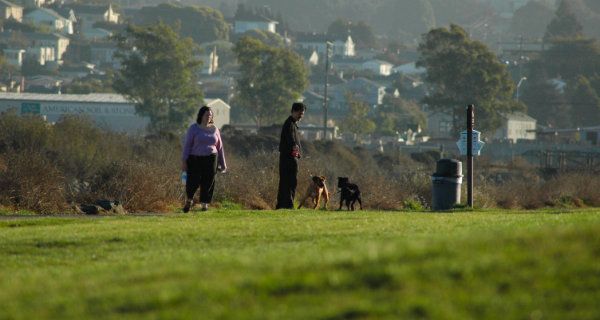
Well, that was me. But it was at a park where a bunch of dogs were playing off-leash, in spite of the signs ringing the park that indicated dogs were supposed to be on leash. I was walking with a friend and her dog toward the middle of the park, toward the swirl of off-leash dogs, and across a narrow zone of people walking their dogs ON-leash and across a busy bike path. Each time my friend’s dog ran right up to a leashed dog (and of course, the humans at the other end of the leash), I would look back at my friend, who always seemed to be doing something else – looking through her pockets, looking at her phone – I don’t know WHAT she was doing!
I whistled for my friend’s dog a couple of times, and he came back to me once. But when he ran up to an older person who was walking a little West Highland White Terrier and who looked up and glared at me as his walk was interrupted by the two dogs greeting, all I could come up with at the moment was “I’m sorry, it’s not my dog!” There was no growling or aggression, but I was so uncomfortable! This isn’t how I would manage my own dogs!
And by the time two people on a tandem bike had to come to a complete halt to make sure they weren’t going to hit my friend’s dog, who was trotting along on a diagonal on the bike path, and they couldn’t easily ascertain which way he was going to go, my nerves were fried.
I think we can all agree that allowing your dog to run up to other people, and especially people with leashed dogs, is incredibly rude and potentially dangerous. It can set back a training and counter-conditioning program of a dog whose own behavior with other dogs is reactive. I know that my friend’s dog has been attacked and bitten by an off-leash dog before. So why on earth would she let her off-leash dog run up to other leashed dogs?
After the moment with the Westie, I did say to my friend, “You know, it’s pretty rude to let your dog run up to people with a leashed dog. If their dog was totally comfortable with other dogs, they’d probably have it off-leash.” My friend’s response? “Oh, I know, but XXX (my dog) is totally good with other dogs.”
All I could say is, “Well, this is hard for me to be around…”
I’ve been thinking this ever since. I guess I’m one of those people who can never think of what to say at the time, who thinks of the perfect thing to say later. But I still haven’t thought of what I should have said and done. I know what I would have liked to say: “Hey! Put the dog on leash, or keep him with us until we are in the middle of the park with all the other off-leash dogs!” But she’s an adult and I’m not her boss.
But this morning I thought, perhaps someone else knows just what to say in this situation, or any situation where you are with a friend or relative and they do something you feel is very wrong. What’s the perfect approach to preserving your relationship, while expressing your discomfort with what your friend or relative is doing? Because simply deciding never to walk with them and their dog again feels bad, too – but that’s the best I have been able to come up with so far.
What would you do or say? What would be a tactful but educational approach to take? (Those might be two different answers!)




When your friend dismissed your concern by saying, “Oh, I know, but my dog is totally good with other dogs”, that was your opening to introduce the issue by asking her to think about an analogous situation involving humans instead of dogs. Ask her how she would feel if she were the mother of an autistic child, whom she had brought to the park to enjoy the outdoors, but who doesn’t handle impromptu social situations well. All of a sudden another overly friendly child (= her dog) whose parent (= your friend) is preoccupied with their phone or whatever, comes running up to her child, calling out loudly to ask if her child wants to play. Her child is distressed by the sudden interaction and invasion of space, has a meltdown, and they have to leave. The child who was not being supervised has ruined the outing for the child who is shy and withdrawn. Asking her to live for a moment in the other dog owner’s reality, and making the situation relatable on a human level, might help her see the problem with her attitude.
I like the idea of sending the link and also simply being respectful that your friend is dealing with a situation she’s not totally equipped to deal with. How do you want to help her? How would you help her through any other situation that you were uncomfortable with? Take that path.
I’m not being dismissive of accountability but we are not perfect dog owners as we are not perfect parents or friends. It’s a question of intent and the ability to be her friend to help her come around to see the issues.
My own 2 years in dog ownership as an adult has certainly been an evolution in in navigating adults, dogs and friendships. I had no idea people felt so strongly about so many issues related to dogs. As I have tried to raise a responsible 35 lb rescue from the age of 2 months (who has A LOT of energy not to mention a deformed paw), it’s a lot to learn and manage.
Feel her out and figure out what’s best for your comfort zone and hers. I continue to do the best I can and be aware of feelings, protocol and also simply the fact my dog is a dog and he’s not always going to be perfect. It’s an emotional whirl but coming from a place of compassion and understanding is always going to get you further. Good luck!
Does your friend read here, Nancy? You could always send her a link to it…
Well , unfortunatly people are people as this is the only polite way to put it. They see the world through their narrow prism, what works for them should work for you too.
I have Kangal dog here in istanbul, she is 82cm at the whithers and weighs about 56 kg. She walk on leash due to the fact of her size , weight and speed ,she can make quite mess if she hits a child, cyclist or runner.
I have haf chiwawas of leash trying to attack my gentle giant and their owners find it amusing, until i have to roar to them to control their dogs.
Being the person that brought positive training methods to these shores, i have tried everything under the sun and the only thing that these people understand is being obnoxious and this keeps them in check , and you can go about your walkies😁
I would warn her of the financial consequences should her dog cause an injury to someone by knocking them over. and Insurance companies would not cover her if the dog was unlawfully off leash. followed up by a fib that a friend was sued for thousands of dollars for injuries caused by her off leash dog. Also that her dog might be friendly but others are not, that is what I say with my GSD when out leash walking and someone lets their dog come up and says, “its ok he/she’s friendly” my response,”mine’s not and will attack”, that always does it.
Next time going to the park is mentioned I would say, “Do you want to walk (Fido) or should I?
I could never forgive myself if something bad happened to( Fido) off leash.”
I’m of a certain age where the communication ‘filter’ is thinner. My response would have been along the line of, “Would you mind leashing up your dog until we get to the off leash area?” If your friend says, “Sure, no problem.” Great. If she gets defensive, that’s important info.
Personally, IF i was walking WITH my friend, I would tell her that she should put the leash on the dog.
Guilt by association, I do not want or need.
If it was a friendly acquaintance I would probably say something too.
It it was a stranger, I would leave. I used, in the past, to speak out, but I simply don’t need the grief of abuse from strangers.
You could try being quite up front and say “I’ve been struggling to figure out how to bring something up with you, so I thought I’d give you this for your consideration [Give her the fantastic one-page graphic that Lili of Doggie Drawings created, entitled ‘Space Etiquette for Dogs’]. And you could say that you’d like to continue walking together but unless her dog is on lead it is honestly too hard for you to enjoy it.
You could potentially also say that you understand that owners of friendly dogs sometimes feel really proud of their dog’s friendliness and the opportunity for social interactions that may come from that but that owners of friendly dogs aren’t entitled to impose on the dogs who are not relaxed, friendly extroverts. In the same way that being a friendly human doesn’t entitle you to randomly join someone/everyone else’s picnic in the park, being a friendly dog doesn’t mean you are entitled to introduce/impose yourself on anyone and everyone either.
And a line along the lines of ‘Friendly dogs create aggressive dogs’, and the accompanying explanation of that might help as well.
All the best with it.
If someone says “oh don’t worry my dog’s friendly”. I smile and say “oh, mine’s not!” The expression on their face changes immediately as they watch their dog romp toward my leashed German Shepherd dog. ( which I control perfectly as long as other dogs don’t run up to us). I think they think I should not bring my dog to the park if she doesn’t love strange dogs running up to her ( and me!). But as long as my dog is on a leash I’m not breaking any rules. They ARE breaking a rule. The leash rule. I also had another mixed breed dog (very friendly) attacked by an off leash dog. $2000 and 2 years later she is still afraid of walking in that park.