

Say you are in a grocery store with your best friend and her child, and you both see the child take something, perhaps a candy bar, and start eating it. You look at your friend to see if she’s going to say anything to her child, but she just shrugs. Then you notice that another shopper has also seen this, and that person glares at you, as if to say, “Well, aren’t you going to do something about this?” You smile and shrug helplessly, and the best you can say is, “It’s not my kid!”
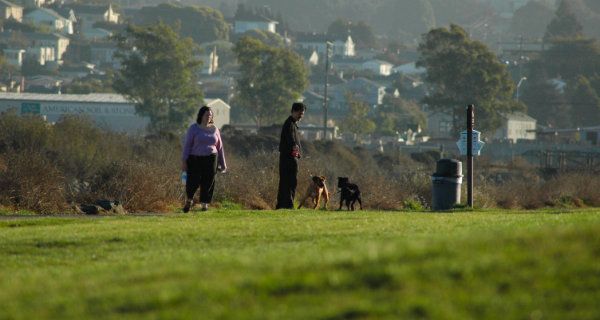
Well, that was me. But it was at a park where a bunch of dogs were playing off-leash, in spite of the signs ringing the park that indicated dogs were supposed to be on leash. I was walking with a friend and her dog toward the middle of the park, toward the swirl of off-leash dogs, and across a narrow zone of people walking their dogs ON-leash and across a busy bike path. Each time my friend’s dog ran right up to a leashed dog (and of course, the humans at the other end of the leash), I would look back at my friend, who always seemed to be doing something else – looking through her pockets, looking at her phone – I don’t know WHAT she was doing!
I whistled for my friend’s dog a couple of times, and he came back to me once. But when he ran up to an older person who was walking a little West Highland White Terrier and who looked up and glared at me as his walk was interrupted by the two dogs greeting, all I could come up with at the moment was “I’m sorry, it’s not my dog!” There was no growling or aggression, but I was so uncomfortable! This isn’t how I would manage my own dogs!
And by the time two people on a tandem bike had to come to a complete halt to make sure they weren’t going to hit my friend’s dog, who was trotting along on a diagonal on the bike path, and they couldn’t easily ascertain which way he was going to go, my nerves were fried.
I think we can all agree that allowing your dog to run up to other people, and especially people with leashed dogs, is incredibly rude and potentially dangerous. It can set back a training and counter-conditioning program of a dog whose own behavior with other dogs is reactive. I know that my friend’s dog has been attacked and bitten by an off-leash dog before. So why on earth would she let her off-leash dog run up to other leashed dogs?
After the moment with the Westie, I did say to my friend, “You know, it’s pretty rude to let your dog run up to people with a leashed dog. If their dog was totally comfortable with other dogs, they’d probably have it off-leash.” My friend’s response? “Oh, I know, but XXX (my dog) is totally good with other dogs.”
All I could say is, “Well, this is hard for me to be around…”
I’ve been thinking this ever since. I guess I’m one of those people who can never think of what to say at the time, who thinks of the perfect thing to say later. But I still haven’t thought of what I should have said and done. I know what I would have liked to say: “Hey! Put the dog on leash, or keep him with us until we are in the middle of the park with all the other off-leash dogs!” But she’s an adult and I’m not her boss.
But this morning I thought, perhaps someone else knows just what to say in this situation, or any situation where you are with a friend or relative and they do something you feel is very wrong. What’s the perfect approach to preserving your relationship, while expressing your discomfort with what your friend or relative is doing? Because simply deciding never to walk with them and their dog again feels bad, too – but that’s the best I have been able to come up with so far.
What would you do or say? What would be a tactful but educational approach to take? (Those might be two different answers!)




If you want to keep this person as your friend and still want to spend time with her, I would avoid going with her on walks with her dog and find other ways and situations where you and she can enjoy each others’ company.
This question is similar to the negotiation of stay/leave whenever a new dog/owner arrives at our local dog park, which is an open fenced field. Fortunately there are very few of us there at any one time, and conversation about our dogs’ compatibility with other dogs is hard to avoid. On/off-leash, like stay/leave, is something to settle pre-walk, not during. By then, too much can happen too quickly.
In step with the last few commenters, I always stop for a few seconds when I am very uncomfortable about something I think I must bring up and give myself time to frame it as a question. Usually (not always) that’s enough time for me to control my tone, too.
Your experience, as evidenced by all the other comments, is a common one. I am different than you, though. Recognizing that the only behavior you have control of is yours, you certainly can say and should say what needs to be said and, in the future, avoid being in a similar situation. The problem (in my opinion) with individuals, who don’t speak up, is they are complicit in any adverse outcome. Does it matter if the offending dog, that caused someone to fall off their bike and break a leg, is owned by your walking buddy? You could have done something. And chose not to. Silence is not golden, and it can have significant consequences. If your friend’s dog is unleashed and causes someone to get bit (breaking up a dog fight) or to fall off their bike, you could also be liable financially, and certainly morally/ethically, right along with the owner. When children are involved, there are even further consequences for not speaking up and doing what is right. (Some ways, I confess, of speaking up are less likely to invoke rage than other ways and one must be mindful of not becoming a victim of a gun-toting dog owner with a short fuse.) Well, good luck. My solution: I bought my dogs a tread mill and quit walking in the neighborhood park. It’s too crowded (not enough green spaces for people) . Plus, parents or dog owners can be psycho when it comes to what, in their opinion, is in the best interests of their kids or pets. Rules don’t apply.
Thank you so much Mary and Kalia for your comments. I have requested to my friend that she keeps her dog on-leash at the reservoir (because I know it’s the rules), and she refuses when we are in the woods. However, I know that Mountain Bikers often go through the area and could get hurt. Also, we were walking through a retirement area today and she took her little dog off-leash and he ran up to an older man who was clearly uncomfortable with the dog off-leash and said something. I told her that many people don’t like it but she just didn’t seem to care. It really bothered me that she just dismissed me and my feelings. I feel that she has done this with some other things too and I am just feeling that maybe the friendship isn’t the best for me at this time.
When one has friends that see the world radically different than we do, and we know this in advance, then our plans with them can compensate for their point of view. So it’s like a compromise without their awareness. Knowing her likely behavior, the next time she suggests a dog outing, suggest one of the places where you are likely to encounter no dogs, but they’re permitted off leash. For me this is generally BLM or National Forest lands where hunting is permitted, because many hunters use dogs, so they are permitted loose, as long as they are under basic control. When I hike with my dogs off leash, I carry treats in a pouch and recall them often. They are generally within sight and have excellent recalls, thanks to all of our off leash hikes with treats. This may seem like a wimpy solution, but it’s really a win-win for all.
First of all, say the truth with love…THEN I would very nicely, in an UN-condescending way, state that she may believe her dog behaves, but no one knows how another dog will behave when her dog runs up to it…this is the dangerous part.
You do not know what the OTHER dog’s experiences have been; he could attack this dog to defend himself. It is not fair, also, to have your dog running on the sidewalk from side to side when others are trying to anticipate where your dog’s going to go; it is dangerous for those on bikes, for elderly, etc.
My dogs know the command, “Stop and wait” and they must stand to the side I am on and WAIT for bikes/people to pass. If another dog is coming, we step off the sidewalk, turn our backs to the sidewalk, and wait…just in case.
I’ve said: “I know Fido loves other dogs … but looks like he’s overwhelming that one … you might want to leash up!” Any protests from Fido’s owner? Follow up with “Yeah, but that little dog has her tail between her legs and the owner looks really worried!”
One idea: Change YOUR walking path so as to avoid the other people and dogs. You don’t have to make it explicit it’s about the dog at all, just say, “I’d rather go this way.” Another aspect here that you skip over in your story is that you watched your friend unleash her dog in spite of the park rules. That was an opportunity to say something.
Personally, I think it’s a bad friend who lets you fuck up without telling you about it. Especially as a dog professional, you can use your reputation and best practices as an excuse. “I can’t have someone recognize me in the worst case scenario. You’ve been on the other side of that worst case yourself.” But the better way to confront is after you’re away from the scene, and at a time when your friend will pay attention to the conversation. “In my line of work, it’s almost a cliche that every offleash dog that attacks another dog has an owner saying, ‘but they’re good with other dogs!’ And they may be good with 99% of other dogs, but every dog dislikes some other dogs, and the owner wasn’t paying attention to their dog when the worst happened.” You can talk about best practices, too, for offleash time, including paying attention, having a good recall. The best advice I have for having a difficult conversation is to “sandwich.” Compliment your friend’s dog training, give her some hard truth, then say something else positive.
I would say: “Let’s put him on a leash…” and then either add “… because of the bicycles” or “because of that out-of-control dog over there” or “because it’s an leash-on area” and then reach to the dog and put the leash on.
I feel like the “Lets put him on a leash” instead of “Put him on a leash, please” would make it sound less bossy to the friend.
I like the approach of discussing this issue away from the situation. I have an 85 pound dog who is not normally dog aggressive, but I’ve had to do some gymnastics at times when he’s approached by an off-leash dog who may, or may not, be friendly. It’s all about one being on leash, and one not. Too many people in my small city get defensive when I ask them to keep their dog away. I don’t know what my dog may do, and, at 85 pounds, I don’t want to find out.
I would say before going that you are “uncomfortable with having dogs unleashed in a leash area. Can we agree to stay leashed until we reach the unleashed area?”