


I have the privilege (and responsibility) of dog-sitting two of the pups from my most recent foster litter – for a whole week! – while their family is on vacation.
How many of you caught the “two pups, one family” thing? If you noticed it (and winced), you’re probably a dog trainer.
Originally, the family was interested in adopting two pups, and I talked them out of this (they are my former in-laws, so we have more of a rapport than in most cases!). Most training professionals try to dissuade people from adopting sibling pups – and insist on a singleton adoption in cases like this, when the family lacks a lot of dog experience. There are numerous reasons for this, but to name a few:
• Sibling pups often bond more firmly and pay more attention to each other than to the human family members.
• House-training (and every other kind of training) often requires twice (or more) of the time that it takes to train one pup.
• Many families lack the time and resources to separate the pups frequently enough that they learn to be confident and social when they are not in the company of their sibling.
There are more reasons to not adopt siblings (and some workarounds, too) in this article by WDJ Training Editor Pat Miller, and I listed all of them to this family. They listened, heard me, and ended up adopting one of the two females in the litter that strongly resembled a purebred Rhodesian Ridgeback. They named her Xena.
But a couple weeks later, the husband’s mom, who lives in the same town as Xena’s family, met Xena and fell in love with her, and then contacted me to inquire about adopting one of the two remaining pups. I ended up driving to the town where both families live, to give the mom a “meet and greet” with the two last puppies, so she and her husband could choose which one suited them best. They ended up falling for the boy pup, and I left him with her and her husband.
I then visited the family who adopted Xena – who was overjoyed to have a chance to play with her last unadopted sibling, whom she hadn’t seen for a couple of weeks.
Over the course of the afternoon that I visited with my former in-laws, they fell in love with the last unadopted puppy, and made a strong and renewed case to be allowed to adopt her, too. I could have just said no – even though the shelter that I was fostering the pups for would have said yes; they don’t have a policy against multiple-pup adoptions. We discussed the pros and cons again, and I reminded them once again about the many accommodations they would need to make to ensure that both pups would end up as well-trained, socially secure pups who could be separated without trauma. They were willing to do the work, they said.
Two things clinched my decision to permit the adoption to go forward:
1. They were doing a great job already with Xena. After just two weeks in their home, she was clearly bonded to the whole family, responding appropriately to her name, nailing a “default sit” whenever anyone made eye contact with her, and still at a healthy weight. I saw lots of dog toys laying around, and a crate in the parents’ bedroom. (I like to see this; it’s the only way to hear the pup who might be fussing in the night because she needs to go potty. People who put their puppy’s crate in some distant room or worse, the garage, end up with dogs who hate their crates and/or learn to just go potty in the crates, since no one could hear or would respond to their cries of distress.)
2. They are in the process of building a new house on a rural property. Frequently, the dad stays in the not-quite-finished house and the mom stays at their old house in a nearby town. This gives them an easy way to easily and frequently separate the pups for a night or day during this critical socialization period.

But, some weeks later, ironically, I feel like I’m the one who has been most inconvenienced by this sibling adoption. While I’m truly happy to be able to spend a week with the pups (I hardly ever get to get my hands on foster puppies of this age; once they get adopted at about 10-week-old mark, I rarely see them again!), now I have to take my own advice and separate them for training and socializing! Especially since, just as I worried, the family is finding it difficult to find the time to take them on separate outings and hold separate training sessions – so I feel I have to do it! And BOY does it take a lot of time!
One thing I should be doing but just don’t have the time to do is to take them on separate walks. I’m already taking my own two dogs on separate walks on certain days! These days, with 14-year-old Otto losing the physical ability to take long walks, I often take just 6-year-old Woody for a drive to our favorite off-leash trails, and then come home and take Otto for his own walk in our rural neighborhood. At this point, he’s content to walk on leash and leave his mark on trees and shrubs along the roadside; we go about a half-mile up the road and then mosey back to our house. In order to get any work done with the puppies here for the week, I need to exercise them to the extent of their energy and fitness level, so I have been taking them out to the off-leash trails with Woody. This is terrific for tiring them out, but it would be better for their social development if they were taking individual outings, not just relying on each other for confidence in new situations.
Did you or someone you know adopt sibling pups? How did it work out? What were the most challenging aspects of the adoption?




As someone who makes adoption decisions for a shelter our rule is not to adopt siblings together. A trainer taught me this many years ago and this rule became stricter several years ago when we did cave to the adopter and explained everything and they called when the pups were age 2 and they were fine with other dogs they met, but were fighting to kill each other. To make the matter worse the adopter remembered our warnings and were absolutely furious with us that we allowed the adoption to happen….alrighty then. Since, we’ve rarely done this and when we do we take into consideration the breed mix (if there is likely dominance/aggression when adult), a strong indication that they likely had different fathers, and the knowledge and experience of the adopters. These adoptions went well and all are happy.
My husband and I have a different situation but are struggling with similar issues. We purchased a pure bred standard poodle in February of 2017. A female. I devoted myself to bonding and training with her for 6 months before returning to work part time. She learned quickly and is great pet. two years later the breeder we purchased her from had another female she offered to us and we accepted. It took a few weeks but the dogs bonded. The problem? The younger dog,now almost 2 is so dependent on the older dog and vice versa. Training the younger dog is very time consuming and I haven’t been successful beyond the very basic commands. And, they can’t be out of each other’s sight. Any suggestions?
Our female boxer had a litter of 10 and we kept 2; largest male fawn and smallest (runt) female brindle. No issues whatsoever in training (they learned and responded in synchronicity, or “off of each other”). But then again, they were boxers! When the male passed around age 7, the female seemed lonely but took to a foster 2 years later. These two respond independently of each other.
My husband and I are experienced dog owners. After losing two dogs in less than 2 months we decided to adopt a brother and sister Rottweiler We did not hear of the caution of adopting siblings until after we did it.
Everything you said is true. Three times harder and longer to teach them anything. They also got into more mischief then other dogs we had. They seemed to egg each other on.
With all that said over time they have become very good dogs and have brought my husband and I a lot of joy and laughter. However, I am not looking forward to their passing as I know the one who’s left will be devastated.
I’ve have two sets of mini schnauzer female littermates. Both times going for one and couldn’t bare to separate the sisters. It has been the best experience of my life. I love them all so much and I live for my dogs. I currently have a total of 5. All girls. Everyone gets along great, and they are all bonded with me and the family. I would definitely do it again.
We adopted two shepherd/pitbull mix puppies at 4 months from a shelter and were not warned of the difficulties. They are VERY bonded to each other, which has strangely seemed to lead to jealousy now that they are adults. We now try to have them separated as much as possible for our family as ones anxiety will be let out on in the other in aggression. From my experience, I would never suggest someone adopt or purchase from the same litter. I’m so glad it has worked out for this family.
Just as stated, training is hard. They get into mischief together, that they don’t while separated. We love our boys though!! But would do it differently had we known.
We adopted 2 male, 5-mo English Shepherd puppies that were running pretty wild on a dairy farm. The runt of the litter was very friendly and the other one was stand offish at first. We couldn’t decide which one to take, so we took both. We brought them into our family that had cats and an older, female [12yrs] Border Collie. We took them to training right away and they did well. Our female did very well with them and trained them, too. She died a year later.
I took the one dog [Cash] horseback riding with me and he did very well. However, the 2 pups would play very rough some times. Cash had separation anxiety, so we did lose a lot of pillows and remotes. The first 2 years were rough, I will admit. Sadly, Cash died suddenly of a heart attack at age 9 yrs. We still have his brother, who is now 11 yrs and we did add another English Shepherd puppy about a year ago. We did not know about there was a “thing” about siblings until long after we had them. I would probably think twice about it, especially with females. However, we have always had 2-4 dogs at a time, so they did have their “pack”. I will say all of our dogs bonded with my husband and I and we never had an issues with bonding.
Yes, I adopted brother and sister pups. No matter how I tried over the (so far) 6 years I’ve had them it became very difficult to keep them from becoming overly bonded. The problem I initially ran into is that in my county parvo is so prevalent that it was suggested we not allow them out with other dogs the first 4 months of puppyhood or until they were fully vaccinated against it, so they were stunted in socializing. (I imagine Covid created a similar problem recently for new pups) I took them independently on walks, keeping one crated or kenneled at home. The female is very independent but the male is completely dependent on the female being nearby. If I need to leave him home and take her anywhere, the veterinarian or walks etc., he freaks out howling and crying until she returns. He looks to her for direction over my commands, and is overly protective of her with strangers away from home. I have taken them to a trainer to work with me on ways to help them out including leaving one of them with her to work with while I take the other. They are wonderful, smart, sweet doggies and are the loves of my life. But if I had it to do over again, I would have only taken one pup home in the beginning. It would have been easier on both of them.
My husband found 2 german shepherd, who we assume to be brother and sister. They are bonded and love each other, they do however also play with the other dogs in the house. We have had to separate them for outside potty and play breaks because when they are together they jump/climb our fence and run away…
We are done with the worry and the scariness of that, so they get training time separate, but still go on walks together.
I find it fun and endearing to see them play and interact.
Training didn’t/doesn’t seem any more difficult than the rest of my motley crew….
But they were already 1.5 years old when we found them
We adopted 2 sheltie pups at 8 months of age through the south land sheltie rescue organization. The pups had been living in isolation in a shed for an unknown portion of their first 6 months before being turned over to rescue. We were delighted to have 2 dogs who played well together and were well bonded. When we got these two very fearful totally untrained boys we engaged an animal trainer for help. Separating the dogs for training was very difficult and training progressed slowly. Both dogs are now well bonded to only 1 human in the family and is somewhat aggressive to the other person. Both dogs are still very fearful of others. They still play well together mostly but that can change when food is present. So, some of the issues are breed specific (Shelties can be fearful, talkative, and shy). We’ve had Shelties before but never litter mates. We would never adopt litter mates again
I adopted two German Shepherd puppies from the same litter. They were wonderful. The down side to doing this is that the end of their lives comes at about the same time. These dogs lived to 13 1/2 and 13 3/4 respective. But to lose two beloved dogs so close together was horrible.
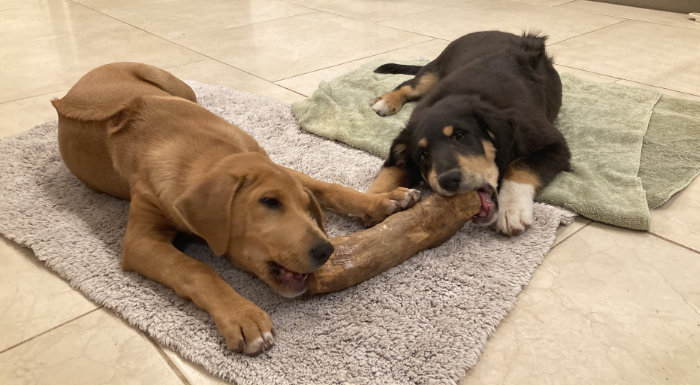
Years ago, we adopted sibling 5 month old pups, and brought the two of them into what was already a multi-dog household. We have a large, wooded yard, where they all played, and we didn’t walk them on our narrow, winding street with no sidewalks and lots of traffic. I loved watching the two of them each hold the end of a bone, just like in the picture in this article. One became a therapy dog. One didn’t. I did some training with all of the dogs, but didn’t go overboard. I would do it all again, although I do wonder if the reason it worked out so well is that they were part of a group of dogs that had lots of stimulation without going on walks.