

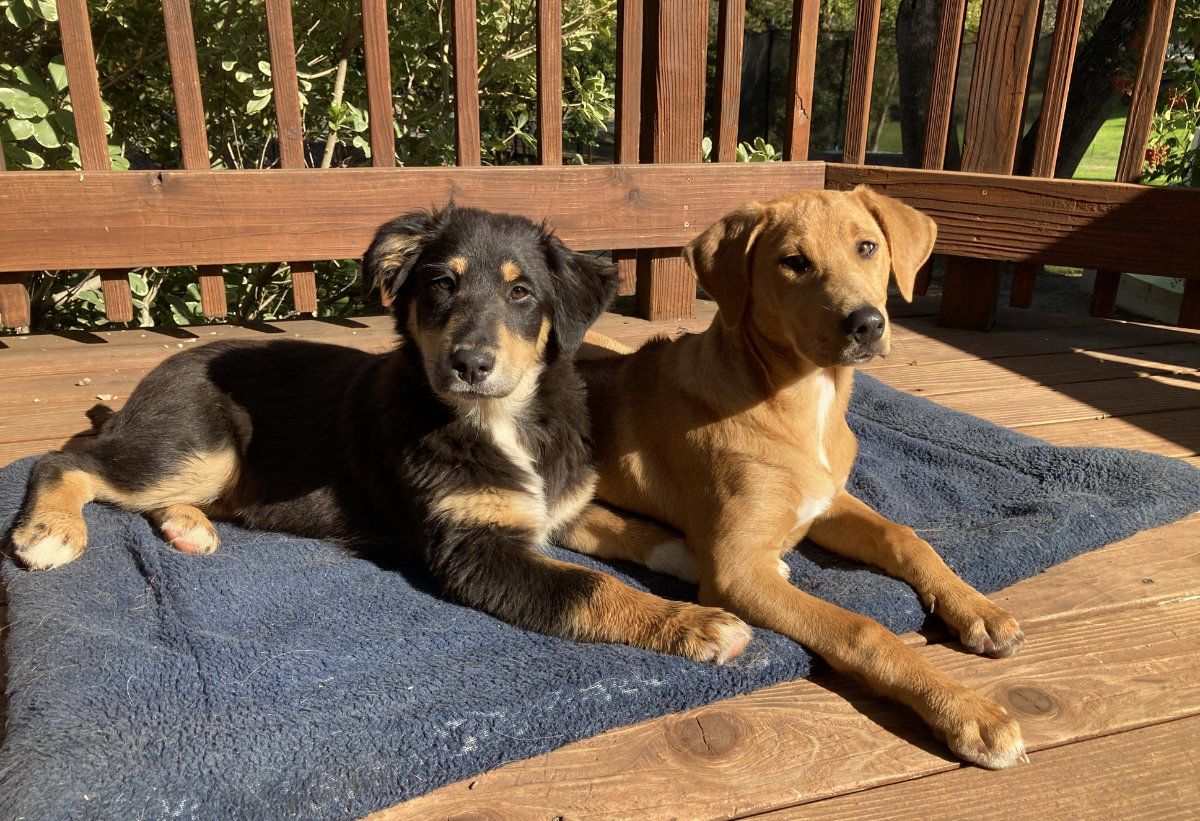
I have the privilege (and responsibility) of dog-sitting two of the pups from my most recent foster litter – for a whole week! – while their family is on vacation.
How many of you caught the “two pups, one family” thing? If you noticed it (and winced), you’re probably a dog trainer.
Originally, the family was interested in adopting two pups, and I talked them out of this (they are my former in-laws, so we have more of a rapport than in most cases!). Most training professionals try to dissuade people from adopting sibling pups – and insist on a singleton adoption in cases like this, when the family lacks a lot of dog experience. There are numerous reasons for this, but to name a few:
• Sibling pups often bond more firmly and pay more attention to each other than to the human family members.
• House-training (and every other kind of training) often requires twice (or more) of the time that it takes to train one pup.
• Many families lack the time and resources to separate the pups frequently enough that they learn to be confident and social when they are not in the company of their sibling.
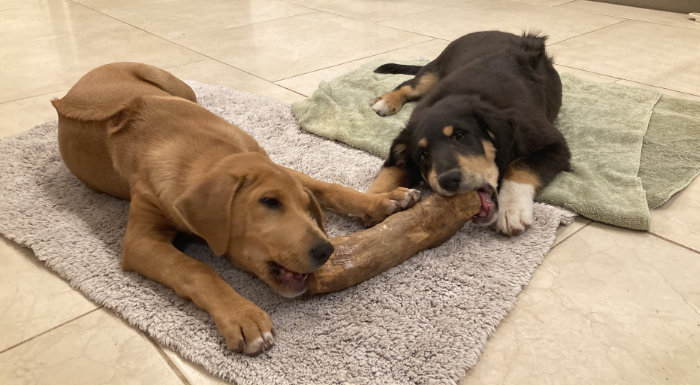
There are more reasons to not adopt siblings (and some workarounds, too) in this article by WDJ Training Editor Pat Miller, and I listed all of them to this family. They listened, heard me, and ended up adopting one of the two females in the litter that strongly resembled a purebred Rhodesian Ridgeback. They named her Xena.
But a couple weeks later, the husband’s mom, who lives in the same town as Xena’s family, met Xena and fell in love with her, and then contacted me to inquire about adopting one of the two remaining pups. I ended up driving to the town where both families live, to give the mom a “meet and greet” with the two last puppies, so she and her husband could choose which one suited them best. They ended up falling for the boy pup, and I left him with her and her husband.
I then visited the family who adopted Xena – who was overjoyed to have a chance to play with her last unadopted sibling, whom she hadn’t seen for a couple of weeks.
Over the course of the afternoon that I visited with my former in-laws, they fell in love with the last unadopted puppy, and made a strong and renewed case to be allowed to adopt her, too. I could have just said no – even though the shelter that I was fostering the pups for would have said yes; they don’t have a policy against multiple-pup adoptions. We discussed the pros and cons again, and I reminded them once again about the many accommodations they would need to make to ensure that both pups would end up as well-trained, socially secure pups who could be separated without trauma. They were willing to do the work, they said.
Two things clinched my decision to permit the adoption to go forward:
1. They were doing a great job already with Xena. After just two weeks in their home, she was clearly bonded to the whole family, responding appropriately to her name, nailing a “default sit” whenever anyone made eye contact with her, and still at a healthy weight. I saw lots of dog toys laying around, and a crate in the parents’ bedroom. (I like to see this; it’s the only way to hear the pup who might be fussing in the night because she needs to go potty. People who put their puppy’s crate in some distant room or worse, the garage, end up with dogs who hate their crates and/or learn to just go potty in the crates, since no one could hear or would respond to their cries of distress.)
2. They are in the process of building a new house on a rural property. Frequently, the dad stays in the not-quite-finished house and the mom stays at their old house in a nearby town. This gives them an easy way to easily and frequently separate the pups for a night or day during this critical socialization period.

But, some weeks later, ironically, I feel like I’m the one who has been most inconvenienced by this sibling adoption. While I’m truly happy to be able to spend a week with the pups (I hardly ever get to get my hands on foster puppies of this age; once they get adopted at about 10-week-old mark, I rarely see them again!), now I have to take my own advice and separate them for training and socializing! Especially since, just as I worried, the family is finding it difficult to find the time to take them on separate outings and hold separate training sessions – so I feel I have to do it! And BOY does it take a lot of time!
One thing I should be doing but just don’t have the time to do is to take them on separate walks. I’m already taking my own two dogs on separate walks on certain days! These days, with 14-year-old Otto losing the physical ability to take long walks, I often take just 6-year-old Woody for a drive to our favorite off-leash trails, and then come home and take Otto for his own walk in our rural neighborhood. At this point, he’s content to walk on leash and leave his mark on trees and shrubs along the roadside; we go about a half-mile up the road and then mosey back to our house. In order to get any work done with the puppies here for the week, I need to exercise them to the extent of their energy and fitness level, so I have been taking them out to the off-leash trails with Woody. This is terrific for tiring them out, but it would be better for their social development if they were taking individual outings, not just relying on each other for confidence in new situations.
Did you or someone you know adopt sibling pups? How did it work out? What were the most challenging aspects of the adoption?




rehoming 2 female dogs they are husky lab and Walker mix they 1year old and need a great home and yard to run they are both great dogs and half to stay together
I adopted two brother Coton de Tulear puppies, feeling that they WOULD bond, and they did. Twelve years later they are best buddies. With totally different personalities, they are a joy to watch. One is clearly the alpha dog, and any time help is needed with the smaller one, the larger one comes to let me know the smaller one needs help, as he frequently gets tangled up in his harness or is afraid to jump off a bench or something. Thank goodness I got both…they love to do everything together. I walk them three times a day, and they look joined at the hip!
Contrary to all suggestions here, I highly suggest you get siblings. When I’m out of the house, they aren’t destructive. They sleep together, and are a complete delight. I’m glad they have each other!
I am working on my third set of siblings now. Just adopted two male border collie puppies. They are 9 months old. I’ve never adopted just a single puppy and raised and trained it. So I don’t know how easy it might be to train a solitary dog. I’ve always gotten dogs in pairs. I’ve been warned by everyone — shelters, trainers, dog experts — that it’s a bad idea to adopt siblings. No one explained the issues, they just told me not to do it. I was glad to read this article to learn of others’ experiences. I have to say, however, I have not experienced most of the issues. I have not found that the siblings are more bonded to each other than to me or my family. And I haven’t seen the fearfulness or other behaviors described by others. Yes, I’ve engaged trainers to help me with the siblings, so I haven’t done all the training by myself. And maybe I’ve just been lucky. Training dogs in pairs is probably not the best approach, but training two siblings together can be done. Yes, I see sometimes that one sibling will lead the other dog astray in training, and just in general. They do learn from each other. But I have adopted non-sibling shelter dogs, and these dogs do the same thing. I think the extra work of siblings is worth it. Seeing the bond between the siblings, watching them grow together, play together, sleep together, almost as if they were one dog in two bodies is the most amazing thing to experience. They seem so happy and well adjusted, unlike some of the shelter dogs I’ve adopted or the solitary dogs I’ve seen with my friends. The joy of the two dogs just running in a field of tall grass is a wonder to behold. It makes my day every time. Yes, the dogs often play very rough, and occasional fights break out, but I’ve never seen any blood or real bites. They are pals, like nothing you can imagine. 10 minutes after a fierce battle over some toy, they are curled up next to each other on their dog beds. They are just like my kids (human) used to be. I spend a great deal of time with the dogs, so perhaps that is explains the difference I’ve experienced with dog siblings compared to others. But I love the sibling way of life. After several non-sibling shelter dogs, I’ve now gone back to siblings, because it’s just a better dog experience for me.
So, this is all so interesting to me. I adopted two Chinese Crested males from our shelter 12 years ago. The shelter told me I had to adopt them together because they were bonded and littermates. I did not know about the issues with having siblings. These are dogs six and seven for me and prior to them I had two unrelated males (a springer spaniel and a mixed bred hound shepherd) that would have blood fights and we had to live with baby gates for six years to keep those males separated. It was a total nightmare and at the time I did not know how to handle it. I developed PTSD from it and to this day I cannot watch two unrelated dogs greet each other without wincing. Seeing my two littermates get along for me was such a freedom and so relaxing. They are both bonded to me and I have been able to train them well. I have noticed that while the shelter told me they were bonded, I have since realized that one would have been so fine to be adopted without the other. My independent boy would have made a great therapy dog. Could this be a breed thing? I had a unrelated male hound and a female beagle where the male hound bullied the female beagle and when the male hound passed the beagle’s personality changed for the better. Maybe this is all based on personality and genetics and not on just being littermates? Based on my experience I have had a successful run with siblings. I have noted the challenge with the siblings crossing the rainbow bridge together or near to together. That will be a challenge for me.
I had 2 Japanese Chins when I wanted one more as my male was aging. The breeder I contacted had a male but also his sister.
She did not sell having an all black head, missing the signature white blaze. I thought 2 new pups too much work but my husband insisted on the pair. They were scared at first but watched the older dogs and caught on quick. They are total opposites in size, temperment and likes – except for dog treats. Now, 9 years later my husband and two older dogs have passed and I know these two will also. I could not imagine my life without Stella, first to greet me, ever watchful and with the biggest heart and to think I almost missrd out on knowing her.
Four years ago we were looking to adopt and we spotted a happy yellow hound mix online. I reached out and learned she was at a shelter out of state. She was rescued three months earlier as part of a litter of four that had spent their first 9 months in a 10 x 10 chain link kennel with no shelter. After about a week of coordinating online, we were told she’d been lodging with one of her brothers and since separating them, both had stopped eating. The shelter concluded they were a bonded pair and said they’d have to be adopted out together. After a couple days of thought, we agreed to take both.
I took them, separately, to group training and they each did well. A little difficult to practice separately at home but we managed. We were going to walk them separately but my husband hurt his knee 2 weeks after we brought them home. We were naive but we did our best.
The first year was rough, mostly because they were two young, energetic dogs who didn’t know “house rules.” But they are both very sweet and eager to please. The brother is more hesitant with strangers and looks to his sister for reassurance. The sister paces when her brother goes to the vet without her, and there’s a grand reunion when he comes home, but they don’t seem to be too distressed by separation. The brother is more of an outside dog and sometimes he sums himself while his sister stays inside. They choose to sleep in separate rooms most nights.
We have two great dogs and I can’t imagine not having both of them. That being said, I feel like doing this again would be tempting fate.