

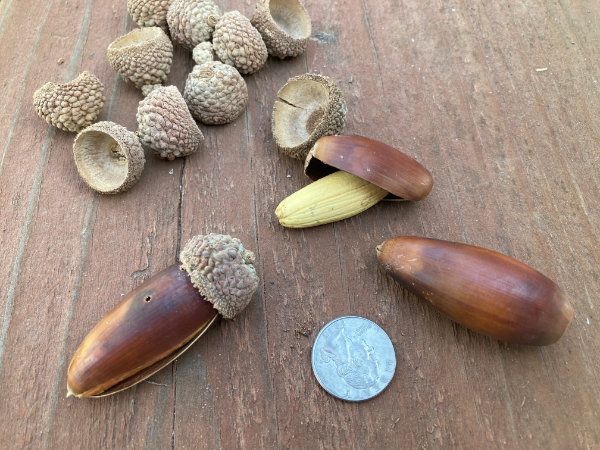
Not that anyone asked, but my favorite tree in the whole world is the oak tree. We have dozens of species of oaks in California, and where I grew up, in the great Sacramento Valley, the Valley Oak (Quercus lobata) is the most ubiquitous and also the largest oak tree around. They live to be hundreds of years old and grow into massive, photogenic shapes. When my husband and I bought the property where we have lived for the past (almost) three years, one of the key selling points was the magnificent hundred-year-old Valley Oak that stands in front of the house, and several other smaller Valley Oaks sprinkled around the property, along with some lesser oak varieties, the Blue Oak and the Live Oak.
Here’s the down side of living with oak trees, one that I never fully appreciated until now: acorns. So. Many. Acorns. And while all the oak trees are producing them, the Valley Oak makes some of the largest ones; they exceed the size of a standard tube of lip balm. Their distinctive “caps”, too, are a hazard. When they separate from the acorn, they become a separate large, hard, marble-shaped hazard.
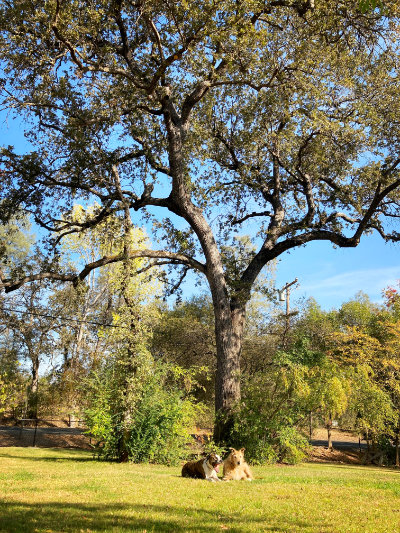
Acorns underfoot on the lawn. (“Ow! OW!”)
Acorns getting mowed by the mower (turning the mower into a dangerous, projectile-throwing machine).
And worst of all: Dogs chewing on and (sometimes) eating the acorns.
California kids grow up with the information that the native indigenous people in California harvested the acorns and made them a staple of their diet – and every California kid who lives near an oak tree tries to reenact this. You gather acorns, peel off the skin to expose what appears to be a big, delicious nut, and find some rocks capable of grinding the nuts into a coarse flour. The goal is to then add some water and use your hands to mix the flour and water into a dough and try to make a tortilla. At some point in the process, you dip your finger into the flour and lick it, or take a little bite of the dough, and – ACK! Blech! It’s bitter!
When California kids get a little older, they learn that acorns are full of bitter tannins, and that the native people used to leach the flour with water, sometimes many times, to remove the bitter substance and make the acorns safe to eat.
And, as vet-bill-paying adults, we learn that in addition to being bitter-tasting, these tannins can be toxic to humans, horses, and dogs. Shoot!
Tannins in acorns can be toxic to dogs
I know several people whose dogs get sort of addicted to chewing the bitter-tasting nuts and end up with an extremely upset stomach – and in severe cases, kidney failure and death. A dog who becomes inappetent after eating acorns requires immediate veterinary care. My sister had a little dog who, at least once a year, would require a vet visit after sneaking a few acorns. She liked them after it had rained a time or two in the fall, when the nuts have gotten soaked with rainwater and fermented slightly – which seemed to increase their toxicity.
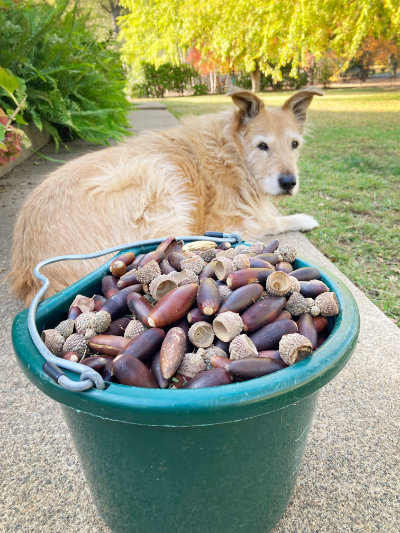
Despite the wealth of nuts littering my property in the fall, neither of my dogs has been interested in picking them up or chewing them, even speculatively, and up until now, neither have any of my foster dogs. That is, until my most recent foster dog arrived. I have to keep a very close eye on Coco, who has become inexplicably drawn to chewing on the acorns, to the extent that I basically can’t have her out of my sight on my fenced, two-acre property. Wah!
Like my sister’s dog from years ago, Coco is (thankfully) uninterested in the dry ones that cover most of my property, and is mostly drawn to the ones that have been soaked by the sprinklers on my front lawn. While this is quite a lot, given the GINORMOUS Valley Oak, the pride of our property, at least it’s just those. So it’s my new evening hobby: hanging out on the front lawn in the evenings with my dogs, throwing the ball for Woody, watching Woody and Coco wrestle, watching Otto watch for feral cats and squirrels … and picking up acorns from the lawn, and dumping them in our “green waste” barrel. I probably have a few more weeks to enjoy this new hobby before the tree’s supply is done and I can relax again.
Have you ever had trouble with an acorn-eating dog? Spread the word about this danger.




I had a Maltese who I think must have survived on them for awhile. She continued to live them after coming to us. It was a problem. Once she got a bit stuck in her eye and had surgery to get it out. She also lived to eat sticks. I just feel like she found food where she could while she was on the run before we got her.
I have not had a dog that chews acorns. But sometimes the caps get stuck on their toes and they need help getting them off their toes.
Are the caps on acorns poisonous to dogs? My morkie chews the caps only.
My beloved rescued beagle Libby was euthanized last month with blood filled lesions on her adrenals, kidneys, liver, and spleen. I was unaware of the dangers with her obsession with acorns. Our yard was full of them for the first time in a couple years (they do not fall every year). None of my other dogs paid any attention to them in previous years other than the annoyance if one got stuck in their paw. She, however, enjoyed them to her death, and I am so very sorry for not researching if they posed a risk. Needless to say I have cleaned and quarantined the yard until I can have the trees removed. Our newest rescue “cheagle” Ellie Mae has shown interest in chewing on them…UGH!
Wow a lot of information thanks.
Different oaks have DIFFERENT AMOUNTS OF TOXIC TANNINS. This probably explains why some dogs noted above didn’t get sick from eating acorns. There are SOOO many different oak species; it can be challenging to ID which one you have growing in your yard. And if you know what oak you have, it may. be very difficult to find out how toxic the acorns are. AND if your dog likes to eat the caps, like my busy chewer, there’s a risk of bowl impaction!
I learned all this while trying to figure out if I had to stop my girl from eating acorns. I ended up teaching her to find them, which she was doing anyway, and bring them to me trade for a TEALLY GOOD treat. I had a little tree so I was able to supervise find/trade sessions for 5 days or so and we had found almost all of them. Then I just kept my eye on her to intervene when she was able to sniff out the odd left-behind nut. Next crop I will try to pluck off the tree before they fall off.
Oh my gosh! Thanks to everyone who suggested the Nut Wizard! (I think I bought an off-brand one.) It actually works better on the round acorn *caps* than the long, cylindrical acorns I have on my property; it only scoops up the long acorns if I roll across them lengthwise. But it’s better than crawling around on my hands and knees! video of the thing in action (and a cameo by Woody): https://www.instagram.com/p/CHTUCJ-BBz8/
Several years ago one of my Bernese Mtn Dogs got massive bloody diarrhea from ingesting rotting acorns. She was treated at the emergency hospital and recovered quickly, but the lesson was learned. The acorns seem to be most enticing, and most toxic, when they start to rot. Whenever one of my grooming clients reports a dog with acute diarrhea around this time of year my first question is “Do you have oak trees in your yard?” Almost always the answer is “yes,” followed by “I never thought of that!” Thanks WDJ for spreading the word about this common and potentially deadly hazard.
My weimaranera loves acorns, she mostly chews but sometimes eats them, she suffers with pancreatitus at least once a year am I right in thinking that this can be part of the cause, as well as bwinf intolerant of tii much fat in her diet.